
Rearview Mirror, Forward Motion: A Japanese Graduate Student Rediscovers the Historian’s Role in the Bay Area
Rearview Mirror, Forward Motion: A Japanese Graduate Student Rediscovers the Historian’s Role in the Bay Area
Naoya Kobayashi, a Japanese PhD student at the University of Tokyo’s Graduate School of Education, reflects on his experience during a SPICE-supported intensive seminar in the San Francisco Bay Area.

The following is a guest article written by Naoya Kobayashi, who traveled to the San Francisco Bay Area with other graduate students from the University of Tokyo in January 2026, under the leadership of Professor Hideto Fukudome. Naoya is also a Guest Researcher at the Keio University Global Research Institute. SPICE/Stanford collaborates closely with the Graduate School of Education at the University of Tokyo and met with the students during their visit to the Bay Area.
Guided by Roger L. Geiger’s remark—“Historians should approach the present with trepidation” (Geiger, 2019, 313)—I have conducted archival research primarily along the East Coast and in the Midwest as a doctoral student specializing in the history of American higher education. Working with historical manuscripts often feels like having conversations with people from the past, drawing me away from the pressing educational issues of the present. However, during my first visit to the Bay Area through a SPICE-supported program, I came to realize that Geiger’s statement is not merely a call for professional restraint. It also points to the significant role historians can and should play in contextualizing the present and actively shaping the future.
This program brought together students and alumni from the University of Tokyo, who had been trained across a wide range of disciplines, including sociology, psychology, policy studies, and comparative education. To reflect these diverse interests, Professor Hideto Fukudome invited guest speakers from various fields. Consequently, we were able to engage in candid discussions on topics such as undergraduate curricula, academic advising, international student support, and public service.
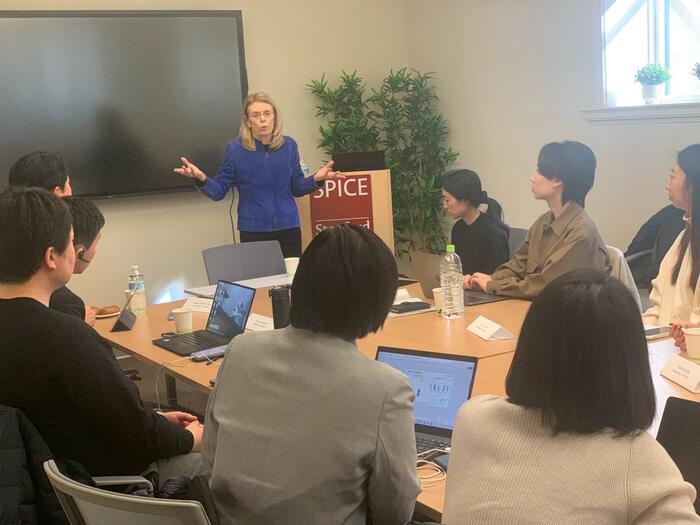
Among these experiences, one particularly memorable moment came during a lecture by Professor Londa Schiebinger, an internationally distinguished historian of science and a leading authority on gender in science and technology. She introduced us to Gendered Innovations, an interdisciplinary initiative that integrates sex, gender, and intersectional analysis into scientific research and technological development. After her talk, my colleague Yuki Kihara asked how her work in the history of science connects to this initiative. In response, she stated without hesitation: “I want to create the future, so I use the same techniques as a historian to push and pull on culture. We need to make human knowledge whole again. That is one of my key challenges.” Her response was deeply thought-provoking, speaking to my long-held interest in how historians might meaningfully engage with contemporary issues. (Photo below of Professor Schiebinger courtesy of Naoya Kobayashi.)
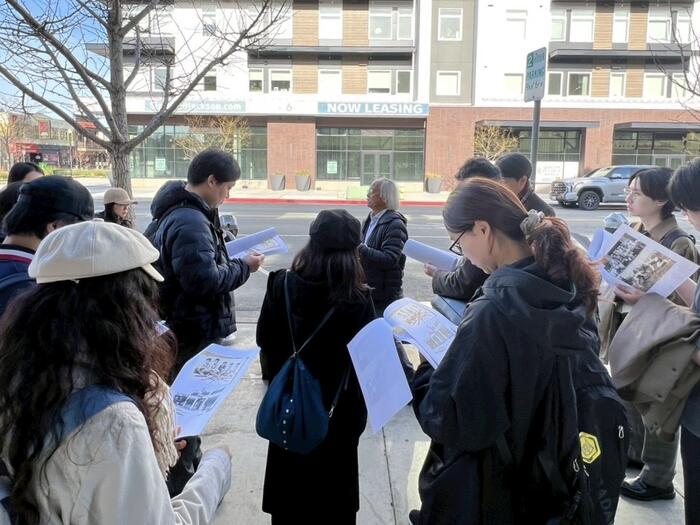
Our learning also extended beyond the university. On the final morning, we visited Japantown in San Jose with SPICE Director Dr. Gary Mukai as our guide. Drawing on his personal memories, he explained the history embedded in local monuments. Through this, we came to appreciate how diverse communities have long been integral to the region’s social fabric, shaped by both hardship and resilience. From the perspective of contemporary Japan, where public discourse has increasingly focused on how diversity might be “accepted,” this experience revealed a simple but profound truth: diversity is not a possibility to be realized but a reality to be recognized. As a historian, I hope to carry this insight forward by using the past not only to understand the present, but also to imagine more inclusive ways of living together in the future. (Photo below taken in Japantown in San Jose courtesy of Naoya Kobayashi.)
Finally, I would like to express my sincere gratitude to Dr. Mukai and all the members of SPICE who so warmly welcomed us. It is my sincere hope that exchanges between the University of Tokyo and SPICE will continue to grow in the years to come.
To stay informed of SPICE news, join our email list and follow us on Facebook, X, and Instagram.


