Education
-

Webinar recording: https://youtu.be/ShtOUZ67F-s


Webinar Description:

From amazing athletic feats to beautiful pageantry, the Olympics command the world’s attention like no other event. Students and families alike are sure to watch at least some of this summer’s games from Tokyo. But how might we, as teachers, use the Olympics to introduce topics from East Asian history? In this webinar, Ethan Segal explores the many meanings of the Olympics for China, Japan, and South Korea, from displaying recovery to promoting democracy. Join us for an interesting, engaging session that will provide useful background content, help you rethink some old assumptions, and highlight some connections for teachers to use in bringing the Olympics into your classroom.

Register at https://bit.ly/3gU7SC5.

This webinar is a joint collaboration between SPICE, the National Consortium for Teaching about Asia (NCTA), and Stanford's Center for East Asian Studies.


Featured Speaker:

Professor Ethan Segal

Image
Professor Ethan Segal

Ethan Segal is Associate Professor of History at Michigan State University. He earned his Ph.D. at Stanford University, was a Fulbright Scholar at the University of Tokyo, and taught as a visiting professor at Harvard. Professor Segal’s research topics include economic and social history, nationalism, women and gender, and contemporary popular culture. He is the author of Coins, Trade, and the State: Economic Growth in Early Medieval Japan as well as numerous articles, reviews, and videos in scholarly journals and online. Professor Segal has won multiple teaching awards and is a regular contributor to NCTA and other outreach workshops and seminars.


Via Zoom Webinar. Registration Link: https://bit.ly/3gU7SC5.

Professor Ethan Segal Associate Professor of History, Michigan State University
Workshops
Authors
News Type
Blogs
Date
Paragraphs

On Saturday, May 22, 2021, Stanford Global Studies (SGS) hosted the 2021 Education Partnership for Internationalizing Curriculum (EPIC) Symposium, which featured presentations by 11 2020–21 EPIC Fellows. SPICE, along with the Center for Spatial and Textual Analysis, is SGS’s EPIC Partner. The following reflection is a guest post by EPIC Fellow Maiya Evans, assistant professor at Skyline College, who gave a presentation on “Reimagining Public Health.”


“I’m telling you, professor. I’m telling you, something’s going on.” I listened intently with curiosity as one of my Skyline College students made her case. Another chimed in, “They’re saying it’s killing old people and that the doctor who discovered it died, too.” Sensing the palpable anxiety in their shares, I decided to pivot the following week’s lesson on epidemiology to focus on what was then called the novel coronavirus and its spread in China.

At the time these conversations took place, we were in late January of 2020, so the coronavirus was still novel to the United States, indeed. Every class session thereafter, we watched the Johns Hopkins Center for Systems Science and Engineering’s global map of new and existing COVID-19 cases grow. As the numbers increased from hundreds to thousands, and subsequently thousands to millions over the course of mere weeks, it became clear that looking at every country’s approach to controlling the spread of COVID-19 was essential. Without knowing it, my students and I were planting the seeds of the Reimagining Public Health (RPH) Roundtable series.

When I made the decision to apply to the Stanford EPIC Fellowship, which aims at internationalizing the community college curriculum, I knew that I wanted to work on a project that expanded the borders of public health in the United States. The purpose of the RPH Roundtable series was to invite students to reshape and rethink our approaches to health and health care in the United States by borrowing from public health methodologies from other nations. This pilot for the RPH Roundtable series was implemented in the Spring of 2021 in my Introduction to Public Health course at Skyline College in San Bruno, California.

My hope for the RPH Roundtable series was simple: to challenge students to gain an understanding of how public health systems function in the United States and abroad. Students were invited to observe the following in other nations: (1) public health approaches to controlling the spread of disease, (2) the connection between economics and health resources, and (3) the influence of health policy on public health interventions. The students gathered virtually throughout the semester to engage in podcast-style conversations around three relevant public health topics that impact the United States: communicable and non-communicable disease, mental health, and substance use.  

Students had powerful insights about current approaches to public health issues in the United States and abroad. For example, one group discussed the societal impact of unfair and punitive drug policy in the United States vs. gentler harm reductionist drug policy in the Netherlands. Students also brainstormed innovative community health solutions, such as implementing holistic, non-Western approaches to addressing mental health issues (as is common in China), or creating mental health programs within the workplace, which is done in some parts of Canada.

All in all, I was extremely satisfied with the outcome of the RPH Roundtable series, and I am incredibly proud of the students for challenging themselves to think critically about making positive, meaningful change in public health. Though there were many lessons learned with regards to the challenges of doing a project of this caliber in the virtual space, I thought the students did an incredible job of having deep, meaningful, and well-informed discussions about the potential of a brighter future in our public health system.

Read More

Zoom screenshots of EPIC fellows
Blogs

2021 Education Partnership for Internationalizing Curriculum Symposium

On Saturday, May 22, 2021, SPICE’s Jonas Edman moderated two panels during the 2021 EPIC Fellowship Program Symposium for community college educators.
2021 Education Partnership for Internationalizing Curriculum Symposium
image of six fellows
News

Collegiality and the 2020–21 EPIC Fellows

On August 13 and 14, 2020, Stanford Global Studies welcomed 12 new Education Partnership for Internationalizing Curriculum (EPIC) Fellowship Program community college instructors as members of its 2020–21 cohort.
Collegiality and the 2020–21 EPIC Fellows
Webinar poster with three speakers
Blogs

Training for the Olympics During COVID-19

For episode 4 of the CoviDB Speaker Series, TeachAids Founder and CEO Dr. Piya Sorcar provides a glimpse into how the pandemic has impacted the lives of two of the world’s greatest athletes.
Training for the Olympics During COVID-19
Hero Image
Maiya Evans at the Van Gogh Museum, Amsterdam, Netherlands
Maiya Evans at the Van Gogh Museum, Amsterdam, Netherlands; photo courtesy Maiya Evans
All News button
1
Subtitle

Guest author Maiya Evans reflects on her EPIC project, which challenges students to reimagine public health.

Authors
Gary Mukai
News Type
Blogs
Date
Paragraphs

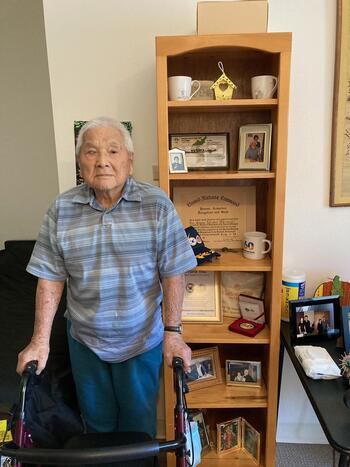
Last week, I had the chance to visit one of my uncles, George Mukai (92), who is a veteran of the Korean War. He recently moved into an assisted-living facility and had very few items delivered from his home to his new residence. One thing that he did have delivered was a curio cabinet that contains Korean War-related items including medals, a cap, a United Nations Command certificate, and a piece of wire from the DMZ.

Image
United Nations Command Certificate
As he has in the past, he shared recollections of his experiences during the Korean War, but unlike when he was young, his recollections felt more poignant. He is a very proud veteran. Another one of my uncles, Roy Mukai (deceased), was also a Korean War veteran, and a third, Toichi Mukai, was stationed in Korea after the Korean Armistice Agreement was signed in 1953.

This month marks the 71st anniversary of the beginning of the Korean War on June 25, 1950. After my visit with George, I started to reflect on the work that my colleagues (past and present) at SPICE have done to promote the study of Korea in U.S. schools and directly to students in the United States. They are:

They have developed extensive curriculum on Korea. The offerings can be found on this webpage and includes offerings such as the following:

  • Colonial Korea in Historical Perspective
  • Divided Memories: Comparing History Textbooks
  • Dynamics of the Korean American Experience
  • Economic Development: The Case of South Korea
  • Inter-Korean Relations: Rivalry, Reconciliation, and Reunification
  • Traditional and Contemporary Korean Culture
  • Uncovering North Korea
  • U.S.–South Korean Relations
     

In addition, the Sejong Korea Scholars Program, an online course for high school students in the United States, has been offered by SPICE since 2013. The SKSP annually selects 20–25 exceptional high school students from throughout the United States and engages them in an intensive study of Korea and U.S.–Korea relations. Selected students participate in the online course on Korea from February to June of each year. The current instructor is Jang.

Lastly, SPICE offers annual summer institutes to middle school and high school teachers in partnership with the National Consortium for Teaching about Asia, and also the East Asia Seminars for Teachers in Hawaii. These are facilitated respectively by Edman, Naomi Funahashi, and Sekiguchi. These programs focus in part on Korea and are funded by the Freeman Foundation.

Image
George Mukai 2021
I wish that I could inform veterans of the Korean War about programs such as these that help to promote a greater understanding of Korea and U.S.–Korea relations among students in the United States, and also to encourage students to reflect upon the sacrifices that were made by the veterans.

Read More

High school student with a diploma standing in front of a banner
Blogs

My Experience with the Sejong Korea Scholars Program in the Midst of a Global Pandemic

The following reflection is a guest post written by Jason Lu, an alumnus of the Sejong Korea Scholars Program, which is currently accepting applications for the 2021 course.
My Experience with the Sejong Korea Scholars Program in the Midst of a Global Pandemic
Student in a red dress presenting at a podium with Stanford signage
Blogs

Coming Full Circle: The Sejong Korea Scholars Program and Stanford

The following reflection is a guest post written by Sandi Khine, an alumna of the Reischauer Scholars Program and the Sejong Korea Scholars Program, which are currently accepting applications for the 2021 courses.
Coming Full Circle: The Sejong Korea Scholars Program and Stanford
5thbuchanan banner
News

SPICE Wins Buchanan Prize for Fifth Time

SPICE Wins Buchanan Prize for Fifth Time
Hero Image
George Mukai in Munsan, a town south of the Imjin River near Panmunjom, during the Korean War, 1951
George Mukai in Munsan, a town south of the Imjin River near Panmunjom, during the Korean War, 1951; image courtesy George Mukai
All News button
1
Subtitle

SPICE offers a series of Korea-focused lesson plans, an online course for U.S. high school students, and teacher professional development opportunities.

News Type
News
Date
Paragraphs

The California Department of Education adopted the Ethnic Studies Model Curriculum last March. Chapter 3 of the Model Curriculum includes a section on “Native American Studies.”

On June 18, 2021, SPICE will host a panel of three Native and Indigenous scholars to reflect on California’s new model curriculum and the state of ethnic studies in their respective regions. The panel will include Navajo, Native Hawaiian, and Ainu educators who will provide a range of educational perspectives on Native and Indigenous studies in the United States and Japan.

  • Dr. Harold Begay, Superintendent of Schools, Navajo Nation
  • Dr. Sachi Edwards, Faculty Member at Soka University in Tokyo, Japan
  • Dr. Ronda Māpuana Shizuko Hayashi-Simpliciano, Vice Principal, Ke Kula Kaiapuni ʻo Ānuenue, Honolulu, Hawaiʻi

The webinar, titled “Indigenous Voices: Educational Perspectives from Navajo, Native Hawaiian, and Ainu Scholars in the Diaspora,” will address several additional topics, such as the various academic field names of the study of Native and Indigenous people, the complexity and diversity of Native and Indigenous people’s experiences, and recommended resources for K–12 educators.

These topics are not only relevant to teachers in California but to educators in other states as well. K–12 educators and administrators are encouraged to attend. Register in advance at https://bit.ly/3z4kxtc.

This webinar is a joint collaboration with the National Consortium for Teaching about Asia (NCTA) and the Center for East Asian Studies at Stanford University.

To stay informed of SPICE news, join our email list and follow us on Facebook, Twitter, and Instagram.

Read More

Tokyo’s Shin Okubo neighborhood, known for its Korea Town
Blogs

Global Human Rights and Minority Social Movements in Japan: A Webinar by Professor Kiyoteru Tsutsui

Tsutsui introduced the audience to three minority groups in Japan—the Ainu, resident Koreans (Zainichi), and the Burakumin—and illustrated how human rights have galvanized minority social movements there.
Global Human Rights and Minority Social Movements in Japan: A Webinar by Professor Kiyoteru Tsutsui
Chinese railroad workers
Blogs

Stanford’s Center for East Asian Studies and SPICE Co-Sponsor Webinar on “Chinese Railroad Workers in North America Project”

The speakers shared extensive primary source documents from Stanford Libraries’ Department of Special Collections, as well as free lesson plans from SPICE's online curriculum unit on Chinese railroad workers.
Stanford’s Center for East Asian Studies and SPICE Co-Sponsor Webinar on “Chinese Railroad Workers in North America Project”
visualizing the essential image
Blogs

Visualizing the Essential: Mexicans in the U.S. Agricultural Workforce

During multiple periods of economic crisis, the U.S. economy has depended on Mexican labor.
Visualizing the Essential: Mexicans in the U.S. Agricultural Workforce
Hero Image
Flyer for the SPICE webinar "Indigenous Voices: Educational Perspectives from Navajo, Native Hawaiian, and Ainu Scholars in the Diaspora"
The June 18 webinar will feature Dr. Harold Begay, Dr. Sachi Edwards, and Dr. Ronda Māpuana Shizuko Hayashi-Simpliciano.
All News button
1
Subtitle

Navajo, Native Hawaiian, and Ainu educators will join together on June 18 to examine the state of Indigenous studies.

-

Webinar recording: https://youtu.be/sQBR-NZBWks


Webinar Description:

On March 18, 2021, the California Department of Education adopted the Ethnic Studies Model Curriculum. Chapter 3 of the Model Curriculum includes a section on “Native American Studies.” Three Native and Indigenous educators will reflect on this and the state of ethnic studies in their regions. The educators are Dr. Harold Begay, Dr. Sachi Edwards, and Dr. Ronda Māpuana Shizuko Hayashi-Simpliciano. Kasumi Yamashita will serve as the moderator of the panel. She is an Instructor for SPICE and was trained as a cultural anthropologist at Harvard University and was a Fulbright Scholar to Brazil.

Some of the topics that will be addressed include (1) the various academic field names of the study of Native and Indigenous people; (2) the complexity and diversity of Native and Indigenous people’s experiences, highlighting key concepts like indigeneity, settler colonialism, diaspora, social justice and activism; and ontological and epistemological philosophy; and (3) recommended resources for K–12 educators.

These topics are not only relevant to teachers in California but to teachers in other states as well. K–12 educators and administrators are encouraged to sign up at https://bit.ly/3z4kxtc.

This webinar is a joint collaboration between the National Consortium for Teaching about Asia (NCTA), Center for East Asian Studies, and SPICE.
 

Featured Speakers:

Dr. Harold Begay

Image
Harold headshot

Dr. Harold Begay, Superintendent of Schools, Navajo Nation, was raised on the Navajo Nation in northern Arizona, amid a deep bicultural chasm irrevocably bound by his traditional Dine’ (Navajo) culture upbringing and mainstream Western Greco-Roman education in the United States. He completed his Ph.D. in school finance/economics, concentrating his advanced studies in educational administration, bilingual education, and social foundations of education from the University of Arizona. Dr. Begay has worked in several Native American school districts in different teaching and administrative capacities over a span of 25 years. Has been a Visiting Scholar at U.C. Berkeley and is currently doing transnational educational work with Stanford University.


Dr. Sachi Edwards

Image
sachi headshot

Dr. Sachi Edwards is a Faculty Member at Soka University in Tokyo, Japan, and also a Lecturer in the Educational Foundations department at the University of Hawaiʻi, Mānoa. Her areas of research include higher education, internationalization, and religious identity, diversity, and oppression. Dr. Edwards received a Ph.D. in higher education from the University of Maryland, College Park. She teaches classes about higher education, international and intercultural education, educational theory/philosophy, qualitative research methods, and academic writing. She was recently featured with Dr. Ronda Māpuana Shizuko Hayashi-Simpliciano in discussion on “Ainu in Diaspora: Rising from Shame, Honoring Ainu Resilience,” hosted by the Japanese American Memorial Pilgrimages.


Dr. Ronda Māpuana Shizuko Hayashi-Simpliciano

Image
mapuana headshot

Dr. Ronda Māpuana Shizuko Hayashi-Simpliciano is Vice Principal of the Hawaiian language immersion school, Ke Kula Kaiapuni ʻo Ānuenue, Honolulu, Hawaiʻi. She is an Ainu-Hawaiian scholar and educator who works in the field of indigenous language and culture restoration. She did her doctoral work at the University of Hawaiʻi, Mānoa. Dr. Hayashi-Simpliciano recently gave a talk on “Ainu in Diaspora History,” hosted by the Japanese American Memorial Pilgrimages.

Via Zoom Webinar. Registration Link: https://bit.ly/3z4kxtc.

Dr. Harold Begay Superintendent of Schools, Navajo Nation
Dr. Sachi Edwards Faculty Member at Soka University in Tokyo, Japan
Dr. Ronda Māpuana Shizuko Hayashi-Simpliciano Vice Principal, Ke Kula Kaiapuni ʻo Ānuenue, Honolulu, Hawaiʻi
Workshops
Authors
Gary Mukai
News Type
Blogs
Date
Paragraphs

On Saturday, May 22, 2021, Stanford Global Studies (SGS) hosted the 2021 Education Partnership for Internationalizing Curriculum (EPIC) Symposium which featured presentations by the 12 2020–21 EPIC Fellows. SPICE along with the Center for Spatial and Textual Analysis are SGS’s EPIC partners. Jonas Edman worked with six of the EPIC Fellows during the academic year as they sought to increase the international, intercultural, and global dimensions in their curriculum.

During the EPIC Symposium, Edman moderated two panels that featured the following six instructors. The “pitches” for their talks can be found here.

Panel One

  • Sravani Banerjee, Evergreen Valley College, San Jose, California; “Incorporating Social Justice and Global Issues in Freshman Composition”
  • Maiya Evans, Skyline College, San Bruno, California; “Reimagining Public Health: Expanding the Borders of Public Health Curriculum”
  • Joanna Sobala, Mission College, Santa Clara, California; “Women and Feminism in the World”
     

Panel Two

  • Julia diLiberti, College of DuPage, Glen Ellyn, Illinois; “The Need for Globalizing Curriculum Post Pandemic”
  • Melissa King, San Bernadino Valley College, San Bernadino, California; “Defining Moments in Global Studies Education”
  • Rebecca Nieman, San Diego Mesa College, San Diego, California; “Internationalizing Business Law Curriculum in Community Colleges Through Experiential Learning Activities”


The EPIC Fellows not only conceptualized and developed ways to globalize their curriculum through the incorporation of new subject matter knowledge but also carefully considered the importance of pedagogical content knowledge, which was popularized by Stanford scholar Lee Shulman. Shulman argued that subject matter knowledge and pedagogical content knowledge—teachers’ interpretations and transformations of subject-matter knowledge in the context of facilitating student learning—should not be treated as mutually exclusive. Edman commented, “While moderating the two panels, I was struck by how each embraced this notion.”

In panel one, Banerjee introduced her project, which focused on incorporating social justice and global issues in freshman composition, and spoke about how her thematic units on topics like human rights not only introduced students to subject matter knowledge such as the Universal Declaration of Human Rights but also engaged them in an inquiry-based learning pedagogical approach. Similarly, Sobala described how she internationalized her social justice course by including the critical viewing of documentaries that focus on women from around the world among her pedagogical approaches. Evans introduced her Reimaging Public Health Roundtable Series, which invites students to reshape and rethink approaches to health and health care in the United States by borrowing from public health methodologies from other countries. She not only introduced students to topics like international perspectives on mental health (including stigma) but also spoke about how she engaged students in creating podcasts as a pedagogical approach.

In panel two, King described her project, which crystalized around the question, “How can San Bernadino Valley College students learn about the world from a different perspective?” Her project engaged students with a podcast that she created called “Within a Grain of Sand” and focused on topics such as migration and refugees as she sought to encourage her students to seek connections between the local and global. Nieman and diLiberti focused their projects on faculty professional development. For Nieman, she challenged faculty to think about how to teach an unfamiliar topic, which happens to be a learning objective of the course, to students. She recommended the engagement of students in experiential learning activities as she internationalized her law courses in areas such as tort law, dispute resolution, and corporate governance. diLiberti developed an eight-week professional development course that has the goal of having the participants gain a more concrete understanding of globalization in tangible ways. As an example, she recommended the use of narrative maps, which she learned from EPIC guest speaker Professor Kären Wigen, as a pedagogical tool.

During the question-and-answer period, 2018–19 EPIC Fellow Dave Dillon, Grossmont College, El Cajon, California, asked how the projects of the 2020–21 EPIC Fellows evolved especially given the pandemic. Evans and Sobala noted that they felt the need to keep strict parameters around the scope of their EPIC projects, and throughout the 2020–21 EPIC Program, the EPIC Fellows expressed the challenges they faced as they transitioned to teaching online. After the Symposium, Edman commented, “despite the enormous challenges that the pandemic posed to the EPIC Fellows, they produced very engaging and meaningful globally focused projects that had direct outcomes on faculty and students, and will continue to have an impact in the years to come.” Edman was especially struck by a comment from one of King’s students who commented on a lesson on refugees: “… I was very unaware of the global refugee situation, and still feel like I do not understand the entire scope of it… when doing more research for the assignment, I found a refugee resettlement tracker that actually showed me how many refugees had resettled in my area historically… That was something I had not previously considered, and the questions asking what my community is doing to help refugees and immigrants really made me think about this issue and how much more there is that we can do at a community level.”

After hearing this student reflection, Edman commented that “perhaps a silver lining to the pandemic is that students began to vividly see the connection between the local and global not only in terms of health but also in other areas that the EPIC Fellows touched upon… for example, refugees, climate, hunger, feminism, immigration, and law as well.”

To stay informed of SPICE-related news, join our email list and follow us on Facebook, Twitter, or Instagram.

Read More

image of six fellows
News

Collegiality and the 2020–21 EPIC Fellows

On August 13 and 14, 2020, Stanford Global Studies welcomed 12 new Education Partnership for Internationalizing Curriculum (EPIC) Fellowship Program community college instructors as members of its 2020–21 cohort.
Collegiality and the 2020–21 EPIC Fellows
Stanford EPIC Fellowship for community college instructors
Blogs

The Education Partnership for Internationalizing Curriculum: Reflections on Collaborating with Community College Educators

The Education Partnership for Internationalizing Curriculum: Reflections on Collaborating with Community College Educators
Stanford professional development workshop for community college instructors
News

The Stanford EPIC fellowship for community college instructors

Since 2012, SPICE has been proud to collaborate with Stanford Global Studies (SGS) on Title VI-funded initiatives aimed at internationalizing community college curricula.
The Stanford EPIC fellowship for community college instructors
Hero Image
Zoom screenshots of EPIC fellows
Top row, left to right: Jonas Edman, Gary Mukai, Maiya Evans; second row, left to right: Melissa King, Rebecca Nieman, Julia diLiberti; third row, left to right: Joanna Sobala, Sravani Banerjee; screenshot courtesy Stanford Global Studies
All News button
1
Subtitle

On Saturday, May 22, 2021, SPICE’s Jonas Edman moderated two panels during the 2021 EPIC Fellowship Program Symposium for community college educators.

Authors
News Type
Blogs
Date
Paragraphs

Stanford e-Entrepreneurship Japan is an online course offered to high school students in Japan. It is offered annually in fall and spring by SPICE and the Japanese NPO e-Entrepreneurship, led by Yusuke Matsuda. The instructors are Irene Bryant (fall) and Maiko Tamagawa Bacha (spring). The goal of the course is to foster creative thinking and problem-solving skills in students with a focus on innovation to address social issues.


Because of my experiences with social issues in Brazil, Argentina, the United States, Japan, and Mexico, my decision to apply to Stanford e-Entrepreneurship Japan—a course for those with a passion in social issues and innovation—was immediate. However, when I started taking the course, I had little idea of the connection between business and social issues. Soon after classes began, I saw real-life examples of how unique innovations can improve the world. Every two weeks, a different professional gave us a lecture. Getting to hear stories of their first-hand experiences as entrepreneurs was an opportunity I never received at school, and I embraced it fully by asking question after question.

My favorite lecture was one given by David “Mas” Masumoto, who runs a sustainable peach farm in California. Through his lesson on growing organic peaches and passing down the farm to his children, I was able to make connections to a larger social issue in Japan: the lack of young people in agriculture. His lecture provided insights on specific ways professionals were practicing social entrepreneurship.

The course was certainly demanding. After the lectures, we had to work on group projects to come up with our own solutions, which enabled me to further understand and practice aspects of social entrepreneurship. It took hours of preparation and as I was one of the only students who lived abroad, I sometimes had to work with peers at ungodly hours. Nonetheless, all the hard work was absolutely worth it. The diversity provided by the unique regional backgrounds of other students located all around Japan exposed me to important perspectives on social issues.

For the final project, which included an individual research report on a social issue and a group business pitch, we had full control of what we wanted to do. The individual paper was refreshing for me because at school there is never this much flexibility, and it was a perfect chance for me to explore my interest in addressing social issues like environmental sustainability through entrepreneurship. For the group project, we created a business plan for a sustainable toothpaste. I have never worked with such motivated, diverse, and brilliant students willing to put in so many hours of work. Through the project, not only did I get to put skills that I learned during the program into practice, but I also made lifelong friends who shared the same passions as me.

Finally, Stanford e-Entrepreneurship Japan has grown my interest in how social issues can be resolved through entrepreneurship, and has motivated me to pursue not only the exploration of social issues, but business in college. It is a course like no other, with wonderful peers, invaluable lessons, and a supportive teaching staff. I encourage people who are curious about social issues or business in general to take advantage of the program.

Read More

Yellow building in Japanese country side
Blogs

SPICE’s Inaugural Online Course on Innovation and Entrepreneurship: Healing During a Pandemic

SPICE concludes its first offering of Stanford e-Entrepreneurship, aimed at training young social entrepreneurs in Japan.
SPICE’s Inaugural Online Course on Innovation and Entrepreneurship: Healing During a Pandemic
Headshot of Risa Ishii and Takaho Iwasaki
Blogs

Journey into the World of Entrepreneurship: Stanford e-Hiroshima Guest Speakers, Risa Ishii and Takaho Iwasaki

Stanford e-Hiroshima is an online course for high school students in Hiroshima Prefecture, Japan, that is sponsored by the Hiroshima Prefectural Government.
Journey into the World of Entrepreneurship: Stanford e-Hiroshima Guest Speakers, Risa Ishii and Takaho Iwasaki
un sustainable development goals
Blogs

Bringing UNSDGs and Entrepreneurship into Oita’s Virtual Classroom

Bringing UNSDGs and Entrepreneurship into Oita’s Virtual Classroom
Hero Image
Stanford e-Entrepreneurship Japan student Naho Abe in Mexico City
Naho Abe in Mexico City; photo courtesy Naho Abe
All News button
1
Subtitle

The following reflection is a guest post written by Naho Abe, an alumna of Stanford e-Entrepreneurship Japan.

Authors
Gary Mukai
News Type
Blogs
Date
Paragraphs

The following is Part 4 of a multiple-part series. For Part 1, please visit here, for Part 2, please visit here, and for Part 3, please visit here.

On December 8, 2020, January 19, 2021, and March 16, 2021 SPICE posted three articles that highlight reflections from 25 students on the question, “What does it mean to be an American?” I have decided to continue the series based on the enthusiastic engagement that I have felt from students and teachers from throughout the United States. Part 4 features eight additional reflections.

The SPICE staff’s hope is that the free educational website—“What Does It Mean to Be an American?”—will help students reflect upon their civil liberties during this challenging time. On March 24, 2021, SPICE’s Rylan Sekiguchi was honored by the Association for Asian Studies for his authorship of the lessons that are featured on the website, which was developed by the Mineta Legacy Project in partnership with SPICE.

For part 4, a special effort was made to include some reflections of students of Asian American and Pacific Islander descent since May is AAPI heritage month. The reflections below do not necessarily reflect those of the SPICE staff.

Kaliʻu Boteilho, Hawaii
As a Hawaiian language speaker, something that I’ve always understood and live by is a Hawaiian proverb that says “‘A‘ole pau ka ‘ike i ka hālau ho’okahi” or “All knowledge is not taught in the same school, one can learn from many sources.” Much like this proverb says, we are not all from the same school, place, or background. We all have different ethnicities, races, and religious beliefs, yet in America we’re able to live side by side and coexist. To me being an American not only means to respect people’s beliefs but to uphold the integrity of my country, my home, and most of all my people. Being an American is an honor, but I shall not forget who I truly am...a Hawaiian.

Santiago Calderon, Florida
Many people in Latin America think of Whites as the stereotypical American. I have been perceived as White due to my palish skin despite my proud Venezuelan and Peruvian heritage. Regardless of how I have been perceived, I am proud of America’s unique ability to diffuse diverse talents, perspectives, and cultures as a point of opportunity and refuge. Of course, America isn’t perfect. Someone once told me to stop speaking Spanish because this is an “English-only” country, but my passion is to continue fighting for my American dream while contributing to a better society for other Americans, regardless of their biases about me. Working at my parents’ Latin restaurant, I engage in conversations with customers visiting from all over the world to share ideas with others, bonded not by ethnic background but by our pride as Americans.

Selina Chen, California
A year ago, I received my U.S. passport, a blue booklet with a silver eagle that replaced my red one with “People’s Republic of China.” Yet I can’t think of myself as “American” in entirety because I’m only comfortable with using the adjective for certain traits or parts of my personality. My full identity, rather, is “Chinese-American,” perhaps because my entire American experience has been during the pandemic, in which, initially, my identity meant being too scared to cough or to wear a mask after the first time someone hollered “Corona!” at me and, now, the weight of pepper spray is in my pocket wherever I go. But although society deems that my appearance is the most defining part of me, being “American” means the opportunity to right this wrong.

Haley Goto, Hawaii
As a Japanese American growing up in Hawaii, I was surrounded by people of different ethnicities and the idea of “‘ohana”—being family with those in my community. My world was small, but now as a teenager, I realize America’s pressing issues of racism and injustice. What happened to the famous “all men are created equal”? Why is there so much disunity in the “United” States of America? To me, being American means being a part of this large country as one great ‘ohana, embracing the diversity that makes our nation unique with different ideas, races, and cultures. “Patriotism” should mean respecting and devoting oneself to America’s diversity. The amazing thing about America is we have the freedom to choose to support diversity over division and respect over ego.

Kyle Kotanchek, California
The foundation of the United States is the Constitution, but I believe the 1st Amendment is what really makes our nation the United States of America. The freedoms of speech, religion, press, assembly, and petition together are in essence the freedom to change people’s minds. We aren’t the only country with these freedoms, but we were the first to have all five specified in a constitution. The United States doesn’t always hold up these freedoms, and we’re far from perfect, but we’re also far from completely broken. The January 6th insurrection proved the United States’ vulnerability to ideas, while the Black Lives Matter movement showed our resilience and fighting desire for equality. The United States is the land of the people, and it’s up to Americans to decide whether we create good or evil.

Faizah Naqvi, New Jersey
There’s nothing about my appearance that suggests I’m American. However, after a conversation with me, it’s apparent that I am—because I’m not afraid to speak my mind. This is in stark contrast to my culture, where women are traditionally quiet. It’s the American part of me that is outspoken, and the American half that chooses to address controversy. What’s unique about being American is that you don’t have to choose between your nationality and heritage—being American enhances your ability to advocate for your own culture. The spirit of American duality inspires me to face controversial topics head on, fielding vitriolic comments. America is not perfect—racial inequality, polarized politics, and systemic imbalances plague the country—but there’s something to be said for the way America makes those who were once invisible shine.

Rylynn Toyama, Hawaii
As a 13-year-old Asian American who has lived in Hawaii all my life, my idea of what being an American means has been largely shaped by my family and local community. Like America at large, Hawaii is home to many cultures and ethnicities. Here, we embrace the differences of our multicultural population, enjoying traditions and cuisines from all over the world. Unfortunately, some Americans disdain races other than their own, which leads to hate crimes and violence. These aggressive acts do not depict my ideal America. My vision of a true American is a person who respects and supports his fellow citizens by treating them with care and kindness, as they would their own family. Every American should be willing to protect the freedom and individuality of all citizens. To me, that is what it means to be an American.

Samantha Williams, California
A few years ago, I would have said that being an American means having the freedom to lead a life full of opportunities and having the ability to achieve anything you desire. After experiencing a year that no one could have predicted—full of protests, demonstrations, and racial injustice—I now realize that these opportunities are not afforded to all Americans equally and that they vary among racial and socioeconomic lines. Personally, it has recently meant that I have the ability to work towards my goals, have some sense of equality, and the freedom to voice my opinions. I have hope that we, as Americans, can exercise our freedoms by speaking our minds, implementing change, and fighting for all to receive equal rights.

Read More

nine students headshot
Blogs

What Does It Mean to Be an American?: Reflections from Students (Part 3)

Reflections of nine students on the website "What Does It Mean to Be an American?"
What Does It Mean to Be an American?: Reflections from Students (Part 3)
seven students headshot
Blogs

What Does It Mean to Be an American?: Reflections from Students (Part 2)

Reflections of eight students on the website "What Does It Mean to Be an American?"
What Does It Mean to Be an American?: Reflections from Students (Part 2)
eight students headshot
Blogs

What Does It Mean to Be an American?: Reflections from Students

Reflections of eight students on the website "What Does It Mean to Be an American?"
What Does It Mean to Be an American?: Reflections from Students
Hero Image
eight students headshot
Clockwise from top left: Kaliʻu Boteilho, Santiago Calderon, Selina Chen, Haley Goto, Kyle Kotanchek, Faizah Naqvi, Rylynn Toyama, Samantha Williams
All News button
1
Subtitle

Reflections of eight students on the website "What Does It Mean to Be an American?"

Date Label
News Type
News
Date
Paragraphs

SPICE currently runs four regional programs for high school students in Japan: Stanford e-Hiroshima, Stanford e-Kawasaki, Stanford e-Oita, and Stanford e-Tottori. These online courses are coordinated in collaboration with school and government officials at the city and prefectural levels, with the goal of presenting creative and innovative approaches to teaching Japanese high school students about U.S. society and culture and global themes.

All four courses recently finished their 2020–21 term. This summer, two top students from each course will be honored through a virtual event hosted by SPICE, Stanford University. Congratulations to the eight honorees below on their academic excellence!

Stanford e-Hiroshima (Instructor Rylan Sekiguchi)

Student Honoree: Sara Arakawa
School: Hiroshima Prefectural Hiroshima Kokutaiji Senior High School
Project Title: Silicon Valley: Secrets Behind Success

Student Honoree: Chika Isone
School: Hiroshima Prefectural Hiroshima Senior High School
Project Title: Making Innovation by Design Thinking in Silicon Valley

Stanford e-Kawasaki (Instructor Maiko Tamagawa Bacha)

Student Honoree: Eric Silang
School: Kawasaki High School
Project Title: Humor and America

Student Honoree: Shunya Tani
School: Kawasaki High School
Project Title: Possible Ways to Promote Renewable Energy in Japan and the U.S.

Stanford e-Oita (Instructor Kasumi Yamashita)

Student Honoree: Hana Burkart
School: Hofu High School
Project Title: Social Discrimination Against Foreigners in Japan

Student Honoree: Yayano Okuda
School: Usa High School
Project Title: Environmental Education

Stanford e-Tottori (Instructor Jonas Edman)

Student Honoree: Eri Tamura
School: Tottori Nishi High School
Project Title: Teachers’ Treatment in the U.S.

Student Honoree: Hinata Yonemura
School: Yonago Higashi High School
Project Title: Veganism: How Japanese Society Can Promote It


The SPICE staff is looking forward to honoring these eight students in a virtual ceremony on August 23, 2021 (August 24 in Japan). Each student will be given the opportunity to make a formal presentation to members of the Stanford community and the Japanese community in the San Francisco Bay Area.


SPICE also offers online courses to U.S. high school students on Japan (Reischauer Scholars Program), China (China Scholars Program), and Korea (Sejong Korea Scholars Program), and online courses to Chinese high school students on the United States (Stanford e-China) and to Japanese high school students on the United States and U.S.–Japan relations (Stanford e-Japan).

To stay informed of SPICE news, join our email list and follow us on Facebook, Twitter, and Instagram.

Read More

Honorees of SPICE’s regional programs in Japan
News

Ceremony Honors Top Students from SPICE’s Regional Programs in Japan

Congratulations to the eight honorees of SPICE’s 2019–2020 regional programs in Japan.
Ceremony Honors Top Students from SPICE’s Regional Programs in Japan
Victoria Tsai in Kyoto
Blogs

Stanford e-Kawasaki Guest Speaker: Victoria Tsai, Founder and CEO, Tatcha

The entrepreneur and businesswoman spoke to students about how certain key experiences in her life influenced her path.
Stanford e-Kawasaki Guest Speaker: Victoria Tsai, Founder and CEO, Tatcha
Headshot of Risa Ishii and Takaho Iwasaki
Blogs

Journey into the World of Entrepreneurship: Stanford e-Hiroshima Guest Speakers, Risa Ishii and Takaho Iwasaki

Stanford e-Hiroshima is an online course for high school students in Hiroshima Prefecture, Japan, that is sponsored by the Hiroshima Prefectural Government.
Journey into the World of Entrepreneurship: Stanford e-Hiroshima Guest Speakers, Risa Ishii and Takaho Iwasaki

Read More

Sumire Hirotsuru performing in Tokyo; photo courtesy Sumire Hirotsuru
Blogs

Giving Back to One’s Hometown: Stanford e-Oita Guest Speaker, Sumire Hirotsuru

The accomplished young violinist, who was born and raised in Oita Prefecture, encouraged students to think about their strengths and emphasized the importance of balancing academics and extracurricular activities.
Giving Back to One’s Hometown: Stanford e-Oita Guest Speaker, Sumire Hirotsuru
Two students holding diplomas with a principle in a room
Blogs

Stanford e-Tottori: An Oasis of Promise

Stanford e-Tottori: An Oasis of Promise
Hero Image
Cherry blossoms in bloom in Karuizawa, Japan
Cherry blossoms in bloom in Karuizawa, Japan; photo courtesy Naoaki Mashita.
All News button
1
Subtitle

Congratulations to the eight student honorees from Hiroshima Prefecture, Kawasaki City, Oita Prefecture, and Tottori Prefecture.

News Type
News
Date
Paragraphs

Applications are open for the China Scholars Program, an intensive, college-level online course on contemporary China for U.S. high school students. The China Scholars Program (CSP) is offered by the Stanford Program on International and Cross-Cultural Education (SPICE), Stanford University, and is open to rising 10th, 11th, and 12th graders. Due to the pandemic, for 2021 only, students who are taking a “gap year”—who have graduated from high school but are not yet enrolling in college—are also eligible to apply.


Stanford University China Scholars Program for high school students
Fall 2021 session (late August through December)
Application period: April 28 to June 15, 2021


The CSP’s goal is to offer high-achieving high school students across the United States a comprehensive distance-learning course on contemporary China, with an emphasis on how the United States and China have influenced and understood each other in recent history. Current issues are placed in broader historical and cultural contexts, and both American and Chinese viewpoints are represented.

Accepted applicants will explore China from different disciplinary perspectives, spanning politics, economics, social issues, culture, and the arts. In real-time conversations with leading scholars, experts, and diplomats from Stanford University and other institutions, participants will be exposed to the cutting edge of U.S.–China relations and scholarship. Students who complete the online course will be equipped with a rare degree of expertise about China and international relations that may have a significant impact on their choice of study and future career.

“The CSP has opened up my eyes to China and its role in the world,” says Angela Li, a recent alum of the program. “While we were examining multiple facets of China from experts in the field, we were also encouraged to make connections and think critically. The class structure forced me to take the basic facts and examine them to create my own conclusions in ways I had never experienced in the classroom before.”

The Fall 2021 cohort of China Scholars will comprise high school students from across the United States. The diversity of student backgrounds and experiences will create an especially rich exchange of ideas and perspectives among the young scholars—a crucial and invaluable component of the learning experience.

“My classmates were truly brilliant students who brought various perspectives I would not have seen anywhere else,” reflects Li. “I thoroughly enjoyed the CSP and hope other students can too learn about the wonders of China.”

More information on the China Scholars Program is available at http://chinascholars.org. Interested high school students can apply now at https://spicestanford.smapply.io/prog/china_scholars_program/. The deadline to apply is June 15, 2021.

To be notified when the next China Scholars Program application period opens, join our email list or follow us on Facebook, Twitter, and Instagram.


The China Scholars Program is one of several online courses for high school students offered by SPICE, Stanford University, including the Reischauer Scholars Program (on Japan), the Sejong Korea Scholars Program, the Stanford e-Japan Program (on U.S. society, offered to high school students in Japan), and the Stanford e-China Program (on technologies changing the world, offered to high school students in China).

Read More

Valerie Wu at Stanford University, August 10, 2018
Blogs

China Scholars Program Instructor Dr. Tanya Lee Interviewed by US-China Today

Lee shares her experience teaching the CSP and discusses an upcoming cross-cultural collaboration between American and Chinese high school students.
China Scholars Program Instructor Dr. Tanya Lee Interviewed by US-China Today
group of students taking a photo in front of a building
Blogs

China Scholars Program: East Asia Through a STEM Lens

The following reflection is a guest post written by Mallika Pajjuri, an alumna of the China Scholars Program and the Reischauer Scholars Program. She is now a student at MIT.
China Scholars Program: East Asia Through a STEM Lens
China Scholars Program instructor Tanya Lee & Professor Gordon Chang
News

The China Scholars Program: Continuing a 45-year tradition of bridging Stanford and schools

The China Scholars Program: Continuing a 45-year tradition of bridging Stanford and schools
Hero Image
Stanford University Hoover Tower
Stanford University Hoover Tower; photo courtesy Ian Mackey on Unsplash
All News button
1
Subscribe to Education