Authors
Naomi Funahashi
News Type
News
Date
Paragraphs

The Stanford Program on International and Cross-Cultural Education (SPICE) honored two of the top students of the 2015 Reischauer Scholars Program (RSP) at a Japan Day event at Stanford University on August 13, 2015. The two 2015 RSP Japan Day honorees were Meera Santhanam and Katie Goldstein.

Japan Day commenced with welcoming comments by Dr. Gary Mukai, SPICE Director, and opening remarks by Consul General Jun Yamada, Consulate General of Japan in San Francisco. Praising Meera, Katie, and their fellow RSP students for their dedication to the study of Japan and U.S.–Japan relations, Consul General Yamada noted, “The U.S.–Japan relationship is one of the most important bilateral relationships in the world today. Without a doubt this is due to past generations’ tireless efforts to understand each other and build the kind of mutual trust that has made this relationship so durable and successful. To assure the future vitality of the U.S.–Japan relationship, it is therefore our joint responsibility to prepare the future generation for continuing this task. Through the Reischauer Scholars Program which has been instrumental in fostering future leaders who have acquired a deep and broad understanding of Japan, a solid foundation for this purpose has been established.” 

Mukai recognized Naomi Funahashi, RSP Manager and Instructor, for her tenth year of teaching the RSP. Funahashi has empowered over 250 Americans with not only subject matter content knowledge on Japan and U.S.–Japan relations but also tools of critical analysis and perspective taking. Reflecting on her ten years of teaching the RSP, Funahashi commented, “While advancements in distance-learning technology over the past ten years have eased the logistical challenges of the RSP, the students remain at the heart of why I continue to love teaching this course. I have the unique privilege of guiding some of the most talented high school students in the United States through an exploration and examination of Japan, and I am confident that many of them will comprise the leadership of future U.S.–Japan relations.”

Funahashi gave an overview of the RSP to the Japan Day audience of over 30 people, which included Professor Indra Levy, RSP advisory board member, and Maiko Tamagawa, Advisor for Educational Affairs, Consulate General of Japan in San Francisco. Named in honor of former U.S. Ambassador to Japan Edwin O. Reischauer, a leading educator and noted scholar of Japanese history and culture, the RSP is an online course on Japan and U.S.–Japan relations that is offered annually to 25–30 high school sophomores, juniors, and seniors across the United States.

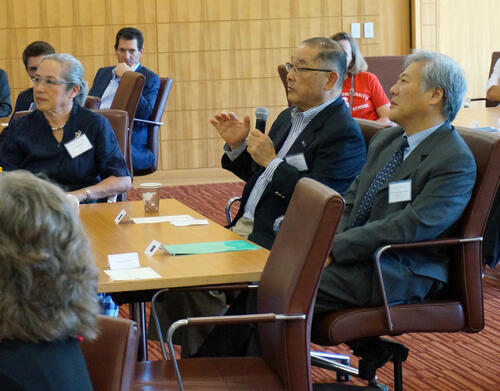
Meera Santhanam (junior, The Nueva School, CA) and Katie Goldstein (senior, Crystal Springs Uplands High School, CA) were recognized for their coursework and exceptional research essays. They articulately presented their research that focused on women in the Japanese workforce and equity-related issues concerning LGBTQ people in Japan, respectively; and skillfully answered provocative questions from the audience. 

Image
2015rsp


Since 2003, the RSP has provided a creative and innovative approach to teaching high school students about Japan and U.S–Japan relations. The program provides American students with unique opportunities to interact with diplomats and top scholars affiliated with Stanford University, the University of Tokyo, the University of Hawaii, and other institutions through online lectures and discussions, and introduces both American and Japanese perspectives on many historical and contemporary issues.

The 2015 Japan Day honorees were reflective of the introduction of varied topics and perspectives in the RSP curriculum. When asked to comment on her RSP experience, Santhanam remarked, “With exposure to a wide array of perspectives and in-depth content alike, participating in this program is a decision I would make a thousand times over again. This rare, interdisciplinary opportunity allowed me to connect with my topic on not just an academic, but personal level as well.” Goldstein shared a similar sentiment, also noting the scholarly, yet congenial atmosphere of Japan Day: “The speakers—Dr. Gary Mukai, Naomi Funahashi, and Consul General Yamada—wonderfully set the formal yet fun tone of the academic event. The conversation, while centered around Japan, revolved around a myriad of topics: literature, current events, policies, you name a topic and it was talked about.”

For the first time in the history of the RSP, several RSP alumni introduced high school life in the United States to Japanese students enrolled in SPICE’s inaugural Stanford e-Japan course, which introduces U.S. society and culture and U.S.–Japan relations to Japanese high school students.

Stanford e-Japan students indicated early on in the course their desire to interact with students from the United States, and as a result, Waka Takahashi Brown, Stanford e-Japan Manager and Instructor, invited RSP alumni to comment on the discussion boards and guest speak at the virtual classroom on “U.S. High Schools and Education” on August 14, 2015. Brown noted, “The response from both the e-Japan students and Reischauer Scholars has been overwhelmingly positive. Not only have students been more engaged in the discussion boards, but the Stanford e-Japan students also seemed very eager to know what about Japan interested the U.S. students to participate in the Reischauer Scholars Program. I would not be surprised if the RSP and e-Japan students strike up a friendship from these initial brief exchanges.”

The distinguished RSP advisory committee members are Consul General Jun Yamada; Professor Emeritus Nisuke Ando, Doshisha University and Kyoto University; Ambassador Michael Armacost, Shorenstein Asia Pacific Research Center, Stanford University; Professor Indra Levy, Stanford University; Professor Phillip Lipscy, Stanford University; and Professor Emeritus Daniel Okimoto, Stanford University.

SPICE has received numerous grants in support of the RSP from the United States-Japan Foundation, the Center for Global Partnership (The Japan Foundation), and the Japan Fund, which is administered by the Freeman Spogli Institute for International Studies at Stanford University.

The RSP will be accepting applications for the 2016 program in September and October 2015. For more information about the RSP, visit www.reischauerscholars.org or contact Naomi Funahashi.

Hero Image
2015rsp
All News button
1
Authors
Jonas Edman
News Type
News
Date
Paragraphs


In collaboration with the Center for Latin American Studies (CLAS) at Stanford University, SPICE hosted a professional development seminar for elementary school teachers that focused on strategies to incorporate Latin American and Latino children’s literature into the K–5 classroom.

On February 6, 2015, 32 teachers from across the Bay Area gathered at Stanford University to listen to guest lectures, participate in curriculum demonstrations, and collaboratively explore issues related to immigration and identity.

The workshop commenced with a presentation by children’s book author and illustrator Duncan Tonatiuh, whose most recent book, Pancho Rabbit and the Coyote: A Migrant’s Tale, was a 2014 recipient of the Americas Book Award. The Americas Book Award was founded in 1993 by the Consortium of Latin American Studies Programs (CLASP) to encourage and commend authors, illustrators, and publishers who produce quality children’s and young adult books that portray Latin America, the Caribbean, or Latinos in the United States.

Mr. Tonatiuh shared the inspiration for Pancho Rabbit and the Coyote, which tells the story of a young rabbit’s journey from Mexico to the United States in search of his father. According to Mr. Tonatiuh, the book can be read as an allegory of the experiences that undocumented immigrants endure in order to reach the United States. During his talk, Mr. Tonatiuh played a short video created by an elementary school teacher in which students shared their own immigration stories in response to the book. The moving video was a reminder of the importance immigration issues have in many students’ lives. Each teacher at the workshop received a copy of Mr. Tonatiuh’s book.

Tomás Jiménez, Associate Professor of Sociology and Director of Chicana/o-Latina/o Studies at Stanford University, followed Mr. Tonatiuh’s talk with a lecture on the recent history of immigration to the United States. Professor Jiménez’s educative overview of the economic, social, and political forces that have led to the current state of immigration in the United States perfectly complemented the personal stories shared earlier by Mr. Tonatiuh.

In the afternoon, Keira Philipp-Schnure, Supervisor of Community Education Programs, and Katrina Dillon, Project Assistant, at the Latin American and Iberian Institute at University of New Mexico, shared an educator’s guide for Pancho Rabbit and the Coyote. The educator’s guide offers a plethora of lessons and activities that teachers can use when teaching the book.

As a final activity, workshop participants assembled in small groups to discuss the content and pedagogical strategies that had been shared at the workshop. Jonas Edman, Curriculum Writer at SPICE, facilitated the activity in which teachers offered their own ideas for lesson plans and activities to go along with Mr. Tonatiuh’s book.

In her closing remarks, Elizabeth Saenz-Ackermann, Associate Director at CLAS, expressed heartfelt gratitude to the teachers for their participation in the workshop and for their commitment to incorporating Latin American and Latino themes and topics into their teaching.

Hero Image
img 0707
All News button
1
-

The Center for Latin American Studies (CLAS) and the Stanford Program on International and Cross-Cultural Education (SPICE) are offering an exciting K–5 workshop focusing on strategies to incorporate Latin American and Latino children’s literature into the elementary school classroom.

Featured speakers include Duncan Tonatiuh, author of Pancho Rabbit and the Coyote (2013, Abrams Books for Young Readers) and Tomás Jiménez, Associate Professor of Sociology and Director of Stanford’s Chicana/o-Latina/o Studies.

Registration is $25 and includes breakfast, lunch, and a copy of the book Pancho Rabbit and the Coyote by Duncan Tonatiuh. Register for the workshop at http://tinyurl.com/ncks8sf by January 12, 2015.

TBA
Stanford University

Duncan Tonatiuh Author Featured Speaker
Tomas Jimenez Associate Professor of Sociology and Director of Chicana/o-Latina/- Studies Featured Speaker Stanford University
Workshops
-

In an effort to infuse Asian studies in the social studies and literature curricula, the Stanford Program on International and Cross-Cultural Education (SPICE), in cooperation with the National Consortium for Teaching About Asia (NCTA), is offering a professional development opportunity at Stanford University.

This all day workshop will focus on teaching about issues Asian American face in contemporary society. This is the fourth workshop in a four part series.

Encina Basement Conf. Room, Encina Hall
616 Serra Street
Stanford, CA 94305

Seminars
Authors
Naomi Funahashi
News Type
News
Date
Paragraphs

“What do you think about the financial feasibility of building a shinkansen in California?”

“Should the U.S. have relied only on economic sanctions against Japan leading up to Pearl Harbor, or should it have done something on the military front and not relied solely on the economic instrument?”

“If the tsunami had not caused the nuclear meltdown in Fukushima, or if the nuclear meltdown had been contained at a much lower level, would the ‘nuclear village’ in Japan even be a problem in Japan?” 
 

Three outstanding high school scholars—all honorees of the 2014 Reischauer Scholars Program (RSP)—expertly responded to these challenging questions posed by some of the leading scholars in the field of Japan studies at Stanford University. The Stanford Program on International and Cross-Cultural Education (SPICE) honored Roma Forest (San Luis Obispo, CA), Jonathan Klein (Los Angeles, CA), and John McHugh (Winnetka, IL) at a Japan Day event on August 7, 2014 that was highlighted by presentations based on their RSP research essays on an intriguing range of Japan-related topics: lessons from Japan’s shinkansen for California’s high speed rail project; a critical analysis of U.S. economic policy leading up to Japan’s attack on Pearl Harbor; and Japan’s nuclear energy policies in post-Fukushima Japan. 

Japan Day featured thoughtful and encouraging opening remarks by Consul General Masato Watanabe, Consulate General of Japan in San Francisco, as he shared his reflections on the role of youth in the bilateral relationship between Japan and the United States. “The RSP offers young people an opportunity not only to learn about another country, but to think critically from multiple perspectives,” he noted. “In doing so, this program plays a vital role in training future leaders in the U.S.–Japan field. Your successful completion of this program is not the end, but just the beginning of your journey. 

Naomi Funahashi, RSP Manager and Instructor, gave an overview of the RSP to members of the Stanford community, family members of the honorees, and others who are involved in U.S.–Japan relations. Named in honor of former U.S. Ambassador to Japan Edwin O. Reischauer, a leading educator and noted scholar of Japanese history and culture, the RSP annually selects 25–30 talented sophomores, juniors, and seniors from throughout the United States to engage in an intensive study of Japan. Entering its twelfth year in 2015, the RSP presents an innovative approach to engaging high school students in the online study of Japan and U.S.–Japan relations. Prominent scholars affiliated with Stanford University, the University of Tokyo, the University of Hawaii, and other institutions provide lectures and engage students in online dialogue, and students develop a community of peers with a shared interest in Japan. The 2015 RSP will feature comments by Ambassadors Caroline Kennedy and Kenichiro Sasae.


danandcg
Professor Emeritus Daniel Okimoto poses a question following a research presentation by one of the student honorees.

Dr. Rie Kijima, the interim instructor of the 2014 RSP, also gave an insightful presentation on the findings of an RSP alumni tracer study that was conducted in 2013 to commemorate the tenth anniversary of the program. The study reflected the significant and lasting impact of the RSP upon its alumni, with 81 percent of the respondents noting that the RSP helped them to think critically and to become better scholars, and that it ignited added interest to conduct further research on Japan. Dr. Kijima also noted that the study showed that RSP participation positively impacted high school students’ academic records, strengthened students’ desire to learn more about Japan and about Asia, and provided a unique opportunity for inquisitive learners to pursue their academic interests.


Following Japan Day, Jonathan, John, and Roma offered reflections upon their experiences in the RSP. “The RSP provided an opportunity to interact with outstanding students from around the country in an intense and interactive online environment,” remarked Jonathan Klein. “I felt very lucky to have weekly lectures by the exact scholars that write the books we read for assignments, and who are the very people that research and write papers on issues in modern day Japan.” John McHugh was also struck by the direct access to top scholars in the Japan studies field, commenting that he “actually sat next to a researcher from Stanford whose work I had used in my paper!” The challenging nature of the RSP coursework appealed to Roma, who observed, “I’m so glad to have participated in such a rigorous program with highly motivated peers and I look forward to seeing how RSP affects our lives and career choices.”

The distinguished RSP advisory committee members are Consul General Watanabe; Professor Emeritus Nisuke Ando, Doshisha University; and Ambassador Michael Armacost, Professor Phillip Lipscy (principal investigator), Dr. Gary Mukai, and Professor Emeritus Daniel Okimoto of Stanford University.

The RSP received funding for the first three years (2004–06) of the program from the United States-Japan Foundation. The program is currently funded by a grant from the Center for Global Partnership, the Japan Foundation, and the Freeman Spogli Institute for International Studies at Stanford University.

The RSP will be accepting applications for the 2015 program in September and October 2014. For more information about the RSP, visit www.reischauerscholars.org or contact Naomi Funahashi, RSP Manager and Instructor, at nfunahashi@stanford.edu.

Hero Image
danandcg
Professor Emeritus Daniel Okimoto poses a question following a research presentation by one of the student honorees.
Rylan Sekiguchi
All News button
1
Authors
News Type
News
Date
Paragraphs

Standing upright, then slowly clasping both hands and drawing them up to shoulder height, Kevin Won next kneeled on the floor. Bending forward, he bowed his head toward his silent audience.

Won’s demonstration of the Sebae, a traditional bow performed for elders during South Korea’s lunar new year, may have seemed out of place during a warm, sunny day on Stanford’s campus. But the intricate display was in perfect context during a cross-cultural conference for secondary school teachers from the United States to learn about Korean society, as well as providing a forum to directly engage with Korean teachers and students.

Despite Korea’s growing relevance worldwide, there has been little development of Korean studies below university-level, leaving a vacuum for misunderstanding, including stereotypes, to form at an early age. The conference – now in its third year – aims to shift this reality.

For three days in late July, twenty-four teachers from across America participated in a variety of activities and seminars intended to give them new perspectives and teaching strategies.

Gary Mukai, director of SPICE, welcomes participants.

The conference was co-organized by the Korean Studies Program (KSP) at the Shorenstein Asia-Pacific Research Center (APARC) and the Stanford Program on International and Cross-Cultural Education (SPICE), both in the Freeman Spogli Institute for International Studies. The two groups work together to convert research on Asia into material that is suitable for younger students.

“Our mission is to make Stanford scholarship accessible to all,” said SPICE director Gary Mukai, who has been with SPICE for over 26 years. SPICE and Shorenstein APARC, under the direction of Gi-Wook Shin, a professor of sociology, have coordinated curriculum development for key projects on Korean history and perceptions of wartime history in Northeast Asia. 

A cadre of scholars and practitioners from Stanford and other universities and organizations offered talking points and actionable ideas for instruction. Among them was David Straub, the associate director of KSP, who lived in Korea for eight years as a senior U.S. diplomat. 

The United States and Korea have a very close relationship, but lack equal dialogue, explained Straub. America is still “number one” for Koreans, as such, Koreans know more about the United States than Americans know about Korea. This imbalance can lead to misunderstanding. Straub took the teachers through the recent history of U.S.-Korea relations, which is often narrowed to the context of the Korean War. 

Two teachers work together on a curriculum exercise comparing political cartoons.

Since 1945, South Korea overcame extreme poverty and effectively established a democratic society, a transition that was uncommonly quick and relatively smooth, and one that now supports a global powerhouse of trade and culture.

Throughout the conference, SPICE staff demonstrated ways for educators to bring Korea, and greater Northeast Asia, into their classrooms. They gave the teachers a chance to practice student lessons. In one exercise, the teachers deciphered sets of political cartoons and compared news headlines from Japan, China and Korea, using material from SPICE instructional materials. 

Each activity was carefully prepared to guide teachers to examine their own preconceptions. Greater cultural awareness can come when both teachers and students are “more critical consumers of information,” said Rylan Sekiguchi, a SPICE curriculum specialist, in his presentation.

While curriculum is important, establishing rapport seemed an essential part of the conference. A key component to a successful cross-cultural workshop is creating a community, “and looking around the room, I think we’ve done that here,” said Mukai, in an address to participants at a reception.

Also in attendance was a delegation of 11 Korean teachers and students from Hana Academy Seoul, a private high school in Korea with a unique structure and curriculum. The school’s name comes from the Hana Financial Group, which established the school in 2010, and is also the supporter of the Stanford conference. The Korean students gave presentations that covered a wide range of topics, including an analysis of teenage life and the public education system in Korea.

(Left to right): Students Nayoon Kim, Kevin Won, Seung-hyun Kim and Sarah Chey presented on Korean culture and society.

Six students from Hana Academy Seoul performed Samulnori, one of Korea’s most popular genres of music. The musical group, known as Da-Seu-Reum, showcased their talents while wearing traditional, brightly colored outfits. Afterward, the students became the teachers – when they invited the American teachers to come up and play the instruments. 

Three students were also honored for their research and participation in the Sejong Korean Scholars Program (SKSP), a distance-learning opportunity for 25 high school students across the United States to engage in an intensive study of Korea for a semester. SKSP is dually led by SPICE and Shorenstein APARC, and sponsored by the Korea Foundation.

“I feel very honored to attend, and have learned a lot about U.S.-Korea relations,” said Won, who is from Korea and attends The Taft School in Connecticut. “But mostly, I am just glad my presentation went well.” 

Won, a relative newcomer to public speaking, explained Korean holidays and how to perform a traditional bow. After demonstrating the correct posture and sequence to the audience, he asked for, and easily received, teacher participation. 

Kelly McKee, a teacher from Illinois, tries playing the Buk, a drum used in Samulnori, with direction from a Hana Academy Seoul student.

“From the impeccably credentialed presenters to the wonderful pacing of the presentations, I thoroughly enjoyed my three days here,” said Eladio “Lalo” Martin, a humanities teacher at Cesar Chavez Middle School in Watsonville.

“This conference, by far, is the best I’ve ever attended,” he added. Martin has been teaching for more than 18 years, and says he looks forward to returning to Stanford.

“The speakers have been fantastic,” said Kelly McKee, a social studies teacher. “They’ve shared in-depth expertise on topics like Korea’s special economic zones and North Korea – areas you can’t find in professional development workshops elsewhere.”

McKee, who works at Lake Forest High School in Illinois and is a leader of a student exchange program to Shanghai, says she plans to supplement her Korea unit with what she has learned. As the availability of Asian studies curriculum continues to grow, she says the future certainly looks bright.

Hero Image
Hana Activity Logo
All News button
1
Authors
News Type
News
Date
Paragraphs

On July 30, 2014, three anxious but very poised high school students from the Sejong Korean Scholars Program (SKSP)—an online course on Korea sponsored by the Stanford Program on International and Cross-Cultural Education (SPICE) and the Shorenstein Asia-Pacific Research Center—took the stage to present their final papers to an audience of 25 American and Korean high school teachers and several university professors at a three-day conference on Korea at Stanford University. 

The students—Alex Boylston, a recent graduate of Riverwood International Charter School in Atlanta, GA; Anne Kim, a rising senior at Richard Montgomery High School in Rockville, MD; and Elaine Lee, a rising senior at Los Altos High School in Los Altos, CA—were selected from a class of 26 students, based on the excellence of their academic work and final course papers. 

When asked how he came to choose his topic on Koreans in Japan’s yakuza, Alex Boylston thoughtfully replied that he had thought “outside the box” because he didn’t want his instructor “to have to read 20 essays on the Korean War.” Taking a different tack, Anne Kim turned her personal interest in historical Korean dramas (“sageuk”) into the topic for her final paper, “Let’s Talk Drama: Sageuk as a Reflector and Perpetrator of Societal Change in South Korea.” Closing out the presentations, Elaine Lee stepped up to the podium and discussed the challenges South Korea faces as a global economic power, leaving no doubt she will achieve her goal of participating in the future of U.S.–South Korean relations. All three were honored with an award for excellence, following their presentations.

The SKSP accepts 20-25 exceptional high school students from throughout the United States for each course offering. The course provides students with a broad overview of Korean history and culture as well as U.S.–Korean relations and an opportunity to learn from and interact with top scholars and experts in Korean studies. The SKSP is now accepting applications for its spring 2015 term; www.sejongscholars.org.

Hero Image
2014 Sejong Scholars Honorees
Left to right: Anne Kim, Alex Boylston, Annie Lim (SKSP instructor), and Elaine Lee
All News button
1
Authors
Gary Mukai
News Type
News
Date
Paragraphs


The Bracero Program was a series of laws that allowed the United States to recruit temporary guest workers (braceros, lit. “individuals who work with their arms”) from Mexico. As the United States entered World War II, its agriculture and railroad industries witnessed a shortage of laborers due to the U.S. military draft and the forced removal of Japanese Americans from the West Coast of the United States. The United States and Mexico entered into legal agreements that would ultimately be known as the Bracero Program, which operated from 1942 to 1964. Braceros worked throughout the United States, but the largest concentration of braceros was employed in California. There were an estimated 4.5 million contracts signed by braceros over the 22-year period. Today a large proportion of the Mexican-American population can trace its heritage to former braceros.

—By Ignacio Ornelas Rodriguez


My Childhood

I have a personal connection to braceros. The forced removal of people of Japanese descent from the West Coast in 1942 contributed to the labor shortage in states like California. My family was interned in Poston, Arizona, in what was called the Poston War Relocation Center from 1942 until the end of World War II in 1945. The “relocation center” was built on a Colorado River Indian Tribes reservation and was surrounded by barbed wire. My family returned to California after the end of the war. As a child of farm laborers in the 1950s and 1960s, I worked side-by-side with braceros. My neighbors in San Jose were braceros. I thought that I was a hard worker until I met them. I was compensated by the amount of crops I harvested, known as piecework. The braceros’ punch cards usually had at least double the punches that mine had.

Some years ago, I asked my mother if she had a photo of the bracero home that stood next to my home. She did have a photo, and to my surprise, I was in it. One of the fondest memories of my childhood was occasionally telling my mother that I didn’t want rice and tofu and instead going to the bracero home to enjoy homemade tortillas and beans. The tortillas were made from flour and manteca or lard. As a child, I felt more Mexican than Japanese.

In my work as a teacher (from 1977 to 1988) and at SPICE (since 1988), I have always known that there were legacies from my life growing up with braceros that have profoundly impacted me. I used to be ashamed of being the son of farm laborers, but through the years, I have come to appreciate the importance of farm labor, and I could not have had greater role models than the braceros when it came to hard work and discipline.  

Thus, it was particularly meaningful for me to facilitate an event called “Legacies of the Bracero Program, 1942–1964,” during which ten former braceros were recognized by SPICE, FSI, and the Center for Latin American Studies (CLAS). The event was meticulously organized by SPICE Event Coordinator Sabrina Ishimatsu and took place at Stanford University on February 27, 2014. 


The Speakers

Rodolfo Dirzo, CLAS Director, whose father was a bracero, spoke about the transmission of the richness and diversity of Mexican culture to generations of Mexican Americans. His message of “pride in one’s identity” prompted multiple generations of Mexican Americans in the audience to consider the pioneers of their community. Francis Dominguez, the granddaughter of former bracero José Guadalupe Rodriguez Fonseca, reflected, “I felt that the speeches were educational for those not familiar with the history, but also connected with the families of braceros on an emotional level.” 

“Three things are interesting to me about what happened during the bracero years that have made what the country is today,” noted Mariano-Florentino Cuéllar, FSI Director. “Number one, the United States realized that it could not function without immigration…; number two, immigration was considered vital to our national security…; number three, we came to realize that sometimes what looks temporary is actually permanent.”

These three points resonated with Ignacio Ornelas Rodriguez, whose grandfather is Fonseca. Rodriguez, a former high school teacher in Salinas and now with the Special Collections and University Archives Department of Stanford University Libraries, noted that, “Tino’s historical analysis and considerations about immigration and the Bracero Program have implications that polarizing opposite left/right political views have failed to consider. Tino’s perspective was quite fascinating.” 

Several high school teachers were in the audience, and Rodriguez spoke about ways that teachers can interactively engage students in the study of the Bracero Program. “This event is a great example of how SPICE reaches out to the larger community and bridges the gap between academia and communities,” said Rodriguez. Rodriguez and the other teachers in the audience have used SPICE curricular materials to underscore the importance of understanding and appreciating diverse perspectives on U.S. history. SPICE curricular materials on topics like the history of U.S.–Mexico relations serve as a bridge between FSI/Stanford University and schools nationally.


Recognition

Each former bracero was presented with three certificates from Stanford University, the California State Assembly (signed by Luis A. Alejo, 30th Assembly District), and Monterey County (signed by Supervisor Simón Salinas). The former braceros proudly posed in Stanford sweatshirts, and tears could be seen among their families’ photographers, making even clear photographs seem blurry.  


Former Braceros Reunited
Former Braceros with Rodriguez (back row, far left); and Dirzo, Cuéllar, and Mukai (back row, right side), courtesy of Rod Searcey.

Reflecting upon the event, Fonseca humbly stated, “I felt very honored to be recognized for my work and proud to be reunited with fellow braceros.” He was particularly touched that the honorable Carlos Ponce Martinez, Consul General of Mexico in San Jose, and Simón Salinas, Monterey County Supervisor, were in attendance. “I would like to thank the organizers of the event and Stanford University.”


Adios

Toward the end of the evening, Supervisor Salinas, whose father was a bracero, approached me and asked if I was related to the Mukai family that once farmed in Salinas before and after World War II. I was, I told him. To my astonishment, he informed me that his family used to sharecrop with my family and that he was particularly close to one of my uncles and two of my cousins who once worked for Driscoll’s, growers of berries. Though the Bracero Program ended 50 years ago, I continue to discover new connections and ways in which it has affected my life and my family. 

As sons and grandsons of former braceros, Dirzo, Rodriguez, and Salinas are prime examples of proud legacies of the Bracero Program. As the former braceros were departing the Bechtel Conference Center at Encina Hall, I had a flashback to 1964 at the Bracero Program’s end, when I said “adios” to my bracero co-workers from childhood. A faded memory of my childhood suddenly became clear and poignant once again, as I wondered if I would ever see them again. 

Hero Image
Bracero Home
Gary Mukai in front of the bracero home that stood next to his home, circa 1957.
All News button
1
Subtitle

The Bracero Program was a series of laws that allowed the United States to recruit temporary guest workers (braceros, lit. “individuals who work with their arms”) from Mexico.

Subscribe to North America