
The 2025 Stanford/SPICE East Asia Seminars for Teachers in Hawai‘i Summer Institute
The 2025 Stanford/SPICE East Asia Seminars for Teachers in Hawai‘i Summer Institute
The Stanford/Freeman SEAS Hawai‘i Fellows gathered at the East-West Center, from July 12 to 14, 2025.

The fifth year of the Stanford/SPICE East Asia Seminars for Teachers in Hawaiʻi (“Stanford SEAS Hawai‘i”) was launched in April 2025 and included four online seminars that featured Stanford-affiliated scholars—Professor Ethan Segal, Professor Andrew Walder, PhD candidate Zoë Gioja, and Ambassador Scot Marciel—and culminated in a three-day in-person summer institute that took place from July 12 to 14, 2025 at the Hawai‘i Imin International Conference Center at Jefferson Hall, East-West Center. This year’s cohort included 19 public and private high school teachers—Stanford/Freeman SEAS Hawai‘i Fellows—from across Hawai‘i. Below are the names of the 2025 Stanford/Freeman SEAS Hawai‘i Fellows, their schools, and the islands where their schools are located:
| Adrienne Pulu | Maui High School | Maui |
| Amelia Thorne | Konawaena High School | Hawai‘i |
| Angelica Grimble | Kailua High School | O‘ahu |
| Annie Paopao | Kahuku High and Intermediate School | O‘ahu |
| Aura-Rae Pohai Wong | Central District Office @ ‘Aiea Elementary | O‘ahu |
| Casey Hulten | Kea‘au High School | Hawai‘i |
| Eric Asuncion | Maui High School | Maui |
| Jaylin Petersen | ‘Aiea High School | O‘ahu |
| Jonathan Loomis | McKinley High School | O‘ahu |
| Kristen Hairston | Leilehua High School | O‘ahu |
| Lono Baldado | Hilo High School | Hawai‘i |
| Lyn Nicole Chua | ‘Aiea High School | O‘ahu |
| Mahina Goo | Pearl City High School | O‘ahu |
| Micah Kawaguchi-Ailetcher | Lahainaluna High School | Maui |
| Michelle Levine Aquino | Farrington High School | O‘ahu |
| Misael Bernard | Hawaiian Mission Academy | O‘ahu |
| Rhealiza Pira-Miki | Konawaena High School | Hawai‘i |
| Rukhsanna Guidroz | Seabury Hall | Maui |
| Tammy Johnson | Calvary Chapel Christian School | O‘ahu |
Stanford SEAS Hawai‘i Manager Rylan Sekiguchi invited scholars from Hawai‘i as well as curriculum writers and facilitators of teacher professional development to offer presentations over the course of the institute. They are listed below as well as the titles of their presentations. The presentation topics were selected to support Hawai‘i State Department of Education standards such as “U.S. History and Government Theme 1 (Immigration and Migration, 1880–1930), Anchor Standard 16 (Global Interconnections and Changing Spatial Patterns): Cause and Effects of Migration.”
- Shana Brown, Associate Professor, University of Hawai‘i at Mānoa, “U.S.–China Relations: Problems and Potential”
- Douglas D. L. Chong, President of the Hawaii Chinese History Center, “The Chinese Diaspora in Hawai‘i”
- Jonas Edman, Instructional Designer, SPICE, “SPICE Curricula on Chinese American History”
- Naomi Funahashi, Manager, Reischauer Scholars Program and Teacher Professional Development, SPICE, “Teaching Contemporary Korea with SPICE”
- Merle Grybowski, Director of Teacher Training, Pacific and Asian Affairs Council, “East-West Center Walkabout”
- Patricia Halagao, Professor, University of Hawai‘i at Mānoa, “Teaching Filipino Identity, History, and Resistance”
- Ken K. Ito, Professor Emeritus, University of Hawai‘i at Mānoa, “Nakashima Naoto’s ‘Waiawa Station’ (1934) as Diasporic Fiction”
- C. Harrison Kim, Associate Professor, University of Hawai‘i at Mānoa, “Korea in the 20th Century: Colonialism, North/South Division, Futures”
- Jonathan Okamura, Professor Emeritus, University of Hawai‘i at Mānoa, “East Asians and Southeast Asians in Unequal Hawai‘i”
- Rylan Sekiguchi, Manager of Curriculum and Instructional Design, SPICE, “Divided Memories: Comparing History Textbooks”
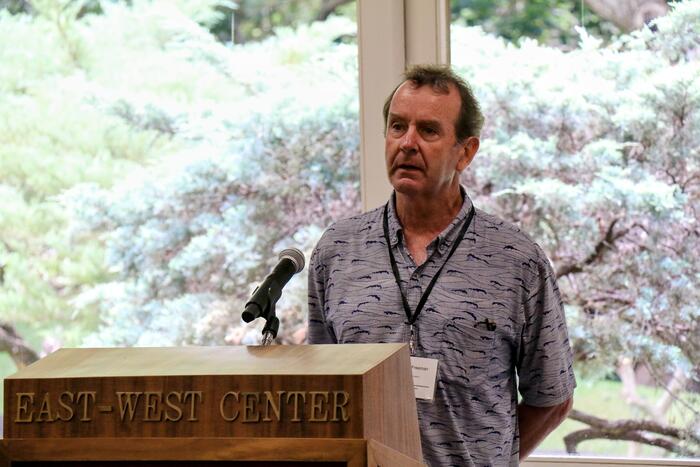
Stanford SEAS Hawai‘i is made possible by a generous grant from the Freeman Foundation. President Graeme Freeman (photo above) spoke during the summer institute about the Freeman Foundation’s mission of helping to enhance the teaching of East Asia through programs such as the National Consortium for Teaching about Asia and Stanford SEAS Hawaiʻi and expressed his gratitude to the Stanford/Freeman SEAS Hawai‘i Fellows for the tremendous impact their learning has on their students. Graeme was joined by Vice President Shereen Goto, Executive Assistant Sandra Lee, and Foundation Assistant Kellie Matsudaira of the Freeman Foundation. Additional support for the summer institute was kindly provided by Stanford Global Studies and the Stanford Center for East Asian Studies through the U.S. Department of Education National Resource Center funding under the auspices of Title VI, Section 602(a) of the Higher Education Act of 1965.
As I observed the lectures, curriculum demonstrations, and listened to the Stanford/Freeman SEAS Hawai‘i Fellows’ comments, questions, and resource sharing, I reflected on ways that SPICE has continued to serve as a bridge between Stanford University scholars and teachers in Hawai‘i since 1988 when SPICE founding director Dr. David Grossman established the Consortium for Teaching Asia and the Pacific in the Schools (CTAPS) at the East-West Center. During the institute, I shared thoughts on three Stanford scholars. Stanford scholar Lee Shulman is someone whom I mentioned to teachers at the second CTAPS summer institute that was held in 1989. Shulman is known for developing the concept of pedagogical content knowledge or PCK, which emphasizes that teachers need not only subject matter expertise but also pedagogical content knowledge. While listening to the Stanford/Freeman SEAS Hawai‘i Fellows, their unique blend of subject matter knowledge and pedagogical content knowledge really shined. Second, during the institute, I could really feel the fellows’ embrace of the diversity of their students, the people in Hawai‘i, and beyond. I spoke about Stanford psychologist Jamil Zaki, who has noted that empathy is an umbrella term that captures at least three ways that we connect with one another’s emotions. One is emotional empathy, which is vicariously sharing somebody else’s feelings. Cognitive empathy is one’s attempt to understand what someone else is feeling and why. And empathic concern or compassion is one’s motivation to improve others’ well-being. Third, Stephen Murphy-Shigematsu is a psychologist formerly with the University of Tokyo who now teaches at Stanford. His scholarship on heartfulness—elucidated in his book, From Mindfulness to Heartfulness: Transforming Self and Society with Compassion—notes that heartfulness is a way of living with mindfulness, compassion, and responsibility that enhances well-being and transformation. Sekiguchi noted that he certainly felt this heartfulness while interacting with the Stanford/Freeman SEAS Hawai‘i Fellows since April of this year.
In the month following the institute’s conclusion, each Stanford/Freeman SEAS Hawai‘i Fellow will create an original lesson plan that incorporates content that was introduced during Stanford SEAS Hawaiʻi. Sekiguchi awaits in anticipation of seeing how content from the seminar will reach hundreds of secondary school students throughout Hawai‘i.
Sekiguchi and Sabrina Ishimatsu, SPICE Event Coordinator, who organized the institute, and I are grateful to the East-West Center for allowing SPICE to host the Stanford SEAS Hawai‘i summer institute at its beautiful venue.
Most importantly, everyone at SPICE is immensely grateful to President Graeme Freeman, Vice President Shereen Goto, and the Freeman Foundation for its generosity in making Stanford SEAS Hawai‘i possible and providing us the opportunity to engage Stanford/Freeman SEAS Hawai‘i Fellows with scholars from Stanford University, the University of Hawai‘i at Mānoa, and beyond.
To stay informed of SPICE news, join our email list and follow us on Facebook, X, and Instagram.


