
The 2026 Stanford/SPICE East Asia Seminars for Teachers in Hawai‘i Summer Institute
The 2026 Stanford/SPICE East Asia Seminars for Teachers in Hawai‘i Summer Institute
The East-West Center co-hosted the Stanford/Freeman SEAS Hawai‘i Fellows from July 22 to 24, 2026.

The sixth year of the Stanford/SPICE East Asia Seminars for Teachers in Hawaiʻi (“Stanford SEAS Hawai‘i”) was launched in March 2026 and included five online seminars that featured Stanford-affiliated scholars—Professor Ethan Segal, PhD candidate Zoë Gioja, Professor Andrew Walder, Ambassador Scot Marciel, and Dr. Thomas Fingar—and culminated in a three-day in-person summer institute that took place from July 22 to 24, 2026 at the Hawai‘i Imin International Conference Center at the East-West Center. This year’s cohort included 19 public, charter, and private high school teachers—Stanford/Freeman SEAS Hawai‘i Fellows—from across Hawai‘i. Below are the names of the 2026 Stanford/Freeman SEAS Hawai‘i Fellows:
Alice De Pina, Āliamanu Middle School (O‘ahu)
Arlene Nishimura, Farrington High School (O‘ahu)
David Brooks, Ka‘ū High and Pāhala Elementary School (Hawai‘i)
Ishael Shaw-De Mello, Waiākea High School (Hawai‘i)
Jacqueline Muir, Kīhei Charter School (Maui)
John Ziegler, Olomana High & Intermediate School (O‘ahu)
Kevin Quinn, Maui High School (Maui)
Kristen Gallander, Kīhei Charter School (Maui)
Lauren Kido, Kawānanakoa Middle School (O‘ahu)
Lulu Lulu, Maryknoll School (O‘ahu)
Malina Folsom Perez, Hawai‘i Technology Academy (Kaua‘i)
Maria Glenda Ventura, King Kekaulike High School (Maui)
Maryjane Lanzon, Konawaena High School (Hawai‘i)
Patricia Tupinio, Leilehua High School (O‘ahu)
Peng Ongart Ratchaworapong, St. Andrew’s Schools (O‘ahu)
Quiana Lemmon, Hilo High School (Hawai‘i)
Vanessa Fowler, Kaimukī Christian School (O‘ahu)
Yue Yin, Henry J. Kaiser High School (O‘ahu)
Yuka Chubachi, Matsudo Kokusai High School, Japan (O‘ahu)
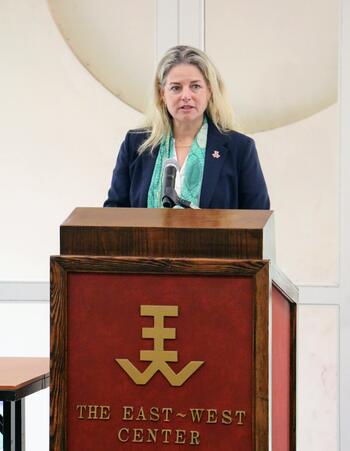
Stanford SEAS Hawai‘i Manager Rylan Sekiguchi invited speakers from Hawai‘i as well as curriculum writers and facilitators of teacher professional development to offer presentations over the course of the institute. The institute began with inspiring welcoming remarks from President Celeste A. Connors of the East-West Center. SPICE has been collaborating with the East-West Center since 1988, and President Connors noted the East-West Center’s continued support of teachers. The other speakers are listed below as well as the titles of their presentations. The presentation topics were selected to support Hawai‘i State Department of Education standards such as “U.S. History and Government Theme 1 (Immigration and Migration, 1880–1930), Anchor Standard 16 (Global Interconnections and Changing Spatial Patterns): Cause and Effects of Migration.”
- Michelle Levine Aquino, Teacher, W.R. Farrington High School, “Teaching Filipino Identity, History, and Resistance”
- Shana Brown, Associate Professor, University of Hawai‘i at Mānoa, “China in the World Today”
- Douglas D. L. Chong, President of the Hawai‘i Chinese History Center, “The Chinese Diaspora in Hawai‘i”
- Naomi Funahashi, Manager, Reischauer Scholars Program and Teacher Professional Development, SPICE, “What Does It Mean to Be an American: Teaching Civil Rights and Japanese American Incarceration”
- Merle Grybowski, Director of Teacher Training, Pacific and Asian Affairs Council, “East-West Center Walkabout”
- C. Harrison Kim, Associate Professor, University of Hawai‘i at Mānoa, “Korea in the 20th Century: Colonialism, North/South Division, Futures”
- Tanya Lee, Instructor, SPICE, “Approaches to Teaching Korean and Chinese American History: Dynamics of Diversity and Diaspora”
- Christine Ogura, Superintendent of Honouliuli National Historic Site, National Park Service, “Honouliuli: A History Awakened”
- Jonathan Okamura, Professor Emeritus, University of Hawai‘i at Mānoa, “East Asians and Southeast Asians in Unequal Hawai‘i”
- Rylan Sekiguchi, Manager of Curriculum and Instructional Design, SPICE, “Divided Memories”
- Jake Shimabukuro, Musician
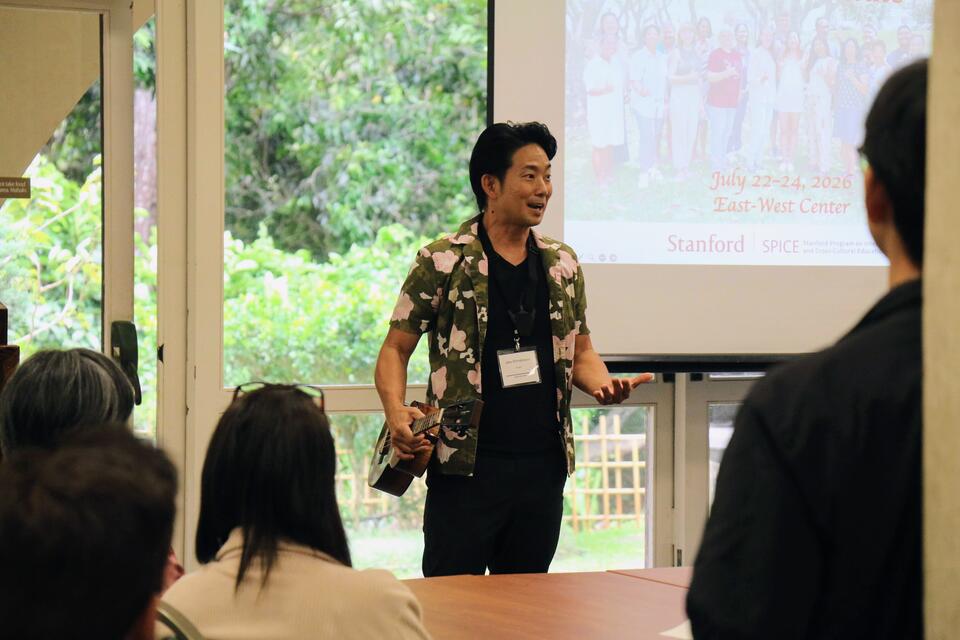
A highlight of the institute was a talk and performance by musician Jake Shimabukuro, who has been very supportive of SPICE’s work in the United States and also in Japan. Jake underscored the importance of music in the transmission of culture. Many teachers commented on how they felt that Jake’s music and talk were so culturally relevant.
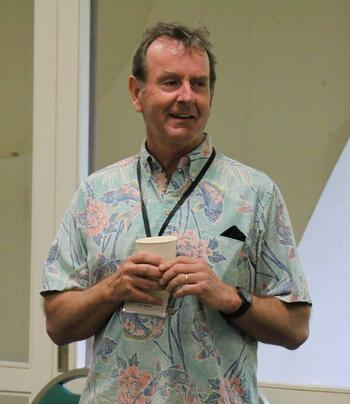
Stanford SEAS Hawai‘i is made possible by a generous grant from the Freeman Foundation. President Graeme Freeman spoke during the institute about the Freeman Foundation’s mission of helping to enhance the teaching of East Asia through programs such as the National Consortium for Teaching about Asia and Stanford SEAS Hawaiʻi and expressed his gratitude to the Stanford/Freeman SEAS Hawai‘i Fellows for the tremendous impact their learning has on their students. Graeme was joined by Freeman Foundation Vice President Shereen Goto.
In the month following the institute’s conclusion, each Stanford/Freeman SEAS Hawai‘i Fellow created an original lesson plan that incorporates content that was introduced during Stanford SEAS Hawaiʻi.
Sekiguchi, Sabrina Ishimatsu, SPICE Event Coordinator, who organized the institute, and I are grateful to the East-West Center—and especially to President Celeste A. Connors—for agreeing to co-host the Stanford SEAS Hawai‘i summer institute again.
Most importantly, everyone at SPICE is truly grateful to President Graeme Freeman, Vice President Shereen Goto, and the Freeman Foundation for its generosity in making Stanford SEAS Hawai‘i possible and providing us the opportunity to engage Stanford/Freeman SEAS Hawai‘i Fellows with scholars from Stanford University, the University of Hawai‘i at Mānoa, and beyond.
To stay informed of SPICE news, join our email list and follow us on Facebook, X, and Instagram.


