
Universality Within Diversity: Keys to Multicultural Co-Learning Gained from the Stanford e-Saidai Course
Universality Within Diversity: Keys to Multicultural Co-Learning Gained from the Stanford e-Saidai Course
Stanford e-Saidai alum Honoka Anzai shares her reflections on the course.

The following is a guest article written by Honoka Anzai, a student attending Saitama University. Anzai enrolled in the Stanford e-Saidai Course on diversity and inclusion, which was organized by SPICE and Professor Makoto Nagasawa, Saitama University, and taught by Seo Jin (Jenny) Lee.
What does it mean to understand others who are different from oneself? Before participating in the Stanford e-Saidai Program, I thought that multicultural understanding began with learning about other cultures. I believed that the more cultures we engaged, the more open-minded we would become. However, throughout this course, I came to realize that understanding others requires something more fundamental: first understanding ourselves. Only by becoming aware of our own values, assumptions, and unconscious biases can we begin to understand people whose perspectives differ from our own.
One of the most important lessons I learned through this program is the significance of recognizing unconscious bias. We often tend to view bias as something intentional, yet in reality, many of our judgments are formed unconsciously. Cultural background, education, language, media, and daily experiences shape what we consider “normal.” Because these assumptions are so deeply ingrained in our lives, we sometimes fail to realize that they are merely assumptions to begin with. This realization led me to understand that diversity is not simply about accepting differences in others; rather, it calls upon us to question the very criteria we use to define those “differences” in the first place.
For instance, when we discussed historical narratives, I came to realize that history is by no means merely an accumulation of objective facts. What is remembered, emphasized, or overlooked can shift depending on whose perspective is reflected. The history of the internment of Japanese Americans, as recounted by Dr. Gary Mukai, held particular significance for me. While that experience was rooted in a specific historical and cultural context, the underlying human experience—facing exclusion and misunderstanding, and being denied a place to belong—was universal. This brought about a significant shift in my thinking. I began to realize that understanding another culture does not necessarily mean discovering something entirely unknown; sometimes, it involves finding familiar human emotions within an unfamiliar context.
At the same time, this does not mean that cultural differences should be overlooked. Discussions regarding the Navajo people reminded me of this fact. The Navajo perspective places immense importance on relationships among people, communities, traditions, languages, and the land—a view that differs from the more individual-centered perspective that I was accustomed to. I learned not to judge these differences through my own framework, but rather to ask what this perspective reveals about the human experience—aspects that my own framework could not fully capture.
Through this process, I became increasingly convinced that understanding one’s own culture is the starting point of multicultural understanding. Before trying to explain another culture, we need to recognize where our own interpretations come from. What do I consider “normal”? What do I consider “universal”? What experiences have shaped my definition of fairness, success, community, or identity?
The reason such questions are difficult is that our own culture is precisely what we are least conscious of. However, becoming aware of the assumptions we harbor does not mean eliminating them entirely. While unconscious biases may never fully disappear, we can strive to be more aware of them and ensure that our perceptions of and interactions with others are not swayed by such prejudices.
I also learned that these efforts are closely linked to the concept of “universality within diversity.”
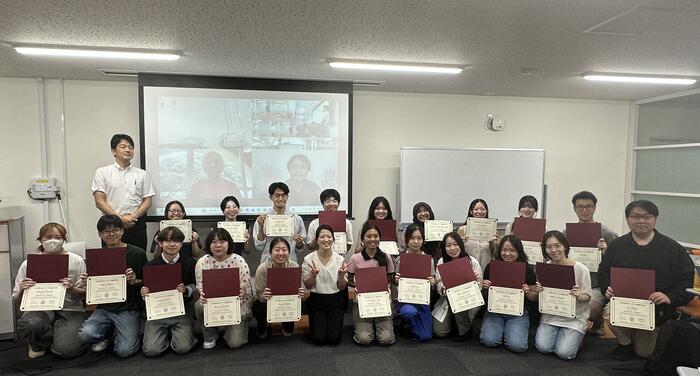
Through this course, I encountered people, histories, and worldviews different from my own. Yet, I was repeatedly reminded that underlying these differences are shared human aspirations—the desire to belong, to be respected, to express oneself, and to have one’s voice heard. These commonalities taught me that universality and diversity are by no means in conflict. (Photo above of the Stanford e-Saidai Closing Ceremony on July 24, 2026; courtesy of Saitama University.)
Acknowledging universality does not mean that everyone is the same; rather, it is about finding connections without erasing differences. Discussions regarding the Black Panther Party helped me understand these differences. By learning about the vital contributions of Black women—contributions often overlooked in historical narratives—I reaffirmed the importance of representation. This matters not merely because people wish to see themselves reflected in history, but because the absence of certain voices renders a society’s self-understanding incomplete. A similar perspective emerged in discussions about music and identity. While forms of expression vary across communities, the desire to preserve memory and share one’s experiences is fundamental to the human condition. Even if the forms of expression differ, the desire to have one’s voice heard persists at all times.
However, I also came to realize that simply acknowledging our “shared humanity” is not enough. Unless people feel a sense of security that allows them to voice unfamiliar perspectives or opinions that might not be readily accepted by others, they cannot truly participate in a multicultural learning environment. This is where the concept of “psychological safety” became particularly important to me. Even in a classroom where people from diverse backgrounds gather, mere diversity does not guarantee that dialogue will emerge. If students are afraid of making mistakes, being misunderstood, or facing criticism, they may choose to remain silent instead. In such a case, diversity exists only in a physical sense, failing to materialize at an intellectual level.
For me, this experience highlighted the importance of listening. “Active listening” creates the space for the other person to speak and demonstrates that their perspective is worth hearing. It also requires humility; rather than immediately asking whether a viewpoint is right or wrong, one can first ask why that perspective makes sense when viewed through the lens of that person’s experiences.
Through the Stanford e-Saidai program, I have come to view “multicultural co-learning” as a process that simultaneously moves in two directions: inward—understanding one’s own assumptions; and outward—understanding others. Looking inward helps reveal unconscious biases, while looking outward exposes us to perspectives different from our own. It is precisely in the interplay between these two movements that the potential to discover universality within diversity lies. Adopting this perspective has also transformed my understanding of “true inclusion.” Inclusion is not merely about bringing diverse people together in the same space; it is about creating an environment where individuals can bring their unique differences—just as they are—and express them without fear, while recognizing one another as equally valued participants. I know that it is impossible to completely eliminate one’s own biases. However, it is possible to recognize those biases, question them, and avoid creating invisible walls between oneself and others. It is also possible to continue learning about one’s own culture while remaining open to perspectives that challenge it.
Reflecting on the Stanford e-Saidai program, I feel that the greatest lesson I learned was not merely how to understand other cultures, but how to engage with “difference” itself. It begins with understanding the origins of one’s own perspective. Next comes recognizing the assumptions one holds. Then, listening to viewpoints different from one’s own. And finally, exploring what connects us without erasing our differences.
In a world of increasing diversity and deepening interconnectedness, I believe this process is essential for meaningful multicultural co-learning and coexistence. Diversity teaches us that there are many ways to understand the world. Self-understanding teaches us to question the limitations of our own perspectives. And universality reminds us that, despite our differences, we can learn from one another. That, for me, is the true value of diversity.
Stanford e-Saidai is one of several online courses offered by SPICE.
To stay updated on SPICE news, join our email list and follow us on Facebook, X, and Instagram.


