History
Authors
News Type
Blogs
Date
Paragraphs

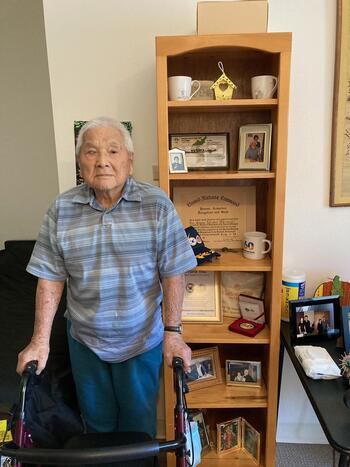
Kouji Yamada (MBA, Harvard), former Visiting Lecturer, Hitotsubashi University Graduate School of International Corporate Strategy, is an advisor to Stanford e-Hiroshima. His parents, Ryuji and Nanako, are supporters of Stanford e-Hiroshima, which is an online course that SPICE offers to high school students in Hiroshima. Taught by Rylan Sekiguchi, Stanford e-Hiroshima was launched in 2019 with the support of the Hiroshima Prefectural Board of Education. SPICE is grateful to Governor Hidehiko Yuzaki for his vision and leadership and Superintendent Rie Hirakawa for her unwavering support.

Ryuji Yamada adjusts the window shades to savor the view that grows elusive to his aging eyes. If you gaze towards Diamond Head from the Yamadas’ condominium, kite surfers glide in and out of your perspective in some random Brownian motion; their paths, pace, and direction seem chaotic. They all share the same wind, waves, and current, but the skill of the rider to look ahead and channel the energies around them sends them on very different and wonderful journeys. 

“I was just 14 living in Hiroshima and still a minor when the bomb dropped. My brother was only one year older but considered an adult and was sent on work detail for defense preparations. He had to walk through ground zero to come home. My father had a meeting at City Hall, but the ferry was cancelled. We all survived, but the blast sent us in very different directions.

“They rebuilt the community with their personality, spirit, and bare hands, but I was pushed inward to my studies. I needed to comprehend the natural force that had wrought so much destruction.

“In the sixties, foreign exchange was scarce, and I was one of the first scientists that the Japanese government sponsored to do research abroad. At Cornell, Robert Wilson guided my career and brought me along to establish what became Fermilab in 1967. We built Fermilab as an oasis of fundamental research in the Illinois prairie. We thought that the pursuit of knowledge would unite us. Wilson’s famous defense in April 1969 of Fermilab to Congress seems even more relevant today.

‘Are we good painters, good sculptors, great poets? I mean all the things that we really venerate and honor in our country and are patriotic about. In that sense, this new knowledge has all to do with honor and country, but it has nothing to do directly with defending our country except to help make it worth defending.’”[1]


Nanako Yamada also grew up in Hiroshima, but her greatest challenges were still ahead of her. “In the ’70s, there were few role models for women in building identity outside of the home in middle America. But when it became apparent that our second child was uncontrollable in his adolescent years, I decided to lead by example and went back to school to rekindle my love for learning. At Northern Illinois University, Helen Merritt guided me through a career in art history, and we authored several books together.

“Our specialty was kuchie woodblock prints from the late 19th to early 20th century. They offered a glimpse into a culture in flux. Western influences disrupting Japanese culture after Commodore Perry’s black ships forced the opening of Japan.

“What to accept, what to reject. What to cherish and what to disavow. Even when you think you stand still, you are always changing, and hopefully growing. Captured in the woodblocks is a narrative. Some cautionary, some celebratory, but all are educational if your eye and mind are willing to engage.

“When we heard about the SPICE program for Hiroshima, we were honored to stand by the Hiroshima Board of Education and continue the legacy of exploration and learning. Technology allows the new generation to not only be buffeted by social media but to also make profound connections to community, both near and far. Hopefully the students can find their own Robert Wilsons and Helen Merritts. We were blessed to make these relations, but we would have never found them without exploring and engaging. We didn’t have a grand plan, but we never stopped looking. We look forward to seeing what wonderful things they will find.”


Stanford e-Hiroshima is one of SPICE’s local student programs in Japan.

To stay informed of news about SPICE, join our email list and follow us on Facebook, Twitter, and Instagram


[1] Fermilab; https://history.fnal.gov/historical/people/wilson_testimony.html [access date: February 5, 2022].

Read More

Photo of student honorees holding plaques
News

SPICE Honors Top Students from 2020–2021 Regional Programs in Japan

Congratulations to the eight student honorees from Hiroshima Prefecture, Kawasaki City, Oita Prefecture, and Tottori Prefecture.
SPICE Honors Top Students from 2020–2021 Regional Programs in Japan
Headshot of Risa Ishii and Takaho Iwasaki
Blogs

Journey into the World of Entrepreneurship: Stanford e-Hiroshima Guest Speakers, Risa Ishii and Takaho Iwasaki

Stanford e-Hiroshima is an online course for high school students in Hiroshima Prefecture, Japan, that is sponsored by the Hiroshima Prefectural Government.
Journey into the World of Entrepreneurship: Stanford e-Hiroshima Guest Speakers, Risa Ishii and Takaho Iwasaki
Stanford e-Hiroshima is an online course for high school students created by SPICE and Hiroshima Prefecture
News

Stanford e-Hiroshima, SPICE’s Newest Online Course for High School Students: Sharing Cranes Across the Pacific

Stanford e-Hiroshima seeks to underscore the importance of helping high school students understand the interdependence between Japan and the United States.
Stanford e-Hiroshima, SPICE’s Newest Online Course for High School Students: Sharing Cranes Across the Pacific
Hero Image
Rylan Sekiguchi at Hiroshima University High School with Kenzi Watanabe, Principal, and Akiyoshi Kai, Head of R&D Department and member of the Mathematics Department
Rylan Sekiguchi at Hiroshima University High School with Kenzi Watanabe, Principal, and Akiyoshi Kai, Head of R&D Department and member of the Mathematics Department; photo courtesy Rylan Sekiguchi
All News button
1
Subtitle

Ryuji and Nanako Yamada share reflections on their lives in Hiroshima and their American mentors.

Authors
Gary Mukai
News Type
Blogs
Date
Paragraphs

Rylan Sekiguchi has been selected as a cohort fellow for the Movers and Shakas program (M&S)—an initiative to attract remote workers, especially returning kamaʻāina (Hawaiʻi residents), to create a more innovative, resilient, and sustainable Hawaiʻi. The rationale for the establishment of M&S is based on the following.

“Brain drain” is an enduring challenge for Hawaiʻi as we lose key talent and family members to economic opportunities on the continent. M&S focuses on “brain gain” to grow and diversify Hawaiʻi’s economy so that local folks can come home and never have to leave in the first place.

A recent article, “Hawaiʻi’s Population Drain Outpaces Most States—Again,” in Honolulu Civil Beat features comments by M&S Director Nicole Lim. In the article, she notes, “The overall goal is really brain gain. How to tie people into Hawaiʻi for the good of Hawaiʻi.”

Selected from thousands of applicants, Sekiguchi is one of 50 in the second M&S cohort contributing to the community through volunteer projects and developing personal and professional relationships with people from diverse backgrounds. Sekiguchi is working primarily with the PA‘I Foundation, which is led by Executive Director Vicky Holt Takamine, a respected kumu hula (master teacher of hula), well-known Native Hawaiian advocate, and valuable proponent of M&S in the local community.

The Movers and Shakas program is based on three key pillars.

  • Learn: Cultural education helps cohort fellows understand the historical and current context of Hawaiʻi, allowing them to build stronger personal relationships and connect more deeply with Hawaiʻi.
  • Contribute: Volunteering allows cohort fellows to contribute their unique professional skillsets and experiences to local nonprofits and startups while learning about Hawaiʻi from community leaders in a reciprocal relationship.
  • Connect: Community building centers around the two-way sharing of knowledge, ideas, and culture to foster strong bonds between individuals, within the cohort, with volunteer partner orgs, and with the general public.
     

Following a recent visit to the Bishop Museum, designated as the Hawaiʻi State Museum of Natural and Cultural History, Sekiguchi reflected on his experience. “Though I was born and raised in Hawaiʻi, it wasn’t until I moved to the continent as a student at Stanford University that I began to truly recognize my connection to this place. After being away for 19 years, M&S has been an incredibly meaningful experience for me and an extraordinary opportunity to reconnect with Hawaiʻi. It’s also been inspiring to connect with my M&S cohort mates, many of whom also have personal connections to the state. Someday, I hope to connect my SPICE work more closely with the M&S community.”

rylan sekiguchi

Rylan Sekiguchi

Full Bio

Read More

SPICE Instructor Kasumi Yamashita speaks with Native and Indigenous educators
Blogs

Indigenous Voices: Educational Perspectives from Navajo, Native Hawaiian, and Ainu Scholars in the Diaspora

This article recaps a June 18, 2021 webinar that featured three Native and Indigenous scholars and includes recommendations for using the webinar recording in classrooms.
Indigenous Voices: Educational Perspectives from Navajo, Native Hawaiian, and Ainu Scholars in the Diaspora
rylan sekiguchi
News

SPICE’s Rylan Sekiguchi Is the 2021 Franklin R. Buchanan Prize Recipient

Rylan Sekiguchi was announced this week as the recipient of the 2021 Franklin R. Buchanan Prize for his authorship of What Does It Mean to Be an American?
SPICE’s Rylan Sekiguchi Is the 2021 Franklin R. Buchanan Prize Recipient
Stanford Professor Kären Wigen gives a virtual seminar for Stanford SEAS Hawaii
News

Teachers in Hawaii Connect with Stanford Scholars

Twenty-four high school educators comprise the inaugural cohort of Stanford/Freeman SEAS Hawaii Fellows.
Teachers in Hawaii Connect with Stanford Scholars
Hero Image
group photo including Rylan Sekiguchi at the beach in Hawaii
Rylan Sekiguchi (front row, fourth from the right) with his cohort mates on Oahu; photo courtesy Movers and Shakas
All News button
1
Subtitle

Movers and Shakas is an initiative to attract remote workers, especially returning kamaʻāina, to create a more innovative, resilient, and sustainable Hawaiʻi.

Authors
Gary Mukai
News Type
Blogs
Date
Paragraphs

December 7, 2021 marked the 80th anniversary of the Japanese attack on Pearl Harbor. On the occasion of the anniversary, Professor Yujin Yaguchi, Graduate School of Interdisciplinary Information Studies, University of Tokyo, gave a lecture on Pearl Harbor to high school students enrolled in SPICE’s Stanford e-Japan, which is taught by Instructor Meiko Kotani. Yaguchi has been an advisor to both Stanford e-Japan and SPICE’s Reischauer Scholars Program (RSP), an online course about Japan and U.S.–Japan relations that is offered to high school students in the United States and is taught by Instructor Naomi Funahashi. From 2004 to 2009, I worked with Yaguchi during the “Pearl Harbor: History, Memory, and Memorial” summer institutes for American and Japanese teachers that were hosted by the AsiaPacificEd Program for Schools, East-West Center, Honolulu.

Prior to Yaguchi’s lecture, Kotani compiled questions from her students to share with Yaguchi, and he used them to conceptualize his lecture. The students were also required to view a lecture by Stanford Emeritus Professor Peter Duus on the Japanese attack on Pearl Harbor. Yaguchi informed the students that he would be introducing diverse perspectives on the Pearl Harbor attack and also encouraged students to think about the questions that they had written while he delivered his lecture. He encouraged them to consider two questions that he devised based on the students’ questions: “Why do you ask such questions?” and “What do the questions tell you about how you think of the past and today?” Yaguchi noted, “I am kind of spinning the table around.”

Yaguchi set the context for his talk by giving a brief geographic and historical background of Pearl Harbor. He pointed out that for ancient Hawaiians, the name of the harbor now known as Pearl Harbor was Puʻuloa, regarded as the home of the shark goddess, Kaʻahupāhau. Following the overthrow of the Hawaiian Kingdom, the U.S. Navy established a base on the island in 1899. Over the years, Pearl Harbor, along with the Naval Base San Diego, remained a main base for the U.S. Pacific Fleet after World War II. He also noted that Pearl Harbor is the most popular destination in Hawaii for American visitors.

Yaguchi pointed out that the excellent questions from the students were primarily about the United States and Japan. He posed the question, “But is Pearl Harbor really only about the U.S. and Japan?” and encouraged students to critically consider the following points, which were the five key points of his lecture.

  1. We need to see history in a longer and wider perspective.
  2. History is not only about powerful nation states.
  3. History is not only about (mostly male) politicians and leaders making decisions.
  4. Pearl Harbor means different things to many people.
  5. We need to see Pearl Harbor from multiple angles—especially from the perspectives of race and gender (non-white, non-Japanese, non-male)—those who have been making/writing history.
     

He followed up each point with specific questions. For example, “What does Pearl Harbor mean to the indigenous people of Hawaii or the Native Hawaiians?”; and “Was Pearl Harbor an attack on the United States” or “Was Pearl Harbor an attack on Native Hawaiians as well?” were follow-up questions to point number four. Yaguchi pointed out that he was born and raised in Hokkaido, the northern-most main island of Japan, and to his surprise one of the students mentioned that he lives in Kushiro, a city in Hokkaido that is Yaguchi’s ancestral hometown. Since the Ainu are an indigenous people from the northern region of Japan, particularly Hokkaido, Yaguchi’s questions prompted some students to think about parallels between the Ainu and Native Hawaiians.

At the University of Tokyo, I really encourage students to think about why you learn history in specific ways. Who decides what you need to study?

The five key points of his lecture led to many questions during the question-and-answer period. One student asked, “Is there anything that you keep in mind when teaching Japanese about American history or specific events such as Pearl Harbor?” Yaguchi replied, “At the University of Tokyo, I really encourage students to think about why you learn history in specific ways. Who decides what you need to study? I also encourage students to be critical of the education that you receive. University years are a time for you to reassess what you learn… We living in Japan or educating in Japan tend to connect Pearl Harbor as the beginning and the atomic bombs as the ending… or the cause and the effect. And this is a very common way of framing history. People in the United States do not necessarily think so.”

While listening to Yaguchi’s lecture, I reflected upon UTokyo Compass, which is the University of Tokyo President Teruo Fujii’s statement of the guiding principles of the University of Tokyo—the ideals to which the university should aspire and the direction it should take, under the title “Into a Sea of Diversity: Creating the Future through Dialogue.” In his lecture, Yaguchi extended the reach of UTokyo Compass to Stanford e-Japan high school students throughout Japan. Kotani and I were most appreciative the ripple effect of UTokyo Compass that he provided through his lecture. Kotani stated, “I am so grateful to Professor Yaguchi for introducing my students to not only diverse perspectives on Pearl Harbor but also for engaging them in questions related to epistemology.”

UTokyo Compass prompted me think about the importance of one’s “moral compass,” or a person’s ability to judge what is right and wrong and to act accordingly. Through Stanford e-Japan and the RSP, Kotani, Funahashi, and I hope to encourage high school students to remember to navigate their academic and professional careers with their own moral compass. In addition, as a compass always follows true north, I think that leaders should follow a set of unwavering personal values, including integrity. The students in Stanford e-Japan and the RSP are among the best and brightest in Japan and the United States and future leaders. I encourage them to singlehandedly change the world, to be changemakers.

KotaniMeiko WEB

Meiko Kotani

Instructor, Stanford e-Japan
Full Bio

Read More

gate to University of Tokyo
Blogs

A Gateway to Collaboration: SPICE/Stanford and CASEER/University of Tokyo

The SPICE/Stanford–CASEER/UTokyo Lecture Series provides a platform to share current educational research and practice.
A Gateway to Collaboration: SPICE/Stanford and CASEER/University of Tokyo
collage of honoree headshots
News

Winners Announced for the Spring 2021 Stanford e-Japan Award

Congratulations to our newest student honorees.
Winners Announced for the Spring 2021 Stanford e-Japan Award
Japan Day honorees Zoom image
News

Japan Day: Recognizing Top Students in Stanford e-Japan and the Reischauer Scholars Program

Congratulations to the 2020 Stanford e-Japan and 2021 RSP honorees.
Japan Day: Recognizing Top Students in Stanford e-Japan and the Reischauer Scholars Program
Hero Image
Professor Yujin Yaguchi in front of the main library at University of Tokyo
Professor Yujin Yaguchi at the University of Tokyo; photo courtesy Risako Kondo
All News button
1
Subtitle

Professor Yujin Yaguchi introduced diverse perspectives on Pearl Harbor to 27 high school students in Stanford e-Japan.

Authors
News Type
Blogs
Date
Paragraphs

SPICE recommends the use of a 13-minute lecture—titled “Civil and Human Rights: The Martin Luther King, Jr. Legacy” by Dr. Clayborne Carson—for use at the high school and college levels. Dr. Carson is the Martin Luther King, Jr. Centennial Professor Emeritus at the Center on Democracy, Development, and the Rule of Law, FSI, at Stanford University. In the video lecture, Professor Carson not only discusses Martin Luther King, Jr. as a civil rights leader but also examines his larger vision of seeing the African American struggle as a worldwide struggle for citizenship rights and human rights.

A free classroom-friendly discussion guide for this video is available for download on the website above. The organizing questions that are listed in the guide are:

  • What are civil and human rights?
  • What were the significant achievements of the Civil Rights Movement?
  • What is Martin Luther King, Jr.’s legacy in terms of civil and human rights?
  • How are Martin Luther King, Jr.’s vision, ideas, and leadership still relevant today?
  • How is the American Civil Rights Movement similar and different from other rights-related movements?


SPICE also recommends the resources on the following websites for use in classrooms.

  • The World House Project works to realize Martin Luther King, Jr.’s vision of the world as a large house in which “we must learn somehow to live with each other in peace.” Dr. Carson is the director of the Project.

Read More

headshots of eight high school students
Blogs

What Does It Mean to Be an American?: Reflections from Students (Part 6)

Reflections of eight students on the website “What Does It Mean to Be an American?”
What Does It Mean to Be an American?: Reflections from Students (Part 6)
Zoom screenshots of EPIC fellows
Blogs

2021 Education Partnership for Internationalizing Curriculum Symposium

On Saturday, May 22, 2021, SPICE’s Jonas Edman moderated two panels during the 2021 EPIC Fellowship Program Symposium for community college educators.
2021 Education Partnership for Internationalizing Curriculum Symposium
Banner
Blogs

What Does It Mean to Be an American?: A Web-based Curriculum Toolkit

“What Does It Mean to Be an American?” is a free educational web-based curriculum toolkit for high school and college students that examines what it means to be an American developed by the Mineta Legacy Project and Stanford’s SPICE program.
What Does It Mean to Be an American?: A Web-based Curriculum Toolkit
Hero Image
screenshot of dr. clayborne carson's video lecture
Dr. Clayborne Carson
All News button
1
Subtitle

SPICE recommends the use of a short lecture—titled “Civil and Human Rights: The Martin Luther King, Jr. Legacy” by Dr. Clayborne Carson—for high school and college levels.

Authors
Tanya Lee
News Type
Blogs
Date
Paragraphs

Working across linguistic and cultural differences, students in the China Scholars Program (CSP) and Stanford e-China (SeC) met and collaborated online as partners, from opposite sides of the world, in November and May. The two programs focus on different themes—U.S.–China relations writ large (CSP) and emerging technologies through the lens of design thinking (SeC)—but found common ground in finding local solutions to environmental sustainability problems.

The students were divided into groups, each including both U.S.- and China-based members. Each student shared a sustainability issue that they observed in their home communities—discovering similar issues around recycling, food waste, and environmental pollution, in particular. The group then selected one problem to focus on and brainstormed a specific solution targeted at a specific user group using the design thinking process. Finally, they shared creative presentations of their process and their proposed solutions with both classes. 

Although these projects have real-life applications—with at least one group intending to go forward with actually prototyping their idea to see how far they can take it—the true challenge of this assignment for the students was to figure out how to collaborate across technological, cultural, and (to a lesser extent) linguistic barriers and solve a common problem together. It was not easy. But many students reported that it was one of the most rewarding and memorable experiences in their program. We hope it will seed the skills they need for cross-cultural collaborative problem-solving in the future.

Following the joint project, students sent reflections to CSP Instructor Tanya Lee and SeC Instructor Carey Moncaster, marveling at how much they had in common, and at the value of their differences. An American student noted, “Working with students from [China] showed me what true cross-cultural collaboration is like. It was cool to see how cultural differences affect the way in which people approach and work on a task and how collaborating with people who work differently than you can produce better results or help you see things in a new way.” Reflecting a similar team-driven sentiment, a Chinese student noted, “There are more similarities than differences that divide us. We really need to promote communication between individuals in two countries instead of knowing the other country from the authorities’ slogans.”

Fall 2020 marked the inaugural session of the Stanford e-China Program, an English-language, online program for high school students across China exploring current technological innovation and human-centered brainstorming strategies. The China Scholars Program completed its seventh and eighth sessions this past year, bringing together students from all over the United States to study the politics, economics, and society of contemporary China. Both programs feature lectures and discussions with Stanford University faculty and are offered twice annually, in fall and spring.

Applications for the Fall 2021 Stanford e-China Program are currently open with a final deadline of September 1, 2021. 

Applications for the Spring 2022 China Scholars Program will open in September, due November 1. (Applications for Fall 2021 have closed.)

Read More

Santiago Calderon at Harvard University for debate tournament
Blogs

How SPICE’s China Scholars Program Accelerated My Love for International Relations

The following reflection is a guest post written by Santiago Calderon, an alumnus of the China Scholars Program, which is currently accepting applications for the Fall 2021 course.
How SPICE’s China Scholars Program Accelerated My Love for International Relations
SCPKU Grounds
Blogs

SPICE Launches Stanford e-China

SPICE's newest online course introduces Chinese high school students to the fields of green tech, fintech, health tech, and artificial intelligence.
SPICE Launches Stanford e-China
Valerie Wu at Stanford University, August 10, 2018
Blogs

China Scholars Program Instructor Dr. Tanya Lee Interviewed by US-China Today

Lee shares her experience teaching the CSP and discusses an upcoming cross-cultural collaboration between American and Chinese high school students.
China Scholars Program Instructor Dr. Tanya Lee Interviewed by US-China Today
Hero Image
arches at Stanford University
Archway at Stanford University; photo courtesy Jason Leung
All News button
1
Subtitle

Students in SPICE’s China Scholars and Stanford e-China Programs meet in virtual classrooms.

-

Webinar recording: https://youtu.be/ShtOUZ67F-s


Webinar Description:

From amazing athletic feats to beautiful pageantry, the Olympics command the world’s attention like no other event. Students and families alike are sure to watch at least some of this summer’s games from Tokyo. But how might we, as teachers, use the Olympics to introduce topics from East Asian history? In this webinar, Ethan Segal explores the many meanings of the Olympics for China, Japan, and South Korea, from displaying recovery to promoting democracy. Join us for an interesting, engaging session that will provide useful background content, help you rethink some old assumptions, and highlight some connections for teachers to use in bringing the Olympics into your classroom.

Register at https://bit.ly/3gU7SC5.

This webinar is a joint collaboration between SPICE, the National Consortium for Teaching about Asia (NCTA), and Stanford's Center for East Asian Studies.


Featured Speaker:

Professor Ethan Segal

Image
Professor Ethan Segal

Ethan Segal is Associate Professor of History at Michigan State University. He earned his Ph.D. at Stanford University, was a Fulbright Scholar at the University of Tokyo, and taught as a visiting professor at Harvard. Professor Segal’s research topics include economic and social history, nationalism, women and gender, and contemporary popular culture. He is the author of Coins, Trade, and the State: Economic Growth in Early Medieval Japan as well as numerous articles, reviews, and videos in scholarly journals and online. Professor Segal has won multiple teaching awards and is a regular contributor to NCTA and other outreach workshops and seminars.


Via Zoom Webinar. Registration Link: https://bit.ly/3gU7SC5.

Professor Ethan Segal Associate Professor of History, Michigan State University
Workshops
Authors
Gary Mukai
News Type
Blogs
Date
Paragraphs

Last week, I had the chance to visit one of my uncles, George Mukai (92), who is a veteran of the Korean War. He recently moved into an assisted-living facility and had very few items delivered from his home to his new residence. One thing that he did have delivered was a curio cabinet that contains Korean War-related items including medals, a cap, a United Nations Command certificate, and a piece of wire from the DMZ.

Image
United Nations Command Certificate
As he has in the past, he shared recollections of his experiences during the Korean War, but unlike when he was young, his recollections felt more poignant. He is a very proud veteran. Another one of my uncles, Roy Mukai (deceased), was also a Korean War veteran, and a third, Toichi Mukai, was stationed in Korea after the Korean Armistice Agreement was signed in 1953.

This month marks the 71st anniversary of the beginning of the Korean War on June 25, 1950. After my visit with George, I started to reflect on the work that my colleagues (past and present) at SPICE have done to promote the study of Korea in U.S. schools and directly to students in the United States. They are:

They have developed extensive curriculum on Korea. The offerings can be found on this webpage and includes offerings such as the following:

  • Colonial Korea in Historical Perspective
  • Divided Memories: Comparing History Textbooks
  • Dynamics of the Korean American Experience
  • Economic Development: The Case of South Korea
  • Inter-Korean Relations: Rivalry, Reconciliation, and Reunification
  • Traditional and Contemporary Korean Culture
  • Uncovering North Korea
  • U.S.–South Korean Relations
     

In addition, the Sejong Korea Scholars Program, an online course for high school students in the United States, has been offered by SPICE since 2013. The SKSP annually selects 20–25 exceptional high school students from throughout the United States and engages them in an intensive study of Korea and U.S.–Korea relations. Selected students participate in the online course on Korea from February to June of each year. The current instructor is Jang.

Lastly, SPICE offers annual summer institutes to middle school and high school teachers in partnership with the National Consortium for Teaching about Asia, and also the East Asia Seminars for Teachers in Hawaii. These are facilitated respectively by Edman, Naomi Funahashi, and Sekiguchi. These programs focus in part on Korea and are funded by the Freeman Foundation.

Image
George Mukai 2021
I wish that I could inform veterans of the Korean War about programs such as these that help to promote a greater understanding of Korea and U.S.–Korea relations among students in the United States, and also to encourage students to reflect upon the sacrifices that were made by the veterans.

Read More

High school student with a diploma standing in front of a banner
Blogs

My Experience with the Sejong Korea Scholars Program in the Midst of a Global Pandemic

The following reflection is a guest post written by Jason Lu, an alumnus of the Sejong Korea Scholars Program, which is currently accepting applications for the 2021 course.
My Experience with the Sejong Korea Scholars Program in the Midst of a Global Pandemic
Student in a red dress presenting at a podium with Stanford signage
Blogs

Coming Full Circle: The Sejong Korea Scholars Program and Stanford

The following reflection is a guest post written by Sandi Khine, an alumna of the Reischauer Scholars Program and the Sejong Korea Scholars Program, which are currently accepting applications for the 2021 courses.
Coming Full Circle: The Sejong Korea Scholars Program and Stanford
5thbuchanan banner
News

SPICE Wins Buchanan Prize for Fifth Time

SPICE Wins Buchanan Prize for Fifth Time
Hero Image
George Mukai in Munsan, a town south of the Imjin River near Panmunjom, during the Korean War, 1951
George Mukai in Munsan, a town south of the Imjin River near Panmunjom, during the Korean War, 1951; image courtesy George Mukai
All News button
1
Subtitle

SPICE offers a series of Korea-focused lesson plans, an online course for U.S. high school students, and teacher professional development opportunities.

News Type
News
Date
Paragraphs

The California Department of Education adopted the Ethnic Studies Model Curriculum last March. Chapter 3 of the Model Curriculum includes a section on “Native American Studies.”

On June 18, 2021, SPICE will host a panel of three Native and Indigenous scholars to reflect on California’s new model curriculum and the state of ethnic studies in their respective regions. The panel will include Navajo, Native Hawaiian, and Ainu educators who will provide a range of educational perspectives on Native and Indigenous studies in the United States and Japan.

  • Dr. Harold Begay, Superintendent of Schools, Navajo Nation
  • Dr. Sachi Edwards, Faculty Member at Soka University in Tokyo, Japan
  • Dr. Ronda Māpuana Shizuko Hayashi-Simpliciano, Vice Principal, Ke Kula Kaiapuni ʻo Ānuenue, Honolulu, Hawaiʻi

The webinar, titled “Indigenous Voices: Educational Perspectives from Navajo, Native Hawaiian, and Ainu Scholars in the Diaspora,” will address several additional topics, such as the various academic field names of the study of Native and Indigenous people, the complexity and diversity of Native and Indigenous people’s experiences, and recommended resources for K–12 educators.

These topics are not only relevant to teachers in California but to educators in other states as well. K–12 educators and administrators are encouraged to attend. Register in advance at https://bit.ly/3z4kxtc.

This webinar is a joint collaboration with the National Consortium for Teaching about Asia (NCTA) and the Center for East Asian Studies at Stanford University.

To stay informed of SPICE news, join our email list and follow us on Facebook, Twitter, and Instagram.

Read More

Tokyo’s Shin Okubo neighborhood, known for its Korea Town
Blogs

Global Human Rights and Minority Social Movements in Japan: A Webinar by Professor Kiyoteru Tsutsui

Tsutsui introduced the audience to three minority groups in Japan—the Ainu, resident Koreans (Zainichi), and the Burakumin—and illustrated how human rights have galvanized minority social movements there.
Global Human Rights and Minority Social Movements in Japan: A Webinar by Professor Kiyoteru Tsutsui
Chinese railroad workers
Blogs

Stanford’s Center for East Asian Studies and SPICE Co-Sponsor Webinar on “Chinese Railroad Workers in North America Project”

The speakers shared extensive primary source documents from Stanford Libraries’ Department of Special Collections, as well as free lesson plans from SPICE's online curriculum unit on Chinese railroad workers.
Stanford’s Center for East Asian Studies and SPICE Co-Sponsor Webinar on “Chinese Railroad Workers in North America Project”
visualizing the essential image
Blogs

Visualizing the Essential: Mexicans in the U.S. Agricultural Workforce

During multiple periods of economic crisis, the U.S. economy has depended on Mexican labor.
Visualizing the Essential: Mexicans in the U.S. Agricultural Workforce
Hero Image
Flyer for the SPICE webinar "Indigenous Voices: Educational Perspectives from Navajo, Native Hawaiian, and Ainu Scholars in the Diaspora"
The June 18 webinar will feature Dr. Harold Begay, Dr. Sachi Edwards, and Dr. Ronda Māpuana Shizuko Hayashi-Simpliciano.
All News button
1
Subtitle

Navajo, Native Hawaiian, and Ainu educators will join together on June 18 to examine the state of Indigenous studies.

-

Webinar recording: https://youtu.be/sQBR-NZBWks


Webinar Description:

On March 18, 2021, the California Department of Education adopted the Ethnic Studies Model Curriculum. Chapter 3 of the Model Curriculum includes a section on “Native American Studies.” Three Native and Indigenous educators will reflect on this and the state of ethnic studies in their regions. The educators are Dr. Harold Begay, Dr. Sachi Edwards, and Dr. Ronda Māpuana Shizuko Hayashi-Simpliciano. Kasumi Yamashita will serve as the moderator of the panel. She is an Instructor for SPICE and was trained as a cultural anthropologist at Harvard University and was a Fulbright Scholar to Brazil.

Some of the topics that will be addressed include (1) the various academic field names of the study of Native and Indigenous people; (2) the complexity and diversity of Native and Indigenous people’s experiences, highlighting key concepts like indigeneity, settler colonialism, diaspora, social justice and activism; and ontological and epistemological philosophy; and (3) recommended resources for K–12 educators.

These topics are not only relevant to teachers in California but to teachers in other states as well. K–12 educators and administrators are encouraged to sign up at https://bit.ly/3z4kxtc.

This webinar is a joint collaboration between the National Consortium for Teaching about Asia (NCTA), Center for East Asian Studies, and SPICE.
 

Featured Speakers:

Dr. Harold Begay

Image
Harold headshot

Dr. Harold Begay, Superintendent of Schools, Navajo Nation, was raised on the Navajo Nation in northern Arizona, amid a deep bicultural chasm irrevocably bound by his traditional Dine’ (Navajo) culture upbringing and mainstream Western Greco-Roman education in the United States. He completed his Ph.D. in school finance/economics, concentrating his advanced studies in educational administration, bilingual education, and social foundations of education from the University of Arizona. Dr. Begay has worked in several Native American school districts in different teaching and administrative capacities over a span of 25 years. Has been a Visiting Scholar at U.C. Berkeley and is currently doing transnational educational work with Stanford University.


Dr. Sachi Edwards

Image
sachi headshot

Dr. Sachi Edwards is a Faculty Member at Soka University in Tokyo, Japan, and also a Lecturer in the Educational Foundations department at the University of Hawaiʻi, Mānoa. Her areas of research include higher education, internationalization, and religious identity, diversity, and oppression. Dr. Edwards received a Ph.D. in higher education from the University of Maryland, College Park. She teaches classes about higher education, international and intercultural education, educational theory/philosophy, qualitative research methods, and academic writing. She was recently featured with Dr. Ronda Māpuana Shizuko Hayashi-Simpliciano in discussion on “Ainu in Diaspora: Rising from Shame, Honoring Ainu Resilience,” hosted by the Japanese American Memorial Pilgrimages.


Dr. Ronda Māpuana Shizuko Hayashi-Simpliciano

Image
mapuana headshot

Dr. Ronda Māpuana Shizuko Hayashi-Simpliciano is Vice Principal of the Hawaiian language immersion school, Ke Kula Kaiapuni ʻo Ānuenue, Honolulu, Hawaiʻi. She is an Ainu-Hawaiian scholar and educator who works in the field of indigenous language and culture restoration. She did her doctoral work at the University of Hawaiʻi, Mānoa. Dr. Hayashi-Simpliciano recently gave a talk on “Ainu in Diaspora History,” hosted by the Japanese American Memorial Pilgrimages.

Via Zoom Webinar. Registration Link: https://bit.ly/3z4kxtc.

Dr. Harold Begay Superintendent of Schools, Navajo Nation
Dr. Sachi Edwards Faculty Member at Soka University in Tokyo, Japan
Dr. Ronda Māpuana Shizuko Hayashi-Simpliciano Vice Principal, Ke Kula Kaiapuni ʻo Ānuenue, Honolulu, Hawaiʻi
Workshops
Subscribe to History