


SPICE’s Rylan Sekiguchi Receives the 2021 Franklin R. Buchanan Prize
News Type
News
Date
Paragraphs
Established in 1995 by the AAS Committee on Educational Issues and Policy and the Committee on Teaching about Asia, the Franklin R. Buchanan Prize is awarded annually to recognize an outstanding pedagogical, instructional, or curriculum publication on Asia designed for K–12 and college undergraduate instructors and learners.
On March 24, 2021 during the annual Association for Asian Studies conference, SPICE’s Manager of Curriculum and Instructional Design Rylan Sekiguchi formally accepted the 2021 Franklin R. Buchanan Prize for his authorship of What Does It Mean to Be an American?
SPICE co-developed the website for What Does It Mean to Be an American? with the Mineta Legacy Project. What Does It Mean to Be an American? was inspired by the life of Secretary Norman Mineta, former U.S. Secretary of Commerce under President Bill Clinton and U.S. Secretary of Transportation under President George W. Bush. President Clinton, President Bush, and Secretary Mineta contributed video interviews for the website.
Buchanan Prize Committee Chair Kristi Roundtree praised the publication, sharing the Committee’s reasons for why it deserved the distinction:
What Does It Mean to Be an American? was chosen by the committee for its blend of traditional classroom methods and materials with compelling videos, well-conceived discussion questions and activities, and extension lessons as well as its excellent use of primary and secondary sources… Committee members also agreed the curriculum answers an urgent need for teachers to be able to engage students with the ongoing conflicts around race, immigration, civic engagement and activism, while grounding these concerns within a clear historical framework. What Does It Mean to Be an American? skillfully weaves the Japanese experience into each unit, making the curriculum a most worthy recipient of the Buchanan Prize.
In his acceptance speech, Sekiguchi noted
I feel deeply honored to receive the Buchanan Prize… To my team of collaborators on this project—Dianne Fukami, Debra Nakatomi, Amy Watanabe, Hannah Eaves, and Monica Olivera—thank you for truly bringing our online curriculum to life. … I [also] want to thank the members of AAS for the important work you do to promote a better understanding of Asia. As you know, in the U.S. there’s been a recent surge of violence against Asian people. I believe ignorance is a factor in these attacks, because ignorance can breed fear, and even hate. The work that you do to promote a better understanding of Asia is so invaluable. Let’s all continue that work as a community.
Sekiguchi is a three-time recipient of the prize, and his third award marks the seventh time that SPICE staff has received the award.
What Does It Mean to Be an American? is comprised of six lessons: Immigration, Civil Liberties and Equity, Civic Engagement, Justice and Reconciliation, Leadership, and U.S.–Japan Relations. There are more than 200 primary source images and 23 videos created specifically for the curriculum. To access the free online curriculum, visit https://www.whatdoesitmeantobeanamerican.com/.
Read More


Hero Image

Kristi Roundtree, University of Washington, announces Buchanan Prize recipient, Rylan Sekiguchi; images courtesy Association for Asian Studies
All News button
1
Subtitle
The prize is awarded annually by the Association for Asian Studies. It is the seventh time the SPICE staff has received the award.
Live Long and Prosper… and Stand Back
News Type
Blogs
Date
Paragraphs
In his March 15, 2021 lecture for SPICE’s Reischauer Scholars Program, actor George Takei—who played Hikaru Sulu, helmsman of the USS Enterprise in Star Trek—added “and Stand Back” to the iconic Star Trek words, “Live Long and Prosper,” as he was greeting students. His addition of “and Stand Back” was a message to the RSP students that it is important to continue to socially distance during the pandemic.
During his riveting lecture, Takei didn’t need to draw upon his acting skills to engage his audience of students as he recollected his family’s life after the Japanese attack on Pearl Harbor on December 7, 1941, and drew parallels between his family’s experience during World War II and anti-Asian sentiment and hate crimes (including killings and stabbings) against Asian Americans today. Takei was four years old at the time of the Pearl Harbor attack, and following the signing of Executive Order 9066 by President Franklin Roosevelt on February 19, 1942, Takei and his family along with approximately 120,000 people of Japanese descent—two thirds of whom were American citizens like Takei—were forced from their homes.
As he did with his legions of fans in Star Trek, Takei had the students glued to their screens as he recalled the day that he and his family were forced from their home in Los Angeles.
On that day that I can never forget, I had just turned five years old. It was a few weeks after my birthday, April 20. My father had gotten us dressed up hurriedly and told us to wait in the living room while my father and mother did some last-minute packing in the bedroom. Our baby sister was an infant and she was in the bedroom with them in a cradle. In the living room, my brother and I were just gazing out the front window at our neighborhood and suddenly we saw two soldiers marching up our driveway. They carried rifles with shiny bayonets on them. They stomped up the front porch and with their fists, began pounding the door. I still remember how it felt, like the walls were trembling… My father came out of the bedroom, answered the door, and literally, at gunpoint we were ordered out of our home… Shortly after and escorted by one of the soldiers, my mother came out holding our baby sister in one arm and a huge duffle bag in the other, and tears were streaming down her cheeks. The terror of that morning is still alive in me. I will never be able to forget that horrific day. It is seared into my memory.
Upon hearing this, RSP student Kogen Brown reflected, “I was deeply struck by the fact that these details remained in Mr. Takei’s mind after all these years. I remember only a few snippets of my life from that age, and the fact that he remembers so many specific aspects about the time that he was interned really goes to show the emotional and psychological impact that internment had on Japanese Americans—even those who were so young that they didn’t know what was happening or why it was happening to them.”
The War Relocation Authority (WRA) was the federal agency created in 1942 to oversee the Japanese Americans who were removed from the West Coast during World War II. The WRA built and operated a network of camps, where those removed were subjected to forced incarceration. Takei and his family were taken to the horse stables in Santa Anita Racetrack where they were assigned to a horse stall, which was still pungent with horse manure. The family stayed for four or five months in the so-called Santa Anita Assembly Center while the more permanent concentration camps were being built. From Santa Anita, Takei and his family were sent by train to the so-called Rohwer War Relocation Center in Arkansas. Takei recollected, “There, as a five-year-old child, I had an adventure. A discovery of a whole alien world. I am a southern Californian. I’m used to palm trees. In Rohwer beyond the barbed wire fence was the bayou. I have memories of camp as a fun experience, but that was a child’s experience. At the same time, parallel to my childhood experience, my parents had a grotesque experience—barbed wire fences, sentry towers, machine guns pointed at them. When we made the night run to the latrine from our barrack, searchlights followed us. My mother considered it an invasive, humiliating light but the five-year-old me thought it was nice that they lit the way for me to pee. Same experiences but two different memories.”
During his recollection of his life during World War II, Takei noted, “There are relevant lessons that apply to what’s happening today. We talk about Asian hate, hate of Asian people, and horrific things are being done to elderly Asians because of the pandemic we are going through. This kind of hate is what Japanese Americans were subjected to more than 80 years ago… back then, graffiti was painted on some of our homes, on our cars… like what’s happening today.”
Takei underscored the ironies of being detained behind barbed wire. He noted,
I went to school in a black tar barrack and every morning, we started the school day with the Pledge of Allegiance to the flag. I could see the barbed wire fence and the sentry towers right outside my school house window as I recited the words, ‘with liberty and justice for all.’
“I still can’t wrap my head around how horribly the U.S. government failed Japanese Americans,” reflected RSP student Kalia Lai, “Hearing from Mr. Takei that he and the other Japanese American students still had to say the Pledge of Allegiance at the start of school made me realize how empty those words, ‘with liberty and justice for all,’ turned out to be for Japanese Americans, and how inhumane the incarceration camps were.”
Takei also shared that in 1943, the War Department and WRA established a “loyalty questionnaire” as a means to assess the loyalty of all adults in the WRA camps. Takei spoke specifically about the final two questions, questions 27 and 28, which created confusion and resentment.
Question number 27 asked if Japanese Americans were willing to serve in the armed forces of the United States on combat duty wherever ordered. Question number 28 asked if individuals would swear unqualified allegiance to the United States and faithfully defend the United States from any or all attack by foreign or domestic forces, and forswear any form of allegiance or obedience to the Japanese Emperor, or any other foreign government, power, or organization. U.S. citizens resented being asked to renounce loyalty to the Emperor of Japan when they had never held a loyalty to the Emperor. At the time, Japanese immigrants were barred from becoming U.S. citizens, so they wondered if renouncing their only citizenship would leave them stateless.
Despite the confusion, thousands from Hawaii and the concentration camps served in the U.S. Army. The 442nd Regimental Combat Team was organized on March 23, 1943, after more than a year during which Americans of Japanese descent were declared enemy aliens by the U.S. War Department. Takei emphatically noted, “We weren’t the enemy, we were Americans.” The 442nd RCT became the most decorated unit for its size and length of service in U.S. military history. Following the end of the war, President Truman honored them and said, “You fought not only the enemy, but you fought prejudice—and you have won.”
Takei noted the importance for students to study about history as it teaches us important lessons and stated that he has made it his life’s mission to talk about the incarceration of Japanese Americans. “As a matter of fact, today we are living through a time that will be studied as a very important part of history by future generations,” expressed Takei. Recalling his years behind barbed wire, he emphasized that he and his family were viewed with suspicion and hate simply because of the way they looked. “There were no charges, no trial, no due process… Terror made toxic by racism started to affect the so-called leaders of our country, the politicians, but instead of leading, these politicians got swept up by the hysteria and became part of that hysteria… We have so much to learn from history because we are repeating the same kind of mentality that put us in these barbed wire prison camps.”
These words resonated in RSP student Noah Kurima, whose paternal grandparents were among the 120,000 who were incarcerated. Kurima commented, “What surprised me the most upon hearing Mr. Takei speak about his wartime experiences are the parallels that I see in our country eight decades later. As a 16-year-old, I would have hoped that more progress had been made in the area of cross-cultural understanding. The hysteria, racism, and failure of political leadership that Mr. Takei described from his childhood seem eerily similar to what I have seen in the media recently. I hope that the RSP students in the year 2100 will not be witnessing the same parallels that I am today.”
In a strongly emphasized message to the students, Takei said that the ideals of the United States “are noble but they become real and true only when the people infuse those ideals with truth with backing. At times of panic and hysteria, we start behaving irrationally.”
RSP Instructor Naomi Funahashi reflected, “I hope that my students especially take this message to heart. I honestly hesitated to close the session because of the clear impact that Mr. Takei was having on my students.” Funahashi gratefully acknowledged Takei and noted, “Sharing your recollections—particularly those of you as a five-year-old boy—we could feel your very palpable sense of terror and fear, and through your voice, you helped students to understand why it’s such an important issue to study today.”
George Takei is a social justice activist, social media superstar, Grammy-nominated recording artist, New York Times bestselling author, and pioneering actor whose career has spanned six decades. He has appeared in more than 40 feature films and hundreds of television roles, and he has used his success as a platform to fight for social justice, LGBTQ+ rights, and marriage equality. For the full story of George Takei’s childhood imprisoned within American concentration camps during World War II, see his graphic memoir, They Called Us Enemy. Naomi Funahashi and I are grateful to Brad Takei for his support of George’s lecture and this article, and also to Michael Kurima for his support as a liaison between SPICE and George Takei.
Read More


Hero Image

George Takei; photo courtesy Hosato Enterprises, Inc., Los Angeles
All News button
1
Subtitle
In his March 15, 2021 lecture for SPICE’s Reischauer Scholars Program, actor George Takei—who played Hikaru Sulu, helmsman of the USS Enterprise in Star Trek—added “and Stand Back” to the iconic Star Trek words, “Live Long and Prosper,” as he was greeting students.
What Does It Mean to Be an American?: Reflections from Students (Part 3)
News Type
Blogs
Date
Paragraphs
The following is Part 3 of a multiple-part series. For Part 1, please visit here, and for Part 2, please visit here.
On December 8, 2020 and January 19, 2021, SPICE posted two articles that highlight reflections from 16 students on the question, “What does it mean to be an American?” I decided to ask students to share their reflections because many have expressed concern about the divisions in U.S. society either directly to the SPICE staff or indirectly through the teachers with whom the SPICE staff works. Part 3 features nine additional reflections.
The SPICE staff’s hope is that the free educational website—“What Does It Mean to Be an American?”—will help students reflect upon their civil liberties during this challenging time. On March 24, 2021, SPICE’s Rylan Sekiguchi will be honored by the Association for Asian Studies for his authorship of the lessons that are featured on the website, which was developed by the Mineta Legacy Project in partnership with SPICE.
One of the featured students, Keilyn Toma, is an American who is enrolled in SPICE’s Stanford e-Japan course, which introduces U.S. society and culture and U.S.–Japan relations to high school students in Japan. The other eight students live in the United States. The reflections below do not necessarily reflect those of the SPICE staff.
Talia Christian, Texas:
As a multiracial South African immigrant, I’ve had to keenly observe America. I noticed that people in the U.S. come from many different bloodlines. Sadly, the beauty of this is overlooked because so many find peace with the idea that America is a melting pot yet don’t acknowledge what that means. I find myself uncomfortable because I don’t belong to any racial group in America. How will I identify at school? South African isn’t an option. Am I going to live on the White, Hispanic, or Black side of town? Because de facto segregation is very much alive, I must choose. I hope to see change in America as part of being an American, which means that I have the freedom to be that change and instill unity.
Gracee Curley, Arizona:
In today’s world, people seem to be judged by what they do and don’t have, or their race. It seems like after 2020 happened, everyone has a different perspective of America and what it means to be American. To me, being a Native American in the new world today means seeing those “above us” imitating our sacred sound or backing away from us just because of the color of our skin. It means seeing our own culture used as a Halloween costume outfit, and even seeing our people used as school mascots. Being American for me is being scared to go out into public. Nobody wants to be judged in this world just because of one’s ethnicity.
Jeana Fermi, New Jersey:
The American identity is inherently revolutionary, forged in the radical notion that anyone can adopt it, and rooted in the winds of change. Being an American has no strict boundaries; it is an open-ended question that we fill with our own uniqueness and interpretations, thus birthing an identity of synergy. Our nation is not perfect, its history marred by painful legacies of injustice that continue to permeate the society we live in now. But I’ve found a unique hope in the American propensity for change—that the pursuit of progress is not merely optional, but fundamental to being American. The American story is a collective striving to form a more perfect union not in spite of our differences, but because of them. I feel most American when I join this effort.
Zaynab Jawaid, California:
To be American is to be hardworking. My grandmother came to New York in the ’70s and always held multiple jobs. In order to make it in America and provide for her family she had to work hard and always give 110 percent. Hard work may seem difficult at first, but it is always rewarding. My parents have also persevered and worked hard to give my siblings and me a better and easier life than they had. My grandmother and my parents’ example (especially my mother’s) have shown me how hard work always pays off in the end. As an immigrant and a person of color, you have to give that extra effort in order to make it in American society. Being American also means to be able to believe and practice the religion you want, and for me that means Islam.
Koki Mashita, California:
As a Japanese citizen living in the U.S., I have been able to observe cultural differences. The U.S. values individualism, patriotism, and opportunity unlike anywhere else I have lived. Americans often speak up for their own beliefs by protesting. This may make the U.S. seem like an unstable country but speaking up is essential for change. If Americans didn’t love their country, Americans wouldn’t be advocating for their beliefs. An example of this advocacy has taken place during COVID-19, with many Americans, who are struggling to make ends, speaking up. By speaking up, some new opportunities have arisen despite the pandemic. For example, many new businesses that accommodate for restrictions, such as social distancing, have been established. The values of individualism, patriotism, and opportunity come to mind when I think of what it means to be an American.
Phoebe Masters, Ohio:
America is by no means perfect. There are actually times in my life when I have not been very proud to be an American. There are so many problems that plague the country: racial inequities, record high incarceration rates, and corruption in the government. But, being an American means we have the ability to see these imperfections in our country and advocate for change. In America, we have the right to protest and speak out against what we think is wrong and unjust. It is our duty and right to hold lawmakers and government officials accountable for implementing the change we want to see. America is not perfect, but being an American means change, evolution, and innovation as a result of endless ideas and opinions coming together, creating one united nation.
Ellie Sul, California:
To me, being American means taking advantage of every opportunity given. We have a proper education, a gateway to our dream occupations, and a path to our aspirations. Growing up in America, I’ve been given countless possibilities to achieve my dreams. My grandfather, who came to America to seek a better life for his family, gave his children and grandchildren the opportunity to be successful in America. He was like so many other immigrants who crossed oceans to come to America for the greater good of their families. Being American has granted me this life full of fortune and possibilities, and I am eternally grateful.
Keilyn Toma, Japan:
If you were to ask me “Are you American?” I would answer no. I was born in California to Japanese and Chinese parents, but 16 out of my 18 years were spent overseas. I prefer the rice fields of Saitama to the mountains of Utah and the bustling streets of Hong Kong to the avenues of Boston. But perhaps this is the new “American.” The increasingly international fabric of America means more people like me. For me, the American ideals of individuality, opportunity, and freedom serve as support and an instrument of change in whichever culture I choose to be a part of. The opportunity in multiculturalism lies in applying the best parts of different cultures. That means encouraging individuality within Japanese conformity and promoting change within Chinese rigidity.
Abigail Weiss, Louisiana:
If I was asked what it means to be American growing up, I would likely say I am proud of the country I am from, referencing equality of opportunity and the American Dream. Recently, however, the overwhelming level of injustice in this country has diminished the sense of pride I used to have by being American. I used to gladly dress up on July 4th, but in recent years my friends and I are hesitant to even associate with anyone who posts a picture in front of the American flag. This may not represent the universal experience of young Americans, but I think this does highlight the growing political divide. I think there is still hope for me and many other members of my generation to restore our sense of pride in this country by electing officials who care about the lives of all Americans.
Read More


Hero Image

Clockwise from top left: Talia Christian, Gracee Curley, Jeana Fermi, Zaynab Jawaid, Koki Mashita, Phoebe Masters, Ellie Sul, Keilyn Toma, Abigail Weiss.
All News button
1
Subtitle
Reflections of nine students on the website "What Does It Mean to Be an American?"
Stanford e-Kawasaki Guest Speaker: Victoria Tsai, Founder and CEO, Tatcha
News Type
Blogs
Date
Paragraphs
Stanford e-Kawasaki is an online course for high school students in Kawasaki City, Japan, that is sponsored by Kawasaki City. Launched in fall 2019, it is offered by the Stanford Program on International and Cross-Cultural Education (SPICE) in collaboration with Kawasaki City. SPICE is grateful to Kawasaki Mayor Norihiko Fukuda whose vision made this course possible.
The two key themes of Stanford e-Kawasaki are entrepreneurship and diversity, and Stanford e-Kawasaki Instructor Maiko Tamagawa Bacha invites guest speakers with these themes in mind. Most guest speakers address one of the themes. However, when Victoria Tsai—a Taiwanese American entrepreneur who is the founder and CEO of Tatcha—agreed to speak, Bacha noted that she could not imagine anyone more qualified to share her insights on both themes. Tatcha was founded by Tsai to share the geisha’s wisdom with modern women everywhere, and to further the belief that true beauty begins with the heart and the mind. Launched in 2009, Tatcha is now one of the biggest skincare retailers in the United States.
While listening to Tsai’s guest lecture on February 5, 2021, Bacha and I were especially struck by her resilience, approachability and gift for empowering youth, openness to diverse perspectives, and respect for traditional culture. We both quickly realized what a great role model she is for all of the Stanford e-Kawasaki students but for the girls, in particular.
Resilience
While sharing her experiences as a young professional on Wall Street, Tsai mentioned that she was 21 and was next to the World Trade Center buildings when they were hit by a terrorist attack on September 11, 2001. She recalled, “We saw lots of people jumping and dying and then my husband got very sick and it made me question my purpose in life. And at that time, I didn’t know anything about ikigai [a Japanese concept that means “a reason for being”] but I knew that if I was going to spend the hours that I am awake working and not with my family and not playing, that I wanted my work to mean something.” After experiencing various jobs and going to business school, which “looked good on paper,” she decided to seek work with a greater purpose.
This led her to establish Tatcha. Tsai mentioned to the students that she hadn’t taken a salary at Tatcha for nine years. This prompted a student to ask about her motivation, to which Tsai replied, “When I think of my life’s purpose, I don’t expect it to be easy, but I do hope that it’s worthwhile. This work is my life’s purpose, so even when it gets hard, I just think, ‘that’s part of life.’” During the pandemic, I imagine that Tsai’s resilience really resonated among the students.
Approachability and Gift for Empowering Youth
I knew from articles about Tsai that she is a Harvard Business School graduate and an extremely successful CEO. Yet, by accepting the invitation to speak to the high school students in Kawasaki—some of whom are aspiring entrepreneurs—she demonstrated her desire to pass on her wisdom to the next generation. Prior to Tsai’s guest lecture, Bacha had sent her a list of questions that the students had written based on their reading about Tsai’s background. In her opening comments, Tsai noted, “You are much more advanced than I was. I could not compete with you.”
This comment seemed to quickly put students at ease. One of the students commented, “I think it’s wonderful that you found purpose in life and help people… A lot of young people like me and my friends feel lost in life, don’t have a dream or long-term vision of our lives, so I want to know how can we find our own purpose in life or dream.” This comment prompted Tsai to describe an activity that was devised by Harvard Business School’s Dr. Tim Butler, who has noted that as youth, they actually already have a hunch about what they want to be when they grow up, but just don’t know the specific names of the jobs. Tsai continued, “then, the problem is when you get older, you start hearing your friends, parents, and teachers saying, ‘oh, you should do that.’ And then in your head you can’t tell anymore if you really want to do something, or if you simply think you should do it because everybody else thinks you should do it.” The activity that Butler recommends is in two parts: (1) read articles that interest you, and identify patterns (specifically, areas of interest) in them; and (2) while keeping these interests in mind, write about what you envision yourself doing in ten years as you are the happiest that you have ever been—that is, completely focused and engaged. Tsai encouraged the students to try this, and some already have.
Openness to Diverse Perspectives
When a student asked Tsai about overcoming gender- and culture-related differences, she reflected upon three experiences: one on the trading floor on Wall Street and two in Kyoto with a taxi driver and geisha. Concerning her Wall Street experience, Tsai recollected, “When I first worked on Wall Street and I walked onto the trading floor, I was so scared. One, there were no women, and I couldn’t even understand what they were saying because they were speaking financial language… I remember being so intimidated. Then one year later, I could understand everything.” She came to the conclusion that “These people are not smarter than me. They’re just older, and the harder I work, the faster I can close the gap in knowledge. I have a great education, I have a decent mind, I have a very strong work ethic, I’ll just keep asking questions. So I figured it out.”
Concerning her experience with a taxi driver in Kyoto, Tsai noted that he is the one who taught her that there’s a difference between a job and a purpose. Through his actions, the driver taught her that his job is to be a driver but that his purpose is to make people happy. When he met Tsai for the first time, she was not feeling well and thus didn’t seem happy. After dropping off Tsai at her hotel, he went home to make CDs of images of Kyoto and delivered them to the hotel, thinking that the images would make her happy. They did and he felt only then that his job had been completed. Tsai reflected, “… and that just stuck with me and I did not know what omotenashi [hospitality that goes above and beyond the expectations of the person receiving the service] was back then, but then I felt it in my heart.”
Lastly, concerning her experience with geisha, who inspired Tatcha’s skincare products, Tsai noted “People in America don’t understand what a geisha is. The importance of a geisha is they were trained in a lot of the classical Japanese arts, such as dance, music, flower arrangement, and the tea ceremony. These are classical traditions that have very important meanings. I think that if you forget where you come from, then you don’t know where you are going. And so I try to hold on to tradition, because it matters. I just thought that’s a beautiful thing… I learned so much from geisha about entrepreneurship and about women’s empowerment through Japanese traditions.”
Respect for Traditional Culture
Her emphasis on Japanese traditions prompted a student to comment, “I was surprised that you made an innovation from old Japanese culture. However, there is a trend to discard old customs. So, how can we get a balance between new trends and old customs?” Tsai shared that what is so interesting about ancient civilizations like China and Japan is that “there is a lot of wisdom in this and something to learn from the past. What we try to do [at Tatcha] is to innovate within tradition, so I never tried to change the core of the tradition, because if it lasted 1000 years, there’s a very good reason for its continuity.”
What Does It Mean to Be a Global Citizen?
One very interesting part of Tsai’s presentation was to learn about Tatcha’s work with Room to Read, which seeks to transform the lives of millions of children in low-income communities in Southeast Asia and Africa by focusing on literacy and gender equality in education. A percentage of each Tatcha purchase is donated to Room To Read. Despite the enormity of some of the challenges that these youth face, Tsai noted that “they have a dream and they show up every day and they study hard and they work hard because they want that dream to come true. Nothing that I will ever face in my life will compare to what these little girls are going through, but then I think if I do my job and I don’t give up, then I can make sure thousands, hundreds of thousands, millions of those girls can have a different life, and then my life meant something.” This really resonated in Bacha, who is very familiar with Room to Read as her husband works for the organization.
Reflecting upon the session, Tsai noted “I learned about the concept of sekaijin [global citizen] when studying the writings of D.T. Suzuki, and I fell in love with the idea. As people who live between cultures, we have the opportunity to share the best of both worlds to advance society and uplift individuals. It was an honor to share my story of cross-cultural entrepreneurship with the students, who were inquisitive, earnest, and wise beyond their years. I believe that Stanford’s e-Kawasaki program is helping to nurture tomorrow’s sekaijin.” When I consider the question, “What does it mean to be a global citizen?,” Tsai immediately comes to mind, and believe that Tsai’s talk really encouraged the students to aspire to become sekaijin as well.
The SPICE staff would like to express its appreciation to Tsuyoshi Inoue of Kawasaki City and Hisashi Katsurayama from the Kawasaki Board of Education for their unwavering support of Stanford e-Kawasaki.
Read More


Hero Image

Victoria Tsai in Kyoto; photo courtesy Victoria Tsai
All News button
1
Subtitle
The entrepreneur and businesswoman spoke to students about how certain key experiences in her life influenced her path.
SPICE’s Rylan Sekiguchi Is the 2021 Franklin R. Buchanan Prize Recipient
News Type
News
Date
Paragraphs
SPICE’s Manager of Curriculum and Instructional Design Rylan Sekiguchi was announced this week as the recipient of the 2021 Franklin R. Buchanan Prize for his authorship of What Does It Mean to Be an American? The prize is awarded annually by the Association for Asian Studies, which will formally honor Sekiguchi in a ceremony at 2pm PDT on March 24, 2021. This is the third time that Sekiguchi has won the award.
SPICE co-developed the website for What Does It Mean to Be an American? with the Mineta Legacy Project. What Does It Mean to Be an American? was inspired by the life of Secretary Norman Mineta, former U.S. Secretary of Commerce under President Bill Clinton and U.S. Secretary of Transportation under President George W. Bush. President Clinton, President Bush, and Secretary Mineta contributed video interviews for the website.
Established in 1995 by the AAS Committee on Educational Issues and Policy and the Committee on Teaching about Asia, the Franklin R. Buchanan Prize is awarded annually to recognize an outstanding pedagogical, instructional, or curriculum publication on Asia designed for K–12 and college undergraduate instructors and learners.
Read More


Hero Image

All News button
1
Subtitle
Rylan Sekiguchi was announced this week as the recipient of the 2021 Franklin R. Buchanan Prize for his authorship of What Does It Mean to Be an American?
What Does It Mean to Be an American?: A Webinar for Educators, February 20, 2021, 10am PST
News Type
News
Date
Paragraphs
February 19th marks the 79th anniversary of President Franklin D. Roosevelt’s signing of Executive Order 9066 in 1942 that led to the incarceration of Japanese Americans during World War II. The Mineta Legacy Project and SPICE are providing an educational opportunity for people across the country to learn about the Japanese American experience during World War II by presenting a webinar on Saturday, February 20, at 10am PST. (Register for free at http://bit.ly/DORteacherwebinar.) As part of the webinar, representatives from both organizations will be giving a virtual tour of the free online curriculum, What Does It Mean to Be an American?, which was inspired by Secretary Norman Mineta, who was incarcerated as a young boy and rose to become the U.S. Secretary of Commerce under President Bill Clinton and U.S. Secretary of Transportation under President George W. Bush. The curriculum is also a companion component to the documentary film, Norman Mineta and His Legacy: An American Story. The Mineta Legacy Project is also making the film available to stream throughout the month of February.
Representing SPICE will be Rylan Sekiguchi, who was recently announced as the recipient of the 2021 Franklin R. Buchanan Prize for his authorship of What Does It Mean to Be an American? The prize is awarded annually by the Association for Asian Studies, which will formally honor Sekiguchi in a ceremony at 2pm PDT on March 24, 2021.
The curriculum is comprised of six lessons: Immigration, Civil Liberties and Equity, Civic Engagement, Justice and Reconciliation, Leadership, and U.S.–Japan Relations. There are more than 200 primary source images and 23 videos created specifically for the curriculum. During the webinar, in addition to hearing from Sekiguchi, educators will hear Karen Korematsu talking about her father and civil rights icon Fred Korematsu; Secretary Norman Mineta sharing why Japan is so important to him; the reaction from Japanese American women on receiving their apology and redress checks; and the powerful story of 99-year old Yae Wada from Berkeley, who reveals the decades of anger she felt from the time she and her family were evicted from the Bay Area and how she found peace upon receiving her apology. Importantly, the curriculum is broader than the Japanese American experience, exploring issues of inclusion and delving into the definitions of civil liberties and justice and how they are implemented.
Register for the free webinar at http://bit.ly/DORteacherwebinar.
Read More

Hero Image

Secretary Norman Mineta and Rylan Sekiguchi; photo courtesy Gary Mukai
All News button
1
Subtitle
The Mineta Legacy Project and SPICE are providing an educational opportunity for people across the country to learn about the Japanese American experience during World War II by presenting a webinar on Saturday, February 20, at 10am PST.
The Silva Family’s Bracero Legacy and Stanford University: Abuelito and Abuelita’s Journey
News Type
Blogs
Date
Paragraphs
Grandparents have an endearing position of high stature in Mexican culture. Grandchildren have countless stories about the cariño (endearment) they receive from Abuelito (Grandpa) and Abuelita (Grandma). My immigrant grandparents sacrificed a lot when they migrated to the United States. Their courageous journeys and perseverance to attain the American dream left an invaluable mark on me. My abuelito’s journey to the United States initially on the Bracero Program led me to conduct research on the program. The Bracero Program was a binational labor agreement between the United States and Mexico that was in effect from 1942 to 1964. It was established due to the labor shortage brought about by World War II. Thousands of Mexican men were recruited and joined the program to work primarily in agriculture in states like California.
It was my abuelito’s cariño, work ethic, and courage as an immigrant that I have never forgotten. My abuelito worked in the highlands of Jalisco, Mexico, where his skilled farm labor contributed to making the highlands of Jalisco productive for the cultivation of agave. Thousands of the region’s men—including my abuelito—joined the Bracero Program and left Mexico for the United States. Once in the United States, they worked in the agricultural industry and transformed it into the multibillion-dollar business that it is today.
In my research, I have had the chance to interview members of the family of Rafael Silva, who was also a bracero from Jalisco. One of his grandsons, Isa Silva, will be entering Stanford next fall as a recruit for the Stanford Men’s Basketball team. I recently had the chance to talk with Isa and reflect upon the legacy of his abuelito and mine. The work that they performed was brutal, often working with the short-handled hoe for long periods. Reflecting on his abuelito’s contribution to making the Salinas Valley into the “Salad Bowl of the World,” Isa noted, “My grandparents’ immigrant journey and hard work means everything to me. It’s one thing that motivates me and inspires me. I respect the generations before me and am forever grateful for their sacrifices. Because of my grandparents and parents, I work hard in the classroom and it has taught me to give back.”
After the Bracero Program formally ended in 1964, agricultural executives sponsored thousands of braceros like Rafael Silva to stay in California. Not only had the braceros’ lives been transformed from rural poverty in Mexico to making working-class earnings, but their hard work would also eventually transform the lives of their children and grandchildren like Isa. Considered the “Ellis Island” for many Mexican immigrants, the U.S.–Mexico border became an important migration corridor for thousands wanting to find work in the agricultural fields in places like the Salinas Valley. For many young braceros, their earnings provided them with the hope of one day marrying and starting a family. For Rafael Silva, that hope became a reality when he married Eva Silva Ruelas and they settled near the U.S.–Mexico border in San Luis, Sonora, Mexico. While Rafael worked in the agricultural fields in Arizona, Eva and her young children resided in San Luis. Eventually they were able to move together to the Salinas Valley where Rafael continued working in the agricultural fields and Eva worked at the Matsui Nursery, a company founded by Andy Matsui, an immigrant from Japan.
My research has uncovered numerous stories of braceros like Rafael Silva overcoming poverty. Among children and grandchildren of braceros are professors at U.C. Berkeley and Stanford, members of the U.S. Congress and California legislature, as well as successful entrepreneurs, attorneys, educators, physicians, and a former NASA astronaut. Despite these successes, braceros themselves have received little recognition. With this in mind, I decided to organize an event with SPICE to honor braceros, with hopes that it would also make an indelible impression on a Mexican American generation whose bracero fathers or grandfathers had made major contributions to the U.S. economy. They, too, were part of America’s “Greatest Generation.”
Image
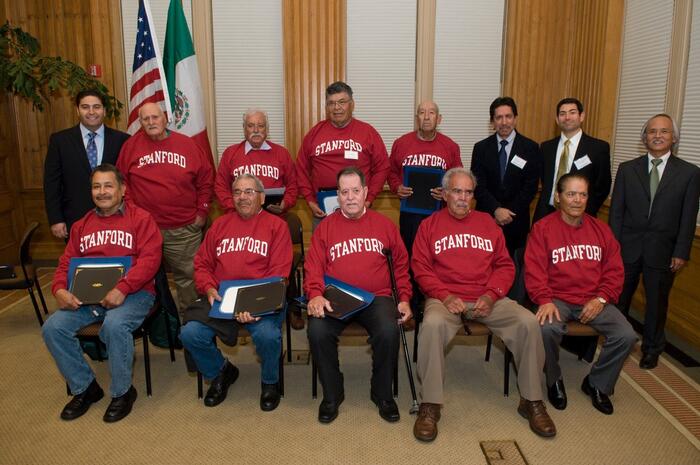
On February 26, 2014, ten former braceros and their families were invited to an event at Encina Hall at Stanford. The invitees included Rafael Silva and Eva Silva Ruelas. Former FSI Director Mariano Florentino Cuellar, who is currently a California Supreme Court Justice, spoke along with Stanford Biology Professor Rodolfo Dirzo and me. SPICE Director Gary Mukai moderated the event and spoke about his youth as a farm laborer working with braceros. The evening was historic in that it was one of only a few times that former agricultural workers were recognized at a university. In the photo, I am standing next to my abuelito, José Guadalupe Rodriguez Fonseca, top left. Isa’s abuelito, Rafael Silva, is in the front center.
Image

What else stood out that evening was the Silva grandchildren’s palpable love for their grandparents. One photo of the evening captures the Silva family legacy. Rafael (wearing a Stanford sweatshirt) and Eva Silva are in the middle with six of their children and numerous grandchildren surrounding them. Isa is standing in front of his grandfather. Three of their grandchildren are currently attending Stanford, with Isa soon to become the fourth. Reminiscing about the event, Isa noted, “I was a ten-year-old boy. It was cool to see the whole family get together and be there. We were there to support my abuelito and recognize all his hard work. It was great to see him honored for what he did so long ago. As we grow older, we appreciate him more and more.” Isa knows that his abuelito and abuelita’s journey is what transformed the Silva family and made his own American dream possible. Reflecting that pride in his family’s story, Isa closed our conversation by saying, “On and off the court, I will always represent being Mexican American.”
Read More


Hero Image

Isa Silva and his family; photo courtesy Karen Hickey/Stanford Athletics
All News button
1
Subtitle
Isa Silva, grandson of a bracero from Jalisco, will enter Stanford next fall as a recruit for the Stanford Men’s Basketball team.
Journey into the World of Entrepreneurship: Stanford e-Hiroshima Guest Speakers, Risa Ishii and Takaho Iwasaki
News Type
Blogs
Date
Paragraphs
Launched in fall 2019, Stanford e-Hiroshima is offered by the Stanford Program on International and Cross-Cultural Education (SPICE) in collaboration with the Hiroshima Prefectural Board of Education.
When asked in a 2013 interview with the Stanford Graduate School of Business about the impact he would like to have on the world, Hiroshima Governor Hidehiko Yuzaki (MBA, ’95) stated, “In my current capacity as governor I would like to create social and economic systems that would continuously create innovation and entrepreneurship. This will enhance our ability to create sustainability, wealth, security, and safety.” Six years later during the California-Japan Governor’s Symposium at Stanford, Yuzaki again spoke about his desired impact specifically in the context of Hiroshima–Silicon Valley relations. To achieve this, Yuzaki knew that a global mindset in students in Hiroshima would need to be cultivated, and with his vision, Stanford e-Hiroshima was launched in fall 2019.
With the cultivation of a global mindset as an objective, Stanford e-Hiroshima Instructor Rylan Sekiguchi invited two young Japanese entrepreneurs in the United States to speak as part of the 2020–21 course. The first speaker was Risa Ishii, Senior Partnerships Manager at Plug and Play Tech Center, a company in Silicon Valley that fosters innovation and supports entrepreneurs from around the world. The second speaker was Takaho Iwasaki, Founder and CEO of MajiConnection, a company in Honolulu, Hawaii, that aims to support entrepreneurs, innovators, and businesses in Japan and Hawaii in building relationships with each other.
Ishii’s talk was called “What I’ve Seen in Silicon Valley: Its Special Ecosystem and What We Can Learn from It.” She was born in Shizuoka Prefecture and graduated from high school in the United States and from Waseda University in Tokyo. Ishii spoke about the uniqueness of the Silicon Valley ecosystem and underscored the diversity of its workforce and critical availability of venture capital. In referencing the “Silicon Valley mindset,” she advised, “Don’t think that you are too young or that you do not know enough to do anything. Just act and see what happens. It’s okay to fail … and be open to adjusting.” Concerning Plug and Play, she noted that it aims to reform the corporate mindset to promote collaboration with startups. A chart that surprised the students was one which showed that in the 1990s, Japanese companies accounted for eight of the ten largest in the world; today, no Japanese companies remain in the top ten. Given this, she stressed that Japan needs to encourage study abroad opportunities and to welcome more students to Japan as a way to attract global talent. Ishii closed by stressing that students need to “think of how each one of us can contribute to the society and look into unique opportunities in areas that Japan has strengths, like disaster management and prevention and caring for the elderly.”
Iwasaki’s talk was called “Why I Am Supporting Startups in Hawaii.” Iwasaki was born in New York and raised in Kagoshima Prefecture, Japan. She studied at International Christian University in Tokyo and also received an MBA from the University of Hawaii, Manoa. She interned at Plug and Play where she met Ishii. While in Silicon Valley, she decided that she wanted to help small- and medium-sized enterprises (SMEs) in rural areas and strongly believed she could do this in Hawaii. She founded MajiConnection in 2019 and her first event was “Island Innovation Demo Day,” a pitch event during which Hawaii-based startups pitched ideas to Japanese investors and companies. The event inspired Hawaii startups to go to Japan and Japanese companies to come to Hawaii. “A lot of people never believed that I could make it successful because Hawaii had never been a business place for Japanese SMEs,” commented Iwasaki. Despite this, she succeeded by cultivating a global mindset among SMEs in Hawaii and Japan. She also noted the conducive environment in Hawaii for doing business with Japan (e.g., manageable time difference, managing the relatively low language barrier, and strong Asian cultural influences). She closed by noting, “I strongly believe that if Hawaii and Japan work together on common problems, we can tackle a lot of real problems that cannot be solved by ‘continental startups’ [those on the U.S. mainland] in areas like high-cost and non-sustainable energy, marine debris and plastic waste, agriculture and food self-sufficiency problem, and tourist-based economies.”
Iwasaki’s comments prompted a student to remark on a challenge that places like Hiroshima and Hawaii face with young people moving to larger metropolitan areas like Tokyo and on the U.S. mainland, respectively. Iwasaki commented that indeed many young people in Hawaii seek higher education and more diverse types of employment on the U.S. mainland. That said, she noted that during the COVID-19 pandemic, many people have returned to Hawaii because of the lower rates of COVID-19. She noted that this trend may happen in Japan as well because of the high costs of living in big cities like Tokyo and the increased reliance on and acceptance of telecommuting in the workplace.
Another student piggybacked on this point in asking about students moving from Hiroshima to bigger cities like Tokyo for higher education and Ishii’s concern about the decline of Japanese students going abroad to study. The student pointed out the financial burden of living abroad in the United States. Ishii noted that the Japanese government realizes that Japan needs to send more people abroad and encouraged students to look into scholarships and fellowships that are available in Japan, like Tobitate, the Yanai Tadashi Foundation’s International Scholarship Program, and those offered by universities in the United States.
Keeping in mind the geographic similarities of Hawaii and Japan as islands, one student pointed out the relationship between the UN Sustainable Development Goals and companies in Hiroshima and asked how companies in Silicon Valley and Hawaii are helping to reach the SDGs. Ishii pointed out efforts on the part of companies like Google and Tesla that are trying to go carbon neutral. Iwasaki noted that transporting oil to Hawaii is very expensive and this has prompted many people to consider the importance of sustainable energy.
After reflecting upon the comments by Iwasaki and Ishii, Hiroshima Board of Education Superintendent Rie Hirakawa added, “I hope that all students—and especially girls—are inspired by young women entrepreneurs like Takaho Iwasaki and Risa Ishii. I am just one of two female prefectural superintendents in Japan and hope that Japan’s new global mindset will underscore the importance of diversity, including more opportunities for women.” Yuzaki agrees and in the 2013 interview noted, “I believe diversity is very important in an organization.” To this point, Ishii reflected, “As a girl who grew up in a rural area, I understand the importance of filling in regional gaps in terms of education, not only domestically but also internationally. I was able to feel the positive energy through my monitor from the students of Stanford e-Hiroshima and I hope that they will continue to drive themselves to create changes in society.” Iwasaki echoed Ishii’s sentiments and added, “I really enjoyed teaching and talking with the students of Stanford e-Hiroshima and was very impressed by how passionate they are to study and try to contribute to their community. I hope we can continue this program for those students and would like to be part of it again.”
SPICE is grateful to Hiroshima Governor Hidehiko Yuzaki whose vision made this course possible and to Superintendent Rie Hirakawa of the Hiroshima Prefectural Board of Education for her leadership. SPICE also extends its appreciation to Teacher Consultant Rika Ryuoh for her unwavering support of Stanford e-Hiroshima.
Read More


Hero Image

Risa Ishii and Takaho Iwasaki; photos courtesy Risa Ishii and Takaho Iwasaki
All News button
1
Subtitle
Stanford e-Hiroshima is an online course for high school students in Hiroshima Prefecture, Japan, that is sponsored by the Hiroshima Prefectural Government.


