Education
News Type
News
Date
Paragraphs

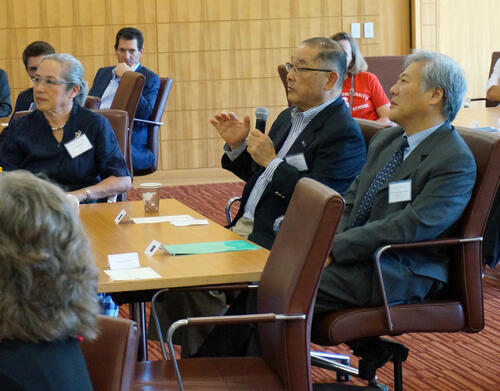
At the request of the Silicon Valley Innovation Center, the SPICE staff was invited on December 5, 2014 to give an overview of its work to a group of 20 educators from Kazakhstan. The educators are counseling specialists and school administrators from Nazarbayev Intellectual Schools (NIS). The NIS is a network of schools for exceptional students of ages 12 to 18 throughout Kazakhstan. The primary purpose of the visit to Stanford University and also to U.C. Berkeley was to learn more about the admission process to competitive universities in the United States.

After opening comments by Dr. Gary Mukai, Jonas Edman introduced SPICE’s curriculum development process and described two SPICE curriculum units that are historically- and culturally-relevant to Kazakhstan. They are called The Mongol Empire and Islamic Civilization and the Arts. Both topics are required in many world history courses taught at public secondary schools in the United States. Jonas’ talk inspired discussions about how curriculum materials on topics such as world religions can help to raise levels of cultural sensitivity not only among students but also among educators, including counseling specialists who need to be aware of the cultural diversity represented among students.  

Naomi Funahashi described SPICE’s distance-learning programs on Japan and Korea for high school students in the United States. Her presentation was interspersed with energetic discussions about the possibility of engaging students from NIS with SPICE’s distance-learning programs. The possibility of developing a SPICE distance-learning course for NIS was met with enthusiasm. The proposed course could introduce NIS students to U.S. society and culture as a way to help prepare them for college life in the United States and to also encourage students to someday pursue careers in U.S.–Kazakhstan relations.  

Johanna Wee shared SPICE’s web-based resources and illustrated components of a curriculum unit, Along the Silk Road, that are available on SPICE’s website and are also historically and culturally important to the people in Kazakhstan. One of the NIS educators said that he was grateful to SPICE for its work on the Silk Road and for introducing the Silk Road’s cultural significance—in particular, important cities along the historic Silk Road located in Kazakhstan—to young students in the United States.

Gary spoke about SPICE’s collaboration with Stanford’s Center for Russian, East European and Eurasian Studies (CREEES) and also SPICE’s teacher professional development initiatives with independent schools abroad that are affiliated with the European Council of International Schools (ECIS) and the East Asia Regional Council of Independent Schools (EARCOS). Gary recommended that the educators explore the CREEES website to learn about the ways Stanford is promoting the study of and research on the Central Asian Republics.

In her closing comments, Dr. Almagul Kanagatova, a director of the NIS Astana campus, expressed how rewarding it was to be on the Stanford campus and how she feels that students at NIS are ready to take on the challenge of studying at top universities like U.C. Berkeley and Stanford. An invitation was extended to SPICE to participate in an NIS-led teacher conference in Astana in October 2015. If participation in the October 2015 teacher conference becomes a reality, it will be the first time in SPICE’s nearly 40-year history that SPICE would formally collaborate with a school in one of the Central Asian Republics. 

Hero Image
kazakh educators 12 5 14
All News button
1
-

In an effort to infuse Asian studies in the social studies and literature curricula, the Stanford Program on International and Cross-Cultural Education (SPICE), in cooperation with the National Consortium for Teaching About Asia (NCTA), is offering a professional development opportunity at Stanford University.

This all day workshop will focus on teaching about issues Asian American face in contemporary society. This is the fourth workshop in a four part series.

Encina Basement Conf. Room, Encina Hall
616 Serra Street
Stanford, CA 94305

Seminars
-

In an effort to infuse Asian studies in the social studies and literature curricula, the Stanford Program on International and Cross-Cultural Education (SPICE), in cooperation with the National Consortium for Teaching About Asia (NCTA), is offering a professional development opportunity at Stanford University.

This all day workshop will focus on teaching about Korea in the social studies classroom. Participants will hear from top Korea scholars, engage in Korea related curriculum, and network with other local teachers.  This is the third workshop in a four part series.

Encina Basement Conf. Room, Encina Hall
616 serra Street 
Stanford, CA 94305

Seminars
-

In an effort to infuse Asian studies in the social studies and literature curricula, the Stanford Program on International and Cross-Cultural Education (SPICE), in cooperation with the National Consortium for Teaching About Asia (NCTA), is offering a professional development opportunity at Stanford University.

This all day workshop will focus on teaching about Japan in the social studies classroom. Participants will hear from top Japan scholars, engage in Japan related curriculum, and network with other local teachers.  This is the second workshop in a four part series.

During the course of the day, participants will examine the factors that lead to WWII and Japan's role pre and post war.

Encina Basement Conf. Room, Encina Hall
616 Serra Street
Stanford, CA 94305

Seminars
-

In an effort to infuse Asian studies in the social studies and literature curricula, the Stanford Program on International and Cross-Cultural Education (SPICE), in cooperation with the National Consortium for Teaching About Asia (NCTA), is offering a professional development opportunity at Stanford University.

This all day workshop will focus on teaching about contemporary China in the social studies classroom. Participants will hear from top China scholars, engage in China related curriculum, and network with other local teachers.  This is the first workshop in a four part series.

During the course of the day, participants will learn about the challenges China faces, including their geopolitical, cultural, military, and economic significance. 


Encina Hall, Ground Floor Conf. Room
616 Serra Street
Stanford, CA 94305

Seminars
Authors
Naomi Funahashi
News Type
News
Date
Paragraphs

“What do you think about the financial feasibility of building a shinkansen in California?”

“Should the U.S. have relied only on economic sanctions against Japan leading up to Pearl Harbor, or should it have done something on the military front and not relied solely on the economic instrument?”

“If the tsunami had not caused the nuclear meltdown in Fukushima, or if the nuclear meltdown had been contained at a much lower level, would the ‘nuclear village’ in Japan even be a problem in Japan?” 
 

Three outstanding high school scholars—all honorees of the 2014 Reischauer Scholars Program (RSP)—expertly responded to these challenging questions posed by some of the leading scholars in the field of Japan studies at Stanford University. The Stanford Program on International and Cross-Cultural Education (SPICE) honored Roma Forest (San Luis Obispo, CA), Jonathan Klein (Los Angeles, CA), and John McHugh (Winnetka, IL) at a Japan Day event on August 7, 2014 that was highlighted by presentations based on their RSP research essays on an intriguing range of Japan-related topics: lessons from Japan’s shinkansen for California’s high speed rail project; a critical analysis of U.S. economic policy leading up to Japan’s attack on Pearl Harbor; and Japan’s nuclear energy policies in post-Fukushima Japan. 

Japan Day featured thoughtful and encouraging opening remarks by Consul General Masato Watanabe, Consulate General of Japan in San Francisco, as he shared his reflections on the role of youth in the bilateral relationship between Japan and the United States. “The RSP offers young people an opportunity not only to learn about another country, but to think critically from multiple perspectives,” he noted. “In doing so, this program plays a vital role in training future leaders in the U.S.–Japan field. Your successful completion of this program is not the end, but just the beginning of your journey. 

Naomi Funahashi, RSP Manager and Instructor, gave an overview of the RSP to members of the Stanford community, family members of the honorees, and others who are involved in U.S.–Japan relations. Named in honor of former U.S. Ambassador to Japan Edwin O. Reischauer, a leading educator and noted scholar of Japanese history and culture, the RSP annually selects 25–30 talented sophomores, juniors, and seniors from throughout the United States to engage in an intensive study of Japan. Entering its twelfth year in 2015, the RSP presents an innovative approach to engaging high school students in the online study of Japan and U.S.–Japan relations. Prominent scholars affiliated with Stanford University, the University of Tokyo, the University of Hawaii, and other institutions provide lectures and engage students in online dialogue, and students develop a community of peers with a shared interest in Japan. The 2015 RSP will feature comments by Ambassadors Caroline Kennedy and Kenichiro Sasae.


danandcg
Professor Emeritus Daniel Okimoto poses a question following a research presentation by one of the student honorees.

Dr. Rie Kijima, the interim instructor of the 2014 RSP, also gave an insightful presentation on the findings of an RSP alumni tracer study that was conducted in 2013 to commemorate the tenth anniversary of the program. The study reflected the significant and lasting impact of the RSP upon its alumni, with 81 percent of the respondents noting that the RSP helped them to think critically and to become better scholars, and that it ignited added interest to conduct further research on Japan. Dr. Kijima also noted that the study showed that RSP participation positively impacted high school students’ academic records, strengthened students’ desire to learn more about Japan and about Asia, and provided a unique opportunity for inquisitive learners to pursue their academic interests.


Following Japan Day, Jonathan, John, and Roma offered reflections upon their experiences in the RSP. “The RSP provided an opportunity to interact with outstanding students from around the country in an intense and interactive online environment,” remarked Jonathan Klein. “I felt very lucky to have weekly lectures by the exact scholars that write the books we read for assignments, and who are the very people that research and write papers on issues in modern day Japan.” John McHugh was also struck by the direct access to top scholars in the Japan studies field, commenting that he “actually sat next to a researcher from Stanford whose work I had used in my paper!” The challenging nature of the RSP coursework appealed to Roma, who observed, “I’m so glad to have participated in such a rigorous program with highly motivated peers and I look forward to seeing how RSP affects our lives and career choices.”

The distinguished RSP advisory committee members are Consul General Watanabe; Professor Emeritus Nisuke Ando, Doshisha University; and Ambassador Michael Armacost, Professor Phillip Lipscy (principal investigator), Dr. Gary Mukai, and Professor Emeritus Daniel Okimoto of Stanford University.

The RSP received funding for the first three years (2004–06) of the program from the United States-Japan Foundation. The program is currently funded by a grant from the Center for Global Partnership, the Japan Foundation, and the Freeman Spogli Institute for International Studies at Stanford University.

The RSP will be accepting applications for the 2015 program in September and October 2014. For more information about the RSP, visit www.reischauerscholars.org or contact Naomi Funahashi, RSP Manager and Instructor, at nfunahashi@stanford.edu.

Hero Image
danandcg
Professor Emeritus Daniel Okimoto poses a question following a research presentation by one of the student honorees.
Rylan Sekiguchi
All News button
1
Authors
News Type
News
Date
Paragraphs

On July 30, 2014, three anxious but very poised high school students from the Sejong Korean Scholars Program (SKSP)—an online course on Korea sponsored by the Stanford Program on International and Cross-Cultural Education (SPICE) and the Shorenstein Asia-Pacific Research Center—took the stage to present their final papers to an audience of 25 American and Korean high school teachers and several university professors at a three-day conference on Korea at Stanford University. 

The students—Alex Boylston, a recent graduate of Riverwood International Charter School in Atlanta, GA; Anne Kim, a rising senior at Richard Montgomery High School in Rockville, MD; and Elaine Lee, a rising senior at Los Altos High School in Los Altos, CA—were selected from a class of 26 students, based on the excellence of their academic work and final course papers. 

When asked how he came to choose his topic on Koreans in Japan’s yakuza, Alex Boylston thoughtfully replied that he had thought “outside the box” because he didn’t want his instructor “to have to read 20 essays on the Korean War.” Taking a different tack, Anne Kim turned her personal interest in historical Korean dramas (“sageuk”) into the topic for her final paper, “Let’s Talk Drama: Sageuk as a Reflector and Perpetrator of Societal Change in South Korea.” Closing out the presentations, Elaine Lee stepped up to the podium and discussed the challenges South Korea faces as a global economic power, leaving no doubt she will achieve her goal of participating in the future of U.S.–South Korean relations. All three were honored with an award for excellence, following their presentations.

The SKSP accepts 20-25 exceptional high school students from throughout the United States for each course offering. The course provides students with a broad overview of Korean history and culture as well as U.S.–Korean relations and an opportunity to learn from and interact with top scholars and experts in Korean studies. The SKSP is now accepting applications for its spring 2015 term; www.sejongscholars.org.

Hero Image
2014 Sejong Scholars Honorees
Left to right: Anne Kim, Alex Boylston, Annie Lim (SKSP instructor), and Elaine Lee
All News button
1
-

The third annual Hana-Stanford Conference on Korea for U.S. Secondary School Teachers takes place this summer, from July 28 to 30, at Stanford. It will bring together secondary school educators from across the United States as well as a cadre of educators from Korea for intensive and lively sessions on a wide assortment of Korean studies-related topics ranging from U.S.-Korea relations to history, and religion to popular culture. In addition to scholarly lectures, the teachers will take part in curriculum workshops and receive numerous classroom resources developed by Stanford Program on International and Cross-Cultural Education (SPICE).

During the conference, the Sejong Korean Scholars Program (SKSP), a distance-learning program on Korea, will also honor high school students for their exceptional performance in the SKSP program. The finalists will be chosen based on their final research papers, and their overall participation and performance in the online course. The SKSP honorees will be presenting their research essays at the conference. The SKSP program is generously supported by the Korea Foundation

For details of the application procedures for the teachers, please visit the SPICE website.

A video clip from the conference held in 2013 is available.

Paul Brest Hall West
555 Salvaterra Walk
Stanford University

Conferences
0
carey_moncaster.jpeg MA

Carey Moncaster is the instructional designer and manager of the Stanford e-China Program. She launched the program as instructor for the inaugural course, Technologies Changing the World: Design Thinking into Action, and now designs and manages Climate Tech Innovation and U.S.-China Collaboration and Design Thinking into Action: Teen Well-being. She is also co-instructor for the U.S.–China Co-Lab on Climate Solutions, which brings together students from both the United States and China in one classroom.

She has worked as a curriculum consultant for the Stanford Program on International and Cross-Cultural Education (SPICE) on additional projects, including co-authoring curriculum units:

Sustainable Development and Modern China
Understanding China in the 21st Century

Carey worked in Seattle’s high tech world of start-up ventures, collaborating with Silicon Valley entrepreneurs and industry professionals. Prior, Carey founded and served as Executive Director of Pacific Village Institute for ten years, with programs based in China, India, Vietnam, New York, and Seattle, working with educational leaders and organizations to develop and implement global education programs in Asia and the U.S. for students and educators from over 100 public and independent high schools.

Carey lived in China off and on from the early 1990s though 2006 working at Nanjing and Zhejiang Universities, as well as with environmental NGOs in Beijing and Yunnan Province with a focus on water and energy issues. She received her M.A. from Stanford University with a focus on modern China, and a B.A. from UC Berkeley. Carey was selected by the Asia Society as a U.S. delegate to join the Asia21 Global Leadership Forum and cohort. 

Instructional Designer and Manager, Stanford e-China
Date Label
-

The Stanford Korean Studies Program (KSP) and the Stanford Program on International and Cross-Cultural Education (SPICE), with support from Hana Financial Group, are offering a very exciting and intensive professional development opportunity for secondary school teachers: The Hana–Stanford Conference on Korea for U.S. Secondary School Teachers. This three-day summer conference will feature scholarly lectures and curricular presentations on topics such as Korean history, North Korea, inter-Korean relations, politics, economics, culture, and U.S.–Korean relations. We hope to bring together educators who are interested in incorporating Korean studies into their curricula and to provide a venue for them to learn and exchange ideas.

All conference meals and registration costs will be covered by the conference. For those who reside more than 50 miles from Stanford University, shared hotel accommodations and reasonable airfare expenses will be covered. Each teacher will be given a $300 stipend to cover incidental expenses and also receive an excellent selection of books and complimentary teaching materials about Korea. In addition, teachers can earn an optional 2 units of credit from Stanford Continuing Studies.

Space is limited to 30 teachers from secondary schools throughout the United States. Teachers from out of town are encouraged to arrive on July 27, 2014. To apply to attend the conference, please fill out the Applicant Registration Form and return it to the address below by February 7, 2014. We will notify you once your applicant registration form has been reviewed by the selection committee. 

For more information, please contact Sabrina Ishimatsu at sishi@stanford.edu.

Paul Brest Hall West
555 Salvatierra Walk
Stanford University

Conferences
Subscribe to Education