


Secretary Norman Mineta and His Contributions to SPICE
News Type
Blogs
Date
Paragraphs
As a young student in San Jose in the 1960s and early 1970s, I used to see Norman Mineta on occasion in San Jose’s Japantown. Once at Jackson Barber Shop in Japantown, Norm was on the barber chair. After he left, barbers Takeo and Atsuo Fukuda asked me if I knew who he was. I didn’t, and Takeo told me that he was Norman Mineta, vice mayor of San Jose. That was the first time that I sat next to him, and the last time (photo above) was on September 20, 2019, just a few months prior to the pandemic.
Since that day at Jackson Barber Shop, I recognized Norm whenever I saw him in Japantown, in the San Jose Mercury News, and in the national news. Whenever I met with him as mayor, congressman, or secretary, I was struck by how he remembered members of my family in San Jose. His capacity for empathy is something that I have admired since my youth and aspire to in my adulthood. Norm’s passing on May 3, 2022 prompted me to recall our work together on several education-focused projects that were deeply personal to him and to me.
Norm’s life story—including his family’s incarceration in Heart Mountain Relocation Center by the U.S. government during World War II—is eloquently captured in the remembrance, “Remembering Mineta as unselfish American,” which was written by Daniel Okimoto, Professor Emeritus, Stanford University. Norm’s life is also brilliantly captured in the film, Norman Mineta and His Legacy: An American Story, by Dianne Fukami and Debra Nakatomi, Mineta Legacy Project. According to Fukami and Nakatomi, the film is about injustice and redemption, and Norm’s burning desire for all people to be treated equally. That desire was influenced greatly by his childhood incarceration experience. I often heard Norm talk about the anguish and heartbreak he felt as a 10-year-old when his family was taken from their San Jose home in 1942 and he was forced to leave behind his dog, Skippy.
In the early 2000s, I consulted with him about SPICE’s curricular work on a comprehensive curriculum unit that focused on the incarceration of Japanese Americans during World War II and a teacher’s guide for the film, Uncommon Courage: Patriotism and Civil Liberties, directed by gayle yamada. The curriculum helps to raise public awareness concerning the history and the lessons of civil rights violations or civil liberties injustices experienced by certain communities—something that Norm experienced first-hand as a child. The teacher’s guide helps teachers to set the context for and to debrief the viewing of the film that tells the story of the Military Intelligence Service (MIS) during World War II and the Allied Occupation of Japan. Approximately 6,000 MIS soldiers, primarily Japanese American, fought for the United States in the Pacific, interrogating Japanese prisoners, translating documents, intercepting communications, and infiltrating enemy lines. Many of the soldiers volunteered from the incarceration camps. While developing the guide, I spoke to Norm about many of the MIS soldiers whom he knew and also about his experiences as an intelligence officer in Japan and Korea in the 1950s.
When I was a board member of the National Japanese American Memorial Foundation, Norm (as one of the founding members of the Memorial) supported the development of educational resources on the Memorial in Washington, DC, which I developed back in the early 2000s with Kerry Yo Nakagawa, Director, Nisei Baseball Research Project. Norm’s quote is inscribed on one of the walls of the Memorial. It reads,
May this memorial be a tribute to the indomitable spirit of a citizenry in World War II who remained steadfast in their faith in our democratic system.
Image
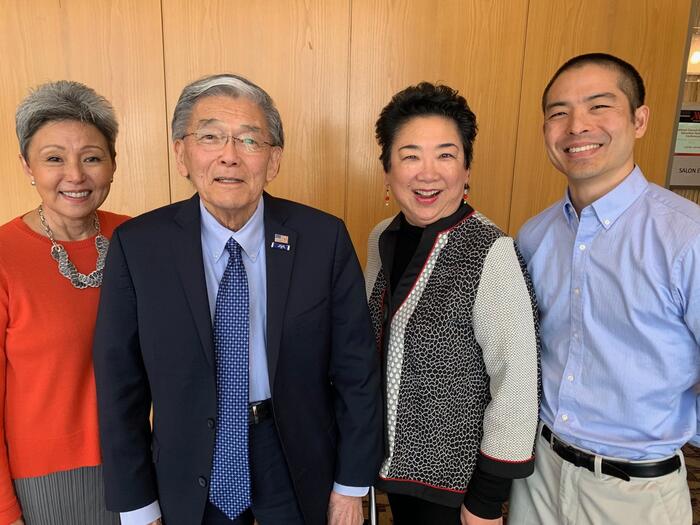
In addition, my colleague, Rylan Sekiguchi, and I had the honor of working in collaboration with the Mineta Legacy Project—specifically with Norm, Dianne Fukami, Debra Nakatomi, and Amy Watanabe—on the development of a comprehensive web-based curriculum called “What Does It Mean to Be an American?” Inspired by the life and career of Norm, the six themed lessons are: Immigration, Civil Liberties & Equity, Civic Engagement, Justice & Reconciliation, Leadership, and U.S.–Japan Relations. Norm also joined Sekiguchi and members of the Mineta Legacy Project in introducing the curriculum at several venues, including the U.S.-Japan Council annual conference in Tokyo (November 2018); National Council of History Education conference in Washington, DC (March 2019); Ronald Reagan Presidential Library in Simi Valley, California (April 2019); and the National Council for the Social Studies annual conference in Austin, Texas (November 2019). Note: The photo above was taken at the National Council of History Education conference, Washington, DC; Secretary Norman Mineta with Nakatomi (left) and Fukami (right) and Sekiguchi.
Lastly, in spring of 2021, I was asked by Stanford’s Center for East Asian Studies for recommendations for a keynote speaker for the CEAS commencement. The first person who came to mind was Norm, and he accepted CEAS’s invitation. I will always remember his important words—that there are two things to always cherish and to hold dear to your heart no matter what the situation. These are your name and integrity.
Image
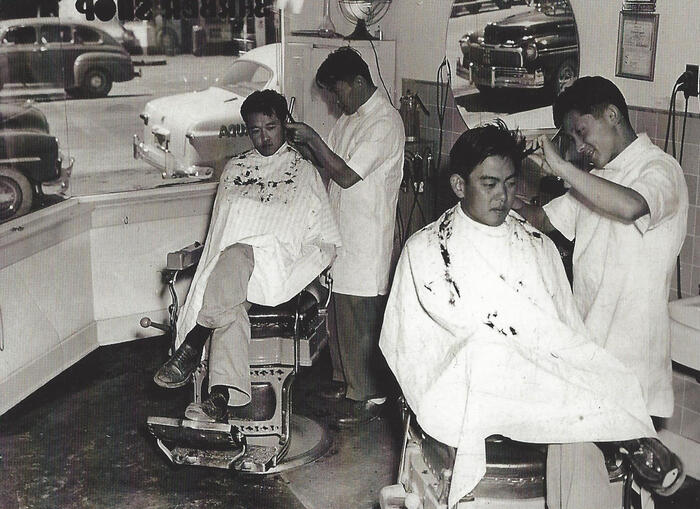
During the keynote address, my mind periodically drifted back to my first encounter with Norm at Jackson Barber Shop. Today, May 30, 2022, Memorial Day, I walked past the location of where Jackson Barber Shop once stood. I recalled the first time that I saw Norm and remembered Atsuo and Takeo, who are shown in the photo (1950s) above where Takeo (near the window) is cutting my father’s hair and Atsuo is cutting the hair of one of my father’s best friends. Takeo and Atsuo’s family was in the same block as my father and his family in Poston War Relocation Center in Arizona. Takeo used to cut my hair, and I remember talking with him about one of my relatives, Hachiro Mukai, who was drafted into the U.S. Army from Poston and was killed in action in France. Norm wanted Hachiro’s story (and others like it) to be transmitted to future generations. I will always remember that and his support of SPICE’s educational efforts over the years. Note: Photo of Jackson Barber Shop, courtesy Chiyo Fukuda.
At the COPANI XX conference in San Francisco, I shared the photo of Jackson Barber Shop with Norm and we shared not only some sadness about the bygone years of many Japantown businesses but also some laughter too, as he said that I still needed a haircut.
Read More


Hero Image

All News button
1
Subtitle
The late Secretary Mineta was unwavering in his commitment to SPICE’s efforts to educate students about civil liberties and equality.
Japan’s Top Envoy to the U.S. Discusses the State of Japan Studies in Higher Education with Stanford and UC Berkeley Experts
News Type
News
Date
Paragraphs
On March 22, 2022, APARC's Japan Program welcomed a delegation from the Embassy of Japan in the United States and the Consulate-General of Japan in San Francisco, including Ambassador Koji Tomita and Consul-General Hiroshi Kawamura, who met with a joint panel of scholars and administrators from Stanford and the University of California, Berkeley for a discussion about fostering a greater understanding of Japan studies in the United States.
APARC Deputy Director and Japan Program Director Kiyoteru Tsutsui presented data on enrollment and employment statistics for Japanese studies in higher education. According to the report, Japanese studies have been in a slow state of decline since the late 1980s, when many in the United States viewed Japan as an economic threat and the country was not as well-understood as it is today. Despite this decline, students today are still very interested in studying Japan and are eager to visit the country.
Naomi Funahashi, Manager of the Reischauer Scholars Program and Teacher Professional Development at the Stanford Program on International and Cross-Cultural Education (SPICE), presented outcomes from SPICE's outreach efforts and promotion of Japanese studies in the K-14 context. Funahashi indicated strong interest in and engagement with SPICE curricular units focused on Japan and with its local student programs in six regions, one university, and two high schools in Japan.
Sign up for APARC newsletters to receive our experts' analysis and commentary.
Ambassador Tomita

Professor Kiyoteru Tsutsui

Consul-General Kawamura

Junko Habu

The delegation discusses Japan studies in the U.S.


Professor Junko Habu, Chair of the Center for Japanese Studies (CJS) and Professor of Anthropology at UC Berkeley, along with Kumi Sawada Hadler, Program Director of CJS, described logistical challenges Japan scholars have faced during the COVID-19 pandemic, including the inability to access the country under lockdown, and indicated that, across the board, universities are not providing as much support for Japanese studies as they used to, especially in terms of endowed faculty positions and departmental "slots" specifically for Japan specialists.
Ambassador Tomita and Consul-General Kawamura agreed that more support was needed to bolster scholarships of Japan. Ambassador Tomita stated that over his long career, he has seen the theoretical focus of Japan studies in the United States shift away from bilateral relations between the two countries toward the region at large. He noted that the public discussion is increasingly directed at Japan as part of a broader complex of nations in East Asia. Consul-General Kawamura indicated that the pandemic has posed a host of challenges for his office but that Japan will continue to open its doors to scholars in the future.
The meeting concluded with a reaffirmation of the longstanding and crucial relationship between the two nations and of the importance of Japan studies in the United States in fostering fruitful collaboration between the two nations.
Read More
Hero Image

All News button
1
Subtitle
At an in-person meeting of a joint delegation from Japan's Embassy to the United States and Consulate-General of Japan in San Francisco with a panel of experts from Stanford and UC Berkeley, Japanese Ambassador Koji Tomita stressed the importance of bilateral academic collaboration in the continual development of the U.S.-Japan partnership.


Virtual Workshop for Community College Instructors Will Explore Cyber Threat Across the U.S. Nuclear Enterprise
News Type
News
Date
Paragraphs
SPICE and Stanford Global Studies are pleased to announce an upcoming Education Partnership for Internationalizing Curriculum (EPIC) workshop for community college instructors that will feature a talk by Dr. Herbert Lin on his latest book, Cyber Threats and Nuclear Weapons. This free virtual workshop will take place on Tuesday, January 25, 4:00pm–6:00pm (Pacific Time). All attendees will receive a copy of Dr. Lin’s book after the workshop. Please see the workshop description below for more information as well as the registration link.
The Stanford Program on International and Cross-Cultural Education (SPICE) and Stanford Global Studies (SGS) are continuing their partnership to offer engaging professional development opportunities for community college instructors who wish to internationalize their curriculum. This two-hour workshop is presented by SPICE and SGS as part of the Education Partnership for Internationalizing Curriculum (EPIC) and is supported by Department of Education Title VI funding.
This workshop will feature a talk by Dr. Herbert Lin on his latest book, Cyber Threats and Nuclear Weapons. Participants will have the opportunity to ask questions and discuss with Dr. Lin the cyber threat across the U.S. nuclear enterprise.
As noted by Stanford University Press, the publisher of Cyber Threats and Nuclear Weapons, “The technology controlling United States nuclear weapons predates the Internet. Updating the technology for the digital era is necessary, but it comes with the risk that anything digital can be hacked. Moreover, using new systems for both nuclear and non-nuclear operations will lead to levels of nuclear risk hardly imagined before. This book is the first to confront these risks comprehensively.” (https://www.sup.org/books/title/?id=34611)
Dr. Herbert Lin is Senior Research Scholar at the Center for International Security and Cooperation, FSI, and Hank J. Holland Fellow in Cyber Policy and Security, Hoover Institution.
Please register here at your earliest convenience and before January 21, 2022.
Read More


Hero Image

All News button
1
Subtitle
SPICE and Stanford Global Studies will offer a free virtual workshop with Dr. Herbert Lin on January 25th, 4:00pm–6:00pm.
Growing Up Navajo
News Type
Blogs
Date
Paragraphs
SPICE has been working with the Navajo Nation for ten years. SPICE featured Dr. Harold Begay in a webinar called “Indigenous Voices: Educational Perspectives from Navajo, Native Hawaiian, and Ainu Scholars in the Diaspora” on June 18, 2021. On the occasion of National Native American Heritage Day, November 26, 2021, SPICE invited him to share reflections on his life.
The Journey from a Community Trash Dump Scavenger to U.C. Berkeley
There was a youngster, a scavenger at an early age who had to rummage through the community trash dump for winter firewood and other discarded household items. This youngster from a single-parent home living on a traditional livestock economy on the Navajo Reservation, speaking only his Navajo language, entered school in his elementary school years and was able to attain nationally normed test scores on the Iowa Test of Basic Skills in the upper 80s and 90s. He initially spent his kindergarten and first grade years as a student running away along with other local school kids from a U.S. government boarding school. He was transferred to the local state public school, and beginning in second grade, his homeroom teacher stayed with him grade-to-grade (looping) through his high school years. He dropped out of high school but came back, graduated, and was recommended by an Arizona State Senator, as required for admission, and by his high school teachers, counselors, and principal, to attend the U.S. Air Force Academy in Colorado Springs, Colorado. He instead enrolled at Arizona State University with “Honors at Entrance.” He dropped out of pre-med, enlisted in the U.S. Marine Corps, and spent time in the Vietnam War before being medevacked out of Vietnam during the Tet Offensive in 1968. He spent some four weeks in the Naval Hospital in Guam, another month in the Naval Hospital in San Diego, and was honorably discharged from the U.S. Marine Corps Recruit Depot Casualty Company and is a disabled veteran.
After Vietnam and work in construction as an iron worker, he returned to college, graduated in three years with a B.A. in psychology and earned an M.A. in counseling the following year from Northern Arizona University. He then earned a Ph.D. in school finance and education administration from the University of Arizona.
He began work at the University of Arizona for four years, then moved out to the most disenfranchised under-resourced rural school sites—school sites with the most persistent student academic underachievement state-wide. He began the local community college branch, then Navajo Community College, now Diné College, for his community and surrounding area wherein he taught for a couple years. He worked at the lowest achieving district with the second lowest per pupil wealth in the county. Within the past five years, in concert with Stanford University, his district high school exceeded all the eight school districts’ math achievement in the county, including the school district with the highest per pupil wealth.
He has been appointed as a Visiting Scholar at the University of California, Berkeley. He has published in refereed journals, and contributed chapters to two scholarly books. He has been honored by the Arizona State Department of Education with the “Certificate of Distinction Award” and “Stars of Arizona Education”; by the Arizona Gifted Education Association as “Gifted Administrator of the Year”; and by the North Central Association of Elementary and Secondary Schools with the “National Innovative Award.” He has turned down speaking engagements from several state education departments, school board organizations, and universities in countries including China, England, New Zealand, and Ecuador.
His school district has worked in collaboration with Stanford University for some 20 years and in the process has attained unprecedented academic achievement profiles for the school district. There is much more to this, but who is this person? The person is writing this brief bio for you so that you may get to know him a little better.
~Harold G. Begay, Ph.D.
Read More


Hero Image

All News button
1
Subtitle
Dr. Harold Begay, Navajo Nation Superintendent (Select) of Schools, Department of Diné Education, shares reflections on his life.
Stanford e-Japan Online Course Now Accepting Applications for Spring 2022
News Type
News
Date
Paragraphs
Applications opened recently for the Spring 2022 session of the Stanford University Scholars Program for Japanese High School Students (also known as “Stanford e-Japan”), which will run from mid-February through the end of June 2022. The deadline to apply is December 31, 2021.
Stanford e-Japan Program for high school students in Japan
Spring 2022 session (February to June 2022)
Application period: November 15 to December 31, 2021
All applications must be submitted at https://spicestanford.smapply.io/prog/stanford_e-japan/ via the SurveyMonkey Apply platform. Applicants and recommenders will need to create a SurveyMonkey Apply account to proceed. Students who are interested in applying to the online course are encouraged to begin their applications early.
Accepted applicants will engage in an intensive study of U.S. society and culture and U.S.–Japan relations. Ambassadors, top scholars, and experts from Stanford University and throughout the United States provide web-based lectures and engage students in live discussion sessions.
“Participating in Stanford e-Japan has been one of the highlights of my high school experience,” reflected Fall 2020 honoree Allison Lin. “Through the course, I gained the opportunity to learn from intelligent and experienced scholars which I wouldn’t have had otherwise and found myself aspiring to be like them in the future.”
Stanford e-Japan is offered by the Stanford Program on International and Cross-Cultural Education (SPICE), Stanford University. The Spring 2022 session of Stanford e-Japan is generously supported by the Yanai Tadashi Foundation, Tokyo, Japan.
For more information about Stanford e-Japan, please visit stanfordejapan.org.
To stay informed of news about Stanford e-Japan and SPICE’s other student programs, join our email list or follow us on Facebook, Instagram, and Twitter.
SPICE offers separate courses for U.S. high school students. For more information, please visit the Reischauer Scholars Program (on Japan), the Sejong Scholars Program (on Korea), and the China Scholars Program (on China).
Read More


Hero Image

All News button
1
Subtitle
Interested students must apply by December 31, 2021.
Teaching Diverse Perspectives on the Vietnam War
News Type
Blogs
Date
Paragraphs
On Veterans Day last week, I was reflective of my relatives and friends who are veterans of U.S. wars. My parents were migrant farmworkers and sharecroppers before and after World War II and several of my relatives are veterans of World War II. I also grew up as a farmworker, and most of my co-workers were migrant laborers from Mexico contracted through the Bracero Program. The Bracero Program was a 22-year initiative started in 1942 that allowed the United States to recruit temporary guest workers from Mexico. The laborers, called braceros, or individuals who work with their arms, were mostly concentrated in California. I attended school with many children of braceros.
Several of my classmates and family friends—including some children of my bracero co-workers—served in the Vietnam War, referred to by Vietnamese as the American War. A family friend, John Nishimura, died of wounds on April 4, 1968 sustained from hostile gunfire that left him as a quadriplegic on December 10, 1967 in the central highlands province of Kontum, Vietnam. Like other Asian Americans who served in Vietnam, he faced race-related challenges during his service. This topic is covered in the PBS series, Asian Americans, for which SPICE’s Waka Brown developed a teacher’s guide.
During my freshman year at U.C. Berkeley, 1972–73, I witnessed anti-Vietnam War protests and took a course in Chicano Studies (now Chicana/o and Latina/o Studies). Because of my childhood, I felt more Mexican than Japanese in many ways. In the Chicano Studies course, I recall a lecture on Chicano veterans of U.S. wars. The informal learning (observing the protests) and formal learning in Chicano Studies marked the first time in my life that I had been introduced to perspectives on the Vietnam War that were not included in my high school U.S. history textbook.
After graduating in 1976, I entered a teaching credential program at U.C. Berkeley’s Graduate School of Education that was called the Black-Asian-Chicano Urban Program or BAC-UP. One of the students was Charley Trujillo, a recent graduate of U.C Berkeley who majored in Chicano Studies. I felt a closeness to him because of my upbringing, and also recall how much I appreciated what we would now call “global perspectives” that he shared. We completed BAC-UP in 1977 and I went to teach in Japan and lost touch with him.
In 2014, while planning for a SPICE event that honored braceros with Dr. Ignacio Ornelas, the grandson of a bracero, Ornelas asked to introduce me to his friend, Charley Trujillo, and I immediately recalled Charley Trujillo from BAC-UP and wondered if he was the same person. I looked up his name online and was pleasantly surprised that he was the same person whom I had last seen 37 years prior. During our reunion, I learned from Trujillo that he had become a novelist, editor, publisher, and filmmaker. He is very well known for his book and documentary, Soldados: Chicanos in Viet Nam. While in BAC-UP, I didn’t know that he was a disabled Vietnam War veteran and that his father was a veteran of World War II. After hearing about his experiences in Vietnam, the global perspectives that he shared during BAC-UP became even more poignant. I also recalled how he sometimes challenged our professors—something that I could not do—on topics related to the “master narrative” of U.S. history.
Prior to my reunion with Trujillo, my former colleagues, Dr. Rennie Moon and Dr. Kenneth Koo, developed a SPICE curriculum unit, Legacies of the Vietnam War, which I encourage high school teachers to use as a supplement to the information about the Vietnam War in their U.S. history textbooks. The five lessons in the curriculum unit are described below. Someday, I would like to add Trujillo’s documentary as the foundation for a sixth lesson.
- Lesson One examines the political and economic aftermath of the Vietnam War. Students learn about the political situation following the war, Vietnamese emigrants known as the “boat people,” and post-war economic development.
- Lesson Two examines the impact of warfare on human health and the natural environment. Students learn about tools of warfare, including Agent Orange and landmines, and their harmful consequences on the ecosystem as well as on generations of civilians and veterans.
- Lesson Three combines a number of neglected and hidden themes in the Vietnamese war literature, including the experience of Vietnamese Amerasians and the involvement of non-U.S. soldiers who fought in Vietnam.
- Lesson Four gives voice to different categories of Vietnamese who have migrated abroad in the decades following the war: Vietnamese Americans, the Montagnards, and Vietnamese brides in Korea.
- Lesson Five investigates the idea of history as competing narratives. Students examine three representations of the Vietnam War—the war as depicted in American history textbooks, the war as exhibited at the War Remnants Museum in Ho Chi Minh City, and the war as represented in an effort to build a monument to the U.S.–South Vietnam alliance by the Vietnamese American community in Wichita, Kansas.
Trujillo and I are in periodic touch and he continues to expand my perspectives on the Vietnam War and its legacies by sharing his riveting and heartbreaking yet inspiring story. Most recently, we met at the San Jose Vietnam War Memorial. He is in the midst of producing a film based on his book, Dogs From Illusion, a Vietnam War novel on the Chicano war experience. Ornelas, a social studies (including ethnic studies) teacher at Willow Glen High School in San Jose, is currently enrolled in the Principal Leadership Institute at U.C. Berkeley’s Graduate School of Education. It’s very gratifying to know that Ornelas, Trujillo, and I share similar cultural histories that are not usually included in U.S. history textbooks at the high school level, and also share similar academic experiences that were only made possible by those who came before us. I am eternally grateful to Trujillo, Nishimura, and other veterans who sacrificed so much to make our lives better. I feel that it is essential for us as teachers to include their unique perspectives in the teaching of U.S. history.
Read More


Hero Image

All News button
1
Subtitle
On Veterans Day 2021, SPICE Director Gary Mukai reflects on some lesser-known stories of Vietnam War veterans.