616 Jane Stanford Way
Encina Hall, E005
Stanford, CA 94305-6060

0
img_8514.jpg PhD

Keikoh Ryu is an Advisory Committee Member for the Stanford e-China Program at SPICE. He was also a visiting scholar at the Shorenstein Asia-Pacific Research Center (APARC) from 2016–17. Dr. Ryu is the director of the Japan Society for Business Ethics and an affiliate professor at Beijing Normal University, Lanzhou University and Hubei University in China. His research spans the areas of political science, economic sociology, and public management. Currently, his research has primarily dealt with cross-cultural research methodology in Education Economics and Management.

In 2010, Waseda University Press published Dr. Ryu’s book titled Creating Public Value (in English), which was also selected as a winner of the 2010 Emerald/EFMD Outstanding Doctoral Research Awards. Recently, Fudan University Press published his Redefining Business–Society Relationship for Japanese Corporations in China (in Chinese), and Oxford University Press published his Globalization and Economic Nationalism in Asia (in English). Dr. Ryu’s research also has published in Journal of International Business, Corporate Communication Studies, and other scholarly academic journals.

Advisory Committee Member, Stanford e-China Program
2016–17 Visiting Scholar at the Shorenstein Asia-Pacific Research Center
Authors
Sabrina Ishimatsu
News Type
News
Date
Paragraphs

Thirty sophomores and juniors in Osaka, Japan, recently completed the inaugural Stanford e-Course on Global Health for Takatsuki Senior High School. The course, jointly developed and offered by the Stanford Program on International and Cross-Cultural Education (SPICE) and Takatsuki Senior High School, provided students with a broad overview of the importance of global health with a special focus on a few pioneering examples of international work conducted by researchers at the Freeman Spogli Institute for International Studies (FSI) at Stanford University and the Stanford University School of Medicine. The course provided students of Takatsuki High’s Global Advanced Course with unique opportunities to interact with top global health researchers including the following: Scott Rozelle, PhD, the Helen F. Farnsworth Senior Fellow at FSI and Co-director of the Rural Education Action Program; Kathryn M. McDonald, MM, Executive Director of the Center for Health Policy and the Center for Primary Care and Outcomes Research at Stanford (CHP/PCOR); Phillip C. Yang, MD, Associate Professor of Medicine (Cardiovascular Medicine); C. Jason Wang, MD, PhD, Associate Professor of Pediatrics; Nomita Divi, Project Manager of the Stanford India Health Policy Initiative; and Karen Eggleston, PhD, Director of the Asia Health Policy Program, and Center Fellow at CHP/PCOR.

From September 2015 to February 2016, the students participated in eight web-based lectures, or “virtual classes,” in English and had the opportunity to engage the guest lecturers in question and answer sessions. The virtual classes covered a variety of topics ranging from stem cell research to building a health care system from scratch. The students completed reading and homework assignments for each topic.

“Teaching this course, I felt the students were given the unique experience to practice and improve their English language abilities in the context of global health and they rose to the challenge. And the guest lecturers were excellent role models to my students,” commented course instructor Sabrina Ishimatsu. “They provided non-Japanese perspectives on global health that may have a strong influence on students aspiring to attend medical school or to pursue their studies in other health-related fields.”

The course’s distinct mix of content with cross-cultural and linguistic aspects was also appreciated by Tsuyoshi Kudo, Takatsuki’s Vice Principal. “Through this course the students learned it is possible and it is enjoyable to learn something new in English,” he said. “I think education at school is to help students realize their potential. In this sense, I feel very pleased that SPICE/Stanford and Takatsuki were able to offer this great course.”

Following his talk on stem cell research, guest lecturer Phillip C. Yang, MD, said, “I truly enjoyed the online experience with the students, and they were very intelligent, inquisitive, and conscientious. During the Q&A their questions were very insightful and relevant. I appreciate the opportunity to experience this unique teaching method.”

The primary aim of the course was to nurture future global leaders who have a profound awareness of the significance of global health. Students who successfully completed the course earned a Certificate of Completion from SPICE, Stanford University.

For more information, please email Sabrina Ishimatsu, course instructor, at sishi@stanford.edu.

Hero Image
class
All News button
1
Subtitle

Thirty sophomores and juniors in Osaka, Japan, recently completed the inaugural Stanford e-Course on Global Health for Takatsuki Senior High School.

Authors
News Type
News
Date
Paragraphs

From atomic bombs to harsh military occupations in the World War II period, the past is very much the present in the Asia Pacific region.

Stanford scholars are striving to help heal these wounds from yesteryear. Helping old enemies better understand each other today is the aim of the Divided Memories and Reconciliation project, a multi-year comparative study of the formation of historical memory regarding the wartime period in countries such as China, Japan, South Korea, Taiwan and the United States.

Left unattended, misguided wartime narratives may exacerbate current disputes to the point of armed conflict, said Daniel Sneider, associate director of research at Stanford's Shorenstein Asia-Pacific Research Center. He leads the Divided Memories project along with Gi-Wook Shin, a Stanford sociology professor and the Shorenstein center director.

Sneider points out the critical importance of textbooks and what is taught in schools – especially given the rise of nationalism among youth in China, Japan, Taiwan and South Korea.

"Dialogue among youth of the different nations is needed, along with an appreciation for the diversity of views and the complexity of history," he said.

Shin said, "Each nation in northeast Asia and even the U.S. has selective or divided memories of the past, and does not really understand the views of the other side."

Education and history

Launched in 2006, the Divided Memories project has published research findings, issued recommendations and convened conferences. In the early days, the researchers examined high school history textbooks in China, Japan, Korea, Taiwan and America.

Image
divided memories 1
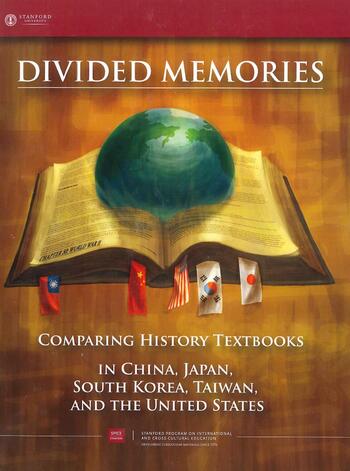
The outcome was the project's first book in 2011, History Textbooks and the Wars in Asia: Divided Memories, which suggests that an "introspective effort" to understand national narratives about WWII has the potential to bring about historical reconciliation in the region. Sneider describes it as the first comparative study of textbooks in the countries involved; it soon evolved into a classroom supplemental textbook published by the Stanford Program on International and Cross-Cultural Education.

"Formal education is a powerful force in shaping our historical understandings," Sneider noted. "We wanted to look at the textbooks that have the most impact and usage."

A 2014 book, Confronting Memories of World War II: European and Asian Legacies, which was co-edited by Shin, Sneider and Daniel Chirot, a sociologist with the University of Washington, compared successful European WWII reconciliations with lagging Asian efforts. Another book, Divided Lenses, published earlier this year, examined the impact of dramatic film and other forms of popular culture on wartime memory. A new book is due out this summer, Divergent Memories: Opinion Leaders and the Asia-Pacific War, which focuses on leaders in politics, the media and academia in Japan, China, South Korea and the U.S.

The Divided Memories project aims to generate discussions and collaborations among those who create "historical memories" – educators, policymakers and government leaders. One report that grew out of such dialogues included suggestions for reconciliation:

  • Create supplementary teaching materials on the issue. 
  • Launch dialogues among Asian, American and European historians. 
  • Offer educational forums for journalists, policymakers and students. 
  • Conduct museum exchanges and create new museums, such as one wholly dedicated to WWII reconciliation in Asia. 
  • Increase student exchanges among all the countries involved. 

History is reflected in today's geopolitics, as noted in the revived disputes by these nations over rival claims to islands in the South China Sea and elsewhere. Without resolution, these disagreements can flare up into military conflicts, Sneider wrote.

"The question of history taps into sensitive and deeply rooted issues of national identity," he noted.

Whether recounting Japanese atrocities in China, China's exaggerated account of its Communist fighters' role in World War II, or the U.S. decision to drop atomic bombs on Japan, no nation is immune to re-creating the past to further its own interests today, Sneider wrote.

For example, Divided Memories research on Chinese textbooks shows how the Chinese government in recent decades embarked on a "patriotic education" campaign to indoctrinate young people by exaggerating its role in Japan's WWII defeat. This narrative suits the nationalistic desires of a Chinese government no longer exclusively motivated by communist ideology, Sneider said.

One project of APARC and its Japan Program that was also an outgrowth of Divided Memories involved Stanford scholars urging Japanese Prime Minister Shinzo Abe to show "clear, heartfelt remorse" in a 2015 speech on the 70th anniversary of the end of WWII. A 15-page report featured hypothetical statements suggesting what Abe might say to make amends for Japanese actions in China and Korea.

"While we cannot claim to have directly influenced the prime minister, his statement did go further in the direction of an expression of remorse over the war and the need to continue to look clearly and honestly at the past than many expected," said Sneider.


Image
divided memories 2

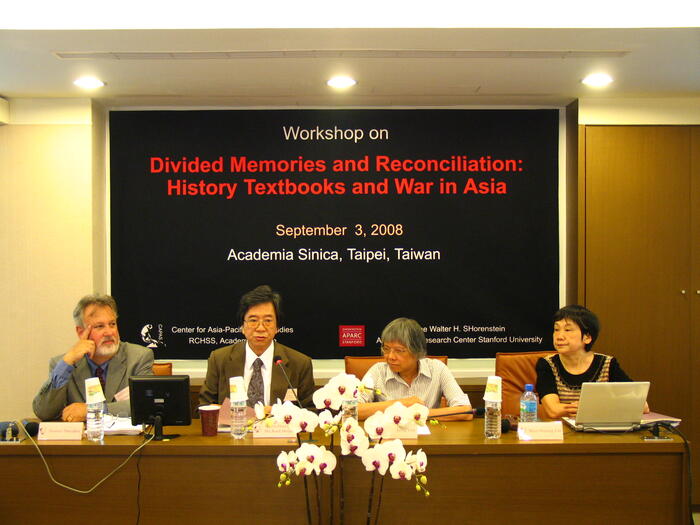
A workshop on history textbooks co-hosted by Shorenstein APARC and Academia Sinica's Center for Asia-Pacific Area Studies takes places in Taipei, Sept. 3, 2008.


Generations and grievances

Consciousness-raising on other fronts, however, is getting results, thanks to Stanford's Divided Memories project. A 2015 landmark agreement between Japan and South Korea over the WWII "comfort women" dispute was reached due to extensive U.S. involvement. Comfort women were women and girls who were forced into sexual slavery by the Imperial Japanese Army in occupied territories before and during World War II.

In an article, Sneider explained how the U.S. perceived that the dysfunctional relationship between South Korea and Japan over this issue, among others, threatened to undermine American strategic interests in Asia. 

Shin highlights the importance of U.S. involvement. "The U.S. is not just an outsider to historical and territorial disputes in the region," he said. "From a geopolitical perspective, the U.S. has done a wonderful job in reviving the devastated region into a prosperous one after 1945, but from a historical reconciliation perspective, the U.S. has done a poor job."

He suggests that America should "play a constructive role in promoting historical reconciliation" among the countries involved. And so, the Divided Memories project has included the United States in its efforts.

According to Sneider, Divided Memories is unique among all reconciliation projects for its emphasis on the inclusion of the U.S.; comparative analyses across countries; and real-world policy impacts. As part of the Shorenstein research center, it is housed within Stanford's Freeman Spogli Institute for International Studies.

"This project reflects what Stanford, our center and the Freeman Spogli Institute are all about – true interdisciplinary research and engagement," Sneider said.

Clifton Parker is a writer for the Stanford News Service.

Hero Image
divided memories reconciliation headline
Japanese soldiers in Shanghai, March 23, 1927 | A Stanford project encourages World War II reconciliation and historical accuracy about the conflict and its consequences in Japan, China, Korea, Taiwan and the United States. Progress has been made on classroom textbooks and scholarly discussions and exchanges.
Getty Images
All News button
1
Authors
Gary Mukai
News Type
News
Date
Paragraphs

My daughter, Emily, was teaching English at a middle school in Asahi City, Chiba Prefecture, on the Japan Exchange and Teaching (JET) Program when the 2011 Tohoku earthquake struck on March 11, 2011. Tohoku is a region in the northeast portion of the island of Honshu, the largest island in Japan. Though Asahi City, a coastal city, is not in the Tohoku region, it was still heavily damaged by the resulting tsunami. Several of Emily’s students lost their homes. She was emotionally shaken, of course, but was fortunate not to sustain any injuries.

With the fifth anniversary of the 2011 Tohoku earthquake and tsunami approaching, I have been reflecting upon the tremendous anxiety that I felt that day about Emily’s safety, my wife’s family in Tohoku, and the people of Japan in general. My reflections deepened last week while observing the interaction of SPICE’s Reischauer Scholars Program (RSP) students (American high school students studying about Japan) with SPICE’s Stanford e-Japan students (Japanese high school students studying about the United States) in an informal online “social hour.” The RSP and Stanford e-Japan are distance-learning courses that are offered by SPICE.

Stanford e-Japan instructor Waka Brown and RSP instructor Naomi Funahashi organized the social hour to help to build bridges between youth in Japan and the United States. During the latter part of the social hour, RSP student, David Jaffe (Mesa, Arizona), posed the question, “How is 3.11 remembered today?” Among the many Stanford e-Japan students who spoke was Minoru Takeuchi (Sakura City, Chiba Prefecture), who stated, “When the earthquake happened, I was an elementary school student (12 years old). I still remember very well… at that time, I was in school. Some students were very afraid and crying… Maybe after the earthquake, many Japanese noticed the importance of working together, the preciousness that they could meet their friends…” The Japanese students’ sharing of their experiences related to 3.11 extended the social hour far beyond the hour, and the gratitude expressed by the American students to their counterparts in Japan flowed for many minutes in a text-chat box.

Observing the students was one of the most rewarding experiences of my career at SPICE. The Japanese students’ remembrances of 3.11 brought back poignant and difficult memories for me but also provided me with hopeful thoughts on the future of the U.S.–Japan relationship as I witnessed students from across the Pacific forming budding friendships and discussing topics of mutual relevance.
 

Resources for the classroom
 

My hope is that teachers will carve out some time in their curriculum to engage their students in a study of 3.11 as well as its legacies. The study of natural hazards ought to be a core part of school curriculum. SPICE has undertaken many curricular projects related to 3.11. I would recommend that teachers show the film, After the Darkness, which was produced by Risa Morimoto and Funahashi. After the Darkness is a documentary film that touches upon the events of the disaster itself but also focuses on the experiences of two survivors in particular. It is accompanied with free curricular lessons that are accessible to students of various ages. I also recommend a lecture by Professor Emeritus Daniel Okimoto, Stanford University, on “Japan’s Geological Factors,” which is accompanied by a free lesson plan. Another recommended curricular unit is SPICE’s Examining Long-term Radiation Effects, which was produced prior to 3.11 but can help students understand the radiation-related concerns following the Fukushima Daiichi nuclear disaster. In addition, the film, Live Your Dream: The Taylor Anderson Story, is about one of two American JET Program teachers who lost their lives during 3.11. SPICE developed a teacher’s guide for the film that can be freely downloaded from the Live Your Dream: The Taylor Anderson Story website. Lastly, I recommend the use of the films from the 113 Project in classrooms. Earlier this week, I moderated a panel discussion that included Wesley Julian (director of the 113 Project), Andy Anderson (father of Taylor Anderson and board member of the Taylor Anderson Memorial Fund) as well as other Americans and Japanese who continue to contribute to relief efforts in the Tohoku region.

Hero Image
tohoku
A distraught woman carries an elderly woman on her back, away from the piles of debris that are the flattened remnants of what was once a city in the Tohoku region of Japan. This scene comes from a photo taken the day after a 9.0 magnitude earthquake struck Japan on March 11, 2011, triggering a destructive tsunami.
Kahoku Shimpo
All News button
1
News Type
News
Date
Paragraphs

When I first started the Stanford e-Japan program, I never expected to be up on that podium making a speech [at Stanford University]… Yet there I stood, a little more grown up than before.
—Seiji Wakabayashi, Kumon Kokusai Junior-Senior High School

If I hadn’t participated in this program, I wouldn’t have been as interested in the U.S. as I am right now.
—Hikaru Suzuki, Senior High School at Otsuka, University of Tsukuba

I am very grateful to be given the chance to think about and to discuss with my fellow classmates what we should do in order to strengthen the U.S.–Japan relationship in the future.
—Haruki Kitagawa, Keio Senior High School


The Stanford Program on International and Cross-Cultural Education (SPICE) honored three of the top students of the inaugural 2015 Stanford e-Japan distance-learning course at an event at Stanford University on November 2, 2015. The three Stanford e-Japan Day honorees—Haruki Kitagawa (Keio Senior High School), Hikaru Suzuki (Senior High School at Otsuka, University of Tsukuba), and Seiji Wakabayashi (Kumon Kokusai Junior-Senior High School)—were recognized for their coursework and exceptional research essays that focused respectively on “A Comparison and Analysis of Educational Systems: What Is ‘Successful’ Education?,” “Why the Japanese Have a Good Image of America,” and “Schooling Japan.”

Stanford e-Japan Day featured welcoming comments by Dr. Gary Mukai, SPICE Director, and opening remarks on youth and the future of U.S.–Japan relations by Deputy Consul General Nobuhiro Watanabe, Consulate General of Japan in San Francisco. Deputy Consul General Watanabe reinforced that youth are the ones to shoulder the U.S.–Japan relationship in the coming years, and that he is very much looking forward to the day when these students will engage in furthering our two countries’ strong ties.

Waka Takahashi Brown, Stanford e-Japan Instructor, gave an overview of the course. Stanford e-Japan is a distance-learning course on U.S. society and culture and U.S.–Japan relations that is offered annually to 25–30 high school students across Japan. The course presents a creative and innovative approach to teaching high school students about U.S. society and culture and U.S–Japan relations, and provides Japanese students with unique opportunities to interact with diplomats and top scholars affiliated with Stanford University and other institutions through online lectures and discussions. Importantly, the course introduces both American and Japanese perspectives on many historical and contemporary issues.

Each student honoree gave a succinct and lucid summary of his/her research essay and skillfully answered questions from the audience. Following the question-and-answer period, each student was presented with a plaque by Brown. Following the presentations, the students and their families joined the audience in a luncheon.

Following the event, Stanford undergraduate Mathieu Rolfo took time from his studies to take the three honorees on a tour of the Stanford campus. Mathieu is a former student in SPICE’s Reischauer Scholars Program (RSP), a distance-learning course on Japan and U.S.–Japan relations that has been offered to high school students in the United States for 12 years. RSP Instructor Naomi Funahashi honored Rolfo as one of her top three RSP students in 2011. Funahashi and Brown are planning to continue to engage their students “virtually” across the Pacific.

Stanford e-Japan has been generously funded for the first three years (2015–17) by a grant from the United States-Japan Foundation. SPICE supporter Amanda Minami Chao was in attendance and had the chance to share her thoughts on Brown University with student honoree Seiji Wakabayashi who plans to apply to her alma mater.

During a recent trip to Japan, Mukai had the opportunity to meet with other excellent students who were enrolled in the inaugural course. Shoko Kitamura, Waseda Honjo Senior High School, noted that she especially enjoyed a lecture by Dr. Joseph Yasutake on Japanese-American internment during which Yasutake shared his first-hand accounts. Tairi Goto, International School of Asia in Karuizawa, stated that he especially appreciated a class activity during which he was introduced to textbook descriptions of the atomic bombing of Japan from Taiwan, Korea, Japan, China, and the United States. Misaki Katayama, Hiroshima Prefectural Hiroshima Junior/Senior High School, commented on her interest in learning about Japanese picture brides who left prefectures like Hiroshima to the United States in the early 20th century.

Reflecting back on the inaugural Stanford e-Japan course and e-Japan Day, Brown noted, “The inaugural group of e-Japan students was phenomenal. It was wonderful to be able to meet at least some of the students in person on e-Japan Day, although I felt like I had already met them through our interaction during the course. I have no doubt that future leaders, diplomats, and entrepreneurs will emerge from this cohort. ”

Hero Image
ejapanphoto
2015 Stanford e-Japan Honorees: Seiji Wakabayashi, Hikaru Suzuki, and Haruki Kitagawa
All News button
1
Authors
Naomi Funahashi
News Type
News
Date
Paragraphs

The Stanford Program on International and Cross-Cultural Education (SPICE) honored two of the top students of the 2015 Reischauer Scholars Program (RSP) at a Japan Day event at Stanford University on August 13, 2015. The two 2015 RSP Japan Day honorees were Meera Santhanam and Katie Goldstein.

Japan Day commenced with welcoming comments by Dr. Gary Mukai, SPICE Director, and opening remarks by Consul General Jun Yamada, Consulate General of Japan in San Francisco. Praising Meera, Katie, and their fellow RSP students for their dedication to the study of Japan and U.S.–Japan relations, Consul General Yamada noted, “The U.S.–Japan relationship is one of the most important bilateral relationships in the world today. Without a doubt this is due to past generations’ tireless efforts to understand each other and build the kind of mutual trust that has made this relationship so durable and successful. To assure the future vitality of the U.S.–Japan relationship, it is therefore our joint responsibility to prepare the future generation for continuing this task. Through the Reischauer Scholars Program which has been instrumental in fostering future leaders who have acquired a deep and broad understanding of Japan, a solid foundation for this purpose has been established.” 

Mukai recognized Naomi Funahashi, RSP Manager and Instructor, for her tenth year of teaching the RSP. Funahashi has empowered over 250 Americans with not only subject matter content knowledge on Japan and U.S.–Japan relations but also tools of critical analysis and perspective taking. Reflecting on her ten years of teaching the RSP, Funahashi commented, “While advancements in distance-learning technology over the past ten years have eased the logistical challenges of the RSP, the students remain at the heart of why I continue to love teaching this course. I have the unique privilege of guiding some of the most talented high school students in the United States through an exploration and examination of Japan, and I am confident that many of them will comprise the leadership of future U.S.–Japan relations.”

Funahashi gave an overview of the RSP to the Japan Day audience of over 30 people, which included Professor Indra Levy, RSP advisory board member, and Maiko Tamagawa, Advisor for Educational Affairs, Consulate General of Japan in San Francisco. Named in honor of former U.S. Ambassador to Japan Edwin O. Reischauer, a leading educator and noted scholar of Japanese history and culture, the RSP is an online course on Japan and U.S.–Japan relations that is offered annually to 25–30 high school sophomores, juniors, and seniors across the United States.

Meera Santhanam (junior, The Nueva School, CA) and Katie Goldstein (senior, Crystal Springs Uplands High School, CA) were recognized for their coursework and exceptional research essays. They articulately presented their research that focused on women in the Japanese workforce and equity-related issues concerning LGBTQ people in Japan, respectively; and skillfully answered provocative questions from the audience. 

Image
2015rsp


Since 2003, the RSP has provided a creative and innovative approach to teaching high school students about Japan and U.S–Japan relations. The program provides American students with unique opportunities to interact with diplomats and top scholars affiliated with Stanford University, the University of Tokyo, the University of Hawaii, and other institutions through online lectures and discussions, and introduces both American and Japanese perspectives on many historical and contemporary issues.

The 2015 Japan Day honorees were reflective of the introduction of varied topics and perspectives in the RSP curriculum. When asked to comment on her RSP experience, Santhanam remarked, “With exposure to a wide array of perspectives and in-depth content alike, participating in this program is a decision I would make a thousand times over again. This rare, interdisciplinary opportunity allowed me to connect with my topic on not just an academic, but personal level as well.” Goldstein shared a similar sentiment, also noting the scholarly, yet congenial atmosphere of Japan Day: “The speakers—Dr. Gary Mukai, Naomi Funahashi, and Consul General Yamada—wonderfully set the formal yet fun tone of the academic event. The conversation, while centered around Japan, revolved around a myriad of topics: literature, current events, policies, you name a topic and it was talked about.”

For the first time in the history of the RSP, several RSP alumni introduced high school life in the United States to Japanese students enrolled in SPICE’s inaugural Stanford e-Japan course, which introduces U.S. society and culture and U.S.–Japan relations to Japanese high school students.

Stanford e-Japan students indicated early on in the course their desire to interact with students from the United States, and as a result, Waka Takahashi Brown, Stanford e-Japan Manager and Instructor, invited RSP alumni to comment on the discussion boards and guest speak at the virtual classroom on “U.S. High Schools and Education” on August 14, 2015. Brown noted, “The response from both the e-Japan students and Reischauer Scholars has been overwhelmingly positive. Not only have students been more engaged in the discussion boards, but the Stanford e-Japan students also seemed very eager to know what about Japan interested the U.S. students to participate in the Reischauer Scholars Program. I would not be surprised if the RSP and e-Japan students strike up a friendship from these initial brief exchanges.”

The distinguished RSP advisory committee members are Consul General Jun Yamada; Professor Emeritus Nisuke Ando, Doshisha University and Kyoto University; Ambassador Michael Armacost, Shorenstein Asia Pacific Research Center, Stanford University; Professor Indra Levy, Stanford University; Professor Phillip Lipscy, Stanford University; and Professor Emeritus Daniel Okimoto, Stanford University.

SPICE has received numerous grants in support of the RSP from the United States-Japan Foundation, the Center for Global Partnership (The Japan Foundation), and the Japan Fund, which is administered by the Freeman Spogli Institute for International Studies at Stanford University.

The RSP will be accepting applications for the 2016 program in September and October 2015. For more information about the RSP, visit www.reischauerscholars.org or contact Naomi Funahashi.

Hero Image
2015rsp
All News button
1
-

In an effort to infuse Asian studies in the social studies and literature curricula, the Stanford Program on International and Cross-Cultural Education (SPICE), in cooperation with the National Consortium for Teaching About Asia (NCTA), is offering a professional development opportunity at Stanford University.

This all day workshop will focus on teaching about religion in China and Japan and the influence of Daoism, Confucianism, and Buddhism. Participants will hear from top China and Japan scholars, engage in China and Japan related curriculum, and network with other local teachers.  This is the fourth seminar in a four part series.

Encina Basement Conf. Room, Encina Hall
616 Serra Street
Stanford, CA 94305

Seminars
-

In an effort to infuse Asian studies in the social studies and literature curricula, the Stanford Program on International and Cross-Cultural Education (SPICE), in cooperation with the National Consortium for Teaching About Asia (NCTA), is offering a professional development opportunity at Stanford University.

This all day workshop will focus on teaching about feudal Japan and the Tokugawa era. Participants will hear from top Japan scholars, engage in Japan related curriculum, and network with other local teachers.  This is the third seminar in a four part series.

Encina Basement Conf. Room, Encina Hall 
616 Serra Street
Stanford, CA 94305

Seminars
-

In an effort to infuse Asian studies in the social studies and literature curricula, the Stanford Program on International and Cross-Cultural Education (SPICE), in cooperation with the National Consortium for Teaching About Asia (NCTA), is offering a professional development opportunity at Stanford University.

This all day workshop will focus on teaching about Japan in the social studies classroom. Participants will hear from top Japan scholars, engage in Japan related curriculum, and network with other local teachers.  This is the second workshop in a four part series.

During the course of the day, participants will examine the factors that lead to WWII and Japan's role pre and post war.

Encina Basement Conf. Room, Encina Hall
616 Serra Street
Stanford, CA 94305

Seminars
Subscribe to Japan