
Celebrating SPICE’s 50th: Sharpening Our “Cultural Vision”: Seeing the World Through the Eyes of Other Cultures
Celebrating SPICE’s 50th: Sharpening Our “Cultural Vision”: Seeing the World Through the Eyes of Other Cultures
Stanford alum and former SPICE Japan Project Coordinator Kay Sandberg shares memories of SPICE’s first 10 years through her eyes.

This article was written by Kay Sandberg, former Japan Project Coordinator at SPICE in the 1970s and 1980s. In its early years, SPICE comprised several separate area-focused projects. This is the seventh of several articles—focusing on the 50-year history of SPICE—that will be posted this year.
What a joy to congratulate the SPICE program on its 50th birthday, triggering many fond memories of the first decade of SPICE. I began volunteering for what was then Teaching Japan in the Schools while a graduate student in East Asian Studies and Anthropology. Founder Lynnette King left the university just as I was completing my studies, offering the perfect segue into leadership. I had the privilege of collaborating with and learning from supportive Stanford faculty, senior administrators including Bob Ward and Ron Herring at the Center for Research in International Studies (CRIS), enthusiastic classroom teachers in several states, their K–12 students, and a cadre of eager graduate students who called Stanford—and SPICE—home. Current SPICE Director Gary Mukai was one of those teachers! The Japan Project’s team included grad students Liz Nichols, Bob Huey, Nancy Sato, Kate Saltzman-Li and young professionals Lia Turk, Nancy Beckman, and Anne Callaghan during my tenure. Then there was Tuckie Yirchott!
I still recall our excitement when Tuckie, a vibrant classroom teacher from Illinois, called us from Japan to say she was relocating to the Bay Area. Might we have a position that would allow her to engage with fellow teachers and continue to teach/learn about her beloved Japan? Relationships are especially blessed when both parties feel they’ve “scored,” and we hit the jackpot! Tuckie would long remain a core presence, helping to guide the course of SPICE and subsequent programs that influenced countless teachers and students in California, Colorado, Nevada, Utah, and beyond. Our work was generously supported in part by the Consulate General of Japan in San Francisco, which demonstrated a remarkable commitment to nurturing K–12 education and healthy U.S.–Japan relations at the grassroots level.
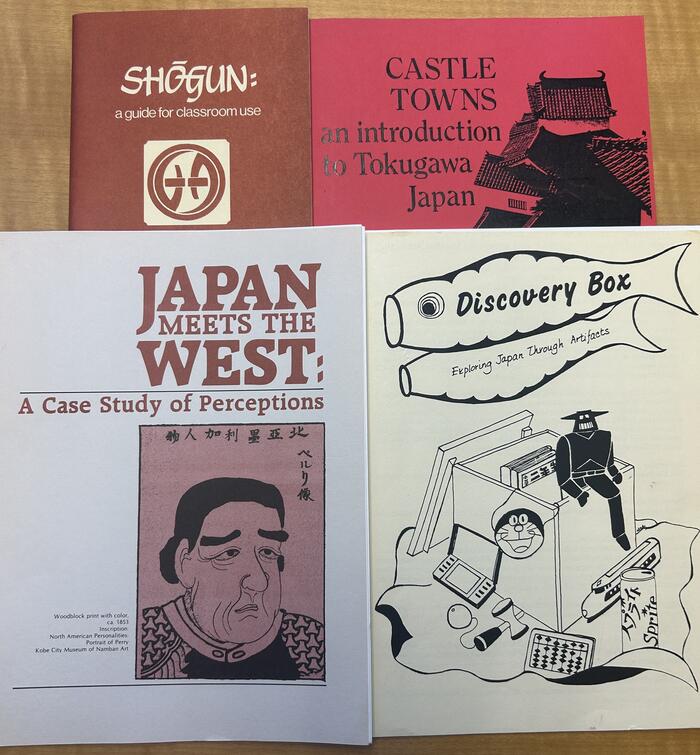
Curriculum development was at the heart of each of our area studies-focused projects. The work, led by Dr. David Grossman, was lively, engaging, and sometimes included unique opportunities, including being asked to develop classroom materials for the mini-series Shogun. All were tested in classrooms before being shared far and wide. As I recall, The Rabbit in the Moon was one of our first units, thanks in no small part to Liz Nichols, a professional storyteller to this day.
Here is a snapshot of some of the curriculum units.
SPICE was a family in the true sense of the word, a highly productive one at that! Yet we found time to laugh uncontrollably at meetings, celebrate birthdays, important cultural holidays, and the birth of “global babies”—our children. The 1985 CRIS Holiday Commemorative Cookbook is still a source of favorite international recipes. The fact that we still hold periodic reunions is a testament to the love and respect we’ve come to count on.
Working at SPICE was a “golden era” in many of our lives, setting us up for academic and teaching success and work in the private, government, and nonprofit sectors. We came away with lifelong friends, a commitment to valuing diversity, and the satisfaction of knowing we have made a difference, along with some great recipes. Heartfelt thanks to Gary and the many colleagues who have sustained programming lo these 50 years. Here’s to the next 50!


