
Stanford e-Japan Alumni Gather in Tokyo
Stanford e-Japan Alumni Gather in Tokyo
In June 2026, alumni from across Japan convened in Tokyo for the first-ever Stanford e-Japan reunion.

Stanford e-Japan is made possible with the generous support of the Yanai Tadashi Foundation.
The Stanford e-Japan Program began in 2015, and since then, 21 additional cohorts have completed the program. While there have been annual Japan Day ceremonies to celebrate the top students from each session, there had never been an official alumni gathering across all cohorts until Sunday, June 21, 2026. On that afternoon, the first official Stanford e-Japan alumni reunion took place at the University of Tokyo, Hongo campus. Professor Hideto Fukudome (the University of Tokyo) kindly arranged a room where the event could be held. Approximately 75 students from throughout Japan attended, from the first 2015 cohort through the most recent graduates of the program, Spring and Fall 2025.
At the beginning of the gathering, I spoke briefly about the history of the Stanford e-Japan Program. I described how in 2015, the Stanford e-Japan Program had been funded by the United States-Japan Foundation, and how the program’s one-hour virtual classes were a novelty at that time. I detailed how in subsequent years, applicant numbers increased, a second teacher was added to the program (first Ms. Elin Matsumae, and then my colleague Ms. Meiko Kotani), virtual classes increased from 60 to 90 minutes, and program sponsorship changed to the Yanai Tadashi Foundation. I reminisced about the years prior to the pandemic in which students became increasingly interested in studying abroad, particularly in the United States, and then how the world and everyone’s plans seemed to come to a halt as we all navigated the COVID-19 years together. While during the first years of the course, learning how to unmute ourselves before speaking felt like half the battle, the pandemic changed how comfortable everyone felt with technology. Multiple questions of “Can you hear me?” were replaced by students experimenting with fancy backgrounds and virtual reactions. I became somewhat concerned that the novelty of Stanford e-Japan’s distance-learning format might result in decreased interest in the program. Fortunately, it did not, and in 2022, as the world slowly emerged from the pandemic, the in-person Japan Day ceremony was re-established, and students began considering overseas studies again.
After opening remarks, students were directed to organize groups according to their cohorts or years depending on the numbers in attendance. Once in their “breakout groups,” I asked students to share their name, session, and school that they attended. Students from earlier sessions were encouraged to share what they were doing for work. Students from recent sessions were instructed to share what they were studying, or the kind of work they would like to do in the future. Finally, everyone was asked to share how Stanford e-Japan may or may not have affected their lives. As everyone became acquainted or re-acquainted with each other, I stopped by each group to say hello. It was truly a joy to hear how everyone had fared since the program, and to finally meet some longtime supporters of Stanford e-Japan whom I had only known from a small square on Zoom up until that point.
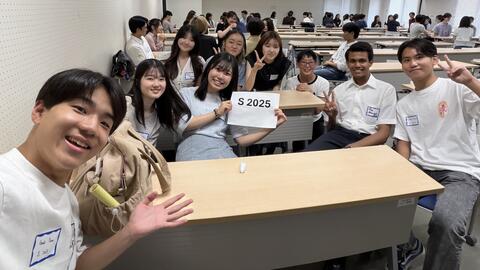
After approximately 45 minutes, alumni were invited to make some remarks. Some alumni took the time to discuss their local business ventures and invited fellow alumni to stop by, while offering a special “Stanford e-Japan alumni discount.” Others, such as Manami Rawaha Malek and Manoka Furui described ventures they were involved in and shared their social media handles, which many alumni then followed and supported in turn.
The event ended with a general mingling and networking session. Alumni later mentioned how much they enjoyed seeing their former classmates and making new connections as well.
Aimin Kozuma, from the spring 2021 session, mentioned how this event, “reminded me of the genuine excitement of learning at Stanford e-Japan, and not just within my own cohort. That energy seemed to carry across every class, which made it easy for all of us to get to know each other quickly. Since starting my job, I haven’t had many opportunities to meet this many energetic people, so I left feeling truly inspired.”
Fall 2022 alumna Ami Osaka stated how, “it was wonderful to be reunited with my cohort and to learn more about everyone’s future aspirations, dreams, and current pursuits… The gathering reminded me how inspiring and diverse the Stanford e-Japan community is.”
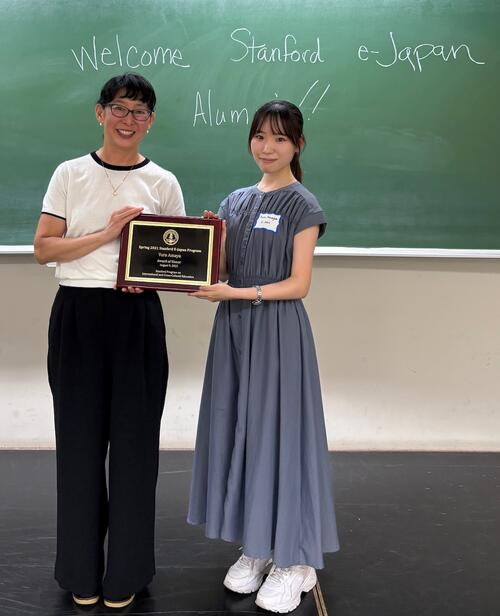
One of the most poignant moments during the gathering was one in which spring 2021 award winner Yura Amaya approached me with her award plaque. Due to COVID restrictions, her cohort did not have an in-person ceremony at Stanford, but a virtual one instead. Yura and I met in person for the first time during this June gathering, and took the opportunity to recreate the award-ceremony moment with this photo. Yura mentioned she had been waiting years for this moment. In addition, she had these kind words to say: “It was really nice to chat with my friends from spring 2021, and also meet new people having various backgrounds and careers…. Also, I hope Stanford e-Japan continues providing positive impact on many students in Japan.”
We are all so grateful to the Yanai Tadashi Foundation for helping make this gathering a reality, and its support for the Stanford e-Japan Program and all its current and former students. Meiko Kotani and I are hoping to have another reunion next year in the Kansai area.
Stanford e-Japan will begin accepting applications for the spring 2027 course on November 15, 2026.
Stanford e-Japan is one of several online courses offered by SPICE.
To stay updated on SPICE news, join our email list and follow us on Facebook, X, and Instagram.


