
An Unexpected Encounter That Led Me to Rethink History and Education
An Unexpected Encounter That Led Me to Rethink History and Education
Yuki Kihara, a Japanese PhD student at the University of Tokyo’s Graduate School of Education, reflects on her experience during a SPICE-supported intensive seminar in the San Francisco Bay Area.

The following is a guest article written by Yuki Kihara, who traveled to the San Francisco Bay Area with other graduate students from the University of Tokyo in January 2026, under the leadership of Professor Hideto Fukudome. Yuki is also an administrative staff member at the University of Tokyo. SPICE/Stanford collaborates closely with the Graduate School of Education at the University of Tokyo and met with the students during their visit to the Bay Area.
On the final day of the intensive seminar in the San Francisco Bay Area, we visited the Japanese American Museum of San Jose. When we entered the museum, an elderly woman who happened to be there told us about her experience living in a concentation camp. She said that in the middle of the desert, the barracks’ housing was full of dust, and that every night before falling asleep she would check under the bed to make sure there was no scorpion. This unexpected encounter became a memorable moment that wrapped up what I learned at the intensive seminar.
At first, this story did not have a strong impression on me. However, as we walked through the museum, docent Atsushi Uchida explained in detail about life in the concentration camp, citing the elderly lady’s words. For instance, because the camps were built hastily, undried wood was used for the barracks. Consequently, as the wood dried and shrank over time, gaps appeared, and clouds of dust came into the barracks and rose in the air. These gaps also allowed scorpions to sneak in, which is why the elderly lady had to be cautious every night. Of course, this is a minor memory of that elderly lady which would never be written down in a textbook. It would also perhaps have slipped out of my memory quickly if Atsushi had not shed light on it. But because he pointed it out, her experience was incorporated into my thoughts and has stayed with me for a long time. Photo below of docent Atsushi Uchida at the Japanese American Museum of San Jose, courtesy of Tina Tan.
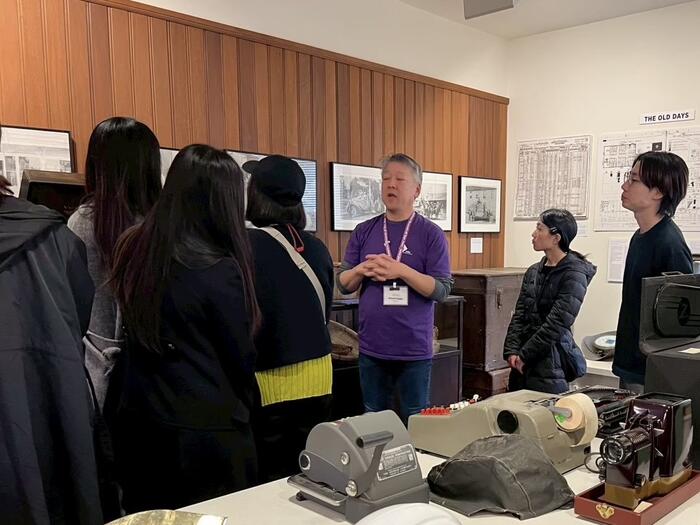
Atsushi also told us about some remaining words which have been passed down within the Nikkei (Japanese emigrants and their descendants) community in California. Among them is the phrase “Shikata Ga Nai,” meaning “it cannot be helped” in English. In Japan, this expression shows a certain sense of giving up or resignation. On the other hand, the word “Shikata Ga Nai” used in California also contains a slightly positive nuance: It means doing what can be done in the place where one has been put. This story made me focus on the pain that Nikkei people at that time had to face, and the perseverance to overcome the hardship, with a somewhat optimistic outlook on life. Atsushi’s comment on “Shikata ga nai” also made me realize that the nuanced differences between the Japanese and Japanese American interpretation of specific Japanese terminology are not merely subtle linguistic variations, but something I may be able to perceive, perhaps, because I stand both inside and outside of this cultural context.
I believe that the privilege of a researcher is to pass down people’s words, regardless of how many people read them. In this regard, I cannot help but think about what I should write and pass down as a person who specializes in education. The children captured by an official government photographer looked cheerful, even at the concentration camp, but I feel that I must also turn my eyes to the moments of pain that would have been hidden from a master narrative of history.
The explanation from Atsushi extended to the story of Norman Mineta. He was a Nisei (second-generation Japanese American) who served as the United States Secretary of Transportation during the George W. Bush administration. Because of his experience of incarceration in his childhood, he opposed racial profiling after the September 11 attacks. His influence on society was huge, and no one doubts his significant achievement. At the same time, interestingly enough, the recollection of the elderly lady also stayed in my memory. I felt that the defining experiences of the two were the same, and it was not until I visited the museum that I came to realize the link between the two. I learned the importance of actually visiting the site on my own. The story of Norman Mineta and the recollection of this elderly woman formed an interesting contrast, and together they left a deep impression on me.
Speaking of this contrast, I also cannot help looking back on the education I received when I was an elementary school student. As homework for a history class, I interviewed my grandmother about her experiences during World War II. She told me about wartime evacuation and her life at home and school. At that time, somewhere in my mind, I regarded these stories as merely personal experiences, not as history to be learned, and I dismissed them as insignificant. The encounter with the elderly lady brought up this memory again, forming a strong contrast with my elementary school experience. It made me reconsider what history is and for whom it exists.
But then another question comes to my mind. If I once regarded my grandmother’s experience as insignificant because of what I learned in history education, does that mean education itself is meaningless? Of course, now, as an adult, I need to examine critically what I have been taught. Yet it was also education itself, this time through Atsushi’s explanation which functioned as scaffolding, that enabled me to question and shed light on something unseen. Here I found hope in education.
I would like to express my sincere gratitude to Professor Hideto Fukudome for arranging such a wonderful opportunity, to Director Gary Mukai and everyone at SPICE for creating the rich program and welcoming atmosphere, to our Teaching Assistant Mr. Naoya Kobayashi for making the seminar run smoothly in many ways, and to all the classmates who shared thoughtful and engaging discussions with me throughout this intensive seminar. Special thanks to Ms. Anna Marie Rodriguez, my friend and an assistant language teacher (ALT) in Japan under the Japan Exchange and Teaching (JET) Programme, for her proofreading of this article.
To stay informed of SPICE news, join our email list and follow us on Facebook, X, and Instagram.


