Authors
News Type
Blogs
Date
Paragraphs

In March 2022, SPICE released Introduction to Issues in International Security, an online lecture series that was developed in consultation with the Center for International Security and Cooperation (CISAC). Four CISAC scholars are featured in accessible video lectures that aim to introduce high school students to various global security issues.

Dr. Ignacio Ornelas Rodriguez, high school educator, historian, and researcher, was an advisor to the first cohort of high school students to engage with the lectures. Ornelas guided students from San Jose and Salinas through the video lectures and accompanying curriculum. Students took the initiative to complete the series and assignments on top of their regular schoolwork.

Ornelas’s efforts culminated in the inaugural International Security Symposium that was held on May 26, 2022. The four CISAC scholars gathered online with the first cohort of students. The objectives of the symposium were to offer students a chance to interact with leading scholars in the field of international security and to learn from the scholars about careers in the field.

The scholars, who are featured in the lecture series and who were present during the symposium, are:

Dr. Martha Crenshaw, Senior Fellow, Freeman Spogli Institute for International Studies (Terrorism and Counterterrorism)

The Honorable Rose Gottemoeller, former Deputy Secretary General of NATO and Frank E. and Arthur W. Payne Distinguished Lecturer at Freeman Spogli Institute for International Studies (International Security and North Korea’s Nuclear Program)

Dr. Norman Naimark, Professor of History and Senior Fellow, Hoover Institution and the Freeman Spogli Institute for International Studies (Ethnic Cleansing and Genocide)

Dr. Megan J. Palmer, Executive Director of Bio Policy and Leadership Initiatives at Stanford University, Adjunct Professor in the department of Bioengineering, and Affiliate of the Center for International Security and Cooperation (Biosecurity)

During the symposium, the scholars shared key turning points in their careers and how they came to be in their fields of expertise. This was followed by student presentations in breakout sessions, where the students were given the opportunity to present on one of the four topics covered in Introduction to Issues in International Security.

In the breakout session on ethnic cleansing and genocide, Professor Naimark was impressed by how the students had absorbed the most important lessons of the material on mass atrocities: 1) that ethnic cleansing and genocide are an important part of human history, and 2) that these are phenomena that need to be studied and understood in order to prevent them from repeating in the future.

The student participants from Salinas were recently featured in an article in The Salinas Californian. Alisal High School student Ashley Corral commented that the series “brought awareness to COVID, mass atrocities and weapons,” and “it was really helpful that students from Salinas Valley could have that opportunity.” Another student, Bilha Piceno said, “It lets me see if this is something that I’m interested in."

The lecture series encourages students to think about international security not only on a broader level, but also how they can contribute to the safety of the world as global citizens starting with their own communities. Given the success of the first symposium, CISAC and SPICE hope to expand on the lecture series, which is part of their DEI-focused efforts, and reach more underrepresented minority students.

Read More

CISAC Scholars Martha Crenshaw, Rose Gottemoeller, Norman Naimark, Megan Palmer; photos courtesy CISAC
News

Introduction to Issues in International Security

A new video curriculum series is released.
Introduction to Issues in International Security
Dr. Hebert Lin
News

Virtual Workshop for Community College Instructors Will Explore Cyber Threat Across the U.S. Nuclear Enterprise

SPICE and Stanford Global Studies will offer a free virtual workshop with Dr. Herbert Lin on January 25th, 4:00pm–6:00pm.
Virtual Workshop for Community College Instructors Will Explore Cyber Threat Across the U.S. Nuclear Enterprise
an image of five men at the beach and an image of a man standing
Blogs

Teaching Diverse Perspectives on the Vietnam War

On Veterans Day 2021, SPICE Director Gary Mukai reflects on some lesser-known stories of Vietnam War veterans.
Teaching Diverse Perspectives on the Vietnam War
Hero Image
Dr. Ignacio Ornelas Rodriguez speaks with Salinas students
Dr. Ignacio Ornelas Rodriguez speaks with Salinas students; photo courtesy Jocelyn Ortega/The Salinas Californian
All News button
1
Subtitle

High school students from San Jose and Salinas Valley met online with scholars from Stanford's Center for International Security and Cooperation for the inaugural International Security Symposium.

Authors
Gary Mukai
News Type
Blogs
Date
Paragraphs

SPICE’s relationship with the East-West Center dates back to 1988 when David L. Grossman, Founding Director of SPICE, departed Stanford to become the Director of the Consortium for Teaching Asia and the Pacific in the Schools (CTAPS) at the EWC. In 1995, Grossman left the EWC to join the faculty and administration of the newly established Hong Kong Institute of Education, now the Education University of Hong Kong. Namji Kim Steinemann became his successor and CTAPS became the AsiaPacificEd Program for Schools, which Steinemann directed until her retirement in 2019. I had the pleasure of giving sessions for CTAPS and AsiaPacificEd during its summer institutes from 1989 to 2009.

Over the years, SPICE has continued its connection to the EWC through its work with the EWC’s past presidents like Michel Oksenberg, former Senior Fellow at the Asia-Pacific Research Center, Stanford University, and most recently with EWC President Suzanne Puanani Vares-Lum who took office in January 2022. She is the first woman, Native Hawaiian, and Hawaii resident to be chosen for this role. On June 6, 2022, I met with President Vares-Lum to discuss a teacher summer institute that SPICE will host at the EWC in July 2022 and mentioned my desire to continue SPICE’s long history with the EWC.

The summer institute is the culmination of two online professional development programs (2020–21 and 2021–22) for high school teachers across Hawaii that is supported through a grant from the Freeman Foundation. It is called the Stanford/SPICE East Asia Seminars for Teachers in Hawaii or Stanford SEAS Hawaii and is managed by Rylan Sekiguchi.

Stanford SEAS Hawaii aims to build teachers’ content knowledge of East Asia by connecting them with scholars at Stanford University, the University of Hawaii, and other local institutions in Hawaii. The participating teachers—Stanford/Freeman SEAS Hawaii Fellows—also receive teaching resources from SPICE and share pedagogical strategies to support their teaching in the high school classroom.

Image
Freeman Foundation folks

SPICE is grateful to the Freeman Foundation for its generous support of Stanford SEAS Hawaii and EWC President Vares-Lum for her commitment to continuing the EWC’s long history of working with SPICE. Photo above (left to right): Gary Mukai and the Freeman Foundation’s President Graeme Freeman, Senior Program Officer Alec Freeman, and Office Manager Robin Sato.

Read More

Stanford Professor Kären Wigen gives a virtual seminar for Stanford SEAS Hawaii
News

Teachers in Hawaii Connect with Stanford Scholars

Twenty-four high school educators comprise the inaugural cohort of Stanford/Freeman SEAS Hawaii Fellows.
Teachers in Hawaii Connect with Stanford Scholars
SPICE Instructor Kasumi Yamashita speaks with Native and Indigenous educators
Blogs

Indigenous Voices: Educational Perspectives from Navajo, Native Hawaiian, and Ainu Scholars in the Diaspora

This article recaps a June 18, 2021 webinar that featured three Native and Indigenous scholars and includes recommendations for using the webinar recording in classrooms.
Indigenous Voices: Educational Perspectives from Navajo, Native Hawaiian, and Ainu Scholars in the Diaspora
Stanford/SPICE East Asia Seminars for Teachers in Hawaii
News

Announcing the Stanford/SPICE East Asia Seminars for Teachers in Hawaii

SPICE, with generous support from the Freeman Foundation, is proud to announce the launch of a new teacher professional development opportunity for secondary school teachers in Hawaii.
Announcing the Stanford/SPICE East Asia Seminars for Teachers in Hawaii
Hero Image
President Suzanne Puanani Vares-Lum with Gary Mukai
President Suzanne Puanani Vares-Lum with Gary Mukai; photo courtesy Felicia Williams, East-West Center
All News button
1
Subtitle

SPICE will host a 2022 teacher summer institute at the East-West Center, continuing its longstanding relationship with the Center.

Authors
Gary Mukai
News Type
Blogs
Date
Paragraphs

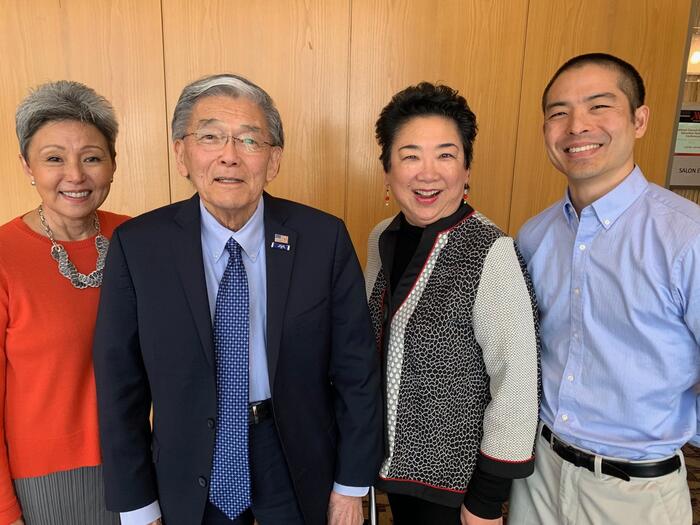
As a young student in San Jose in the 1960s and early 1970s, I used to see Norman Mineta on occasion in San Jose’s Japantown. Once at Jackson Barber Shop in Japantown, Norm was on the barber chair. After he left, barbers Takeo and Atsuo Fukuda asked me if I knew who he was. I didn’t, and Takeo told me that he was Norman Mineta, vice mayor of San Jose. That was the first time that I sat next to him, and the last time (photo above) was on September 20, 2019, just a few months prior to the pandemic.

Since that day at Jackson Barber Shop, I recognized Norm whenever I saw him in Japantown, in the San Jose Mercury News, and in the national news. Whenever I met with him as mayor, congressman, or secretary, I was struck by how he remembered members of my family in San Jose. His capacity for empathy is something that I have admired since my youth and aspire to in my adulthood. Norm’s passing on May 3, 2022 prompted me to recall our work together on several education-focused projects that were deeply personal to him and to me.

Norm’s life story—including his family’s incarceration in Heart Mountain Relocation Center by the U.S. government during World War II—is eloquently captured in the remembrance, “Remembering Mineta as unselfish American,” which was written by Daniel Okimoto, Professor Emeritus, Stanford University. Norm’s life is also brilliantly captured in the film, Norman Mineta and His Legacy: An American Story, by Dianne Fukami and Debra Nakatomi, Mineta Legacy Project. According to Fukami and Nakatomi, the film is about injustice and redemption, and Norm’s burning desire for all people to be treated equally. That desire was influenced greatly by his childhood incarceration experience. I often heard Norm talk about the anguish and heartbreak he felt as a 10-year-old when his family was taken from their San Jose home in 1942 and he was forced to leave behind his dog, Skippy.

In the early 2000s, I consulted with him about SPICE’s curricular work on a comprehensive curriculum unit that focused on the incarceration of Japanese Americans during World War II and a teacher’s guide for the film, Uncommon Courage: Patriotism and Civil Liberties, directed by gayle yamada. The curriculum helps to raise public awareness concerning the history and the lessons of civil rights violations or civil liberties injustices experienced by certain communities—something that Norm experienced first-hand as a child. The teacher’s guide helps teachers to set the context for and to debrief the viewing of the film that tells the story of the Military Intelligence Service (MIS) during World War II and the Allied Occupation of Japan. Approximately 6,000 MIS soldiers, primarily Japanese American, fought for the United States in the Pacific, interrogating Japanese prisoners, translating documents, intercepting communications, and infiltrating enemy lines. Many of the soldiers volunteered from the incarceration camps. While developing the guide, I spoke to Norm about many of the MIS soldiers whom he knew and also about his experiences as an intelligence officer in Japan and Korea in the 1950s.

When I was a board member of the National Japanese American Memorial Foundation, Norm (as one of the founding members of the Memorial) supported the development of educational resources on the Memorial in Washington, DC, which I developed back in the early 2000s with Kerry Yo Nakagawa, Director, Nisei Baseball Research Project. Norm’s quote is inscribed on one of the walls of the Memorial. It reads,

May this memorial be a tribute to the indomitable spirit of a citizenry in World War II who remained steadfast in their faith in our democratic system.

Image
National Council of History Education conference, Washington, DC; Secretary Norman Mineta with Nakatomi (left) and Fukami (right) and Sekiguchi.


In addition, my colleague, Rylan Sekiguchi, and I had the honor of working in collaboration with the Mineta Legacy Project—specifically with Norm, Dianne Fukami, Debra Nakatomi, and Amy Watanabe—on the development of a comprehensive web-based curriculum called “What Does It Mean to Be an American?” Inspired by the life and career of Norm, the six themed lessons are: Immigration, Civil Liberties & Equity, Civic Engagement, Justice & Reconciliation, Leadership, and U.S.–Japan Relations. Norm also joined Sekiguchi and members of the Mineta Legacy Project in introducing the curriculum at several venues, including the U.S.-Japan Council annual conference in Tokyo (November 2018); National Council of History Education conference in Washington, DC (March 2019); Ronald Reagan Presidential Library in Simi Valley, California (April 2019); and the National Council for the Social Studies annual conference in Austin, Texas (November 2019). Note: The photo above was taken at the National Council of History Education conference, Washington, DC; Secretary Norman Mineta with Nakatomi (left) and Fukami (right) and Sekiguchi.

Lastly, in spring of 2021, I was asked by Stanford’s Center for East Asian Studies for recommendations for a keynote speaker for the CEAS commencement. The first person who came to mind was Norm, and he accepted CEAS’s invitation. I will always remember his important words—that there are two things to always cherish and to hold dear to your heart no matter what the situation. These are your name and integrity.

Image
Jackson Barber Shop


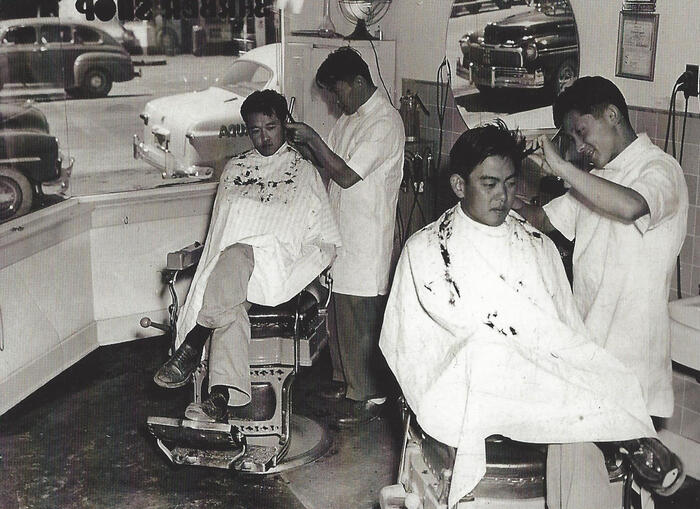
During the keynote address, my mind periodically drifted back to my first encounter with Norm at Jackson Barber Shop. Today, May 30, 2022, Memorial Day, I walked past the location of where Jackson Barber Shop once stood. I recalled the first time that I saw Norm and remembered Atsuo and Takeo, who are shown in the photo (1950s) above where Takeo (near the window) is cutting my father’s hair and Atsuo is cutting the hair of one of my father’s best friends. Takeo and Atsuo’s family was in the same block as my father and his family in Poston War Relocation Center in Arizona. Takeo used to cut my hair, and I remember talking with him about one of my relatives, Hachiro Mukai, who was drafted into the U.S. Army from Poston and was killed in action in France. Norm wanted Hachiro’s story (and others like it) to be transmitted to future generations. I will always remember that and his support of SPICE’s educational efforts over the years. Note: Photo of Jackson Barber Shop, courtesy Chiyo Fukuda.

At the COPANI XX conference in San Francisco, I shared the photo of Jackson Barber Shop with Norm and we shared not only some sadness about the bygone years of many Japantown businesses but also some laughter too, as he said that I still needed a haircut.

Read More

headshots of eight high school students for WDIMTBA 8
Blogs

What Does It Mean to Be an American?: Reflections from Students (Part 8)

Reflections of eight students on the website “What Does It Mean to Be an American?”
What Does It Mean to Be an American?: Reflections from Students (Part 8)
Secretary Norman Mineta and Rylan Sekiguch
News

What Does It Mean to Be an American?: A Webinar for Educators, February 20, 2021, 10am PST

The Mineta Legacy Project and SPICE are providing an educational opportunity for people across the country to learn about the Japanese American experience during World War II by presenting a webinar on Saturday, February 20, at 10am PST.
What Does It Mean to Be an American?: A Webinar for Educators, February 20, 2021, 10am PST
mlp team with bush manual rotate 360
News

Presidents Bill Clinton and George W. Bush interviewed for the Mineta Legacy Project

Presidents Bill Clinton and George W. Bush interviewed for the Mineta Legacy Project
Hero Image
Gary Mukai and Norman Mineta at Convención Panamericana Nikkei (COPANI) XX, San Francisco, September 20, 2019
Gary Mukai and Norman Mineta at Convención Panamericana Nikkei (COPANI) XX, San Francisco, September 20, 2019; photo courtesy Mark Shigenaga
All News button
1
Subtitle

The late Secretary Mineta was unwavering in his commitment to SPICE’s efforts to educate students about civil liberties and equality.

Authors
Gary Mukai
News Type
Blogs
Date
Paragraphs

Sponsored by Stanford Global Studies, the Education Partnership for Internationalizing Curriculum (EPIC) Community College Faculty Fellowship program brings together a cohort of community college faculty and academic staff from various disciplines to work collaboratively with Stanford staff for one academic year (August–May). Each EPIC Fellow designs a project that aims to internationalize curricula and develop global competencies among community college students. Jonas Edman worked with four of the nine 2021–22 EPIC Fellows throughout the academic year. The fellowship culminated with the EPIC Symposium, “Integrating Global Topics into Community College Curricula,” which was held on May 22, 2022 and featured panels of current and past EPIC Fellows. The four EPIC Fellows with whom Edman worked are listed below. Each gave an overview of their project to an audience of Stanford faculty and staff, EPIC alumni, and other community college faculty.

Lauren M. Blanchard, Faculty, Political Science, Monterey Peninsula College
Project: Hands-on Migration: Service-Learning Curriculum in Global Studies

  • The goal of this project is to introduce migration studies to Monterey Peninsula College. Crafting a service-learning curriculum will provide students the opportunity to dedicate a semester to the comparative study of internal and international migrations in the 20th and 21st centuries, alongside the chance to gain hands-on experience working with the diverse immigrant communities of Monterey County. This curriculum will provide insight into the international agreements and values that have shaped government responses to immigration in the past and will shape responses to migration in the 21st century.
     

Miloni Gandhi, Faculty, Global Studies and Workforce, Foothill College
Project: Virtual Study Abroad

  • Virtual Study Abroad is a way to bridge equity gaps in international education at the community college. Study abroad is a unique experience to explore other cultures and traditions firsthand. However, it is often limited to those with the ability to leave their current situations for long periods of time or those with the financial ability to cover the opportunity cost of being away from home. Virtual Study Abroad allows for all students to have firsthand experiences exploring other cultures through meaningful curated content and authentic relationship-building with people in other countries without having to physically be abroad.
     

Tomasz B. Stanek, Associate Professor, History, Victor Valley College
Project: Global Ethnic Studies Course Proposal

  • The Global Ethnic Studies Course Proposal involves the construction of a new global or hemispheric ethnic studies course with major emphasis on paradigmatic discoveries, environmental and indigenous ideas, transnational issues, climatology, human behavior, a trauma of conflict, and modern philosophy, all encapsulated into one community college course bound from the 1500s to the present. The idea of this course is to create an interdisciplinary discussion space and a comparative analysis beyond national borderlands and local marginality.
     

Alexandria White, Professor, English, Sacramento City College
Project: Black Atlantic Explorations

  • The purpose of Black Atlantic Explorations is to provide a comparative approach to understanding the intersectionalities and divergences among Black Atlantic identities and experiences. Juxtaposing the diverse experiences of Afro-Brazilians, Afro-Caribbeans, and Afro-Americans through literature, art, and history will not only be provocative and inspiring, but will also plants seeds in our collective imaginations about the possibilities of Black Atlantic futures rooted in liberation and rooted in the “profoundest creativity to throw bridges across chasms, to open an architecture of space within closed worlds of race and culture (Guyanese writer, Wilson Harris).”


Following the panels, the EPIC Fellows received certificates from SGS upon their successful completion of the Fellowship. With the formal close of the Fellowship, they are now invited to join the Global Educators Network (GEN), which in partnership with Stanford Global Studies (SGS) seeks to inform, inspire, engage, and empower community college educators—and their students—to more deeply engage with global themes and learning resources, as well as international dialogue, research, and pedagogical strategies.

Reflecting on the EPIC Symposium, Edman noted, “Not only was it rewarding to observe the 2021–22 EPIC Fellows giving their impressive presentations after a year-long preparation, but it was also gratifying to see EPIC alumni from many cohorts interacting with this year’s cohort and encouraging them to join GEN. Importantly, I am most grateful to Kristyn Hara for expertly facilitating the EPIC Program over the past year and for planning and implementing this year’s EPIC Symposium.”

The EPIC Community College Faculty Fellowship program is made possible through the support of Department of Education Title VI funding. Pitches of all of the nine 2021–22 EPIC Fellows can be found here.

jonas edman

Jonas Edman

Instructor, Stanford e-Tottori and Instructional Designer
Full Bio

Read More

image of six fellows
News

Collegiality and the 2020–21 EPIC Fellows

On August 13 and 14, 2020, Stanford Global Studies welcomed 12 new Education Partnership for Internationalizing Curriculum (EPIC) Fellowship Program community college instructors as members of its 2020–21 cohort.
Collegiality and the 2020–21 EPIC Fellows
2019–2020 EPIC Fellows
News

SPICE’s Jonas Edman Meets with New EPIC Fellows

SPICE’s Jonas Edman Meets with New EPIC Fellows
2018–19 EPIC Fellows
News

2018–19 EPIC Community College Faculty Fellows Program

2018–19 EPIC Community College Faculty Fellows Program
Hero Image
Stanford Global Studies hosts Education Partnership for Internationalizing Curriculum (EPIC) Symposium
Left to right: Jonas Edman (at podium), Lauren Blanchard, Alexandria White, Tomasz Stanek, Miloni Gandhi, Gary Mukai; photo courtesy Rod Searcey
All News button
1
Subtitle

Stanford Global Studies hosts Education Partnership for Internationalizing Curriculum (EPIC) Symposium.

Authors
News Type
News
Date
Paragraphs

On March 22, 2022, APARC's Japan Program welcomed a delegation from the Embassy of Japan in the United States and the Consulate-General of Japan in San Francisco, including Ambassador Koji Tomita and Consul-General Hiroshi Kawamura, who met with a joint panel of scholars and administrators from Stanford and the University of California, Berkeley for a discussion about fostering a greater understanding of Japan studies in the United States.

APARC Deputy Director and Japan Program Director Kiyoteru Tsutsui presented data on enrollment and employment statistics for Japanese studies in higher education. According to the report, Japanese studies have been in a slow state of decline since the late 1980s, when many in the United States viewed Japan as an economic threat and the country was not as well-understood as it is today. Despite this decline, students today are still very interested in studying Japan and are eager to visit the country.

Naomi Funahashi, Manager of the Reischauer Scholars Program and Teacher Professional Development at the Stanford Program on International and Cross-Cultural Education (SPICE), presented outcomes from SPICE's outreach efforts and promotion of Japanese studies in the K-14 context. Funahashi indicated strong interest in and engagement with SPICE curricular units focused on Japan and with its local student programs in six regions, one university, and two high schools in Japan.


Sign up for APARC newsletters to receive our experts' analysis and commentary. 

Professor Junko Habu, Chair of the Center for Japanese Studies (CJS) and Professor of Anthropology at UC Berkeley, along with Kumi Sawada Hadler, Program Director of CJS, described logistical challenges Japan scholars have faced during the COVID-19 pandemic, including the inability to access the country under lockdown, and indicated that, across the board, universities are not providing as much support for Japanese studies as they used to, especially in terms of endowed faculty positions and departmental "slots" specifically for Japan specialists.

Ambassador Tomita and Consul-General Kawamura agreed that more support was needed to bolster scholarships of Japan. Ambassador Tomita stated that over his long career, he has seen the theoretical focus of Japan studies in the United States shift away from bilateral relations between the two countries toward the region at large. He noted that the public discussion is increasingly directed at Japan as part of a broader complex of nations in East Asia. Consul-General Kawamura indicated that the pandemic has posed a host of challenges for his office but that Japan will continue to open its doors to scholars in the future. 

The meeting concluded with a reaffirmation of the longstanding and crucial relationship between the two nations and of the importance of Japan studies in the United States in fostering fruitful collaboration between the two nations. 

Read More

Hero Image
Delegation
Left to right: Kumi Sawada Hadler, Professor Junko Habu, Ambassador Koji Tomita, Professor Kiyoteru Tsutsui, Consul-General Hiroshi Kawamura, Naomi Funahashi
Michael Breger
All News button
1
Subtitle

At an in-person meeting of a joint delegation from Japan's Embassy to the United States and Consulate-General of Japan in San Francisco with a panel of experts from Stanford and UC Berkeley, Japanese Ambassador Koji Tomita stressed the importance of bilateral academic collaboration in the continual development of the U.S.-Japan partnership.

Authors
News Type
News
Date
Paragraphs

Applications opened recently for the Spring 2022 session of the Stanford University Scholars Program for Japanese High School Students (also known as “Stanford e-Japan”), which will run from mid-February through the end of June 2022. The deadline to apply is December 31, 2021.

Stanford e-Japan Program for high school students in Japan
Spring 2022 session (February to June 2022)
Application period: November 15 to December 31, 2021

All applications must be submitted at https://spicestanford.smapply.io/prog/stanford_e-japan/ via the SurveyMonkey Apply platform. Applicants and recommenders will need to create a SurveyMonkey Apply account to proceed. Students who are interested in applying to the online course are encouraged to begin their applications early.

Accepted applicants will engage in an intensive study of U.S. society and culture and U.S.–Japan relations. Ambassadors, top scholars, and experts from Stanford University and throughout the United States provide web-based lectures and engage students in live discussion sessions.

“Participating in Stanford e-Japan has been one of the highlights of my high school experience,” reflected Fall 2020 honoree Allison Lin. “Through the course, I gained the opportunity to learn from intelligent and experienced scholars which I wouldn’t have had otherwise and found myself aspiring to be like them in the future.”

Stanford e-Japan is offered by the Stanford Program on International and Cross-Cultural Education (SPICE), Stanford University. The Spring 2022 session of Stanford e-Japan is generously supported by the Yanai Tadashi Foundation, Tokyo, Japan.

For more information about Stanford e-Japan, please visit stanfordejapan.org.

To stay informed of news about Stanford e-Japan and SPICE’s other student programs, join our email list or follow us on Facebook, Instagram, and Twitter.


SPICE offers separate courses for U.S. high school students. For more information, please visit the Reischauer Scholars Program (on Japan), the Sejong Scholars Program (on Korea), and the China Scholars Program (on China).

Read More

collage of honoree headshots
News

Winners Announced for the Spring 2021 Stanford e-Japan Award

Congratulations to our newest student honorees.
Winners Announced for the Spring 2021 Stanford e-Japan Award
Japan Day honorees Zoom image
News

Japan Day: Recognizing Top Students in Stanford e-Japan and the Reischauer Scholars Program

Congratulations to the 2020 Stanford e-Japan and 2021 RSP honorees.
Japan Day: Recognizing Top Students in Stanford e-Japan and the Reischauer Scholars Program
female student standing in front of Akamon in Japan
Blogs

Stanford e-Japan: A Turning Point in My Life

The following reflection is a guest post written by Hikaru Suzuki, a 2015 alumna and honoree of the Stanford e-Japan Program, which is currently accepting applications for Spring 2021.
Stanford e-Japan: A Turning Point in My Life
Hero Image
a male student standing in front of red building
Stanford e-Japan alumnus Hugo Ichioka, who is currently studying at Williams College as a Yanai Tadashi Foundation Scholar.
All News button
1
Subtitle

Interested students must apply by December 31, 2021.

Subscribe to North America