In its 46-year history, SPICE, Freeman Spogli Institute for International Studies (FSI), has collaborated with numerous Stanford-affiliated organizations on educational programs. One of the most meaningful and significant collaborations has been with TeachAids, an award-winning global leader in designing, producing, and distributing research-based health education. With programs used in 82 countries, TeachAids released its newest product, CrashCourse, seeking to decrease the stigma surrounding concussion reporting and empower youth athletes with much needed knowledge. All TeachAids education content is available for free.
The SPICE staff highly encourages teachers in SPICE’s network to access the CrashCourse Concussion Education content and share it with their colleagues in their school’s science-, health-, and sports-related programs. The following is noted on CrashCourse’s main webpage:
One in five high school athletes will get a concussion. With proper care, most concussions can heal within 10 days, but the overwhelming majority of students, parents, and coaches are unaware of the latest science about prevention and treatment of concussions. If not treated properly, a concussion may have lasting physical, emotional, and cognitive effects.
Since many schools are now in the midst of football season, this is an ideal time to raise awareness of the prevention and treatment of concussions. In particular, the content will be especially helpful if it can be shared with the school’s athletic or health leadership. In less than a year, CrashCourse has gained great momentum and recognition throughout the country with leading organizations such as Pop Warner, USA Synchro, and USA Football (which offers free Certification for CrashCourse content) using the content to educate their young athletes and larger sports communities (ABC, Fox, CBS).
Through our special partnership, SPICE will be distributing all CrashCourse products for free to our network of more than 10,000 schools reaching all major school districts in the United States.
The CrashCourse initiative was developed under the leadership of TeachAids Founder and Adjunct Affiliate at FSI’s Center for Health Policy Dr. Piya Sorcar. Several other Stanford faculty members affiliated with FSI—including Dr. Douglas Owens, Director of Stanford Health Policy, Dr. Lee Sanders, Chief of General Pediatrics, and Dr. Paul Wise, Richard E. Behrman Professor of Child Health and Society—have served as close advisors for TeachAids so teachers can feel extremely confident in its products. CrashCourse is an excellent example of “engagement beyond our university,” which is one of Stanford’s four long-range planning key areas.
SPICE looks forward to continuing its partnership with TeachAids as both organizations strive to continue to make Stanford scholarship accessible to students not only in the United States but also in many other countries around the world.
Hero Image
Behind-the-scenes footage of CrashCourse filming at Stanford University. Dr. Piya Sorcar with players from the Stanford football team who star in the production. | TeachAids
This summer, SPICE Director Dr. Gary Mukai was interviewed at Stanford by The Education Newspaper of Japan about his long experience working with American and Japanese students. In particular, the two-part feature highlighted his impactful work in education and U.S.–Japan relations over his 40-year career.
In Part 1 of the “close-up” interview, Mukai shares his educational philosophy derived from 40 years working with students in Japan and the United States. In Part 2 of the interview, he talks about Stanford e-Japan, the Reischauer Scholars Program, and SPICE’s other Japan-focused projects and online learning courses for high school students.
“I feel honored to be interviewed by The Education Newspaper,” reflected Mukai. “And I’m grateful for the opportunity to share about some of the cross-cultural work we do at Stanford University to promote mutual understanding between students in the United States and Japan.”
Stanford e-Japan is an online course on U.S. society and culture for high school students in Japan. The Reischauer Scholars Program is an online course on Japanese society and culture for high school students in the United States. They are two of the several online courses that SPICE offers to students in the United States and abroad.
From August 14 to 16, 2019, Stanford Global Studies (SGS) welcomed ten new Education Partnership for Internationalizing Curriculum (EPIC) Fellowship Program community college instructors as members of its class of 2019–20. SPICE along with Lacuna are SGS’s EPIC partners. Jonas Edman will be working with five of the community college fellows during the upcoming academic year as they seek to increase the international, intercultural, and global dimensions in their curriculum.
Edman commented, “The three-day intensive workshop seemed to help cultivate a strong professional learning community amongst the fellows. This should bode well for the upcoming online discussions. Since I began working with community college instructors about eight years ago, I have learned so much not only about the challenges that community college instructors face but also about many of the rewarding aspects of their teaching.”
The five instructors are:
Lauren Arenson, Pasadena City College
Dana Grisby, Laney College
Humberto Merino-Hernandez, Cerritos College
Soraya Renteria, Las Positas College
Citlali Sosa-Riddell, Pierce College
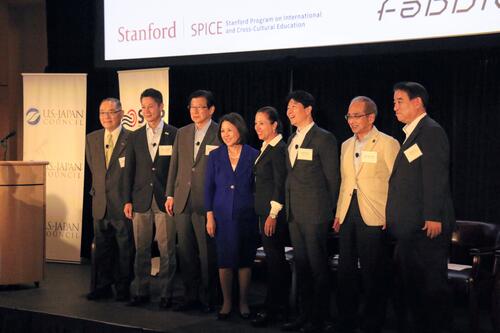
On August 26, 2019, SPICE/FSI served as the Stanford University host of the California-Japan Governors’ Symposium, which was co-hosted by the U.S.-Japan Council (USJC) and the Silicon Valley Japan Platform (SVJP). Four governors and one vice governor from Japan were in attendance along with dignitaries from California.
Dignitaries from Japan
Mr. Katsusada Hirose, Oita Prefecture Governor
Mr. Ryuta Ibaragi, Okayama Prefecture Governor
Dr. Heita Kawakatsu, Shizuoka Prefecture Governor
Mr. Yutaka Ota, Nagano Prefecture Vice Governor
Mr. Hidehiko Yuzaki, Hiroshima Prefecture Governor
Dignitaries from California
Ms. Eleni Kounalakis, California State Lieutenant Governor
Mr. John Roos, former U.S. Ambassador to Japan
Mr. Tomochika Uyama, Consul General of Japan in San Francisco
The goal of the Symposium was to create an opportunity for leaders from Silicon Valley and Japan to come together, reinforce relationships, consider new ways of thinking, initiate dialogue, and catalyze outcomes that benefit both the United States and Japan. USJC President Irene Hirano, California State Lieutenant Governor Kounalakis, and Ambassador Roos set the context for the Symposium by highlighting the interdependence of Japan and California broadly—and Silicon Valley specifically—historically, economically, and socially.
The Symposium featured one panel and two sessions. First, Stanford Emeritus Professor, Shorenstein Asia-Pacific Research Center Co-Founder, and Co-Chair of the SVJP Executive Committee Dr. Daniel Okimoto moderated a panel that featured the governors and the vice governor sharing some of the challenges and opportunities in their prefectures with a special focus on their prefectures’ relationship with Silicon Valley and institutions of higher learning like Stanford. Second, SPICE Director Dr. Gary Mukai moderated an education-focused session that explored issues at the intersection of education and global citizenship. SKY LABO Co-Founder Dr. Rie Kijima and SKY LABO Co-Founder and SPICE Instructor Dr. Mariko Yoshihara Yang spoke about their work in fostering the next generation of innovative human resources in STEAM (Science, Technology, Engineering, Arts, and Mathematics) education with special attention to girls’ and women’s education. They were followed by Governors Hirose, Ibaragi, and Yuzaki, who shared education-related priorities and concerns in their prefectures, e.g., declining school enrollment especially in rural areas, low numbers of Japanese students choosing to study abroad, and empowering Japanese students with global points of view. Third, Dr. Devang Thakor moderated a healthcare-focused session. Stanford Associate Professor Phillip Yang, a cardiologist, and Dr. Caleb Bell, G4S Capital and Ikigai Accelerator, shared comments on the application of AI and machine learning to medical diagnosis and treatment. Also in the session, Governor Kawakatsu and Vice Governor Ota shared reflections on health-related topics such as aging societies, the rising cost of healthcare, and prevention and wellness.
In his closing comments, Okimoto noted that he hopes to convene another symposium with the governors from Japan in three to five years. The goal of the symposium would be to share and discuss the progress that has been made since last month’s gathering.
Over the next three to five years, SPICE plans to do its part—in at least five areas—in terms of building upon the discussion from the education-focused session. First, later this month, Mukai will be offering the first class of Stanford e-Oita, an online class on U.S. society and culture that SPICE will offer to high school students in Oita this fall. Second, Rylan Sekiguchi, Instructor of Stanford e-Hiroshima, will begin instruction from this fall of an online class on U.S. society and culture that SPICE will offer to high school students in Hiroshima. Third, Yang will be visiting Hiroshima in November to meet Governor Yuzaki as well as to offer the final class of the Stanford-Hiroshima Collaboration Program, which will be offered to MBA students at the Prefectural University of Hiroshima and other universities also from this fall. Fourth, SPICE will continue to assist Okayama Prefecture and Shizuoka Prefecture on their educational efforts in areas like sister city school programs and engaging their students in Stanford e-Japan, a national online class that SPICE offers to high school students throughout Japan. Stanford e-Japan is taught by Waka Takahashi Brown and Meiko Kotani. Fifth, SVJP Executive Director Kenta Takamori and Mukai recently shared reflections on the Symposium and their work with the prefectures on NBC Bay Area. They hope to continue to inform the broader Silicon Valley community of the outcomes of the Symposium.
Professor Okimoto, Governor Yuzaki, Governor Kawakatsu, Ms. Hirano, Lieutenant Governor Kounalakis, Governor Ibaragi, Governor Hirose, Vice Governor Ota
Education session with Dr. Mariko Yoshihara Yang, Dr. Rie Kijima, Governor Ibaragi, Governor Hirose, Governor Yuzaki | Rylan Sekiguchi
All News button
1
Subtitle
On August 26, 2019, SPICE/FSI served as the Stanford University host of the California-Japan Governors’ Symposium, which was co-hosted by the U.S.-Japan Council (USJC) and the Silicon Valley Japan Platform (SVJP).
On August 9, 2019, six students from SPICE’s Stanford e-Japan online course and three students from the Reischauer Scholars Program (RSP) were recognized during the 13th annual Japan Day at Stanford University. The nine honorees had the chance to share presentations of their research papers with an audience that included Consul General Tomohiko Uyama (Consulate General of Japan in San Francisco), Ambassador Michael Armacost (former U.S. ambassador to Japan), SPICE supporter Amanda Minami Chao, and Stanford Professor and SPICE advisor Indra Levy.
The program began with opening remarks by Consul General Uyama and his words resonated in me as I grappled with the fact that the celebratory Japan Day was being held on a solemn occasion, the 74th anniversary of the atomic bombing of Nagasaki. Consul General Uyama stated:
The Japan–U.S. alliance is the cornerstone of security, stability, and prosperity in the Asia-Pacific region. As we look at the global challenges we face today, I believe that we must strive to ensure that our special relationship remains strong and vital. One way to accomplish this is by preparing the best and brightest of our young people with the kind of learning opportunities that will deepen mutual understanding. The RSP and the Stanford e-Japan are admirably working toward this goal by providing the knowledge and expertise our young people will need as future leaders in Japan–U.S. relations.
After hearing Consul General Uyama’s comments, I came to the realization that honoring young future leaders from both countries on the 74th anniversary can symbolize the ray of hope for global peace that I feel with programs like the RSP and Stanford e-Japan. The presentations that the nine students made confirmed this feeling. Though the topics of their presentations were varied—ranging from historical topics like post-World War II art in Japan to contemporary social issues in Japan—a common thread among all was the significance of the U.S.–Japan relationship to the security of the world. Their presentations were followed by the awarding of plaques and lunch. During the program and a tour of campus, one could witness the budding relationships between the Japanese and American students.
SPICE student honorees and instructors at Stanford Japan Day 2019
Stanford e-Japan is an online course, which focuses on U.S. society and culture and U.S.–Japan relations, that SPICE has offered to high school students in Japan for five years. The current supporter of the course is Mr. Tadashi Yanai, President of the Yanai Tadashi Foundation, Tokyo. “Carving a brighter future” is at the core of the Foundation’s mission and I hope that all RSP and Stanford e-Japan alumni keep this mission close to their hearts. One of the key programs of the Foundation is the Yanai Tadashi Scholarship Program, which awards scholarships to Japanese students who enroll at select universities in the United States. Several Stanford e-Japan alumni and Stanford students are recipients of the Scholarship.
The 2018 spring and fall Stanford e-Japan course instructors were Elin Matsumae and Waka Takahashi Brown, respectively. Key themes like interdependence, multiple perspectives, and diversity were emphasized in their online courses. Naoya Chonan, Waseda University Senior High School, Tokyo, reflected, “The Stanford e-Japan program was different from any classes at my school in terms of diversity. It prepared an opportunity to compare diverse ideas from all over Japan and the U.S. Collaborative coursework with excellent students taught me the importance of realizing and embracing differences of viewpoints and opinions among people.”
This comment resonated in Brown who noted that the annual Japan Day celebration is so rewarding not only for the students, but also for the instructors. “The students always amaze me with their extraordinary scholarship and poise during their presentations. Perhaps what is most gratifying, however, is the campus tour that we end our day with in which the students are relaxed and happy. It’s during this time they talk with each other about their dreams and future plans. I have no doubt these are the future leaders of the next generation.”
The RSP is an online course that SPICE has offered to high school students in the United States for 16 years. The course introduces Japanese society and culture and U.S.–Japan relations and has enrolled students from most states. Since the inception of Stanford e-Japan, RSP Instructor Naomi Funahashi and Brown have facilitated joint online classes with RSP and Stanford e-Japan students. Funahashi reflected, “It is so rewarding to see the RSP and e-Japan honorees be recognized for their tremendous efforts in their respective courses. Japan Day is a unique opportunity to bring these remarkable students physically together, and it really gives them a chance to learn from one another and deepen the meaningful ways in which these courses connect young leaders across the U.S. and Japan.”
Japan Day was clearly meaningful to the students as well. Sandi Khine, Arcadia High School, Arcadia, California, commented in a follow-up note to Funahashi, “Thank you so much! I’m still kind of in shock that today happened, it feels like such a dream! I had so much fun today meeting Jaimie and Mei and all the other Stanford e-Japan students. I’ll definitely look back on this with lots of love.”
Lantern with the word “heiwa” (peace) in Nagasaki, 74th anniversary of the atomic bombing
Following the Japan Day ceremony, I read about the 74th anniversary ceremonial events that took place in Nagasaki. One of the traditional ceremonial events on the anniversaries of the atomic bombings of Hiroshima and Nagasaki has been the lighting of lanterns. While watching the American and Japanese students receive plaques from their instructors, one could definitely see a glow in each one of them and also in their instructors. I felt a surge of pride in the students, of course, but also in their teachers—Funahashi, Brown, and Matsumae—for empowering their students with such incredible learning experiences and recognition that most certainly brightened their students’ futures.
(Image at right: Lantern with the word “heiwa” (peace) in Nagasaki, 74th anniversary of the atomic bombing; photo credit: Jiji Press.)
Upon seeing the printed agenda for the “Inaugural Stanford e-Tottori Day” on August 23, 2019, Silicon Valley entrepreneur Takeshi Homma, whose hometown is in Tottori Prefecture, remarked that he never thought that he would see Tottori high school students at a ceremony at Stanford University. This prompted me to recall the initiative that Homma took several years ago to introduce me to Tottori Prefecture, the least populated in all of Japan. His vision was to bridge his ancestral home with his current home, the United States, through the establishment of an online class on U.S. society and culture for high school students in Tottori. Through Homma’s vision and the support of Tottori Governor Shinji Hirai and the Tottori Prefectural Board of Education, Stanford e-Tottori was established over three years ago. Jonas Edman has been the Instructor of Stanford e-Tottori since its inception.
The inaugural Stanford e-Tottori Day honored Ayaka Ikei of Seishokaichi High School and Yua Kodani of Tottori Nishi High School for achieving at the highest levels in the course. It began with remarks by Takuya Fukushima, Office Director of the English Education Advancement Office, Tottori Prefectural Board of Education. Fukushima commented on the significance of Stanford e-Tottori to the students who have participated, noting their growth not only in terms of their English communication skills but also their understanding of U.S. society and culture. Fukushima, as a graduate of Hiroshima University and also someone who has studied at the University of California, Santa Barbara, and Ohio State University, knows well the significance of the U.S.–Japan relationship. During his remarks and much to the delight of the audience, he shared a television news program that featured a class that Edman taught in person in Tottori in July.
Rie Kusakiyo makes opening remarks at Stanford e-Tottori Day. She is Advisor for Educational Affairs at the Consulate General of Japan in San Francisco.
Fukushima’s comments were followed by remarks by Rie Kusakiyo, Advisor for Educational Affairs at the Consulate General of Japan in San Francisco. Her words were not only inspiring to the students but she is also someone to whom Ayaka and Yua can aspire, as both students expressed an interest in studying and living in the United States, as Kusakiyo has done.
The highlight of the program was Edman’s introduction of his student honorees, Ayaka and Yua, and their heartfelt presentations, which included their aspirations for the future. During the question and answer period, their passion for helping others surfaced. Ayaka would like to go into the field of education and Yua into the field of medicine. Edman expressed how proud he is of their accomplishments and presented them with plaques.
Visiting Scholar Kenichirou Oyama, Shorenstein Asia-Pacific Research Center, noted, “I was very impressed by the presentations of the two young high school students. In addition, as I am from a provincial town myself, I feel strongly that this program offers hope for young students who live in provincial areas.” By “hope,” Oyama was referring to the fact that students in more rural areas generally have fewer educational opportunities than students in metropolitan areas like Tokyo.
Edman shares a similar sentiment. “The fact that Tottori is quite isolated is what makes the teaching of Stanford e-Tottori so rewarding for me. Making Stanford scholarship accessible to them really captures the heart of SPICE’s mission.” Earlier this year, Edman facilitated a joint online class between his students in Tottori and Japanese language students at Nueva School in Hillsborough, California, whose teacher is Yoko Sase. It was remarkable for Edman to observe how much the students shared and learned from each other. During their trip to the San Francisco Bay Area, Ayaka, Yua, and Fukushima had the chance to visit Nueva and met several of the students with whom they had previously met only virtually. Through Stanford e-Tottori, more students, entrepreneurs, and scholars in the United States are also learning about Tottori.
The fourth Stanford e-Tottori course will commence this fall with the highest enrollment to date.
Jonas Edman and Takuya Fukushima with Stanford e-Tottori student honorees Yua Kodani and Ayaka Ikei at the inaugural Stanford e-Tottori Day. | Sabrina Ishimatsu
SPICE is proud to announce a new partnership with Oita Prefecture in Japan to develop an online course for high school students in Oita Prefecture. The new program, called Stanford e-Oita, will launch in the fall of 2019 and will introduce Japanese high school students to U.S. culture and society. The students will also have an opportunity to improve their English language skills, as the course will be conducted entirely in English.
To commemorate the new online course and partnership between Stanford University and Oita Prefecture, SPICE hosted a ceremony on Stanford campus last week with Oita Governor Katsusada Hirose and a large contingent of Japanese businessmen and government workers from Oita Prefecture, including representatives from the Development Bank of Japan and Japan Semiconductor. Also in attendance was Dr. Michael Armacost, former U.S. Ambassador to Japan and an old friend of Governor Hirose.
“I am so honored to be here at the ceremony with my old schoolmate Ambassador Armacost,” commented Governor Hirose during his formal remarks. “I also extend my sincere gratitude to SPICE Director Dr. Mukai for your generous and continued support on this. It is a dream for our students to be able to take classes from Stanford University even in Oita, a regional city in Japan. I hope the agreement this time will be a great opportunity for students of both countries to learn from each other.”
Planning for the Stanford e-Oita online course is still at an early stage, but the main course topics are now being decided. Dr. Mukai moderated a discussion on possible topics for the new course, and several of those in attendance enthusiastically contributed suggestions for consideration. The SPICE staff shared their experiences teaching other online courses such as Stanford e-Japan, Stanford e-Tottori, Stanford e-Hiroshima, and the Reischauer Scholars Program (a course on Japan for U.S. high school students). Oita Prefectural Board of Education’s Keisuke Toyoda, who oversees the Stanford e-Oita online course, also offered his high-priority topics for the program, which includes entrepreneurship, Japan–U.S. relations, region-to-region partnerships, and the UN’s Sustainable Development Goals. Several others offered their suggestions, as well.
Ambassador Armacost also made formal remarks, commenting especially on the strong and natural modern partnership between the United States and Japan, but also how U.S.–Japan relations at the governmental level have evolved over time to become a more balanced relationship.
“Back in my days—in the late ‘80s, early ‘90s—the United States used to approach U.S.–Japan relations with a kind of instructional mindset. ‘How can we teach Japan to be more like us?’ I always disagreed with that approach,” shared Ambassador Armacost. “Nowadays, it seems to be much better—a more reciprocal mindset. ‘What can we learn from each other to build a better future?’”
Fittingly, it is in that same spirit of mutual respect, reciprocity, and hope for the future that SPICE and Oita Prefecture launch our new Stanford–Oita partnership and online course.
“I have a lot of expectations for the future,” commented Governor Hirose. “Thank you so much.”
Stanford e-Oita is one of several regional online courses that SPICE offers to high school students in other countries. In addition, SPICE offers national online courses to high school students in Japan (Stanford e-Japan) and China (Stanford e-China).
Hero Image
Visitors from Oita Prefecture visit Stanford for the opening ceremony of the Stanford e-Oita online course for high school students. Governor Katsusada Hirose (center with beige jacket) with Mrs. Hirose and Ambassador Michael Armacost to her right.
China Scholars Program: October 15, 2019 Sejong Korean Scholars Program: October 15, 2019 Reischauer Scholars Program: October 15, 2019
All three online courses are currently accepting applications for the Spring 2020 term, which will begin in February and run through June. Designed as college-level introductions to East Asia, these academically rigorous courses present high school students the unique opportunity to engage in a guided study of China, Korea, or Japan directly with leading scholars, former diplomats, and other experts from Stanford and beyond. High school students with a strong interest in East Asia and/or international relations are especially encouraged to apply.
“Our students always come hungry to learn,” says Dr. Tanya Lee, instructor of the China Scholars Program. “The ones who choose to apply to these kinds of online courses are typically looking for an academic challenge beyond what their normal school can offer. We’re incredibly fortunate to have Stanford faculty conducting world-class research on Korea, Japan, and China willing to share their knowledge directly with our students.”
Rising high school sophomores, juniors, and seniors in the United States are eligible to apply to any of the three programs. Students who are interested in more than one program can apply to two or three and rank their preferences on their applications; those who are accepted into multiple programs will be invited to enroll in their highest-preference course.
9/9/19 EDIT: Application deadlines updated. The deadlines for the SKSP and RSP were previously October 4, 2019. All three application deadlines are now October 15, 2019.
The RSP, SKSP, and CSP are SPICE’s online courses for high school students. In addition, we offer online courses for high school students in Japan (Stanford e-Japan) and China (Stanford e-China). To be notified when the next application period opens, join our email list or follow us on Facebook and Twitter.
The Stanford China Scholars Program (CSP) is about to launch its fifth session this fall, with 20 high school students from across the country participating in the online course. The Northeast, South, Midwest, Pacific Northwest, Texas, and California are all represented in this cohort of 10th through 12th graders. Thursday evenings, these high school students will log in and join a real-time session with a scholar from Stanford or another university to discuss an aspect of contemporary China—the U.S.–China trade war, perhaps, or the legacy of the Mao era, or internet censorship and surveillance technologies in China, or China’s efforts to combat pollution and climate change. The rest of the week is filled with readings on that theme, discussed online with classmates.
The Stanford CSP’s focus on contemporary China means that the course material is constantly changing, to keep up with the ever-shifting political landscape under the leadership of Xi and Trump. It also requires the students to engage with the idea of China as not only a thoroughly modern nation but a forward-looking one, challenging the tendency to essentialize China as an ancient civilization mired in the past. Former CSP student Angela Yang (Fall 2018) credits the online course with helping her “contextualize China’s transformation as it’s happening, which is something you wouldn’t really be able to study in any other kind of course.”
Although all of the high school students are exceptionally well prepared academically, their background knowledge on China at the beginning of the online course varies considerably. Some bring strong knowledge of international issues generally, but little specific to China; some have already studied China in some depth. A few come from Chinese families, and a third to a half of the students have been studying Chinese language for several years.
Over the past year, attention has gravitated towards the U.S.–China trade war, perhaps inevitably, and its roots and possible outcomes, as well as the PRC’s ramping up of censorship and surveillance technologies, particularly in Xinjiang. Yet overall, discussions with our guest experts and among the students are fundamentally optimistic: constructive change is possible, and the United States and China have far more to gain from peace than from conflict.
The students round out the program with an independent research paper. Students’ chosen research topics in 2018–19 were as diverse as they were. Example research papers included a discussion of the United Nations Convention on the Law of the Sea as it applies to China’s claims in the South China Sea; the mental health of rural “left-behind” children; China’s economic expansion in Africa; rock ‘n’ roll in the democracy movement of the 1980s; the international effects of China’s restrictions on imported waste for recycling; and many others.
In synthesizing knowledge this diverse, students come to understand just how complex China and the challenges it faces are. They can no longer reduce China to simple generalizations. “The truth is that all of China’s problems aren’t just limited to numbers, statistics or graphs,” Junhee Park (CSP Spring 2018) wrote in response to a documentary film on migrant workers. “They affect everyone of us, whether we are Chinese or not.”
SPICE’s Stanford e-Japan Manager and Instructor Waka Takahashi Brown has won the 2019 Elgin Heinz Outstanding Teacher Award for her teaching excellence with Stanford e-Japan, an online course that introduces U.S. society and culture and U.S.–Japan relations to high school students in Japan. Stanford e-Japan is currently supported by the Yanai Tadashi Foundation. Initial funding for Stanford e-Japan was provided by the U.S.-Japan Foundation. Brown will formally accept the award at a ceremony at Stanford University on December 5, 2019.
“Waka walks in the footsteps of Elgin Heinz as a key leader in educating the next generation about the U.S.–Japan relationship,” stated David Janes, Chair of the Board, EngageAsia. Janes has overseen the Elgin Heinz Outstanding Teacher Award since its inception in 2001.
EngageAsia administers the Elgin Heinz Outstanding Teacher Award, which is funded by the United States-Japan Foundation. The Award recognizes exceptional teachers who further mutual understanding between Americans and Japanese. The 2019 Award focused on the humanities and the 2020 Award is expected to focus on Japanese language. It is named in honor of Elgin Heinz for his commitment to educating students about Asia as well as for the inspiration he has provided to the field of pre-collegiate education.



 SPICE student honorees and instructors at Stanford Japan Day 2019
 Lantern with the word “heiwa” (peace) in Nagasaki, 74th anniversary of the atomic bombing

 Rie Kusakiyo makes opening remarks at Stanford e-Tottori Day. She is Advisor for Educational Affairs at the Consulate General of Japan in San Francisco.


