Last week, 23 educators from across North America gathered at Stanford University for the 2019 East Asia Summer Institute for High School Teachers, a teacher professional development seminar offered by SPICE in partnership with the National Consortium for Teaching about Asia. Over three days of rich content lectures, discussion, and experiential learning, institute participants deepened their background knowledge on Asia and began to rethink and revamp their curriculum plans for the coming school year.
This year’s participants came from as far away as Concord, New Hampshire and Vancouver, Canada, although most attendees were high school teachers in the San Francisco Bay Area. They represented a wide range of teaching subjects, from history and language arts to statistics and genocide studies, but all sought to strengthen their teaching through a clearer, more nuanced understanding of Asia, U.S.–Asia relations, and the Asian American experience—the three main areas explored in this year’s summer institute.
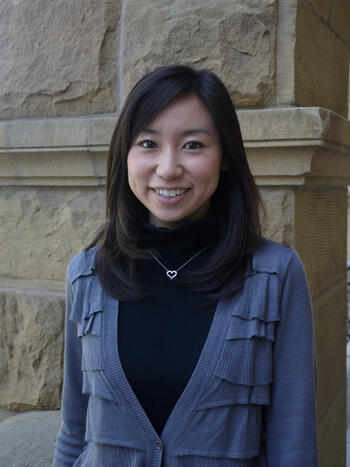
Participant Hellie Mateo poses with a book she made by hand using traditional Japanese book-binding methods.
The institute’s guest speakers came from similarly diverse backgrounds, being scholars, artists, authors, and Stanford University professors with expertise on a specific aspect of Asia, U.S.–Asia relations, or the Asian American experience. Interwoven between their captivating content lectures were classroom-focused lesson demonstrations, hands-on activities, and pedagogy discussions facilitated by SPICE curriculum designers. “We make sure we balance subject-matter content with practical application in all of our teacher professional development seminars,” notes SPICE Director Dr. Gary Mukai. “That’s why we focus so much time and energy on pedagogy and lesson demonstrations. We want to help high school teachers translate their newfound knowledge directly into the classroom.”
To that end, summer institute participants each receive several free books, films, and SPICE lesson plans to help them bring Asia alive for their students. They also receive a stipend and become eligible for three optional units of credit from Stanford Continuing Studies.
“Being in the Bay Area—and particularly at Stanford University—we have access to such incredible experts on these subjects,” says institute coordinator and facilitator Naomi Funahashi. “Our job is to connect those experts with teachers in a way that supports teacher needs. That’s our goal for this summer institute.”
Although the high school teachers have now returned home from Stanford campus, their work is not done. They will now use the content they learned at the summer institute to create original lesson plans to incorporate into their own practice. When they reconvene for a final online session in late July / early August, they will share their lesson plans with each other, and each teacher will walk away with 22 brand new lesson plans designed by their colleagues. “We can’t wait to see what kinds of innovative lessons our teachers will come up with!” says Funahashi. “And we can’t wait to see how they incorporate these new lessons into their plans for the next school year.”
To view photos from the summer institute and read a more comprehensive recap what happened, please see the SPICE Facebook page.
The following reflection is a guest post written by Stacy Shimanuki, SPICE student intern and a 2018 alum and honoree of the Reischauer Scholars Program. In the fall, she will be a freshman at the University of Pennsylvania.
My passion for Japan extends deep into my very identity as Japanese American. I am ethnically half Japanese and half Chinese; my great grandfather was an immigrant from Japan and thus, I am yonsei or fourth-generation Japanese American on my paternal side. My Japanese American grandfather was born in Hawaii and survived the Pearl Harbor bombing on Oahu; he went on to help make history in the renowned U.S. 100th Battalion and the Military Intelligence Service (MIS) as a Japanese language translator in Myanmar during World War II. I grew up visiting sites like the “Go For Broke” Monument in Los Angeles, the Military Intelligence Service Historic Learning Center in San Francisco, and the Nisei Veterans Memorial Center on Maui. This family history and heritage are always with me, and frames my experience with Japan and with U.S.–Japan relations.
However, because my ancestors immigrated to the United States so long ago, my father and most in his generation cannot speak Japanese and know relatively little of the culture; most of my generation knows even less about Japan. Moreover, since I don’t often visit my Japanese American side of the family in Hawaii, I’m much more familiar with my Chinese cultural heritage and Chinese American relatives here in California, and even identified more as Chinese American when I was younger. Yet, my interest in Japan remained, rekindled by my academic experience with Japan, both through Japanese language studies in high school and SPICE’s Reischauer Scholars Program (RSP), a rigorous and intellectually stimulating online course for high schoolers passionate about Japan and U.S.–Japan relations.
At my high school, beyond foreign language classes, the only international-related courses available were a semester of Global Studies freshman year, AP World History, and AP Human Geography—all three of which I took. However, despite fulfilling the core standards and even being excellent classes, none of them offered an intensive focus on a specific region, much less a single country. Through the RSP, as a mere high school senior I was granted the opportunity to explore a myriad of fascinating topics at a high academic level, such as: conflicts over the historical legacies of Japanese aggression in East Asia during World War II, the aging population and its impact on social perspective, the influence of traditional Buddhist and Shinto thought on a society normally considered extremely secular, the bursting of Japan’s economic bubble and recent recovery, and a variety of other issues.
Moreover, almost no high school class teaches material the way the RSP does. Instead of relying on textbooks and handouts, we learned from more engaging sources: biographies and memoirs, academic journal excerpts, news articles, and lectures and discussions with professionals and expert scholars. Our various speakers such as former Ambassador Caroline Kennedy, a practicing Buddhist monk, a Japanese American internee, a Foreign Service Officer in Japan, and professors from both Japanese and American top-tier universities shared valuable knowledge, moving personal stories, and professional expertise and advice. The students also learned from each other; my classmates, selected for the RSP not only for their interest in Japan but also for their diverse perspectives and critical thinking and communication skills, contributed to thought-provoking and interdisciplinary discussion forums.
Additionally, the basic structure of the RSP—self-driven online learning—lent the freedom to truly learn for the sake of learning and the pursuit of knowledge. It was perhaps the first time I gave my all to studying merely because I was fascinated; at times it didn’t even feel like studying, just reading about and further researching aspects that struck me with interest, puzzlement, and excitement. Certain topics also struck a personal chord; for example, studying Japanese American internment prompted me to reflect on my own family’s struggles during the war both as internees and in the MIS. This in turn sparked me to individually research a longtime curiosity I had always wondered about but never looked into before—that is, the existence or not of World War II Japanese American spies for Japan. The topics that compelled me to individually dive deeper naturally sprouted into my final research project, connected under the theme of language, another area I love and credit with my original attraction to Japanese studies.
Student honorees of the 2018 Reischauer Scholars Program with Consul General Tomochika Uyama and RSP Instructor Naomi Funahashi.
On SPICE’s Japan Day 2018, I was one of three RSP student honorees and had the opportunity to present my research on the power of Japanese language during the World War II era as a weapon of nationalism, a weapon of assimilation in Korea and Taiwan, and a weapon against peace through mistranslation, and during the postwar period as a hope-inspiring instrument of internationalism. Sharing my findings with and meeting Stanford faculty and Japanese and Japanese American leaders, as well as exchanging friendship and discussion with the Japanese student honorees of SPICE’s e-Japan program, were the ultimate culmination of my semester in the RSP and a doorway into opportunities and people in the U.S.–Japan community.
That is the beauty of the RSP: the opportunity to discover Japan on a scholarly level rarely found otherwise, self-driven but supported by a dedicated instructor, fascinating speakers, and diverse and enthusiastic fellow students. For self-motivated students wanting to learn about Japan, to discover a love for learning, and to expand their perspective and worldview, the RSP is an absolute gold mine.
For me, it was also the stepping stone and foundation for a path of global discovery, scholarship, and service. The summer after the RSP, I received a scholarship to study abroad in Kyoto for a month, attending a private language school in the mornings and exploring the city in the afternoons. As my first time in Japan, I not only fell in love with the beautiful landscape—the endless sea of green mountains punctuated by bits of city or the brilliant fireworks display at Lake Biwako—but also the people, appreciating the friendly warmth of my host family and the kind earnestness of Japanese university students, whom I now consider close friends. This past year, I immersed myself in studying Mandarin at a high school in Beijing as a gap year through the National Security Language Initiative for Youth (NSLI-Y), following my aspiration of being trilingual in Japanese, Mandarin, and English. Currently, I am incredibly grateful to work with SPICE for the summer as an intern, connecting further with the people and projects that have had such an impact on my education. And this fall, I will enter the University of Pennsylvania in the dual degree Huntsman Program in International Studies and Business. Focusing specifically on Japan and Japanese language, I will also study abroad for a semester at Hitotsubashi University in Tokyo. From my birth and family background, to my academic experiences including the RSP and my aspirations of East Asian expertise and contributing to diplomatic friendship across the Pacific, my journey is inextricably tied with Japan and her people.
Nearly 10 years ago, the 9/11 Tribute Museum in New York City reached out to SPICE following the donation of an origami crane to the Museum. This partnership led to a collaborative “Kamishibai Project” between the Museum and SPICE. The crane was folded by Sadako Sasaki, a girl who died in 1955 at the age of 12 of leukemia caused by exposure to radiation from the atomic bombing of Hiroshima. Sadako believed that folding 1,000 origami cranes would help her to regain her health. The origami crane was donated to the Museum by Sadako’s brother as a symbol of peace.
Illustration of the Children’s Peace Monument in Hiroshima, appearing in SPICE's “Sadako’s Paper Cranes and Lessons of Peace.” Artwork by Rich Lee.
In Hiroshima’s Peace Memorial Park there is a statue of Sadako raising a large paper crane over her head. Her statue stands as a monument to peace and commemorates the thousands of children who died from the atomic bombing of Hiroshima. Students from the United States and many other countries send thousands of origami cranes annually to the monument in a gesture of peace.
During his visit to Hiroshima last month, Rylan Sekiguchi had the chance to visit the statue of Sadako with Hiroshima Jogakuin Senior High School student Utako Hada, who leads tours of the Hiroshima Peace Memorial. He learned from Hada and her teacher, Gerald O’Sullivan, that approximately 330 students from Hiroshima Jogakuin died from the atomic bombing. Hada informed Sekiguchi that those students were in morning chapel at the time of the blast. This had a profound impact on Sekiguchi and his desire to include peace education as a central part of Stanford e-Hiroshima, a new online course for high school students in Hiroshima that will be offered from September of this year. The online course is currently in development, and Sekiguchi will serve as the course instructor.
Sekiguchi had the honor of meeting with Governor Hidehiko Yuzaki of Hiroshima Prefecture, who in 2011 announced the “Hiroshima for Global Peace” initiative, a road map for nuclear abolition. Sekiguchi had the chance to discuss the development of the new online course with him. Commenting on Stanford e-Hiroshima, Yuzaki stated,
As Governor of Hiroshima, I see the value of engaging the “best and brightest” students in Hiroshima in an intensive study of U.S. society and culture that underscores the importance of U.S.–Japan relations. I believe that Stanford e-Hiroshima will encourage students in Hiroshima to study abroad in the United States as I did. As an alumnus of Stanford University (MBA, ’95), I feel strong ties to the university and to many of its faculty like Professor Daniel Okimoto, an advisor to SPICE.
Sekiguchi also had the opportunity to meet with Superintendent Rie Hirakawa of the Hiroshima Prefectural Board of Education. Hirakawa noted, “As you know, the United States and Hiroshima have had a long important relationship and this new online course would help to ensure that the relationship remains a positive one.” With recommendations from Hirakawa, Sekiguchi visited seven high schools in Hiroshima Prefecture with several teacher consultants, including Rika Ryuoh and Nobuo Kawahara, and met with principals, teachers, and students who helped him further solidify the content and structure of Stanford e-Hiroshima. Two of the schools—Hiroshima University High School, Fukuyama, and Hiroshima Junior and Senior High School—have the designation of Super Global High Schools that “aim to foster globalized leaders who will be able to play active roles on the international stage.” This goal will align well with Stanford e-Hiroshima, which seeks to underscore the importance of helping high school students understand the interdependence between Japan and the United States. In addition to peace education, other course topics will likely include early Japanese immigration to the United States from Hiroshima, entrepreneurship between Hiroshima and the United States, and Hiroshima’s sister city relationship with Honolulu, Sekiguchi’s hometown.
As part of the online course, Sekiguchi also hopes to engage high school students in Honolulu with the Stanford e-Hiroshima students. Upon hearing this, I immediately envisioned these students as future messengers of peace between Japan and the United States, as I hope that Stanford e-Hiroshima will provide a platform for students to symbolically “share cranes” or messages of peace across the Pacific and seriously consider the goals of Governor Yuzaki’s “Hiroshima for Global Peace” initiative and their possible roles in it.
From left to right: Superintendent Rie Hirakawa, Stanford e-Hiroshima Instructor Rylan Sekiguchi, and Governor Hidehiko Yuzaki
Hiroshima Prefectural Board of Education
All News button
1
Subtitle
Stanford e-Hiroshima seeks to underscore the importance of helping high school students understand the interdependence between Japan and the United States.
Nearly one year ago on August 10, 2018, SPICE honored the top three students in the 2018 Reischauer Scholars Program (RSP). The students gave presentations based on their final research papers and were honored by their instructor, Naomi Funahashi. One of the RSP honorees was Stacy Shimanuki, then a senior at Amador Valley High School in Pleasanton, California. While listening to her impressive presentation on the Pacific War, I recall continually having to remind myself that she was a high school student. After spending a gap year participating in a Mandarin language immersion program in Beijing through the Department of State’s National Security Language Initiative for Youth, Shimanuki is now working at SPICE as a summer intern.
For her internship at Stanford, Shimanuki is undertaking a list of tasks, which is growing steadily given her immense talents. As an RSP alumna and soon-to-be undergraduate student, she brings a unique perspective to SPICE’s work—especially in the area of curriculum development for high school students. Funahashi commented, “It is enormously rewarding to have one of my former students here at SPICE this summer, and I’m thrilled to have her as a colleague. SPICE is fortunate to have not only a brilliant student but also a person with exemplary interpersonal skills and tremendous focus. Stacy’s future is so bright. All of us at SPICE are excited to see the growth in her capacity for leadership in U.S.–Asia relations as she begins her undergraduate career this fall.”
Following her summer internship at SPICE, Shimanuki will be attending the University of Pennsylvania as a Huntsman Scholar. She will be enrolled in the Huntsman Dual-Degree Program for International Studies and Economics through the Wharton School of the University of Pennsylvania. Students like her make our work at SPICE incredibly rewarding.
Hero Image
Reischauer Scholars Program honoree Stacy Shimanuki presents her research at Stanford University during Japan Day 2018.
This year, the Sejong Korean Scholars Program (SKSP) concluded its sixth year with its largest cohort of 22 students from across the United States. The SKSP is an intensive online course offered by the Stanford Program on International and Cross-Cultural Education (SPICE) at Stanford University for exceptional U.S. high school students who want to engage in an in-depth study of Korea, exploring its history, religion, culture, and relationship with the United States. Students who successfully complete the course earn credit from the Stanford Continuing Studies Program and a Certificate of Completion from SPICE, Stanford University.
Each year from March to June, students in the SKSP online course carry out rigorous coursework that consists of weekly readings, online lectures, assignments, discussion posts, and “virtual classroom” video conferencing sessions, where students engage in live discussion with each other and a guest speaker who is an expert-scholar on the topic of the week. As their culminating final project, students write independent research papers which are printed in journal format at the conclusion of the course.
The SKSP online course offers a unique opportunity for high school students to study Korea and U.S.–Korean relations in a college-level-type course that draws on the wealth of expertise and scholarship on Korean Studies at Stanford University. Top scholars, experts, and former diplomats at Stanford University as well as other universities in the United States provide thematically organized online lectures. The themes for each week include traditional Korean culture, religion, colonial history, the Korean War, post-war recovery, North Korea, modern South Korean society and its educational system, and Korea’s transnationalism. In addition to the recorded online lectures, the guest speakers for the weekly virtual classroom sessions engage in discussions with students and provide answers to their questions.
The co-instructors for the course, as well as guest speakers, often note the quality and maturity of students’ thoughtful insights and questions. Co-instructor HyoJung Jang has noted that “the talented and engaged high school students who participate in the SKSP online course bring their intellectual curiosity, critical thinking skills, and enthusiasm for learning about Korea and its popular culture. On top of their full academic load at their respective high schools across the country, these students go above and beyond to commit to SKSP’s demanding coursework and participate fully in the course as Korea scholars-in-training.”
“Over the past four months, our students have formed a community where they actively engage in intellectual discussions with each other—exchanging their ideas, thoughts, reflections, experiences, and perspectives on various topics,” commented co-instructor Jonas Edman. “For instance, some students contributed their own interpretations and explanations for the stark difference between the Taiwanese colonial experience and memory of Japanese rule and that of Korea. When discussing the issue of ‘comfort women’ during Japanese colonial rule in Korea, one student shared a personal story about his great-great-grandmother’s similarly painful experience under foreign rule in Eastern Europe and powerfully advocated for the importance of justice. Other students shared about their assessments of the roles of the U.S. and South Korean leaders—in addition to the roles played by North Korea, China, and Russia—on the outbreak of the Korean War and its aftermath.”
Alongside their academic engagement with each other, students have also bonded over their shared interests in Korean food and popular culture, namely “K-pop, K-dramas, and K-movies.” Some students chose to write their final research papers on analyzing Korean popular culture. Other discussions on the modern Korean education system have even incorporated students’ personal observations of the education issues portrayed in a popular Korean drama. These interests are encouraged, as students are urged to creatively explore the topics most interesting to them for their final research paper.
One of the strengths of the SKSP online course is that it encourages high school students to consider different perspectives on various issues, think critically about those different perspectives, and develop their own informed opinions. Reflecting on her participation in the course, Chloee Robison, a high school student from Indiana, said, “SKSP was a unique opportunity to explore my interest in Korean history. Even though I am not of Korean heritage, I felt deeply connected to the course material, and I found the lectures to be quite informative and engaging. Coming from a region that is largely homogeneous, hearing the perspectives of diverse-minded students opened my eyes to issues and ideas that I would have otherwise been blind to. I am so grateful to everyone involved in the course, and I would recommend it to all students who wish to challenge themselves and expand their knowledge of Korean history and culture.” Chloee’s research project on Korea’s March First Movement earned first place in Indiana’s National History Day competition.
The popularity and demand for Stanford’s SKSP online course on Korea grows each year. Interested high school students are encouraged to apply early for the program. The application period is between late August and early October each year for enrollment in the online course the following year. The online application can be found on the SPICE website at sejongscholars.org.
To be notified when the next Sejong Korean Scholars Program application period opens, join our email list or follow us on Facebook and Twitter.
The 2019 Education Partnership for Internationalizing Curriculum (EPIC) Symposium brought together community college faculty and administrators from across California to discuss ways to prepare students for an increasingly globalized world.
“Today, more than ever, our students need to be equipped with the critical thinking, communication, socio-emotional, and language skills to work collaboratively with people in the United States and all over the world,” said Dave Dillon, a professor at Grossmont College, who is curating a textbook chapter on cultural competency for use in open educational resources.
Stanford e-Japan Program for high school students in Japan Fall 2019 session (October 2019 to February 2020) Application period: June 24 to August 1, 2019
All applications must be submitted at https://spicestanford.smapply.io/prog/stanford_e-japan/ via the SurveyMonkey Apply platform. Applicants and recommenders will need to create a SurveyMonkey Apply account to proceed. Students who are interested in applying to the online course are encouraged to begin their applications early.
Accepted applicants will engage in an intensive study of U.S. society and culture and U.S.–Japan relations. Ambassadors, top scholars, and experts from Stanford University and throughout the United States provide web-based lectures and engage students in live discussion sessions.
“[The Stanford e-Japan online course] was an exceptional opportunity to assimilate fresh insights on U.S.–Japan relations and produce my own ideas via active discussion,” reflects Anna Oura, a recent alum of the program. “Every week I would excitedly wait for Saturday 13:00, when I would meet my fellow scholars—virtually—and exchange opinions.”
Stanford e-Japan is offered by the Stanford Program on International and Cross-Cultural Education (SPICE), Stanford University. The Fall 2019 session of Stanford e-Japan is generously supported by the Yanai Tadashi Foundation, Tokyo, Japan.
For more information about Stanford e-Japan, please visit stanfordejapan.org.
To stay informed of news about Stanford e-Japan and SPICE’s other student programs, join our email list or follow us on Facebook and Twitter.
Since joining SPICE in 2005, my annual calendar has revolved around not spring flowers, caterpillars dangling from trees, and falling leaves around the beautiful Stanford campus, but the schedule of the Reischauer Scholars Program (RSP), Stanford’s online course on Japan and U.S.–Japan relations for U.S. high school students. As the manager and instructor of the RSP, I have had the pleasure (and truly, the honor) of teaching this online course for 14 years. We accept applications beginning in August, outreach efforts ramp up in September and October, and new cohorts of talented U.S. high school students are selected every November. With January comes the updating of the syllabus with new readings, topics, and video lectures, and identifying and inviting guest speakers for the virtual classes. And the highlight of my year—every year—is on February 1, when the new cohort signs into our online learning platform ready to engage in this new community, connect over shared interests, learn from their differences, and to embark upon the RSP journey together.
It is now early June, and the 2019 Reischauer Scholars Program is, unbelievably, soon coming to an end. This year’s RSP journey has led us through explorations of tales of samurai, the modernization of Meiji Japan through the lens of filmmaker Ozu Yasujiro, comparative perspectives on colonial and wartime legacies through textbooks, and lessons on civil liberties as told by someone who was sent to a Japanese American internment camp with his family as a 9-year-old boy.
While this online course has always approached the study of Japan and U.S.–Japan relations with an intense academic rigor befitting Stanford University, I also wanted to offer students access to the personal stories of practitioners who play an active role in Japanese society and the U.S.–Japan relationship that we study. One of the wonderful aspects of teaching online is that for our weekly virtual classroom sessions—where all students meet synchronously using Zoom video conferencing software—we are able to welcome guest speakers to join us from anywhere in the world.
As we explored the U.S.–Japan security relationship this year and the controversies surrounding the presence of U.S. military bases in Okinawa, for example, students met with an Okinawan native who works on the U.S. Air Force Base in Kadena. Learning about how her experiences and perspectives inform her own efforts to enhance U.S.–Japan relations gave the students new insight into the impact of international policy upon individuals and the communities in which they live.
For our module on U.S.–Japan diplomacy we were joined by the Principal Officer of the U.S. Consulate in Sapporo, Rachel Brunette-Chen, who talked about how her interests in connecting the U.S. and Japan have informed her career in the U.S. State Department. RSP students often cite international relations and diplomacy as two high-interest fields for their future undergraduate studies and career aspirations, so they made the most of this opportunity to ask thoughtful questions about careers in Foreign Service. Given the diverse career tracks available in the State Department, students were inspired to learn that they could take their multidisciplinary interests and apply them in an international context for years to come.
As we grappled with the various challenges facing modern Japanese society during the last few weeks of class—including students mired in a test-centric system, the demographic realities of an aging population and declining birth rates, pervasive issues of gender inequality, and minority rights, among others—it was important to gain an understanding of how these issues are being addressed and experienced by real people. Our final guest speaker for the 2019 RSP, a Japanese American entrepreneur and educator living and working in Tokyo, shared his first-hand perspectives on the state of entrepreneurship and innovation in contemporary Japan.
Perhaps the most memorable of the online video conferencing sessions this year were the two joint virtual classes with the students of the Stanford e-Japan Program. Stanford e-Japan is an online course that engages Japanese high school students in the study of U.S. society and U.S.–Japan relations, and is comprised of students from across Japan. The rich, open discussions and friendly international camaraderie fostered during these joint sessions are always a delight to observe. I know that many of my RSP students—and many of the Stanford e-Japan students, as well—will treasure these experiences and relationships for years to come.
In our virtual class on diplomacy, one student asked, “How can we, as high school students, make a real impact on the U.S.–Japan relationship?” “By taking the initiative to be active participants in courses like the Reischauer Scholars Program,” replied Ms. Brunette-Chen, “you are already on your way. In sharing what you learn about Japan, you are also raising awareness about the importance of the U.S.–Japan relationship among your peers and school communities.” Indeed, these 2019 Reischauer Scholars are already on their way. As the spring flowers, dangling caterpillars, and fall leaves continue to come and go in the years ahead, I am eager to see the different ways in which their impact upon U.S.–Japan relations will continue to take shape. Who knows? Perhaps a few will return to the RSP years from now—this time not as students, but as guest speakers who coach and inspire the Reischauer Scholars of the future.
To be notified when the next Reischauer Scholars Program application period opens, join our email list or follow us on Facebook and Twitter.
We are thrilled to welcome Dr. HyoJung Jang back to the SPICE team! Jang holds a Ph.D. in Educational Theory and Policy as well as in Comparative and International Education from Penn State University, and an M.A. in East Asian Studies from Stanford University. She has returned to SPICE as an instructor for the Sejong Korean Scholars Program, an intensive online course on Korea for high school students across the United States.
“It’s so wonderful to be back at SPICE, where my passion for education issues was sparked,” reflects Jang. “And it’s always inspiring to work with our young Sejong Scholars. Their sharp, inquisitive minds and sincere interest in Korea make me feel optimistic about the future of U.S.–Korean relations.”
At the Ronald Reagan Presidential Library in Simi Valley, California, on April 22, 2019, Secretary Norman Mineta was interviewed on stage and Rylan Sekiguchi shared SPICE’s soon-to-be-released set of free lesson plans, “What Does It Mean to Be an American?” Special guests included Louis Cannon, senior White House correspondent for The Washington Post during the Ronald Reagan administration and biographer of President Ronald Reagan; Joanne Drake, Chief of Staff and Official Spokesperson in the Office of Ronald Reagan; Japanese Americans who were incarcerated during World War II; and teachers and students. Partnering with the Reagan Library on this special event were Facing History and Ourselves, The Mineta Legacy Project, and the Japanese American National Museum.
“Could you tell us about the flag that you wear on your lapel just above your Medal of Freedom?” This was one of the questions that was asked to Secretary Norman Mineta during a recent interview at the Reagan Library. Mineta—after a pause—replied that he wears the U.S. flag pin because some people still treat him like a foreigner, even as an American-born citizen. During the interview, Mineta touched upon different aspects of his life, including being incarcerated by his own country as a 10-year-old boy in 1942, serving in the U.S. Army, and participating at the highest levels of U.S. government. Following the interview with Mineta, Rylan Sekiguchi gave an overview of several forthcoming lessons from SPICE that will use key themes from Mineta’s life to explore the central question, “What does it mean to be an American?”
Rylan Sekiguchi gives an overview of “What Does It Mean to Be an American?”
Megan Gately, Associate Director of Education at the Ronald Reagan Presidential Foundation and Institute, conducted the interview. Her opening question, regarding Mineta’s family, prompted Mineta to note, “I very carefully chose the family that I was born into”—a response that drew laughter from the audience. This was the most lighthearted moment of the interview. He then recounted a familiar American family narrative—that of his father, who immigrated to the United States seeking a better life. Mineta’s father emigrated from Japan in the early 20th century as a 14-year-old who boarded a ship in Yokohama, Japan, not knowing anything about the United States. He initially worked in farm labor camps in the Pacific Northwest and worked his way south to California.
Mineta continued by describing the shocking news of the Japanese attack on Pearl Harbor on December 7, 1941. During an emotional segment of the interview, Mineta shared that his father “couldn’t understand why the country of his birth was attacking the country of his heart… He came to love this country very, very much.” He described the resulting confusion and chaos in the Japanese American community, and how placards suddenly appeared on his neighborhood’s utility poles after Executive Order 9066 was issued on February 19, 1942. He recalled reading the placards that stated “All Japanese persons, both alien and non-alien, will be evacuated” but being puzzled by the term “non-alien.” His older brother had to explain to him that it meant “citizen.” Reflecting on that memory, Mineta emphatically stated, “That is why today I cherish the word ‘citizen,’ because the United States government—my own government—wasn’t willing to describe me as a citizen.”
Mineta and his family were initially incarcerated at the Santa Anita Race Track in Southern California and then in an internment camp in Heart Mountain, Wyoming. While in camp, his Boy Scout troop leader sent an invitation to troops outside of camp to invite them to join the Japanese American scouts in the camps. The initial replies were “no” because those on the outside thought that the camp was a POW camp with its barbed wire fences, guard towers, and machine guns. Eventually a Boy Scout troop from the town of Cody visited the internment camp. This is where Mineta met fellow Boy Scout Alan Simpson, who later became a U.S. Senator while Mineta was a U.S. Congressman. Simpson and Mineta have remained lifelong friends since then.
After World War II, Mineta served in the U.S. Army during the Korean War. He first entered elected office in 1971 when he won the mayoral race in San Jose, California. After serving a four-year term, he successfully ran for Congress. He won re-election to the U.S. House of Representatives ten times before returning to the private sector in 1995. Later, he joined the cabinets of two presidents: first, in 2000, as Secretary of Commerce during Bill Clinton’s final six months in office; then, in 2001, as Secretary of Transportation for George W. Bush.
August 10, 1988, President Reagan shaking hands with Norman Mineta after signing the Civil Liberties Act of 1988; courtesy of the Ronald Reagan Presidential Library.
Gately’s final question to Mineta focused on leadership, and Mineta directed a segment of his reply to the students in the audience. “There are two things that you own that no one else owns,” he remarked. “One is your name and the other is integrity. Do everything you can to protect your name and integrity. Because if you don’t have integrity, you don’t have anything that people can trust you about in terms of any future dealings… As you go through life, don’t take shortcuts.”
This reply led to a smooth transition to Sekiguchi, who shared an overview of the free online lessons that are being developed for high school and college students. The lessons, explained Sekiguchi, consist of six independent learning modules that each examines a key theme from Secretary Norman Mineta’s life and career: immigration, civil liberties and equity, civic engagement, justice and reconciliation, leadership, and U.S.–Japan relations. The lessons have been developed in consultation with Mineta and the Mineta Legacy Project team, including Dianne Fukami, Debra Nakatomi, and Amy Watanabe. Fukami and Nakatomi are the producers of the documentary film, Norman Mineta and His Legacy: An American Story, which will air on PBS on May 20, 2019. The event ended with a book signing of Andrea Warren’s biography, Enemy Child: The Story of Norman Mineta, a Boy Imprisoned in a Japanese American Internment Camp During World War II.