Authors
News Type
Blogs
Date
Paragraphs

I was born in Hiroshima, in the west of Japan. There are a lot of forests in my neighborhood, so many people think of it as the “countryside.” I love the nature of Hiroshima, and it has always fueled me. Surrounded by the sound of wind, frogs, and the textures of leaves, this green heals my heart. I feel that nature always tells me, “You can do that, just challenge yourself.”

This is my original background. I love my hometown of Hiroshima. However, before the Stanford e-Japan Program, I was just a girl born in the countryside. In other words, participating in this program has totally changed my life. It was a new gateway to my future—it was the gateway to a whole new world.

I was very nervous at the beginning of this program because the other students were so fluent in English. I was not confident in my English, so I hesitated to open my mouth. However, I realized this was such a precious chance to talk with other students with various backgrounds and interesting perspectives. Then, I started to communicate with them more and more.

By the end of this program, I learned about others’ views from discussion boards and made friends with them through our group assignments and by chatting with them via Zoom after the virtual classrooms. Most of them dreamed of working abroad and attending universities in foreign countries. Our dreams were diverse, but all of them had their aspirations. The more and more we got to know each other, the broader and broader my own world became. I started to think about learning abroad. I realized it was meaningful to study abroad with students from other countries to understand Japan and the world. The other students were so good at English that I was motivated to develop my skills, too.

Professors who are leaders in their fields provided brilliant classes in sociology, gender studies, and so on. This course allowed students to take classes from them and ask them questions directly. This is one of the most wonderful aspects of this program. 

My area of interest is the problems people with disabilities encounter. Therefore, “Gender, Equity, and Equality” and “Civil and Human Rights: The Martin Luther King, Jr. Legacy” were the most impressive topics for me. Those classes fired my interest in gender and human rights studies. I was able to deepen my thoughts through the discussion boards.

Participating in this program has totally changed my life. It was a new gateway to my future—it was the gateway to a whole new world.

On Japan Day, which took place at Stanford University on August 7, 2023, I talked with Stanford professors, all of whom welcomed us warmly. I made friends with the award winners of the Reischauer Scholars Program as well as ones from e-Japan. I cannot help but hope to visit Stanford again.

After graduating high school in Hiroshima, I entered the University of Tokyo and am now studying sciences. Next year, I plan to proceed to the School of Integrated Health Sciences, Faculty of Medicine. I want to research the health status of people with disabilities in Japan. I am really fascinated to study it at this university. 

In the future, I would like to contribute to realizing health equity in the world. I want to study abroad to learn more about public health in the U.S. This is my dream, which began during Stanford e-Japan.

For more information about the Stanford e-Japan Program, please visit stanfordejapan.org. The application period for the spring 2024 session will begin November 15, 2023.

To stay informed of SPICE news, join our email list and follow us on Facebook, Twitter, and Instagram.

Read More

Students, their family members, and their instructors posing in a group.
News

Top Students of Stanford e-Japan and the Reischauer Scholars Program Are Recognized at Stanford University

Congratulations to the 2022 Stanford e-Japan and 2023 RSP honorees.
Top Students of Stanford e-Japan and the Reischauer Scholars Program Are Recognized at Stanford University
Yukie Arashida, Yohkoh, Hineno, and Ami Osaka
News

Winners Announced for the Fall 2022 Stanford e-Japan Award

Congratulations to our newest student honorees.
Winners Announced for the Fall 2022 Stanford e-Japan Award
Hana Kameyama, Miyu Kato, and Yuta Muraki
News

Winners Announced for the Spring 2022 Stanford e-Japan Award

Congratulations to our newest student honorees.
Winners Announced for the Spring 2022 Stanford e-Japan Award
Hero Image
Miyu Kato at Stanford University
All News button
1
Subtitle

The following reflection is a guest post written by Miyu Kato, an alumna and honoree of the spring 2022 Stanford e-Japan Program.

Authors
Maiko Tamagawa Bacha
News Type
Blogs
Date
Paragraphs

Having been in the field of international relations for my entire career and with no professional experience as an educator, it was a big decision for me to accept the invitation to teach Stanford e-Kawasaki. It is hard to believe that four years have already passed, and the fifth year of Stanford e-Kawasaki has just started. 

An opening ceremony was held on September 30, 2023 in Kawasaki City Hall, and I was able to attend the event in person for the first time. The Honorable Norihiko Fukuda, Mayor of Kawasaki City, addressed the new students, saying “Kawasaki is a diverse city where many of its residents have come from other parts of Japan as well as from outside of Japan. As our city has proven, I want you to learn in this program that diversity brings strength, possibilities, and innovation.” Dr. Gary Mukai, Director of SPICE, encouraged the students to stay curious, think critically, and show empathy as they embarked on the six-month-long course that provides an overview of the United States with a focus on diversity and entrepreneurship. The ceremony concluded with each student giving a self-introduction in English from the podium. Seeing the spark of excitement in their eyes, I felt excited myself and fortunate as well to have this opportunity to work with young students like them. 

A few days after the opening ceremony, I visited Kawasaki High School and Tachibana High School to meet with the students from this year and last year. Students from these two public high schools are selected for participation in Stanford e-Kawasaki annually. The “senpai” (upper class) students shared their experiences with their “kohai” (younger class) students and offered advice on how to handle assignments. It was nice to see a sense of community emerging around Stanford e-Kawasaki in each school. The conversations I had with the students were also informative, and they helped me understand what this program means to them. Below are some examples of their reflections.

Before, I studied English only as a subject. Now I see it as a communication tool that changed my attitude towards English study.

Lessons on diversity gave me an opportunity to think about my identity as a Japanese living in Japan. Lessons on entrepreneurship gave me a hint to think about my future.

I enjoyed the discussion board because it was so exciting to learn what the other students thought of different topics.

I discovered myself through this program. I found out what I think, what I’m interested in, and what I want to learn.


I’m still on a learning curve, but I have come to believe that my role in this program is to help students enjoy learning. Most students are in the 11th grade when they enroll in this program. I believe that it is meaningful for them to have an opportunity to learn for the pure joy of it before they start their last year of high school when they have to study hard for college entrance exams. I also want this program to be a space where students feel encouraged to give things a try and embrace mistakes. One day I visited my son’s elementary school in Colorado and saw a poster saying, “Mistakes are proof you are trying.” I truly wish I had this poster around me when I grew up in Japan. What I can do now as an educator is to be that poster for the students. 

Kawasaki City will celebrate its 100th anniversary in 2024. I hope that the students in this program will help to shape the future of Kawasaki City in the next 100 years. 

Finally, I would like to express my deep gratitude to all the people who have supported this program. In particular, I would like to thank Mayor Fukuda for his vision and leadership. I would also like to thank Section Chief Kentaro Kojima, Kawasaki City Children’s Future Bureau General Affairs Department Planning Division, for his regular communication and support and his many predecessors who have helped to make what Stanford e-Kawasaki is today.

To stay informed of SPICE news, join our email list and follow us on FacebookTwitter, and Instagram.

Read More

Students with Mayor Fukuda; photo courtesy Kawasaki City
Blogs

Kawasaki City Mayor Norihiko Fukuda Delivers Inspirational Comments to Students

Stanford e-Kawasaki closing ceremony held.
Kawasaki City Mayor Norihiko Fukuda Delivers Inspirational Comments to Students
Stanford e-Kawasaki students and instructors
Blogs

Opening Ceremony Held for Stanford e-Kawasaki

Kawasaki Mayor Norihiko Fukuda makes welcoming comments.
Opening Ceremony Held for Stanford e-Kawasaki
Archways and pillars in Stanford University's Main Quad
Blogs

Stanford e-Kawasaki: Arches and Pillars of Support During an Unstable Time

Stanford e-Kawasaki: Arches and Pillars of Support During an Unstable Time
Hero Image
Mayor Norihiko Fukuda and Maiko Tamagawa Bacha at the opening ceremony for Stanford e-Kawasaki, September 30, 2023
Mayor Norihiko Fukuda and Maiko Tamagawa Bacha at the opening ceremony for Stanford e-Kawasaki, September 30, 2023; photo courtesy Kawasaki City Government
All News button
1
Subtitle

Mayor Norihiko Fukuda delivers inspiring remarks during the fifth opening ceremony.

Authors
Naomi Funahashi
News Type
Blogs
Date
Paragraphs

Drawing from former U.S. Ambassador to Japan Edwin O. Reischauer’s legacy of developing a deep understanding of the Japanese people, culture, and society, the Reischauer Scholars Program—a unique online program that offers U.S. high school students an opportunity for the intensive study of Japan and U.S.–Japan relations—has fostered lasting connections with Japan for young students in the United States since its establishment in 2003. Welcoming the 20th RSP cohort at the beginning of 2023 was a milestone. Online teaching and learning was somewhat of a novelty back when the RSP was envisioned in the early 2000s, with many in the first few cohorts of Reischauer scholars needing to seek out computer access and Internet connections at their local libraries in order to participate in the weekly online classes. 

As interest and funding in Japanese language waned following the bursting of the Japanese economic bubble in the early 1990s, a subsequent decline in the study of Japan at the higher education level was beginning to cause some concern within the Japan studies field. Former U.S. Ambassador to Japan Caroline Kennedy shared the following in videotaped remarks to the Reischauer scholars in 2013: “Appointed as ambassador to Japan by my father, President Kennedy, Ambassador Reischauer made tremendous contributions to America’s understanding of Japan… and he remains a model for me and all who follow in his path. As strong as our ties between the United States and Japan are, they are not self-sustaining. Our relationship is something each generation has to rediscover, recreate, and nurture.”

With these priorities in mind, SPICE sought to create a space for high school students to deeply engage in the study of Japan and U.S.–Japan relations, regardless of where in the United States they called home. Introducing students to leading scholars, experts, and diplomats who could share both American and Japanese perspectives on their studies of these two countries, Dr. David Janes, former Director of Foundation Grants at the U.S.-Japan Foundation, Dr. Gary Mukai, SPICE Director, and Ms. Waka Takahashi Brown, the inaugural instructor of RSP, set the stage for a truly unprecedented learning opportunity. I began teaching the RSP from year three.

Importantly, the RSP sought to not just offer content expertise on the history, religions, culture, society, politics, economics, and foreign policy of Japan and U.S.–Japan relations, but to create a community of learners who could discuss these topics on a deeper level that would allow for different perspectives to be shared and understood. The goal of the RSP was never to offer a solely academically-focused course on Japan and the U.S.–Japan relationship. The hope was always to foster the next generation of leaders who could come together from across the United States, bringing together their shared passion for Japan and for learning new global perspectives, and to support each other in their continued growth as individuals who hoped to make a difference in the world as they moved through their academic and professional careers.

As the academic year began to wind down in late June 2023, the magnitude of 20 years of the RSP began to settle in. Since the first RSP cohort in 2004, nearly 600 talented high school students from across the United States have gone on to lead rich and fulfilling lives which, in many cases, have continued to involve Japan. I reached out to some RSP alumni this past summer, curious about how the RSP experience has influenced the life choices of our Reischauer scholars over the years. Connecting with alumni—especially when the rare opportunities arise to do so in person, as we did over lunch at Stanford University in 2021—is always a privilege. It was both enlightening and inspiring to read reflections from 20 years of RSP alumni; the depth and scope of the RSP impact clearly varying depending on how much time had passed since they had signed off after our last virtual class together.

In the final pages of Dr. George Packard’s biography, Edwin O. Reischauer and the American Discovery of Japan, he shares that Reischauer had scribbled the following note in 1984: “Peace in this world depends on international understanding and understanding on knowledge and skills at communication. Thus, peace ultimately depends on education” (Packard 293). It is my hope that the work that students have done in this course to deepen their international understanding will have a lasting impact not only for themselves, but for the U.S.–Japan relationship and beyond. Here are a few reflections that were shared with us by RSP alumni that reflect the range of experiences—and legacies— of the RSP, in their own words.

Image
RSP reflections


Image
Carmel Mercado

RSP was my first opportunity to delve deep and learn more about Japanese culture and history through an academic lens. Growing up in borderline rural Florida, prior to RSP, my only exposure to Japan and Japanese culture was through Cartoon Network anime shows and video games. I would say my time at RSP sparked an interest to continue to learn about Japanese culture. In college, I ended up taking Japanese language courses, which led to studying abroad in Japan. I have had two careers, both in medicine and in art. In both careers and in my personal life, Japan and Japanese culture continue to be a big part of it all.

—Carmel Mercado, RSP Class of 2005


Image
Micah

After participating in the RSP in 2009, I went on to complete my undergraduate degree in Japanese Studies, graduating in 2013. The RSP laid a solid foundation for my undergraduate studies. Out of undergrad, I went straight into the JET Program where I was an assistant language teacher at the elementary and junior high school level on the island of Tokunoshima, which was historically part of the Ryukyu Kingdom but is currently administratively part of Kagoshima Prefecture. At the time I participated in RSP, I had never been to Japan but was really wanting to (re)connect with my Japanese heritage as a Nikkei gosei (fifth generation) from Hawaii. Since undergrad, I have also been exploring my Okinawan/Uchinaanchu heritage, and reflecting on RSP today, I think I'm doing much of what I did as a participant in 2009 by researching my genealogy and trying to (re)connect with indigenous Okinawan spiritual practices by learning more about lunar obon practices and doing (y)eisaa. I am also still connected to my RSP cohort members through social media. Although we don't talk much, it's nice to see how everyone is doing and how far we've come since we participated in RSP together.

 —Micah Mizukami, RSP Class of 2009


Image
Reid Pryzant

I took RSP 12 years ago and it changed my life! Growing up in rural Maine, RSP did the remote Zoom classroom experience way before it was cool...and it worked! The program exposed me to Japan's culture and history, giving me an international mindset that I've kept with me since. I remember being able to talk to high level diplomats like the former ambassador to Japan which was especially formative. Years later, my Stanford RSP experience encouraged me to pursue a PhD in Computer Science at Stanford, where my specialty became English-Japanese Machine Translation. Today, some of my best friends in the world are Japanese. I split my time between Seattle and Tokyo. I consider Japan a second home on the other side of the world, all thanks to my RSP experience which kindled the initial interest and inertia.

 —Reid Pryzant, RSP Class of 2011


Image
Vincent Wesselmann

RSP gave me a window into the college classroom while I was a high school student. From my room in Alabama, I suddenly had access to scholars, former diplomats, and experts from all over the world who gave fascinating lectures on subjects far outside my school curriculum but close to my own interests. Most importantly, however, RSP enabled me to connect with an incredibly unique group of students from all over the country, a group which became a surprisingly close online community by the end of the course.

 —Vincent Wesselmann, RSP Class of 2016


Image
Madison Mackenzie

I loved the cultural and historical lessons RSP offered me as a young scholar. They shaped my academic interests and drove me to pursue literature and cultural studies with a focus on East Asia. I went on to study abroad at Doshisha University in Kyoto during my junior year of college. After my short stint in Asia, I decided to further broaden my horizons by spending some time in Europe. I traveled on to Amsterdam, where I received a MA in comparative literature. Yet, once again, I was drawn back to Japan. I am typing this response seated in an express train speeding through Tokyo! I will spend the next year teaching English to young children in the Kanto region. Needless to say, my interest in Japan hasn’t waned in the slightest since enrolling in RSP. I’m happy to be back!

 —Madison MacKenzie, RSP Class of 2016


I applied to RSP with the motivation to learn more about my cultural background, but what I remember most vividly is the exhilarating experience of bouncing off ideas with my peers… it was during those thoughtful discussions that my knowledge of Japan (and my stance on certain issues) was enriched the most. Our intellectual exchanges reminded me that learning happens not only from the consumption of educational materials, but also from the synergy of diverse perspectives.

 —Mika Isayama, RSP Class of 2016


Image
Grace Rembert

I had an amazing experience participating in the Reischauer Scholars Program. It inspired me to participate in the Sejong Korea Scholars Program and to receive a Bachelors in East Asian Studies. Thanks to the interest in East Asia that it inspired, I have now studied abroad in Korea, traveled around Japan, and hope to participate in the JET Program. I still think about the Buddhist monk who visited our class and the stories he told us!

 —Grace Rembert, RSP Class of 2018


The RSP completely broadened my horizons with regards to Japanese culture and U.S. - Japan relations. I think so often in the U.S. we are taught with a bias towards the U.S. angle and it was so refreshing to view history through the lens of Japan and the Japanese perspective. Moreover, the RSP attracts a broad range of students from everywhere around the U.S.; the melting pot that facilitates was such a pleasure to be a part of and engaging with students with a variety of perspectives and experiences relating to Japan made the RSP extremely dynamic and engaging for me. Many of the guest speakers were extremely memorable. RSP '21 students were extremely fortunate to hear from George Takei, and my particular favorite was the film discussion we had on "大人の見る絵本 生れてはみたけれど" (I was born, but...). That film, which was silent and black and white, was so incredibly fascinating and the discussion we had on it was extremely thought provoking. In a sense that's what made the RSP so compelling -- we engaged in so many aspects and elements of Japanese history that there was something to satisfy everyone's personal interests, as well as something that sparked new interests and curiosities in everyone. Almost three years removed from doing the RSP, I look back on my experience with great fondness and am grateful for the friends I made along the way, many of whom I still am in contact with today. 

 —Jack Turner, RSP Class of 2021


I applied for RSP because I wanted to learn about Japanese history and Japanese-US relations, but what I took from the program was so much more than that. Particularly through the diverse set of speakers we had the opportunity to hear from, I was constantly realizing that no history is static, and that the study of history can not be an isolated field, it is connected to every profession and every person. My most favorite lecture was that from Andrew Lee, the U.S. Consulate General in Sapporo at the time, as I felt he showed how a deep understanding of history is vital to diplomacy. 

 —Sara Baudler, RSP Class of 2022


For more information about SPICE's online courses for students, visit our Student Programs page. To stay informed of SPICE news, join our email list and follow us on FacebookTwitter, and Instagram.

Read More

Students, their family members, and their instructors posing in a group.
News

Top Students of Stanford e-Japan and the Reischauer Scholars Program Are Recognized at Stanford University

Congratulations to the 2022 Stanford e-Japan and 2023 RSP honorees.
Top Students of Stanford e-Japan and the Reischauer Scholars Program Are Recognized at Stanford University
students gathered for a luncheon
Blogs

Reconnecting Under the Trees: An RSP Alumni Lunch Gathering at Stanford

Alumni of the Reischauer Scholars Program recently met at Stanford University over Japanese bentos and sushi.
Reconnecting Under the Trees: An RSP Alumni Lunch Gathering at Stanford
Evan Wright (front row, third from the right), Adriana Reinecke, RSP 2009 (first row, third from the left), and Monica, RSP 2013 (second row, third from the right) with the Reischauer Center staff in Mt. Vernon
Blogs

The Reischauer Legacy: How the RSP Inspired Me to Dedicate My Life to U.S.–Japan Relations

The following reflection is a guest post written by Evan Wright, an alumnus of the Reischauer Scholars Program.
The Reischauer Legacy: How the RSP Inspired Me to Dedicate My Life to U.S.–Japan Relations
Hero Image
RSP honoree giving a presentation
2023 RSP honoree Oliver Cho, Nueva School, giving a presentation on Japan Day at Stanford University on August 7, 2023; photo courtesy Mia Kimura.
All News button
1
Subtitle

Of the nearly 600 RSP alumni, many are engaged in Japan-related fields and U.S.–Japan relations.

Authors
Gary Mukai
News Type
Blogs
Date
Paragraphs

In 1858, Yukichi Fukuzawa established a school for Western studies in Edo, the former name of Tokyo. On February 9, 1860, the Tokugawa shogunate sent the first Japanese diplomatic mission to the United States and Fukuzawa was aboard the ship, Kanrin Maru, which escorted the USS Powhatan upon which the Japanese embassy traveled. The objective of the diplomatic mission was to ratify the new Treaty of Friendship, Commerce, and Navigation between the United States and Japan. After the Japanese embassy’s stay in San Francisco, the USS Powhatan continued with the embassy to Washington, DC, where they met President James Buchanan, and also visited Philadelphia and New York City. The embassy returned to Japan on November 9, 1860. Fukuzawa’s experiences with the first Japanese embassy had a profound impact on his views of education, and in 1868, Fukuzawa changed the name of the school to Keio Gijuku, a leading institute in Japanese higher education. 

One hundred and sixty-three years after Fukuzawa’s trip to San Francisco, a student delegation of 14 students from Keio University visited the San Francisco Bay Area in September 2023. The students were part of Keio University’s Global Passport Program (GPP) and represented the Faculty of Business and Commerce, Faculty of Law, Faculty of Letters, and Faculty of Policy Management. The delegation was led by Professor and GPP Chair Naoko Moriyoshi, Professor Noriyoshi Yanase, and Associate Professor Nobuhiko Kijima, all with the Faculty of Business and Commerce; and assisted by Misako Sack, a graduate of Keio University who lives in the San Francisco Bay Area.  

Keio students and faculty


The Global Passport Program, which is offered in English, is a two-term program of Keio University for junior and senior students that started in 2014 and managed by the Faculty of Business and Commerce to cultivate global leaders. A one-week overseas study program for selected students is one of the highlights of the GPP. During the recent one-week overseas study program, I had the chance to meet the student delegation at U.C. Berkeley on September 12 (photo above courtesy Global Passport Program, Keio University), and at Stanford University on September 15. At U.C. Berkeley, I was joined by KC Mukai, Assistant Director, Parent and Family Philanthropy, Berkeley Cal Parents & Families. KC (front row center in photo above) and I informally spoke with the Keio students, and KC had the chance to share her experiences as the reigning 2023 Northern California Cherry Blossom Festival Queen and her identity as a Japanese and Chinese American. 

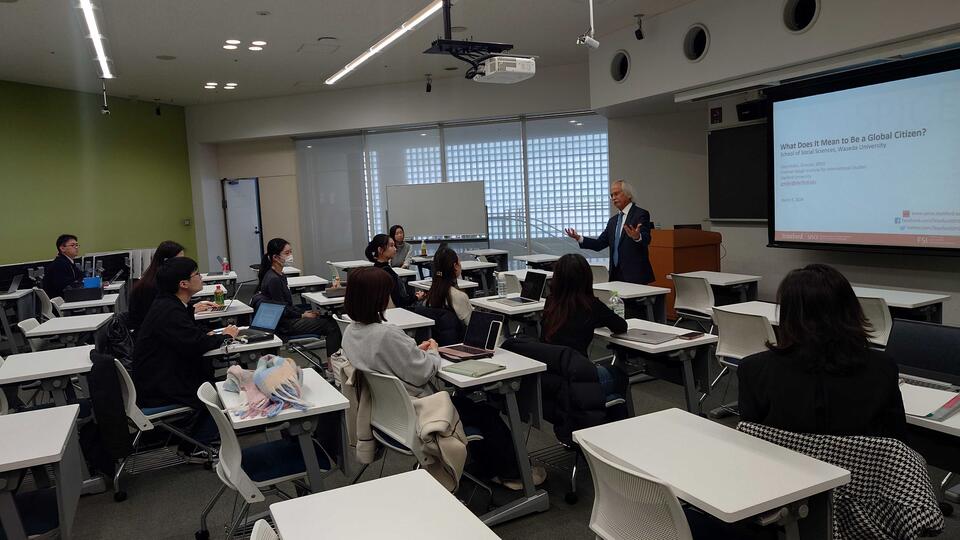
At Stanford, I had the honor of giving a lecture on “What Does It Mean to Be a Global Citizen?” While preparing my lecture, I was aware of the long history and strong synergy between Keio University and Stanford University. I located an article in the April 18, 1914 edition of The Daily Palo Alto about the Stanford-Keio baseball game that was played at Stanford. Numerous sporting events have been held between Keio and Stanford. 

There are many examples of student exchanges as well. For example, the Stanford Japan Exchange Conference includes the following on its website:  
SJEC originated in 1954 as a two-part exchange program with Keio University in Japan. This was engineered by Professor James Watkins of Stanford through his personal contacts with Keio graduates while working in Nagoya, Japan in the late 1920s. The program originally was named The Keio Committee as part of the Institute of International Relations (IIR), a larger umbrella organization. Even today, the Keio-end of the exchange is still operated under IIR. In 1991, SJEC expanded the program by including students from Doshisha University; in 2009, Kyoto University joined the program.

Another student exchange program is the Silicon Valley Keio International Program (SKIP), which notes the following on its website: 
SKIP is an international program between Stanford University students and Keio University students. Every year the program invites more than 15 Stanford students in September and is held for two weeks. Through the program, we deepen our understanding about the society and culture of both countries and discuss the futuristic Japan-America relation based on what we have learned in the program.

In addition, the Keio-Stanford LifeWorks Program brings together students from Keio University and Stanford University to engage in contemplative/artistic/somatic approaches to conflict resolution, intercultural understanding, and creative leadership development. It is led by Stanford University’s Dr. Stephen Murphy-Shigematsu and Keio University’s Dr. Yuki Imoto. 

Stanford e-Japan alumni


Lastly, many Keio alumni and faculty have studied or participated in Stanford programs. For example, in 2018–2019, Keio alumnus Junichiro Hirata was a visiting scholar with the Shorenstein Asia-Pacific Research Center’s Global Affiliates Program and is now an advisor to SPICE’s Stanford e-Japan program and Stanford regional e-Japan programs for Japanese high school students. Many alumni of these programs have gone on to study at Keio University and Stanford University. Photo above: Stanford e-Japan alumni (Jun Yamasaki, currently a PhD student in Aeronautics and Astronautics at Stanford, far left; Hikaru Suzuki, University of Tokyo graduate and now an attorney with Nishimura & Asahi, second from left; Haruki Kitagawa, Keio University graduate and now a Service Commercial Sales Executive at SAP, far right) with Stanford e-Japan spring course instructor Waka Takahashi Brown (third from left) and advisor Junichiro Hirata (second from right); photo taken on February 26, 2019.  

I can imagine how proud Yukichi Fukuzawa would be of these programs and Keio’s Global Passport Program and the 14 students whom I had the pleasure of meeting. Among the diverse student delegation were eight women and six men, including 10 Japanese, two Koreans, one Chinese, and one Taiwanese. I am so impressed with how Keio University is building upon the vision of Fukuzawa with programs like the GPP. Many of the students in the delegation have already spent significant time abroad and the GPP continues to contribute to their expanding global mindsets. For example, Keio senior and GPP member Risa Toyoda has studied at the University of Hawaii at Manoa. Reflecting on the GPP and the recent trip to the San Francisco Bay Area, she noted:

Throughout this journey, I have had the privilege to explore two important themes: “connection” and “failure.” These themes have provided valuable insights that I would like to reflect on. First, regarding “connection,” which is about building and nurturing relationships with others, I was inspired by how our trip was organized by Professor Moriyoshi, and her effort and sincerity to establish trust with people in the Bay Area. This reminded me of the crucial role trust plays in creating opportunities. I also had meaningful interactions with my fellow Overseas Field Trip (OFT) members during the week. Unlike my usual activities at Keio, this experience allowed me to engage with a diverse group, including those who have lived outside Japan. It emphasized the importance of going back to basics, especially for those visiting the United States for the first time. I would like to cherish this idea of appreciating each other’s diversity, and going back to the starting point as I start to work next year. Next, concerning the topic of “failure,” I had an opportunity to have a presentation during this trip with five other members about the challenges Japanese startups face… and was introduced to the concept of “failing forward,” which means making progress by learning from failures, even in the face of setbacks. This approach involves venturing out of one’s comfort zone, and I imagine how it will lead to success in a competitive environment… I am sure that these will undoubtedly guide my future endeavors as I continue to pursue personal and professional growth.


On November 6 and 7, 2023, I will have the honor to speak at the Mita and Hiyoshi campuses of Keio University and hope that the lectures will in a small way help to further strengthen the relationship between Keio and Stanford and build upon the vision of Yukichi Fukuzawa. I also hope to see the OFT students again and encourage them to apply for graduate school in the United States with hopes that they will seriously consider applying to San Francisco Bay Area colleges such as U.C. Berkeley and Stanford.  

To stay informed of SPICE news, join our email list and follow us on FacebookTwitter, and Instagram.

Read More

ejapanphoto
Blogs

The Future to Be Inherited

The following reflection is a guest post written by Haruki Kitagawa, a 2015 alum and honoree of the Stanford e-Japan Program.
The Future to Be Inherited
Male student with a backpack
Blogs

Stanford e-Japan: A Gate for Learning about the United States and a Mirror for Reflection on Japan

The following reflection is a guest post written by Shintaro Aoi, an alumnus of the Stanford e-Japan Program.
Stanford e-Japan: A Gate for Learning about the United States and a Mirror for Reflection on Japan
Stanford e-Japan student Ayano Hirose giving her final presentation
News

Winners Announced for the Fall 2019 Stanford e-Japan Award

Winners Announced for the Fall 2019 Stanford e-Japan Award
Hero Image
Keio students at Stanford University on September 15, 2023
Keio students at Stanford University on September 15, 2023; photo courtesy Global Passport Program, Keio University.
All News button
1
Subtitle

Keio University Founder Yukichi Fukuzawa was a member of the embassy.

Authors
News Type
News
Date
Paragraphs

SPICE’s programs for U.S. high school students are now accepting applications for next spring. Joining our long-running Sejong Korea Scholars Program (SKSP) and Reischauer Scholars Program (RSP) on Japan is a new program called the U.S.–China Co-Lab on Climate Solutions that will enroll U.S. and Chinese students together. 

The new Co-Lab program will be SPICE’s first truly transnational course, bringing equal numbers of 10th–12th graders from the United States and China into conversation to discuss the challenges with the global climate crisis. This program is based on four years of limited collaboration between SPICE’s China Scholars Program for U.S. students and the Stanford e-China Program for Chinese students.  Instructors Carey Moncaster and Tanya Lee are taking this experience to the next level by expanding the collaboration into a standalone program.

As in other SPICE online programs, Stanford faculty will be featured as guest speakers, sharing expertise on climate-related issues, U.S.–China relations, and strategies for global cooperation. Under the guidance of Moncaster and Lee, students will get to know each other’s lives and environments and work together on projects that could improve their own communities.

Meanwhile, the RSP and the SKSP will continue their academically rigorous introductions to East Asia, with students engaging with leading scholars, former diplomats, and other experts from Stanford and beyond.

High school sophomores, juniors, and seniors in the United States are eligible to apply to any of these three online courses. Students who are interested in more than one program can apply to two or three and rank their preferences on their applications; those who are accepted into multiple programs will be invited to enroll in their highest-preference course. 

Chinese students may apply to the U.S.–China Co-Lab on Climate Solutions after October 15.

Applications for all three programs can be found at https://spicestanford.smapply.io/. Deadlines vary:

  • RSP: Oct 20
  • SKSP: Nov 3
  • Co-Lab: Nov 15 for U.S. students and Dec 10 for Chinese students


For more information on a specific online course, please refer to its individual webpage at https://spice.fsi.stanford.edu/fellowship/uschinacolab , sejongscholars.org, or reischauerscholars.org 

The China Scholars Program (CSP) for U.S. high school students will not be offered in Spring 2024; applications for Fall 2024 CSP will open in April. 

Read More

Honorees of the Stanford e-China Program pose with alumni of the China Scholars Program and SPICE staff.
Blogs

Worth the Wait: Reflections on the Inaugural SPICE China Day

Congratulations to the Stanford e-China student honorees 2020–2023.
Worth the Wait: Reflections on the Inaugural SPICE China Day
Students, their family members, and their instructors posing in a group.
News

Top Students of Stanford e-Japan and the Reischauer Scholars Program Are Recognized at Stanford University

Congratulations to the 2022 Stanford e-Japan and 2023 RSP honorees.
Top Students of Stanford e-Japan and the Reischauer Scholars Program Are Recognized at Stanford University
Mia Shay at The Branson School, Ross, California.
Blogs

New Roots: Discovering the Intricacies of Korean Culture Through the Sejong Korea Scholars Program

The following reflection is a guest post written by Mia Shay, an alumna of the 2022 Sejong Korea Scholars Program.
New Roots: Discovering the Intricacies of Korean Culture Through the Sejong Korea Scholars Program
Hero Image
Meyer Green campus scene
Meyer Green; photo credit Andrew Brodhead
All News button
1
Subtitle

Students with a strong interest in East Asia or international relations are encouraged to apply.

Authors
Mariko Yang-Yoshihara
News Type
Blogs
Date
Paragraphs

As academic research has become more interdisciplinary and globalized during the past few decades, there is a heightened need to ensure research is carried out effectively, ethically, and with both academic and societal relevance. This changing landscape of higher education has led to the emergence of a dedicated profession known as research managers and administrators (RMAs).[1] To capture this evolving field within the higher education sector, I have been co-editing a forthcoming book, The Emerald Handbook of Research Management and Administration Around the World (RMA Handbook). This extensive three-year project has provided me with the opportunity to visit Southern Africa in June to participate in the 9th Congress for the International Network of Research Management Societies (INORMS) that convened in Durban, South Africa. 

Study Tour and International Congress 

INORMS was established in 2001 to unite RMA associations worldwide, fostering collaboration among research support professionals across regions. Its biennial congress serves as a platform for members to address shared challenges and promote awareness for this evolving profession. Before participating in the INORMS 2023 International Congress (Congress), I had the privilege of joining RMAs from Belgium, Denmark, Germany, the Netherlands, Norway, Saudi Arabia, Slovenia, Spain, and the UK to embark on a week-long study tour. The expedition took us to various universities in Johannesburg, Pretoria, Gaborone, Stellenbosch, Cape Town, and the Western Cape. The diverse itinerary was organized by the European Association of Research Managers and Administrators (EARMA), a member of the INORMS community. The participants were introduced to research operations at a wide range of institutions from large research universities to smaller community-based campuses, including historic institutions and emerging young campuses. These visits and engagement opportunities enriched my understanding of research management in the region as well as opened my eyes to the keen interest of European institutions in partnering with their African counterparts.

Attendees at the Colloquium on "Global Challenges, Research, Innovation, and Impact," hosted by Botswana Open University in Gaborone, Botswana


As RMAs’ roles and responsibilities continue to expand, the discussions during the tour went beyond the technical and logistical aspects of their research support, frequently centering on advancing science and fostering innovation. In Cape Town and Stellenbosch, I witnessed African and European representatives delve into discussions about research integrity and ethics. In Western Cape, the conversation highlighted the issue of social equity. In Gaborone, the tour group engaged in thought-provoking dialogues during the colloquium “Global Challenges, Research, Innovation, and Impact,” organized by Botswana Open University. This event emphasized raising awareness about SDGs as guideposts for policy and research priorities and promoting research support for the increasing global collaboration. The discussion led to a joint statement that captured the vision of Botswana’s education leaders and the insights of tour members. (Photo above: Attendees at the Colloquium on “Global Challenges, Research, Innovation, and Impact,” hosted by Botswana Open University in Gaborone, Botswana; courtesy Jan Andersen.)

Following the study tour, the Congress took place, hosted by the Southern African Research and Innovation Management Association (SARIMA), which was established in the early 2000s to promote research and innovation management in Southern Africa. The four-day conference consisted of four keynote speeches, nine workshops, 19 panels, 12 presentation sessions, 12 collaborative learning sessions as well as 84 poster sessions. According to SARIMA, the event attracted over 550 RMAs, scholars, and policy experts from 53 countries.[2] Along with the co-editors of the upcoming RMA Handbook, I had the opportunity to serve on a panel where we shared key findings from our study of RMAs with doctoral degrees and discuss how the profession can increase its visibility.

Gained Insights and Future Prospects

Participating in the study tour and engaging with Congress has helped me gain valuable insights and prospects about the field’s future.

  • Equity Awareness: One significant insight was a heightened awareness of the role equity issues play in research. During the Congress, Dr. Catherine Kyobutungi, the executive director of the African Population and Health Research Center, delivered a thought-provoking keynote, shedding light on the inequitable dynamics in research partnerships between high-income countries and low or middle-income countries (LMICs). She argued that LMICs are often limited to data collection, without meaningful contributions to research hypotheses and data analysis that could lead to senior authorship. This creates disparities in leadership roles and academic recognition, impacting LMICs’ potential in science and innovation. Furthermore, ensuring equity in research operations is crucial for driving impactful outcomes. During our conversation, Dr. Simon Gray, Director of Research Development at the University of Bristol, U.K., emphasized the importance of ensuring diverse viewpoints among RMAs and of implementing more equitable approaches to research administration. During the site visits, this viewpoint was reaffirmed through conversations about the societal impact of innovation and academic research. These insights would inspire me to adopt a more comprehensive approach to diversity, equity, inclusion, and justice (DEIJ) issues, broadening my perspective as both a researcher and educator. 

  • Agility and Inclusivity: Several chapters in the upcoming RMA Handbook emphasize the importance of soft skills such as communication, collaboration, and cross-cultural understanding in the realm of research management. My interactions with fellow tour members and Congress participants further underscored these insights; I witnessed the remarkable agility and inclusive approach of RMAs. Our tour group consisted of 17 individuals from ten different countries, each bringing their unique expertise and career trajectories to the table. RMAs viewed diversity as a strength and an opportunity, constantly nurturing connections and networks. Personally, I benefited immensely from their inclusive approach. Although I was the only researcher on the study tour, the group warmly embraced me, always involving me in discussions and conversations during our visits, meals, and bus rides. Further, I observed how effortlessly RMAs connected and collaborated on shared issues, despite their diverse backgrounds. This experience would inspire me to seek collaborative opportunities both within and outside Stanford as I develop new courses.

  • Need for Further Research: This experience has reinforced my belief in the importance of conducting more research studies on topics relevant to research administration.[3] Many dedicated RMAs have expressed concerns regarding the importance of increasing the visibility of their profession and raising awareness about cross-national collaborations. Unlike faculty members, who primarily undergo tenure evaluations based on individual performance, RMAs inherently play a role in fostering collaboration across departments, institutions, and even nations. Consequently, studying research administrators offers a unique perspective that illuminates the broader societal implications of research efforts that extend beyond institutional boundaries. During a keynote address, Professor Cheryl de la Rey, Vice-Chancellor of the University of Canterbury in New Zealand, urged RMAs to be aware of the social importance of their work and encouraged for increased ‘research on research.’

The invaluable insights and awareness I gained from my participation in the INORMS events will undoubtedly shape my perspectives as I continue developing curricula and conducting research at SPICE. 

Acknowledgements

I want to express my sincere appreciation to several individuals who made this experience possible. Dr. Therina Theron, INORMS 2023 Congress Chairperson, and her dedicated team from SARIMA ensured the success of the event through their meticulous preparation. My heartfelt thank you goes out to the fellow tour participants, Gabi Arrigoni, Jan Andersen, Jag Pabla, Johanna Roodt, Liam McKervey, Mimi Urbanc, Nikki Kernaghan, Olga Roig-Herrera, Patrizia Rampioni, Rūta Žmuidzinaitė, Sidney Engelbrecht, Simon Glasser, Simon Gray, Stefan Apitz, Vanda Baloh, and Wendy Mcloone, for their generous sharing of their knowledge and camaraderie. Special recognition is owed to Jan, whose extensive local network made our site visits possible. Johanna’s efforts ensured the seamless execution of our itinerary. I am immensely grateful to the numerous hosts at Southern African institutions for their warm and gracious welcome during our visits. Finally, I wish to extend my gratitude to Dr. Gary Mukai for granting me this invaluable opportunity.

Read More

At the Hiroshima Prefectural Government Offices, with Governor Hidehiko Yuzaki and Professor Katsue Edo from HBMS
Blogs

Inquiry-based Entrepreneurship Education: Reflections on Creating and Instructing SPICE’s Design Thinking-Guided Online Program for Adult Learners

The Stanford-Hiroshima Collaborative Program on Entrepreneurship for MBA students was launched in 2019.
Inquiry-based Entrepreneurship Education: Reflections on Creating and Instructing SPICE’s Design Thinking-Guided Online Program for Adult Learners
view of a mountain from an airplane
Blogs

Mariko Yang-Yoshihara Empowers Girls in Japan with STEAM Education

SPICE’s Yang-Yoshihara aims to level the playing field and raise self-efficacy for all genders.
Mariko Yang-Yoshihara Empowers Girls in Japan with STEAM Education
California-Japan Governors’ Symposium education panel, Stanford University
News

Stanford Alumni Weekend (October 24–27, 2019) Feature: Hiroshima Governor Hidehiko Yuzaki & SPICE’s Dr. Mariko Yoshihara Yang and a New Online Course for MBA Students in Japan

Stanford Alumni Weekend (October 24–27, 2019) Feature: Hiroshima Governor Hidehiko Yuzaki & SPICE’s Dr. Mariko Yoshihara Yang and a New Online Course for MBA Students in Japan
Hero Image
Members of the INORMS 2023 Pre-Congress Study Tour in front of Nelson Mandela's statue in Pretoria, South Africa
Members of the INORMS 2023 Pre-Congress Study Tour in front of Nelson Mandela's statue in Pretoria, South Africa; courtesy Jan Andersen.
All News button
1
Subtitle

Reflections on INORMS 2023 in Southern Africa

Authors
Carey Moncaster
News Type
Blogs
Date
Paragraphs

Stanford e-China is a collection of online programs that SPICE offers to students in China. On July 24, 2023 SPICE held a ceremony on Stanford campus to honor its top students. Carey Moncaster is the instructor of Stanford e-China.


After three years of teaching Stanford e-China students across the ocean and time zones via Zoom, it was surreal to actually meet some of my students from China in person on the Stanford campus. I knew it would be exciting to meet face-to-face under the July sun and palm trees—the students and their parents and guests, as well as their American colleagues living locally with whom the Chinese students had collaborated online, and also fellow SPICE instructors and faculty—all in one place at the same time. I was surprised, however, that the experience was exponentially greater than the sum of its parts.

Stanford e-China (SEC) was launched in 2019 just before the global pandemic. As countries closed borders and schools closed doors, students throughout China enrolled in Stanford e-China’s initial, online course, “Technologies Changing the World: Design Thinking into Action.” Offered from 2020 to 2023 during both fall and spring terms, Chinese high school and university students, Stanford professors, and Silicon Valley entrepreneurs all came together to engage in direct and candid discussions about green tech, health tech, fintech, and artificial intelligence. 

The top three students from each term, recognized for their academic excellence and effort, were invited to Stanford to participate in a summer ceremony in their honor. However, due to Covid travel restrictions, the first time students were able to participate in an inaugural SPICE China Day ceremony was not until this year. As a result, instead of just the top students from a single academic year coming to the Stanford campus, a larger, accumulated, multi-year cohort of Stanford e-China alumni had the unique chance to meet all together. 

In addition, a few of their American colleagues from SPICE’s China Scholars Program (CSP), an online course that teaches students in the United States about China’s modern history and current political, economic, and environmental issues, were also invited and recognized at the ceremony for their active and impressive engagement as CSP alumni. 

The Chinese SEC students and American CSP students immediately and warmly recognized each other as they entered the beautiful hall at Arrillaga Alumni Center, their faces familiar from virtual classes and work together on cross-program projects during their respective courses. “You’re so much taller in person than on Zoom!” CSP instructor Dr. Tanya Lee observed as she greeted the Chinese and American students. 

design thinking challenge


A design-thinking challenge was one of the day’s highlights, facilitated by SPICE instructor and design-thinking specialist Dr. Mariko Yoshihara Yang. Design thinking, a framework focused on human-centered design that comes to life through direct interaction with others, was a key component of the Chinese and American students’ past collaborations despite the limitations posed by virtual circumstances. The opportunity to interview each other face-to-face about ways to improve various social systems, and then build and present tangible prototypes of their solutions to their partners, was a heightened experience with striking results. The students all sat in a circle as they shared their designs, a dramatic contrast to their previous interactions on different sides of technological firewalls and in Zoom boxes.

After presenting their incredibly creative, colorful, and original prototypes to their partners and wider circle of students, as parents and instructors looked on, each student was asked to choose one word that represented their experience. Enlightening, creative, hands-on, intellectual, connection, exchange, potential, and hopeful were among the many words shared in conclusion.

The Chinese students were each awarded engraved plaques and invited to speak at the podium about their key memories and lessons from Stanford e-China. These young adults were poised and prepared, compassionate and creative, intellectual and idealistic. Knowing how hard they had worked to navigate the extremely competitive Chinese educational system simply to get to this point in their academic journey was amazing to consider on its own.

Dr. Gary Mukai, Director of SPICE, opened the program as he welcomed and thanked the students and their families for making the long journey to campus and shared the evolution of SPICE’s China-related programs stemming back to 1973. Also notably present was Liyi Ye, Shanghai-based SEC Advisor, Stanford Center for East Asian Studies alum, and invaluable partner in the development of Stanford e-China.

Following the luncheon and ceremony, we toured the Stanford campus. The sky was a brilliant turquoise above the distinctive golden architecture, Memorial Church, Hoover Tower, Rodin sculptures, sequoias and eucalyptus. Surrounded by the quad’s historic buildings, we touched upon the ironic history of Leland Stanford’s wealth built, in part, on the backs of Chinese immigrant railroad workers who weathered intense discrimination. Amid this stunning setting, there we stood, honoring young Chinese students and scholars as they envisioned new ways to solve wicked problems by engaging in cross-cultural collaborations and relationships.

While we had carefully planned the individual components of the day—focusing on SEC and CSP students, their family members, SPICE educators, design-thinking activities, Stanford venues, and facilitated discussions—I was struck by the way they all came together in a single shared experience. It is hard to find words that describe the organic intensity and inspiration that connected all the parts and both permeated and elevated the inaugural SPICE China Day. Borrowing from the students’ circle, perhaps the word that comes closest is hopeful. And I’ll add grateful for the chance to be a part of it, too.

Carey Moncaster, Mariko Yoshihara Yang, and Tanya Lee at SPICE China Day

Footnotes: 

Photo above: Carey Moncaster, Mariko Yoshihara Yang, and Tanya Lee at SPICE China Day

Attending Stanford e-China students include Yoyo Hsin Yu Chang, Robert Miles Chong, Jiayi Fan, Wanyi Gan, Jiayun Mo, Yuchen Shi, Tianyi Zhang, and Jihui Zhu. The China Scholars Program students include Sudipta Rout, Diego Scanlon, Makena Tom, and Thea Louise Dai. Additional SEC student honorees who were invited but not able to attend SPICE China Day include Nathan Chan, Fuzhi Li, Katherine Yan, Keyue Li, Juchen Shen, Mort Wang, Yudian Zhao, Jiaying Du, Yanyi Wu, Lingjun Dai, Chongxuan Yuan, and Hanru Du.

I’d like to extend a heartfelt thank you to Sabrina Ishimatsu for her generous and expert help in organizing and implementing countless important logistics that made this event possible.


Stanford e-China and the China Scholars Program are two of SPICE’s comprehensive student programs. SPICE also offers online courses to U.S. high school students on Japan (Reischauer Scholars Program) and Korea (Sejong Korea Scholars Program), and online courses to Japanese high school students on the United States and U.S.–Japan relations (Stanford e-Japan) and on entrepreneurship (Stanford e-Entrepreneurship Japan).

To stay informed of SPICE news, join our email list and follow us on FacebookTwitter, and Instagram

Read More

Yoyo Chang portrait
Blogs

A Design Thinking-into-Action Mindset

The following article is a guest post written by Yoyo Chang, an alumna and honoree of the Spring 2021 Stanford e-China Program. Currently, Yoyo is a junior at Shenzhen College of International Education in China.
A Design Thinking-into-Action Mindset
Project 17 co-founders and executive directors hold up the number “17” during a Zoom meeting
Blogs

China Scholars Program and Stanford e-China Alumnae Launch Project 17

Project 17 is a 501(c)(3) nonprofit organization connecting students around the world to address the 17 Sustainable Development Goals of the UN.
China Scholars Program and Stanford e-China Alumnae Launch Project 17
Nathan in Shanghai
Blogs

Stanford e-China: No Ordinary Program

The following reflection is a guest post written by Nathan Chan, an alumnus and honoree of the 2021 Stanford e-China Program, which is accepting student applications until September 1, 2022.
Stanford e-China: No Ordinary Program
Hero Image
Honorees of the Stanford e-China Program pose with alumni of the China Scholars Program and SPICE staff.
All News button
1
Subtitle

Congratulations to the Stanford e-China student honorees 2020–2023.

Authors
News Type
Blogs
Date
Paragraphs

When I attended Korean school as a child, the class hours were long and I had to complete an inordinate amount of homework. However, through these classes, I gained an outlook on Korean culture, history, and traditions that were important in connecting with my heritage.

As I grew older and became increasingly worried about not being able to explore my ethnic Korean roots and heritage further, I came across the Sejong Korea Scholars Program (SKSP), an online course hosted by SPICE that gave me a unique opportunity to delve into my growing curiosity. 

Little did I know how enriching this online program would turn out to be. Gaining personal interactions with guest speakers and professors, getting a chance to further my knowledge in a range of international topics, and thinking on a deeper level with every discussion post I wrote… it was a dream come true.

The four and a half months of SKSP were genuinely an exciting time for me in gaining knowledge about Korea. I found that studying about Korean history and U.S.–Korea relations contributed to a greater appreciation of my ethnic roots.

Most importantly, SKSP provided me access to an incredible set of people, including fellow students from across the country who were participating in the program and the professors who led our weekly lectures. These two aspects of the program, in particular, gave me a chance to reach out and forge connections with people. Above all, I’m grateful that I was able to establish a relationship with Dr. HyoJung Jang, the instructor of SKSP, who greatly expanded my knowledge of Korean societal issues, education, conflicts, and international relations.

SKSP was a genuinely influential force in my life, and I anticipate that it will continue to shape my identity as a Korean American and influence my academic interests and career direction in ways that I am unaware of now.

As SKSP came to an end, I discovered a missing part of my identity by delving into a topic that I found myself wanting to explore more: the way in which the contrasting cultures of the U.S. and South Korea have differentially shaped their education systems. As someone who had experienced both American and Korean-style education, this topic was particularly meaningful to me. I came to be more aware of how education systems work in other countries, and this experience nourished my interest in diversifying education for all. For my final research paper, I decided to analyze how the education systems of both Korea and the U.S. could be improved.

Through this experience, I came to the conclusion that I would like to pursue a career in education. Not only was I ecstatic at this realization, I was extremely thankful to Professor Nancy Abelmann, whose lecture provided me with knowledge about the South Korean education system. Dr. Yoon Choi’s lecture on Hallyu (“the Korean Wave”) also provided me the inspiration to grow my interest in media, making me want to pursue the field of journalism even more than I already did.

SKSP was a truly unforgettable experience that allowed me to grow as a person, a student, and a speaker. As I came to reflect on my experience with SKSP, I have realized how it truly diversified my knowledge in many critical areas, allowed me to develop my love for improving education systems, and motivated me to become a more influential person in the media. In all these ways, SKSP was a genuinely influential force in my life, and I anticipate that it will continue to shape my identity as a Korean American and influence my academic interests and career direction in ways that I am unaware of now.


To stay informed of SPICE news, join our email list and follow us on Facebook, Twitter, and Instagram.

Read More

Michelle Murcia at Gyeongbokgung Palace, South Korea
Blogs

Academic Exploration: My Studies in the Sejong Korea Scholars Program and Korean Peninsula

The following reflection is a guest post written by Michelle Murcia, an alumna of the 2021 Sejong Korea Scholars Program.
Academic Exploration: My Studies in the Sejong Korea Scholars Program and Korean Peninsula
High school student with a diploma standing in front of a banner
Blogs

My Experience with the Sejong Korea Scholars Program in the Midst of a Global Pandemic

The following reflection is a guest post written by Jason Lu, an alumnus of the Sejong Korea Scholars Program, which is currently accepting applications for the 2021 course.
My Experience with the Sejong Korea Scholars Program in the Midst of a Global Pandemic
Student in a red dress presenting at a podium with Stanford signage
Blogs

Coming Full Circle: The Sejong Korea Scholars Program and Stanford

The following reflection is a guest post written by Sandi Khine, an alumna of the Reischauer Scholars Program and the Sejong Korea Scholars Program, which are currently accepting applications for the 2021 courses.
Coming Full Circle: The Sejong Korea Scholars Program and Stanford
Hero Image
Kayleen Kim
All News button
1
Subtitle

The following reflection is a guest post written by Kayleen Kim, an alumna of the Sejong Scholars Program, which is currently accepting student applications until November 3, 2023.

Authors
Gary Mukai
News Type
Blogs
Date
Paragraphs

On September 12, 2023, Monterey County Supervisor Luis A. Alejo and Supervisor Chris Lopez formally recognized Dr. Ignacio Ornelas Rodriguez’s efforts to educate the public about the Bracero Program. During the ceremony in Monterey County, former bracero workers were also formally recognized for their contributions to the agricultural industry and economy of the United States from the early years of the U.S. involvement in World War II. 

Ornelas Rodriguez noted,

The Bracero Program was a series of laws that allowed the United States to recruit temporary guest workers (braceros, lit. “individuals who work with their arms”) from Mexico. As the United States entered World War II, its agriculture and railroad industries witnessed a shortage of laborers due to the U.S. military draft and the forced removal of Japanese Americans from the West Coast of the United States. The United States and Mexico entered into legal agreements that would ultimately be known as the Bracero Program, which operated from 1942 to 1964. Braceros worked throughout the United States, but the largest concentration of braceros was employed in California. There were an estimated 4.5 million contracts signed by braceros over the 22-year period. Today a large proportion of the Mexican American population can trace its heritage to former braceros.


Image
Brisa and Ignacio


KSBW 8 reporter Brisa Colón (photo above, courtesy Ignacio Ornelas Rodriguez) reported that “History was made Tuesday, in Monterey County. It was the first time bracero workers were recognized with a dedicated week to honor their contributions. Never before have the workers been recognized at this level by the county for their contributions to the agricultural industry and economy in the United States.” 

As part of the ceremony, there was also an acknowledgement of the 1963 bus crash that occurred on Highway 101 in Chualar, an areas of Salinas Valley, California. The bus collided with a train and claimed the lives of 32 braceros and injured many other braceros and farm laborers. It is still the single deadliest crash in California history and one of the worst in the nation. In 2013, Ornelas Rodriguez was instrumental in the naming of a portion of Highway 101 as the Bracero Memorial Highway in honor of the braceros who lost their lives. 

Ornelas Rodriguez also focused his PhD dissertation on the Bracero Program and currently works as a lecturer at the Center for Comparative Studies in Race and Ethnicity at Stanford (CCSRE) and trains and collaborates with educators to implement the ethnic studies curriculum in the San Jose Unified School District. He continues to conduct research and share the history and legacy of the Bracero Program through his teaching and public outreach through the Bracero Legacy Project he founded at Stanford. 

I feel a strong emotional connection to the Bracero Program, as I grew up and worked with braceros from the 1950s to 1964. I wish that there were a way for me to reunite with the braceros with whom I worked. 

former bracero, Josafat Arias


Fortunately, during the ceremony, SPICE had the honor—through Ornelas Rodriguez—of offering each bracero in attendance a certificate from SPICE as a very modest acknowledgement of their hard work. Former bracero Josafat Arias, depicted above (photo courtesy Ignacio Ornelas Rodriguez), noted, “I accept this certificate on behalf of the over one million braceros whose lives continue to impact the Salinas area, California, and beyond.” 

After the ceremony, Ornelas Rodriguez, whose grandfather was a bracero, shared that events like the one in Monterey County are important not only because of the recognition offered to the former braceros but also because they empower young descendants of former braceros to do well academically. “School-age descendants are given the chance to reflect on the bracero journey, consider how far descendants of former braceros have come, and appreciate the endless possibilities that lie ahead of them.” 


For more information about the Bracero Legacy Project, visit https://www.facebook.com/BRACEROLEGACY/.

To stay informed of SPICE news, join our email list and follow us on Facebook, Twitter, and Instagram.

Read More

braceroH
News

Reflecting on a childhood shaped by immigration policy

The Bracero Program was a series of laws that allowed the United States to recruit temporary guest workers (braceros, lit. “individuals who work with their arms”) from Mexico.
Reflecting on a childhood shaped by immigration policy
visualizing the essential image
Blogs

Visualizing the Essential: Mexicans in the U.S. Agricultural Workforce

During multiple periods of economic crisis, the U.S. economy has depended on Mexican labor.
Visualizing the Essential: Mexicans in the U.S. Agricultural Workforce
Dr. Ignacio Ornelas Rodriguez speaks with Salinas students
Blogs

Local High School Students Connect with Stanford Security Experts

High school students from San Jose and Salinas Valley met online with scholars from Stanford's Center for International Security and Cooperation for the inaugural International Security Symposium.
Local High School Students Connect with Stanford Security Experts
Hero Image
Ornelas Rodriguez with four former braceros
Ornelas Rodriguez with four former braceros; photo courtesy Ignacio Ornelas Rodriguez.
All News button
1
Subtitle

Supervisor Luis A. Alejo and Supervisor Chris Lopez recognize Ornelas Rodriguez’s work on the Bracero Program.

Authors
Gary Mukai
News Type
News
Date
Paragraphs

In 2015, SPICE launched Stanford e-Japan, a national online course that enrolls high school students from Japan to engage in an intensive study of U.S. society and culture and U.S.–Japan relations. In 2016, SPICE launched Stanford e-Tottori, SPICE’s first regional program in Japan that enrolls high school students from across Tottori Prefecture. As of this fall, SPICE now enrolls approximately 230 students from eight regional programs in Japan. Five programs are prefectural programs (Fukuoka, Hiroshima, Oita, Tottori, and Wakayama), and three are municipal programs (Kawasaki, Kobe, and Kagoshima). SPICE’s newest course, Stanford e-Kagoshima City, was just launched this month. Six top students from Fukuoka, Oita, and Kobe were honored on Stanford campus on August 15, and six top students from Kawasaki, Tottori, and Wakayama were honored on August 17. The ceremony for Stanford e-Hiroshima was held virtually last month. 

Both in-person ceremonies began with opening comments by Yumiko Ishii, Advisor for Cultural and Educational Affairs at the Consulate General of Japan in San Francisco. She commented on how envious she felt that high school students in Japan today have access to online programs such as Stanford e-Japan and the regional programs and can learn various aspects of U.S.–Japan relations virtually, an opportunity she didn’t have as a student. She also noted that “as I was born and raised in the city of Tokyo, I wish that I could have interacted with high school students like you from other regions of Japan… I hope you, young leaders, will continue to deepen our countries’ friendship and exchange as we move forward.” 

Ishii’s opening comments were followed by remarks by the instructors of the courses and student presentations. The instructors and student honorees are:

Stanford e-Fukuoka (Instructor Kasumi Yamashita
Student Honoree: Rui Ogura   
School: Chikushi Jogakuen High School   
Project Title: Creating a New System for a Sustainable Society: From Fukuoka to the World 

Student Honoree: Ayumi Ryu   
School: Kurume High School   
Project Title: A Better Hometown with a Sustainable Food Supply  

Stanford e-Kawasaki (Instructor Maiko Tamagawa Bacha)  
Student Honoree: Miho Ebisawa   
School: Tachibana High School   
Project Title: Possibility of Entomophagy 

Student Honoree: Aoi Yagi   
School: Kawasaki High School   
Project Title: Forest Fires in the U.S.

Stanford e-Kobe (Instructor Alison Harsch)  
Student Honoree: Kiyoka Ueda   
School: Kobe Municipal Fukiai High School   
Project Title: Multiculturalism of Cuisine in Japan and the U.S.: How Washoku Influences Food Culture in the U.S.

Student Honoree: Jaine Haruka Buck   
School: Kobe Municipal Fukiai High School   
Project Title: LGBTQ+ History: Japan vs. USA 

Stanford e-Oita (Instructor Kasumi Yamashita)  
Student Honoree: Sae Higashi   
School: Usa High School   
Project Title: Gender Inequality in Schools

Student Honoree: Nanako Hara   
School: Kusu Miyama High School   
Project Title: “A Pantry for Everyone” Project 

Stanford e-Tottori (Instructor Jonas Edman)  
Student Honoree: Miyoko Mabuchi   
School: Tottori Nishi High School   
Project Title: How to Stop Depopulation in Tottori with Uber Taxis  

Student Honoree: Marin Okabe   
School: Yonago Higashi High School   
Project Title: How to Make the Rate of Foster Parenting Increase 

Stanford e-Wakayama (Instructor Makiko Hirata)  
Student Honoree: Hanako Tanose   
School: Seirin High School   
Project Title: Education Support in Southeast Asia

Student Honoree: Sena Ishibashi   
School: Hashimoto High School   
Project Title: On HSP, Highly Sensitive People

Following each ceremony, the students enjoyed a luncheon, a campus tour, and a dinner. Many students commented that one of the highlights of the visit to Stanford was having the chance to meet high school students from other regions of Japan. Instructor Yamashita commented, “It was an honor to observe the 12 students deliver their presentations in English. They were all very well prepared and spoke with such ease and poise. When challenging questions arose during their Q&A session, they were unflustered and approached each question with curiosity and confidence. They all showed genuine concern for the world around them.”

Importantly, SPICE is grateful to the Board of Education representatives who accompanied the students to Stanford. They are Kyoko Tomita (Fukuoka Prefecture), Kentaro Kojima (Kawasaki City), Shin Hasegawa and Hiroko Murakami (Kobe City), Hironori Sano and Noriko Fujitsuka (Oita Prefecture), Shuichi Hata (Tottori Prefecture), and Masanori Toda (Wakayama Prefecture).


SPICE also offers online courses to U.S. high school students on Japan (Reischauer Scholars Program), China (China Scholars Program), and Korea (Sejong Korea Scholars Program), and online courses to Chinese high school students on the United States (Stanford e-China) and to Japanese high school students on the United States and U.S.–Japan relations (Stanford e-Japan) and on entrepreneurship (Stanford e-Entrepreneurship Japan).

To stay informed of SPICE news, join our email list and follow us on FacebookTwitter, and Instagram

Read More

Yoshino Dake and Haruka Koga with instructor Rylan Sekiguchi
News

SPICE Honors Top Students in Stanford e-Hiroshima

Congratulations to Yoshino Dake and Haruka Koga, the 2022–2023 student honorees.
SPICE Honors Top Students in Stanford e-Hiroshima
Students, their family members, and their instructors posing in a group.
News

Top Students of Stanford e-Japan and the Reischauer Scholars Program Are Recognized at Stanford University

Congratulations to the 2022 Stanford e-Japan and 2023 RSP honorees.
Top Students of Stanford e-Japan and the Reischauer Scholars Program Are Recognized at Stanford University
Honorees of SPICE’s 2021–2022 regional programs in Japan
News

SPICE Honors Top Students from 2021–2022 Regional Programs in Japan

Congratulations to the student honorees from Fukuoka Prefecture, Hiroshima Prefecture, Kawasaki City, Kobe City, Oita Prefecture, and Tottori Prefecture.
SPICE Honors Top Students from 2021–2022 Regional Programs in Japan
Hero Image
group photos of student honorees
(top) Student honorees with their instructors Alison Harsch (third from the left) and Kasumi Yamashita (fourth from the right) and Advisor for Cultural and Educational Affairs Yumiko Ishii (far right), August 15, 2023; photo courtesy Sabrina Ishimatsu; (bottom) Student honorees with their instructors Jonas Edman (top row, third from the right), Makiko Hirata (top row, second from the right) and Maiko Tamagawa Bacha (top row, far right), and Advisor for Cultural and Educational Affairs Yumiko Ishii (bottom row, far right), August 17, 2023; photo courtesy Kasumi Yamashita.
All News button
1
Subtitle

Congratulations to the 2022–2023 student honorees from Fukuoka, Kawasaki, Kobe, Oita, Tottori, and Wakayama.

Subscribe to United States