


Coming Full Circle: The Sejong Korea Scholars Program and Stanford
News Type
Blogs
Date
Paragraphs
As schools across the U.S. began to close due to COVID-19 in mid-March, I was in the unique position of transitioning into online classes while already having had some experience taking fully online classes. The year before, I had completed SPICE’s Reischauer Scholars Program (RSP), an intensive online course focusing on Japanese culture, history, and U.S.–Japan relations; participating in the Sejong Korea Scholars Program (SKSP), an equivalent program, I thought, would be a similar experience.
Yet, being part of the SKSP in the midst of a pandemic framed the way I participated in and learned from the class. As the course went on, we began each Virtual Classroom with a brief discussion on COVID-19, talking amongst ourselves how we were personally doing, and how Korea was handling it as compared to the U.S. We were encouraged to read local news in Korea to learn about COVID-19, and we brought our learnings to each discussion with renewed vigor. There’s a strange and harrowing feeling you get when analyzing the course of a virus in your home country and across the Pacific—an implicit understanding that this isn’t just a research text to pore over, but an unprecedented moment in history we’re living through.
But back to the beginning. After participating in the RSP, I realized how essential it is to analyze stories from all facets.
In my school, I’d only learned from Western perspectives; RSP and SKSP were golden opportunities to more comprehensively learn the nuances of global culture and history.
Sandi Khine
RSP first introduced me to the concept that “history is told from the winner’s perspective,” and SKSP gave me the opportunity to delve deeply into that. I became intrigued with how history is taught and wanted to understand the “other” sides of stories I learned about in my textbooks. Weeks later, when we learned about the Japanese exploitation of Korean comfort women during World War II, I knew that learning about these issues from one side would simply not be enough to fully comprehend parts of history such as these. The way I learn history directly impacts how I view society and the relationships between groups of people.
Hence, each of the modules helped me craft a multifaceted perspective of Korea and U.S.–Korea relations. The lessons and lectures allowed me to understand and re-interpret modern and historical issues in a global context. From Shamanism’s evolving role in Korean society, to Japanese colonial rule in Korea, to the social impacts of the Miracle on the Han River, to class and socioeconomic strata in Korean education systems, I dove into a plethora of topics through readings, lectures, and class discussions. As a high school student, I never believed I would have the honor of learning from distinguished scholars and experts, but SKSP introduced me to a variety of academics with clear passions for Korean history and culture. My learning extended beyond lectures: in discussion boards, I learned from my classmates, who shared their diverse perspectives and experiences and fostered an inclusive and challenging learning environment. We were given the chance to analyze material on our own through readings and assignments, but it was in these virtual interactions with my peers that I discovered the most. The open and constructive group that Dr. Jang and Mr. Edman facilitated was one where we could respectfully engage with one another on any topic while acknowledging at the end of the day the friendships and bonds we’d made. Thus, I paired my self-led education from SPICE with that of my public schooling and constructed a greater comprehensive understanding of the world.
However, it was the Korean War and North Korea units that I believe played the greatest role in not only my intellectual development, but also my personal and political growth. These two units coalesced in my final research paper project, in which I wrote about the critical role of student activism in South Korean democratization. During my research and readings, I analyzed how the March First Movement set the stage for South Korean protest culture and democratization. I recognized that of the two factions of activists post March First, I might have been in the more radical faction, the one that ended up becoming North Korea. This realization, combined with the readings and lectures from the North Korea unit, completely changed my view of geopolitics in Korea. I learned about the U.S.’s role in the Korean War, and subsequently the Western portrayal of North Korea as a rogue, renegade state. I wondered, how much are we to speak about propaganda when students like me are taught lessons that shield Western imperialism with saviorism and American exceptionalism?
SKSP is not simply a fleeting online course with a broad overview of Korea, but an unparalleled opportunity to uncover Korea on an academic level few other high school students have. I hadn’t expected to undergo a personal and political reckoning within myself, but it is because of this growth that I am beyond grateful for SKSP, Dr. Jang and Mr. Edman’s instruction and advising, and all of my peers’ questions and discussions. Since then, I haven’t ceased to continue kindling my interest in Korean history and politics, questioning previously held beliefs, and broadening my worldview. And it is especially during a time like this—a global movement of Black Lives Matter, a local movement to change my high school’s Indigenous emblem, and everything in between, all within the context of a pandemic—that it is so crucial for me to critically analyze what I’ve been taught, and to keep learning as much as I can. In SKSP, I’ve developed the skills necessary to do so. It’s the “other sides” of stories, namely non-Western and non-white, that I am committed to studying, since understanding the nuances of the past can help guide us into a more equitable future.
Next fall, I begin at Stanford, hopefully on campus—it feels like coming full circle, having the privilege to attend college in an institution that first allowed me to foster a genuine love for learning. Now, while many of my friends begin their college careers, I have chosen to take a gap year with the U.S. Department of State’s National Security Language Initiative for Youth (NSLI-Y), a rigorous and competitive academic scholarship to study a critical language abroad. As of August, the in-country program has been pushed back to 2021 due to COVID-19, but I hope to find myself in Seoul in a few months. With everything ahead of me, I know SKSP is only the beginning, as I hope to continue bridging my education to the world.
Reischauer Scholars Program
The Reischauer Scholars Program (RSP) is an online course for high school students sponsored by the Stanford Program on International and Cross-Cultural Education and the Freeman Spogli Institute for International Studies (FSI).
Visit the Reischauer Scholars Program Page
Sejong Korea Scholars Program
The Sejong Korea Scholars Program (SKSP) is an online course for high school students sponsored by the Stanford Program on International and Cross-Cultural Education.
Visit the Sejong Korea Scholars Program Page
Read More


Hero Image

All News button
1
Subtitle
The following reflection is a guest post written by Sandi Khine, an alumna of the Reischauer Scholars Program and the Sejong Korea Scholars Program, which are currently accepting applications for the 2021 courses.
Maiko Tamagawa Bacha
616 Jane Stanford Way
Encina Hall, E005
Stanford, CA 94305-6060
0
mbacha@stanford.edu
maiko_tamagawa_bacha.jpg
MA
Maiko Tamagawa Bacha is the instructor for the Stanford e-Kawasaki Program and Stanford e-KyuSan U (Kyushu Sangyo University, Fukuoka Prefecture) for the Stanford Program on International and Cross-Cultural Education (SPICE).
Prior to joining SPICE, she worked for the Ministry of Foreign Affairs of Japan for 14 years and served in Tokyo, Japan; Bangkok, Thailand; Vientiane, Laos; and San Francisco, United States. She has experience working in different areas of international relations, including disarmament of conventional weapons, United Nations affairs, Japan–Laos bilateral relations, and public diplomacy. In her most recent role as Advisor for Educational Affairs at the Consulate General of Japan in San Francisco, she had an opportunity to work closely with SPICE to support its Reischauer Scholars Program, an online course on Japan and U.S.–Japan relations for U.S. high school students.
Maiko received a BA in American Area Studies from University of Tokyo, and an MA in International Policy Studies from Middlebury Institute of International Studies in Monterey, California. She was born in Fukuoka, Japan, and grew up in Chiba, Japan.
Instructor, Stanford e-Kawasaki
Instructor, Stanford e-KyuSan U
Hide publication sections
Off
Application open for 2019 Summer Institute for High School Teachers
News Type
News
Date
Paragraphs
SPICE is now accepting applications for the 2019 East Asia Summer Institute for High School Teachers. This free three-day institute is SPICE’s premier professional development opportunity for teachers, combining Stanford’s deep content expertise with SPICE’s award-winning lesson plans.
SPICE/NCTA East Asia Summer Institute for High School Teachers
July 8–10, 2019
Stanford University
Application deadline: May 6, 2019
High school teachers of social studies and language arts are especially encouraged to apply.
Participants will learn from Stanford faculty and other experts about the geography, cultures, politics, economics, history, and literature of East Asia, including a special focus on U.S.–Asia relations and the Asian diaspora in the United States. Teachers will also engage in pedagogy-focused discussions and receive training on several SPICE lesson plans on East Asia, in order to help them translate their new content knowledge to the classroom. Teachers who complete the professional development seminar will be eligible for a $250 stipend and three units of credit from Stanford Continuing Studies, and they will leave Stanford with several extensive SPICE curriculum units in hand.
This professional development opportunity will focus largely on China, Japan, and Korea. For example, last year’s speakers included Kathleen Stephens (former U.S. Ambassador to the Republic of Korea), Peter Duus (renowned Stanford scholar of modern Japan), and Clayton Dube (Director of the USC U.S.-China Institute). The institute also featured speakers like author Chun Yu (who grew up in China’s Cultural Revolution) and Joseph Yasutake (who grew up in a Japanese American internment camp), whose rich personal stories brought history to life. SPICE staff led complementary interactive curriculum training sessions on China’s economic development, the atomic bombing of Hiroshima, South Korean pop culture, and East Asia’s “history wars.”
“Every speaker added a new perspective to historical and contemporary events,” remarked participant Kimberly Gavin. “[The] lectures enriched my knowledge base of topics, curriculum demonstrations gave me ideas for effective lessons in the classroom, small group discussions led to rich conversations about primary and secondary sources, and teacher sharing introduced me to new websites. There wasn’t anything that was done that wasn’t valuable to me… I told my administrator yesterday that this was the best conference I have been to as a teacher.”
More information is available at https://spice.fsi.stanford.edu/fellowships/ncta_for_high_school_teachers. Interested high school teachers can apply directly at https://forms.gle/Jd3PP8EowXyPkAyX9. The application deadline is May 6.
The 2019 East Asia Summer Institute for High School Teachers at Stanford University is made possible by the National Consortium for Teaching about Asia.
Stay informed of SPICE news by joining our email list or following us on Facebook and Twitter.
Please note: Due to unexpected funding reductions this year, we are only able to offer our high school institute in 2019. We hope to bring back our middle school institute next year.
Related articles:
- The Freeman Foundation: Supporting the National Consortium for Teaching about Asia for 20 Years
- Institute highlights the teaching of Asia and the Asian-American experience
Hero Image

All News button
1
“From Cold War to Hot Peace: An Ambassador in Putin’s Russia,” a book talk for educators by Ambassador Michael McFaul
News Type
News
Date
Paragraphs
On January 18, 2019, Stanford Global Studies and the Stanford Program on International and Cross-Cultural Education (SPICE) hosted a book talk by Professor Michael McFaul. McFaul served for five years in the Obama administration, first as Special Assistant to the President and Senior Director for Russian and Eurasian Affairs at the National Security Council (2009–2012), and then as U.S. Ambassador to the Russian Federation (2012–2014). He is also one of several contributing scholars to Inside the Kremlin, SPICE’s lesson plan on Soviet and Russian history. McFaul’s talk was given to approximately 30 community college and secondary school educators from the San Francisco Bay Area. Three of the educators—Nancy Willet, Phillip Tran, Don Uy-Barreta—are 2018–19 Stanford Education Partnership for Internationalizing Curriculum (EPIC) Fellows, and this article highlights their reflections.
Ambassador McFaul has described From Cold War to Hot Peace as “three books in one.” First, it is a book that explains the arc of U.S.–Russia relations since the end of the Cold War. Second, it a book that describes the “reset” in U.S.–Russia relations and its aftermath during the Obama presidency. Third, it is a book about McFaul’s life that describes how his involvement with the debate team at Bozeman High School, Montana, sparked his interest in Russia and led to his subsequent study of Russia at Stanford University, Oxford University, and in Russia itself. During his talk, he touched upon all three.
McFaul’s reflections not only provided the educators with important content on U.S.–Russia relations and insights from his youth to his ambassadorship, but also prompted the educators to consider effective teaching and pedagogical strategies. McFaul’s use of storytelling, presentation of multiple perspectives, emphasis on interdisciplinarity, and sharing of first-hand accounts gave the educators a glimpse into McFaul not only as an academic and diplomat but as a teacher.
EPIC Fellow Nancy Willet, Co-chair of the Business & Information Systems Department, College of Marin, noted, “I was most impressed with Ambassador McFaul’s engaging storytelling. His first-hand insights of his time spent studying and working in Russia challenged some of my misguided assumptions and helped expand my understanding of the complexities of U.S.–Russia relations. I grew up during the Cold War and the Ambassador disrupted some of my deep-rooted misconceptions about the former Soviet Union and further opened my mind for a more nuanced understanding.” In a follow-up communication, Willet said that she is devouring From Cold War to Hot Peace and plans to share McFaul’s scholarly insights with her law students—particularly when discussing democracy and rule of law—here and abroad.
EPIC Fellow Philip Tran, Instructor of Business, San Jose City College, remarked that “Ambassador McFaul’s talk reinforced the complicated notion of human relations and the importance of an interdisciplinary study of it—including political science, business, economics, etc. Interdisciplinarity is a key to grasping a better understanding of human relations.” He continued by noting that the biggest take-away from McFaul’s talk was that it cautioned him as a teacher to “refrain from the natural ‘knee-jerk’ reactions and to seek a deeper understanding of the situation from all sides…. Even though Ambassador McFaul is a subject matter expert on U.S.–Russian relations, he displayed humility and acceptance of ambiguity in his responses to some of the toughest questions regarding the U.S. relationship with Russia and Vladimir Putin.”
EPIC Fellow Don Uy-Barreta, Instructor of Economics, De Anza College, reflected upon the significance of sharing first-hand experiences with students. He noted that “Reading about Ambassador McFaul’s experience is very informative, but being able to ask questions and hearing it from the source is a whole different level of experience. As he was telling us about his days in Russia, it felt like I was right next to him, and it gave me goosebumps.” Uy-Barreta found inspiration in McFaul’s talk as he prepares for his presentation on global economics at the EPIC Symposium on May 18, 2019 during which the 2018–19 EPIC Fellows will present their research at Stanford.
McFaul has given numerous talks on From Cold War to Hot Peace but this was the first geared to an audience of educators. As I observed his talk, I was primarily attentive to the pedagogical strategies that he utilized to engage the educators. For me, his effective teaching made the history and insights in From Cold War to Hot Peace come alive and feel more like “four books in one.”
This book talk was made possible by a U.S. Department of Education Title VI grant that provides professional development opportunities for K–12 teachers and community college instructors. Among these opportunities is EPIC, a program that provides one-year fellowships to community college instructors. Title VI grant collaborators include Stanford Global Studies (SGS), SPICE, Lacuna Stories, and the Stanford Graduate School of Education’s Center to Support Excellence in Teaching. SGS’s Denise Geraci and SPICE’s Jonas Edman organized and facilitated the talk by Ambassador McFaul.
SPICE also offers professional development opportunities for middle school teachers and high school teachers. To stay informed of SPICE news, join our email list or follow us on Facebook and Twitter.
Hero Image

All News button
1
President Obama visits Hiroshima: perspectives and classroom resources
News Type
News
Date
Paragraphs
On May 27, 2016, President Obama will become the first sitting president to visit Hiroshima. In light of this historic visit, SPICE hosted a webinar on May 23, 2016, which featured the talk, “Beneath the Mushroom Cloud,” by Clifton Truman Daniel, grandson of President Harry S. Truman and author of Growing Up with My Grandfather: Memories of Harry S Truman. Following a question and answer period with Mr. Daniel, SPICE staff shared classroom resources (Sadako’s Paper Cranes and Lessons of Peace and Divided Memories) that introduced diverse perspectives on the atomic bombing of Hiroshima.
RELATED CLASSROOM RESOURCES
Hiroshima: Perspectives of the Atomic Bombing
Divided Memories: Comparing History Textbooks
Examining Long-term Radiation Effects
Nuclear Tipping Point (video)
Sadako's Paper Cranes and Lessons of Peace
Reflections from an Atomic Bomb Survivor (video)
This webinar is being offered in collaboration with the National Consortium for Teaching about Asia, which is funded by the Freeman Foundation. The NCTA is a multi-year initiative to encourage and facilitate teaching and learning about East Asia in elementary and secondary schools nationwide.
Hero Image

All News button
1
Stanford historical memory project seeks WWII reconciliation in Asia
News Type
News
Date
Paragraphs
From atomic bombs to harsh military occupations in the World War II period, the past is very much the present in the Asia Pacific region.
Stanford scholars are striving to help heal these wounds from yesteryear. Helping old enemies better understand each other today is the aim of the Divided Memories and Reconciliation project, a multi-year comparative study of the formation of historical memory regarding the wartime period in countries such as China, Japan, South Korea, Taiwan and the United States.
Left unattended, misguided wartime narratives may exacerbate current disputes to the point of armed conflict, said Daniel Sneider, associate director of research at Stanford's Shorenstein Asia-Pacific Research Center. He leads the Divided Memories project along with Gi-Wook Shin, a Stanford sociology professor and the Shorenstein center director.
Sneider points out the critical importance of textbooks and what is taught in schools – especially given the rise of nationalism among youth in China, Japan, Taiwan and South Korea.
"Dialogue among youth of the different nations is needed, along with an appreciation for the diversity of views and the complexity of history," he said.
Shin said, "Each nation in northeast Asia and even the U.S. has selective or divided memories of the past, and does not really understand the views of the other side."
Education and history
Launched in 2006, the Divided Memories project has published research findings, issued recommendations and convened conferences. In the early days, the researchers examined high school history textbooks in China, Japan, Korea, Taiwan and America.
Image
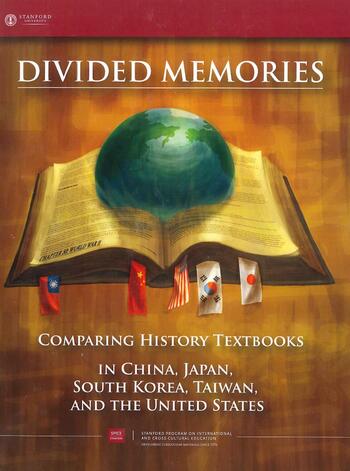
"Formal education is a powerful force in shaping our historical understandings," Sneider noted. "We wanted to look at the textbooks that have the most impact and usage."
A 2014 book, Confronting Memories of World War II: European and Asian Legacies, which was co-edited by Shin, Sneider and Daniel Chirot, a sociologist with the University of Washington, compared successful European WWII reconciliations with lagging Asian efforts. Another book, Divided Lenses, published earlier this year, examined the impact of dramatic film and other forms of popular culture on wartime memory. A new book is due out this summer, Divergent Memories: Opinion Leaders and the Asia-Pacific War, which focuses on leaders in politics, the media and academia in Japan, China, South Korea and the U.S.
The Divided Memories project aims to generate discussions and collaborations among those who create "historical memories" – educators, policymakers and government leaders. One report that grew out of such dialogues included suggestions for reconciliation:
- Create supplementary teaching materials on the issue.
- Launch dialogues among Asian, American and European historians.
- Offer educational forums for journalists, policymakers and students.
- Conduct museum exchanges and create new museums, such as one wholly dedicated to WWII reconciliation in Asia.
- Increase student exchanges among all the countries involved.
History is reflected in today's geopolitics, as noted in the revived disputes by these nations over rival claims to islands in the South China Sea and elsewhere. Without resolution, these disagreements can flare up into military conflicts, Sneider wrote.
"The question of history taps into sensitive and deeply rooted issues of national identity," he noted.
Whether recounting Japanese atrocities in China, China's exaggerated account of its Communist fighters' role in World War II, or the U.S. decision to drop atomic bombs on Japan, no nation is immune to re-creating the past to further its own interests today, Sneider wrote.
For example, Divided Memories research on Chinese textbooks shows how the Chinese government in recent decades embarked on a "patriotic education" campaign to indoctrinate young people by exaggerating its role in Japan's WWII defeat. This narrative suits the nationalistic desires of a Chinese government no longer exclusively motivated by communist ideology, Sneider said.
One project of APARC and its Japan Program that was also an outgrowth of Divided Memories involved Stanford scholars urging Japanese Prime Minister Shinzo Abe to show "clear, heartfelt remorse" in a 2015 speech on the 70th anniversary of the end of WWII. A 15-page report featured hypothetical statements suggesting what Abe might say to make amends for Japanese actions in China and Korea.
"While we cannot claim to have directly influenced the prime minister, his statement did go further in the direction of an expression of remorse over the war and the need to continue to look clearly and honestly at the past than many expected," said Sneider.
Image
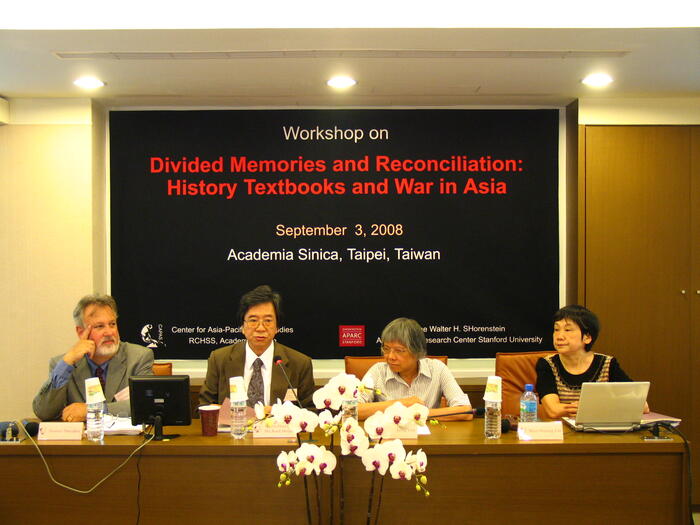
A workshop on history textbooks co-hosted by Shorenstein APARC and Academia Sinica's Center for Asia-Pacific Area Studies takes places in Taipei, Sept. 3, 2008.
Generations and grievances
Consciousness-raising on other fronts, however, is getting results, thanks to Stanford's Divided Memories project. A 2015 landmark agreement between Japan and South Korea over the WWII "comfort women" dispute was reached due to extensive U.S. involvement. Comfort women were women and girls who were forced into sexual slavery by the Imperial Japanese Army in occupied territories before and during World War II.
In an article, Sneider explained how the U.S. perceived that the dysfunctional relationship between South Korea and Japan over this issue, among others, threatened to undermine American strategic interests in Asia.
Shin highlights the importance of U.S. involvement. "The U.S. is not just an outsider to historical and territorial disputes in the region," he said. "From a geopolitical perspective, the U.S. has done a wonderful job in reviving the devastated region into a prosperous one after 1945, but from a historical reconciliation perspective, the U.S. has done a poor job."
He suggests that America should "play a constructive role in promoting historical reconciliation" among the countries involved. And so, the Divided Memories project has included the United States in its efforts.
According to Sneider, Divided Memories is unique among all reconciliation projects for its emphasis on the inclusion of the U.S.; comparative analyses across countries; and real-world policy impacts. As part of the Shorenstein research center, it is housed within Stanford's Freeman Spogli Institute for International Studies.
"This project reflects what Stanford, our center and the Freeman Spogli Institute are all about – true interdisciplinary research and engagement," Sneider said.
Clifton Parker is a writer for the Stanford News Service.
Hero Image

All News button
1
Meiko Kotani
0
meiko@stanford.edu
KotaniMeiko_WEB.jpg
Meiko Kotani is the instructor for the Stanford e-Japan Program, Stanford e-Bunri, and SPICE/Waseda Intensive Course for the Stanford Program on International and Cross-Cultural Education (SPICE).
Prior to joining SPICE, she worked as Program Coordinator for the Japan Program at the Shorenstein Asia-Pacific Research Center (APARC) where she managed projects and events related to research and education on contemporary Japanese issues. She also has experience working as a program manager at a Japanese company in Silicon Valley.
Meiko received a BA in international relations from University of Oregon, and MA in international relations and diplomacy from Schiller International University in Paris. Born in Japan and raised in seven countries, including China, Oman, Pakistan, France, and Russia, and the United States, she has always been strongly conscious of connecting Japan and the world since childhood. She is dedicated to supporting the development of Japan's next generation of leaders and fostering global talent.
Instructor, Stanford e-Japan
Instructor, Stanford e-Bunri
Instructor, SPICE/Waseda Intensive Course
Hide publication sections
Off
Nuclear Tipping Point: A Teacher's Guide
This is a teacher's guide to the documentary film, "Nuclear Tipping Point," which is a conversation with four men intimately involved in American diplomacy and national security over the last four decades.