Authors
News Type
Blogs
Date
Paragraphs

This article was written by Dr. Susan J. Duggan, initial Coordinator of the Western Europe Project at SPICE (1988–1990). In its early years, SPICE comprised several separate area-focused projects. This is the eighth of several articles—focusing on the 50-year history of SPICE—that will be posted this year.

Happy 50th Birthday to SPICE! I am honored to be part of this special group of multi-talented, internationally experienced educators and innovators. 

I came to SPICE in a roundabout way. After studying in France and Italy during my undergraduate years at Stanford, I did my first master’s degree in Political Science (international relations) at Université Laval in Québec in 1980. My thesis was on the political role of educational exchange in Québec’s desire for sovereignty (from Canada). Upon returning to my home in California, I landed a job as the Project Associate at the “Bay Area and the World Project” hosted at the World Affairs Council in San Francisco and sponsored, among others, by Stanford University. In that small, windowless office Dr. Ron Herring discovered me researching the connections between the Bay Area and other countries; and promoting those connections through our publications and conferences with businesses, local governments and educators. He convinced me to come back to Stanford to get my Ph.D. That was the beginning of my SPICE connection, though it would be another six years before I officially worked for SPICE.

Initially, I pursued a second master’s degree in Education at Stanford. That is when I met Dr. David Grossman at the Center for Research in International Studies (CRIS), the predecessor to the Institute for International Studies (IIS), now FSI. I have fond memories of working on a research project looking at young U.S. students’ perceptions of Germany and Germans. David was there in Berlin when I began my field work for my dissertation in 1985. David and Ron encouraged me throughout my pre-SPICE time to explore the role of educational exchange, not only for students, but also for teachers.

Ron recruited me to be the initial coordinator of the newly founded Western Europe Project in 1988. I had just finished my dissertation at the Graduate School of Education at Stanford on the political role of educational exchange between Germany and the United States and was eager to work with the SPICE folks on curriculum development for K–12 students and teachers. Dr. Judy Wooster had just assumed the leadership of SPICE. I had a lot of fun working with this bright group of creative folks! 
Image
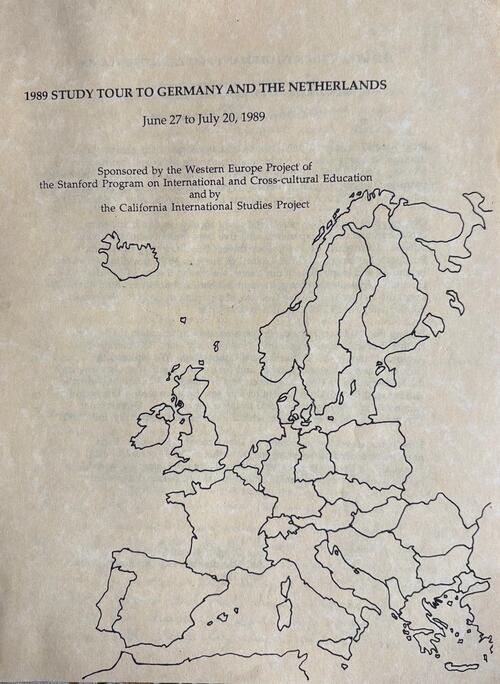
a front page of a study guide with a title and a map


In the summer of 1989, Ron asked me to help coordinate and run a study tour of American teachers to Western Europe. SPICE and the California International Studies Project (CISP) sponsored the tour. I had experience having co-founded the “Berlin-California Teachers Exchange” in 1985 with friend, colleague, and teacher Flex Ninow from the Internationale Lehrerkonferenz Berlin. In our 1989 tour (photo above courtesy of Sue Duggan), 12 brave teachers spent 24 intense days in Berlin; southern Germany (Weinstadt); Strasbourg; and on to Zeeland, Amsterdam and North Holland in the Netherlands. 

The participants focused on two main themes for eventual curriculum development: “Communities, Regions, Nations” and “Conflict and Cooperation.” Mind you, this was the summer of 1989. The study tour focused on Western Europe and what would evolve, eventually, into the European Union. They heard, of course, analyses and speculation about Eastern Europe and Soviet aspirations. In retrospect, what an honor it was to hear from so many European teachers, politicians, political scientists, and regular folk about their perceptions of a 1989 version of Western Europe. No one among our many European interlocutors imagined that the Berlin Wall would fall just a few months after our departure creating a huge change in the political, economic and educational landscape of all of Europe.

In the early months of 1990, I felt compelled to return to Berlin to gather fresh insights about the Fall of the Berlin Wall (which had happened on November 9, 1989, just three and a half months after our return from the SPICE Study Tour). I imagined how hearing from real Germans about an actual historical event could inspire American high school students studying German. I pitched the idea to Judy Wooster along the lines of “Where were you when Kennedy was killed?” I wanted to hear from a variety of Berliners—from the East and West—about where they were when they heard the news of the Berlin Wall being taken down. Remember, there were two parallel walls that bisected the city of Berlin. For some, they only knew the existence of a divided city. For others, they had strong memories of the Wall being built, starting on August 13, 1961. I bought a Sony Walkman and a ticket to Berlin. I was able to line up interviews with various people, from politicians, to teachers, to a pub owner, and even a Berliner in her 60s who not only remembered when the Wall was built, but what happened during the Berlin Airlift (1948–1949) in her hometown. I came back to SPICE with precious recordings of remembrances and personal connections to one of the biggest changes in the latter part of 20th century Europe. 

Possibly because of the Study Tour and the inspiration to record the voices of Berlin after the Wall fell, I felt drawn to return to Germany. The Alexander von Humboldt Stiftung (Foundation) created a new program in 1990 called the “Chancellor Scholars” bringing young, professional Americans to Germany to witness the unfolding of a new version of Europe. I was recruited to be in the initial group. I could not turn that down. With reluctance mixed with anticipation to experience a “whole” Germany, I left my position at SPICE in September 1990. I was pleased to leave the Berlin Perspectives curriculum unit in the capable hands of my successor, and even more pleased that that unit still exists today. 

I have always considered myself lucky to have been part of the developing times of CRIS, IIS, and SPICE. I enjoyed smart, fun, creative colleagues who really cared about the world, education, and each other. Dr. Steve Thorpe, formerly the coordinator of the SPICE China Project, and I finished our PhDs around the same time and have stayed in touch all these years. Dr. Ron Herring is “Uncle Ron” to my daughter, Coral. Gosh, even the SPICE folks survived the Loma Prieta Quake together in the basement of Littlefield Center at 5:04 p.m. on October 17, 1989! 
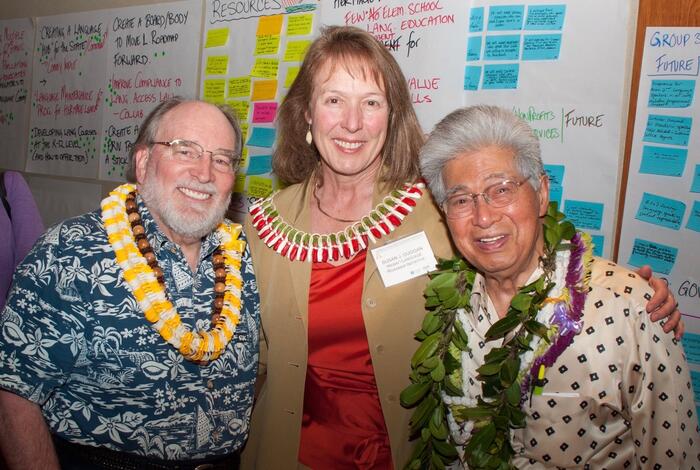
three people with leis smiling Photo above: Governor Neil Abercrombie of Hawai‘i, Dr. Susan Duggan, Executive Director of the Hawai‘i Language Roadmap Initiative, and Senator Daniel Akaka, 2013 | courtesy of Susan Duggan.


I have enjoyed a career mostly in international education. After SPICE and the Humboldt year, I started an international study abroad program in formerly Eastern European countries. I became the Senior Research and Policy Consultant to the National Security Education Program and ended up on the founding team that created the Boren Scholarship Program. Later, as Senior Strategist, I helped shaped The Language Flagship, now comprised of 14 U.S. universities with language and cultural studies in South Korea, Taiwan, Brazil, Morocco, and Kazakhstan. Toward the end of my career, I had the great pleasure of re-connecting with the K–12 sector as I created and ran many state Language Summits to create Language Roadmaps for those states. At times I have branched into the areas of high tech and agricultural tech innovations, but always with an international connection. I feel my early years at SPICE prepared me well for working with a variety of people in education, business, and government, all with creativity and integrity. 

With gratitude, I wish SPICE—and all those involved with this wonderful program—a very happy 50th anniversary!

To stay updated on SPICE news, join our email list and follow us on Facebook, X, and Instagram.

Read More

headshot of woman
Blogs

Celebrating SPICE’s 50th: Sharpening Our “Cultural Vision”: Seeing the World Through the Eyes of Other Cultures

Stanford alum and former SPICE Japan Project Coordinator Kay Sandberg shares memories of SPICE’s first 10 years through her eyes.
Celebrating SPICE’s 50th: Sharpening Our “Cultural Vision”: Seeing the World Through the Eyes of Other Cultures
three people standing at the great wall in China
Blogs

Celebrating SPICE’s 50th: SPICE’s Roots in the Bay Area China Education Project (BAYCEP)

BAYCEP was the predecessor program to SPICE, which was established 50 years ago in 1976.
Celebrating SPICE’s 50th: SPICE’s Roots in the Bay Area China Education Project (BAYCEP)
a family photo at the Japanese Tea Garden in Golden Gate Park
Blogs

Celebrating SPICE’s 50th: Adding SPICE to My Life

Professor Emeritus Steve Thorpe reflects on his years at SPICE from the late 1970s to the 1980s.
Celebrating SPICE’s 50th: Adding SPICE to My Life
Hero Image
9 people posing for a photo in Germany
Sue Duggan, on left, with members of the SPICE Study Tour in Germany, Summer 1989 | Photo courtesy of Sue Duggan
All News button
1
Subtitle

Stanford alum and former Coordinator of the Western Europe Project Dr. Susan J. Duggan shares reflections on her career.

Date Label
Display Hero Image Wide (1320px)
No
News Type
News
Date
Paragraphs

Scholars Corner is an ongoing SPICE initiative to share FSI’s cutting-edge social science research with high school and college classrooms nationwide and international schools abroad.


This week we released “The Rise and Implications of Identity Politics,” the latest installment in our ongoing Scholars Corner series. Each Scholars Corner episode features a short video discussion with a scholar at the Freeman Spogli Institute for International Studies (FSI) at Stanford University sharing his or her latest research.

This Scholars Corner video features New York Times bestselling author Francis Fukuyama discussing the recent rise of identity politics, both in the United States and around the world. “In the 20th century we had a politics that was organized around an economic axis, primarily. You had a left that worried about inequality…and you had a right that was in favor of the greatest amount of freedom,” summarizes Fukuyama. “[N]ow we are seeing a shift in many countries away from this focus on economic issues to a polarization based on identity.”

According to Fukuyama, this shift in politics is reflected in such domestic social movements as Black Lives Matter and #MeToo, as well as in international movements like the Catalan independence movement, white nationalism, and even the Islamic State.

The rise of identity politics may have troubling implications for modern democracies. “In the United States, for example, the Republican party increasingly has become a party of white people, and the Democratic party has become increasingly a party of minorities and women. In general, I think the problem for a democracy is that you’ve got these specific identities…[but] you need something more than that. You need an integrative sense of national identity [that’s] open to the existing diversity of the society that allows people to believe that they’re part of the same political community,” says Fukuyama.

“That, I think, is the challenge for modern democracy at the present moment.”

To hear more of Dr. Fukuyama’s analysis, view the video here: “The Rise and Implications of Identity Politics.” For other Scholars Corner episodes, visit our Scholars Corner webpage. Past videos have covered topics such as cybersecurity, immigration and integration, and climate change.

"Identity" hardcover book by Francis Fukuyama "Identity" hardcover book by Francis Fukuyama

Francis Fukuyama is a Senior Fellow at FSI and the Mosbacher Director of the Center on Democracy, Development, and the Rule of Law. This video is based on his recent book Identity: The Demand for Dignity and the Politics of Resentment, which was recognized as The Times (UK) Best Books of 2018, Politics, and Financial Times Best Books of 2018.

Stay informed of SPICE news by joining our email list or following us on Facebook and Twitter.


Related article:


Hero Image
Scholars Corner video featuring Francis Fukuyama discussing identity politics
Francis Fukuyama discusses identity politics in SPICE's latest Scholars Corner video.
All News button
1
Authors
News Type
News
Date
Paragraphs

Former President George W. Bush met with Stanford students for an hourlong conversation that touched on many of the defining moments and policies of his presidency.

In a relaxed and sometimes self-deprecating exchange on May 5, Bush talked about the limits of congressional power and his relationships and personal diplomacy with other world leaders. His tone was more serious when discussing what he described as universal desires for freedom, his military strategies following 9/11, and his commitment to addressing Africa’s HIV/AIDS pandemic.

Mariano-Florentino Cuéllar, director of the university’s Freeman Spogli Institute for International Studies, moderated the session. Stanford President John Hennessy and Condoleezza Rice – Bush’s secretary of state and national security adviser who has returned to teaching political science and business at Stanford – joined the conversation.

"FSI has a terrific track record of convening leaders at Stanford, from the head of the International Monetary Fund to prime ministers and presidents,” Cuéllar said. “On this occasion, we wanted our students to have an opportunity for a candid conversation with one of the key policymakers of the early 21st century, and we think such experiences will further prepare them for leadership in a complex world."

About 30 students were invited to the session at Encina Hall, but they didn’t know they were meeting Bush until the 43rd president walked into the room.

“I suspect he misses this sort of engagement,” said Gregory Schweizer, a second-year law school student who was part of the discussion that also covered immigration reform, national education policies and the Edward Snowden affair.

“The media always portrays him as being disengaged from current affairs,” Schweizer said. “But I’m impressed with how interested and engaged he still is.”

Along with representatives from Stanford Law School, other students were invited from the Ford Dorsey Program in International Policy Studies. Honors students from FSI’s Center for International Security and Cooperation and Center on Democracy, Development, and the Rule of Law also joined the conversation.

Bush’s visit was arranged with the help of  Brad Freeman, a former university trustee and Ronald Spogli, who is currently on Stanford's board of trustees. Freeman and Spogli are longtime friends of the former president and philanthropists who donated a naming gift to FSI in 2005. Bush appointed Spogli as ambassador to Italy in 2005 and as ambassador to San Marino a year later. 

Stanford has a tradition of hosting current and former heads of state, including German Chancellor Angela Merkel and former Russian President Dmitry Medvedev – both of whom visited in 2010.

Hero Image
screen shot 2014 08 22 at 10 16 22 am
All News button
1
Paragraphs

We live in a period of unprecedented scope of immigration and globalization, facing great numbers of peoples, and also cultural and social difference and strains on welfare economies.  Recent headlines in the U.S. about local, state, and federal immigration law expose anxieties and confusion, and they also highlight our search for ways to guide our students on how we may understand the origins of our immigrant neighbors, and why we should better welcome the newly arrived, as well as make our society more flexible to benefit from the influx of cultures.  For students and teachers, we search the globe for models of what compels people to leave their homes, why they are attracted to new communities, and how our own society should create more flexible cultural norms, political discussion, and economic opportunities to benefit from new immigrants.

All Publications button
1
Publication Type
Working Papers
Publication Date
Authors
Age Range
Secondary - Community College
News Type
News
Date
Paragraphs

SPICE has been transformed from a small local high school program begun by Professor Victor Hao Li (formerly of Stanford Law School), a number of Stanford students, a visionary group of nearby teachers and educators, and me in 1973 into a major national project. SPICE began as a modest start-up focused on Asia and has evolved into an extraordinary asset contributing to broad global education. It is an honor to have been in on the beginning of such a noble effort.

—John Lewis, William Haas Professor of Chinese Politics (Emeritus);        Center for International Security and Cooperation faculty member

Today, the efforts of the Stanford Program on International and Cross Cultural Education (SPICE) to internationalize the K–12 classroom span a broad range of topics—security, the arts, the environment, global health, and international relations. With the dawn of 2013, SPICE looks back to its roots and celebrates 40 years of promoting the study of China. The roots of the Stanford Program on International and Cross-Cultural Education (SPICE) date back to the Bay Area China Education Project (BAYCEP), which commenced operation in 1973. John Lewis was instrumental in the founding of BAYCEP, and several other scholars of Chinese studies, including Albert Dien, Professor of East Asian Languages and Cultures (Emeritus), were actively involved in BAYCEP’s early years and still remain involved with SPICE today.

The first director of BAYCEP was Dr. David Grossman, SPICE’s founding director. He noted the following about the creation of BAYCEP:

“The original impetus was the Nixon visit to China in 1972, and the realization that the general public and students were not prepared for this radical shift in geopolitics. The problem was how to bridge this profound knowledge gap.” 

Image
Economic Choices unit cover image
A BAYCEP publication from the 1980s

The purpose of BAYCEP was to serve as a bridge between Stanford experts on China and K–12 schools in the San Francisco Bay Area. This was accomplished in two ways—China-focused curriculum development and teacher professional development. By 1976, other projects on Japan, Africa, and Latin America were established, and they along with BAYCEP came to form the nucleus of SPICE.

Continuing the 40-year tradition of teacher professional development on China, SPICE staff members Jonas Edman, Naomi Funahashi, Rylan Sekiguchi, and Johanna Wee recently collaborated with Dr. Clayton Dube, Executive Director, U.S.–China Institute, University of Southern California, to lead a series of China-centered sessions at the annual European Council of International Schools November Conference. The sessions were held in Nice, France, from November 22 through 25, 2012, and included an intensive daylong institute called “China in the Humanities.” The institute comprised four theme-specific mini-sessions—Dynasties, Cultural Revolution, Rural and Urban China, and China in the World—each of which involved both a lecture and a pedagogically-focused curriculum demonstration. The featured SPICE-developed curriculum units (with primary Stanford academic advisors listed) were Chinese Dynasties Parts One and Two (Albert Dien, Professor Emeritus); China's Cultural Revolution (Andrew Walder, Professor, Sociology); China in Transition: Economic Development, Migration, and Education (Scott Rozelle, Director, Rural Education Action Project); 10,000 Shovels (Karen Seto, former Assistant Professor, School of Earth Sciences); and Divided Memories (Gi-Wook Shin, Professor, Sociology, and Director, Shorenstein Asia Pacific Research Center, and Daniel Sneider, Associate Director, Shorenstein Asia Pacific Research Center).

Image
China in Transition Cover image
Authored by Rylan Sekiguchi, Curriculum Specialist, and HyoJung Jang, Curriculum Writer

As SPICE moves into its fifth decade, the staff will continue its China-focused curriculum development and teacher professional development seminars. SPICE recently began developing a curriculum unit on sustainable development in China in consultation with Len Ortolano, Professor, Civil and Environmental Engineering. Also, from January 2013, SPICE will begin its twelfth year of offering two 30-hour seminars on East Asia—one for middle school teachers and one for high school teachers. The seminars feature lectures by FSI and Center for East Asian Studies faculty and curriculum demonstrations by SPICE staff that focus on China, and other northeast Asian nations.

In addition, SPICE plans to create of a high school student-focused national distance-learning course on China that is parallel to SPICE’s current distance-learning course offerings, which include the Reischauer Scholars Program on Japan and the Sejong Korean Scholars Program.

With Stanford President John Hennessy’s announcement of the K–12 initiative in 2006, Stanford renewed its long-time commitment to improving public education in the United States. SPICE will continue to make FSI scholarship in the areas of security, the arts, the environment, global health, and international relations accessible to young students. FSI believes it has the opportunity and the obligation to utilize its resources to help address issues facing our schools.

Hero Image
ECIS 2011
All News button
1
0
KotaniMeiko_WEB.jpg

Meiko Kotani is the instructor for the Stanford e-Japan Program, Stanford e-Bunri, and SPICE/Waseda Intensive Course for the Stanford Program on International and Cross-Cultural Education (SPICE). 

Prior to joining SPICE, she worked as Program Coordinator for the Japan Program at the Shorenstein Asia-Pacific Research Center (APARC) where she managed projects and events related to research and education on contemporary Japanese issues. She also has experience working as a program manager at a Japanese company in Silicon Valley. 

Meiko received a BA in international relations from University of Oregon, and MA in international relations and diplomacy from Schiller International University in Paris. Born in Japan and raised in seven countries, including China, Oman, Pakistan, France, and Russia, and the United States, she has always been strongly conscious of connecting Japan and the world since childhood. She is dedicated to supporting the development of Japan's next generation of leaders and fostering global talent.

Instructor, Stanford e-Japan
Instructor, Stanford e-Bunri
Instructor, SPICE/Waseda Intensive Course
Date Label
News Type
News
Date
Paragraphs

The 2012 SPICE catalog is now available.  SPICE developed five new curriculum units in 2011.


Nuclear Tipping Point: A Teacher's Guide

The documentary Nuclear Tipping Point tells the story of how four Cold War-era leaders—former Secretary of State George Shultz, former Secretary of Defense Bill Perry, former Secretary of State Henry Kissinger, and former Senator Sam Nunn—came together to address the threat of nuclear power falling into the wrong hands. Produced by the Nuclear Threat Initiative (NTI), the film is narrated by actor Michael Douglas and earned wide media attention when it came out in 2010. 

Now, through a partnership between SPICE and NTI, the film is accompanied by a new teacher’s guide for classroom use of the documentary. The guide underscores the importance of teaching for critical literacy and addresses specific connections to the National Standards for History in the Schools. Student activities include multiple choice quizzes, persuasive writing and analysis, and ideas for creative projects. 

China in Transition: Economic Development, Migration, and Education

China in Transition introduces students to modern China as a case study of economic development. What are the characteristics of the development process, and why does it occur? How is development experienced by the people who live through it, and how are their lives impacted? How do traditional cultural values—such as China’s emphasis on education—contribute to and/or evolve as a result of modernization? Students examine these questions and others as they investigate the roles that migration, urbanization, wealth, poverty, and education play in a country in transition.


Legacies of the Vietnam War

The 20-year war in Vietnam was a prolonged and devastating conflict. In its aftermath, South Vietnamese civilians fled from the Communist takeover on perilous boat journeys that led to the formation of diasporic communities. Others faced lengthy detention in post-war re-education camps. This unit aims to help students learn and appreciate these and other important legacies that have shaped Vietnam and the world at large.


Angel Island: The Chinese-American Experience

Angel Island: The Chinese-American Experience is a graphic novel that tells the story of Chinese immigrants detained at Angel Island Immigration Station in San Francisco Bay between 1910 and 1940. It offers a stark contrast to the more celebrated stories of European immigrants arriving at Ellis Island on the East Coast and poses important questions about U.S. immigration policy, both past and present.


An Introduction to Ukraine

As the second-largest country in Europe, Ukraine has always stood at a crossroads of cultural influences. It is a key part of Europe–and the management of its relationships with other countries (in particular, Russia) is key to the future of the whole of eastern Europe. This unit seeks to provide high school teachers and students with a broad introduction to Ukrainian history with activities that touch upon Ukrainian culture.


Hero Image
catalog cover
All News button
1
News Type
News
Date
Paragraphs

SPICE staff members Naomi Funahashi, Rylan Sekiguchi, and Johanna Wee participated in the European Council of Independent Schools (ECIS) Annual Conference in Lisbon, Portugal, from November 18 to 20, 2011. One of the teacher seminars that SPICE offered was titled “Divided Memories: Teaching about Bias and Perspective.” Sekiguchi and Funahashi introduced the important concepts of bias and perspective by engaging over 40 teachers from throughout Europe and Central Asia in an examination of textbooks from five Pacific Rim societies: China, Japan, South Korea, Taiwan, and the United States. The seminar was based on the SPICE curriculum unit, Divided Memories: Comparing History Textbooks, which was developed by Sekiguchi in 2009.

Funahashi and Sekiguchi facilitated a provocative discussion around the notion that because the past continues to influence the present, and because our sense of history helps shape our perception of the world, debates over how history is taught in schools can become extremely controversial and political. History textbooks, too, have become arguably the most politically scrutinized component of modern education. In part, this is because school textbooks provide an opportunity for a society to record or endorse the “correct” version of history and to build a shared memory of history among its populace. In small groups, teachers had the opportunity to first consider newspaper headlines that describe the same event in very different ways, and second to critically examine sample excerpts from five textbooks and consider the questions: How do textbooks from different societies treat such episodes? Do they present similar or dissimilar interpretations of history?

Wee, who staffed a SPICE booth at ECIS, has noted that SPICE’s participation in international conferences like ECIS has significantly increased the dissemination of SPICE curricula to countries that have not historically been reached by SPICE. Lastly, the successful ECIS seminar has prompted discussions about the possible creation of another “divided memories”-type curriculum unit with a focus on how various European textbooks depict particular episodes in world history. 


Divided Memories: Comparing History Textbooks was part of a broader “Divided Memories: Advancing Reconciliation in Northeast Asia” project of the Shorenstein Asia-Pacific Research Center, FSI. Professor Gi-Wook Shin, Director, Shorenstein Asia-Pacific Research Center, served as the principal investigator for the project. The primary funding for the curriculum unit was generously provided by the United States-Japan Foundation, New York, NY. The Northeast Asia History Foundation, Seoul, supported the broader “Divided Memories” project. 

Hero Image
ECIS 2011
All News button
1
Subscribe to Western Europe