Authors
News Type
Blogs
Date
Paragraphs

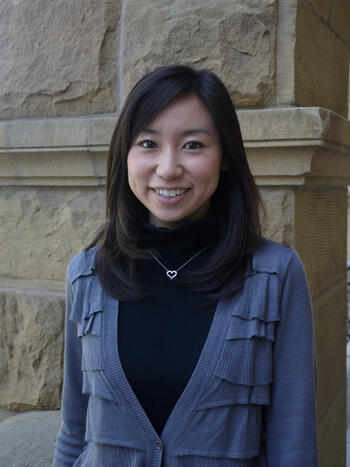
The following reflection is a guest post written by Miyu Hayashi, a Spring 2016 alum and honoree of the Stanford e-Japan Program, which is currently accepting applications for Spring 2020. She is now a medical student at Mie University, Faculty of Medicine.


While the United States is often regarded as an individualistic society, Japan, in general, has more of a group mentality with many people not wanting to stand out. But, I think we as Japanese need to be able to explain ourselves more clearly in today’s globalized society where people around the world interact more frequently. I had a strong interest in the Spring 2016 Stanford e-Japan Program because it involved lectures and discussions I usually could not participate in. 

The lectures included historical topics such as the importance of early U.S.–Japan relations and World War II, and also contemporary topics such as Silicon Valley and entrepreneurship and high schools in the United States and Japan. Students were expected to complete the lectures and readings that were assigned before the online classes. In our lesson on World War II, I read and compared U.S. and Japanese textbook excerpts for the first time, which helped me learn the American point of view in regard to the war. In our lesson on entrepreneurship, I learned the importance of having an entrepreneur-like spirit to improve companies, thinking outside of the box, and having a culture that accepted failure as a positive experience (as long as the failure taught important lessons). In my experience, most Japanese like to live a standard and stable life, and act and think in the same way as others for fear that they might make mistakes. In contrast, an entrepreneurial spirit shows a true passion for building something fantastic from nothing. Learning about this mindset of pushing oneself to the limit to achieve great goals impressed me a lot.

Another key aspect that made the Stanford e-Japan Program interesting was all my peers. They were highly motivated and discussions with them were always stimulating. We helped each other understand lessons more clearly and generate more ideas about each topic. Trying to answer their questions on the online discussion forums offered me a chance to improve myself because these discussions revealed my mistakes and weaknesses or supporting ideas that I had not thought of before. Also, reading other students’ ideas, listening to their questions, and learning from professors’ answers opened up different aspects of each topic.

Stanford e-Japan alum Miyu Hayashi outside of the Shanghai Children's Medical Center Stanford e-Japan alumna Miyu Hayashi outside of the Shanghai Children's Medical Center. Photo courtesy of Miyu Hayashi.
Now I am a medical student in Japan and hope to be a good doctor who goes everywhere to provide help to those who need it. I am especially interested in doctors who work to promote international health. Last year, I had an opportunity through a university program to travel to China and learn about the Chinese healthcare system for about two weeks. The Shanghai Children’s Medical Center was large and filled with many children and their families. Though the doctors and nurses must have been busy, they kindly explained children’s diseases to us. Since both the Chinese doctors and I were not native English speakers, it was sometimes difficult to communicate with each other. Even when I could not understand them fully, I tried to learn as much as possible. I often paraphrased or asked questions without fear of making mistakes. The Stanford e-Japan experience gave me the confidence to speak English and the eagerness to learn new things. As a result, I could enjoy every minute I spent in China.

The Stanford e-Japan Program has become one of my most precious experiences. It gave us a chance to learn about different societies, cultures, and ways of thinking. It broadened my horizons so that I would like to make full use of having experienced it, not only in my long-term future plans, but also in my short-term plans. When the 2020 Olympics are held in Japan, I would be willing to help anyone in trouble. And as a doctor, I want to study in the U.S., since it is one of the world leaders in medicine. I would like to improve the field of medicine in collaboration with doctors from around the world.


For more information on the Stanford e-Japan Program, visit stanfordejapan.org. The Spring 2020 application period is open now until January 8, 2020. To be notified when the next Stanford e-Japan application period opens, join our email list or follow us on Facebook, Twitter, and Instagram.

Stanford e-Japan is one of several online courses for high school students offered by SPICE, Stanford University, including the Reischauer Scholars Program, the China Scholars Program, the Sejong Scholars Program (on Korea), and Stanford e-China. Also, SPICE offers the following regional online courses in Japan: Stanford e-Hiroshima, Stanford e-Oita, Stanford e-Tottori, and Stanford e-Kawasaki. Students interested in these regional online courses should contact Gary Mukai at gmukai@stanford.edu


Related articles:

 
Hero Image
Stanford e-Japan Program alum Miyu Hayashi at the Shanghai Children’s Medical Center, China
Stanford e-Japan alumna Miyu Hayashi (right) at the Shanghai Children’s Medical Center. Photo courtesy of Miyu Hayashi.
All News button
1
Authors
Jonas Edman
News Type
Blogs
Date
Paragraphs

Stanford e-Tottori is a distance-learning course sponsored by the Tottori Prefectural Board of Education and the Stanford Program on International and Cross-Cultural Education (SPICE) at Stanford University. Tottori Governor Shinji Hirai and Superintendent Hitoshi Yamamoto of the Tottori Prefectural Board of Education were instrumental in its establishment. Offered for the first time in 2016, Stanford e-Tottori presents a creative and innovative approach to teaching Japanese high school students about U.S. society and culture. Stanford e-Tottori Instructor Jonas Edman recently wrote these reflections on his work with students in Tottori.


While visiting Tottori Prefecture during the summer, I came to realize that Tottori, which once seemed like a distant and isolated place in my mind, has become a central part of my life’s neighborhood. In early August, I attended the closing ceremony for the third-year course offering of Stanford e-Tottori. On the same day, I attended the opening ceremony for the fourth-year course offering of Stanford e-Tottori. During the ceremonies, student representatives from several high schools in Tottori—Seishokaichi High School, Tottori Nishi High School, and Yonago Higashi High School—offered very meaningful messages. While listening to them, I felt so fortunate to be living in a time when technology affords me the opportunity to work in real time with students on the other side of the Pacific.

We are now in the midst of the fourth-year course offering, and I am already noticing significant growth in the English abilities and critical thinking skills of my 30 students. We have discussed topics ranging from studying at universities in the United States to the popularity of Japanese manga (comics or graphic novels) in the United States. My colleagues Rylan Sekiguchi and Naomi Funahashi led a very engaging discussion on studying at universities in the United States, and my students shared thoughts on what they perceive to be similarities and differences in studying at universities in Japan. The discussion of manga led to feelings of pride among my students, having come to realize the prevalence of Japanese manga in the United States. Tottori is very famous for its manga artists.

Whenever I work with my students in online classes from Stanford on topics like manga, I feel like I have been transported back to Tottori as I see the 30 familiar faces of students whom I first met in Tottori. This inevitably prompts me to reflect upon several key observations that I have made during my several visits to Tottori. First, while traveling in Tottori, one can almost feel that Tottori is the least populated prefecture in Japan. Perhaps correlated with this fact is how I have always been struck by the attention the students receive from their teachers. This infectious dedication to educating the next generation of leaders has had a ripple effect across the Pacific to us at SPICE and my guest speakers for Stanford e-Tottori. For example, Silicon Valley entrepreneur Takeshi Homma, who hails from Tottori, puts his heart and soul into his talk on “Entrepreneurship and Silicon Valley” each year. Second, Tottori is known for its nature and agriculture, and the importance of preserving the environment seems foremost on people’s minds. This is a global mindset that I wish others in the United States and Japan would share. Our online class on the environment has always prompted spirited discussions. Third, since I spent 16 years of my youth in Tokyo, I cannot help but notice the slower pace of life in Tottori. Magically, the slower pace helps me to take notice of each valuable moment that I spend with my students not only in person but virtually as well. Topics like aging and population decline are ones that have drawn interest and critical attention not only in Tottori but across Japan.

In closing, I would like to especially thank Takuya Fukushima, Office Director of the English Education Advancement Office, and Tomoya Minohara, Teachers’ Consultant, Tottori Prefectural Board of Education, for their unwavering support of Stanford e-Tottori and for bringing Tottori into my life’s neighborhood.


To stay informed of SPICE-related news, join our email list and follow SPICE on Facebook, Twitter, and Instagram.


Related articles:


Hero Image
Opening ceremony for the fourth-year course offering of Stanford e-Tottori
Opening ceremony for 2019 Stanford e-Tottori, courtesy Takuya Fukushima, Officer Director of the English Education Advancement Office, Tottori Prefectural Board of Education
All News button
1
Authors
Gary Mukai
News Type
News
Date
Paragraphs

This fall, the Stanford Program on International and Cross-Cultural Education (SPICE) began its ninth offering of Stanford e-Japan, an online course that introduces U.S. society and culture and U.S.–Japan relations to high school students in Japan. Stanford e-Japan is made possible through the support of the Yanai Tadashi Foundation, Tokyo. The fall 2019 Stanford e-Japan online course has continued the tradition of enrolling students from various parts of Japan; engaging students with leading American and Japanese academics, entrepreneurs, and community leaders as guest speakers; and encouraging students to study in the United States.

The 28 students of the fall 2019 cohort were selected from among a competitive group of applicants from throughout Japan. The selected students represent the prefectures of Chiba, Ehime, Gunma, Hiroshima, Hyogo, Ibaraki, Kanagawa, Kyoto, Mie, Miyagi, Nara, Okayama, Saitama, and Tokyo. Stanford e-Japan Instructors Meiko Kotani and Waka Brown have noted that their students not only continue to learn important content and perspectives from the guest speakers but also important perspectives from their fellow students. Brown recalled, “…last year, I was particularly struck by the impact a student from Okinawa had on the other students in his cohort as he shared insights on the U.S. military presence in Okinawa from his personal experiences.”

The fall 2019 course recently featured guest speaker Suzanne Basalla, who has become a regular speaker for Stanford e-Japan. Basalla is Chief of Staff at the Toyota Research Institute in Silicon Valley and a former officer (Lieutenant Commander) of the U.S. Navy. Following her naval career, Basalla served as Director for Japan in the Office of the Secretary of Defense and as Senior Advisor to U.S. Ambassador to Japan John Roos, serving at the U.S. Embassy in Tokyo from 2010 to 2012. During her talk with the students, she touched upon her work with security-, economic-, political-, and cultural-related issues in the U.S.–Japan relationship and also offered keen insights into her current work as a leading entrepreneur in Silicon Valley.

Speakers like Basalla as well as Instructors Brown and Kotani have been encouraging Japanese students to consider studying in the United States. Many Stanford e-Japan alumni have enrolled in summer programs in the United States, spent a year studying abroad in the United States, and several have enrolled in four-year colleges in the United States. Among the latter are Jun Yamasaki (Fall 2017 Stanford e-Japan cohort) and Hanako “Hannah” Tauchi (Spring 2017 Stanford e-Japan cohort), who are recipients of Yanai Tadashi Foundation Scholarships. The following is noted on the scholarship’s website.

[The] Yanai Tadashi Foundation Scholarship aims to provide promising young people with leadership potential the opportunity to study at world-class universities in the United States. The scholarship enables recipients to mix with an internationally diverse student body to cultivate their entrepreneurial skills and enhance their global perspective, encouraging their development as future drivers of a better society.

Yamasaki, a freshman at Northwestern University, and Tauchi, a freshman at the University of California, San Diego, recently commented on how Stanford e-Japan helped them as high school students to prepare for undergraduate studies in the United States. Their comments follow.

Yamasaki: As an institution, Northwestern places a great emphasis on interdisciplinary studies and learning—a characteristic that is apparent in both its research and the academic interests and aspirations of its students. The structure of the Stanford e-Japan program itself encouraged me to examine the U.S.–Japan relationship through multiple perspectives, ranging from sports to entrepreneurship. In addition to furthering my understanding of the dynamics of the U.S.–Japan relationship, Stanford e-Japan helped me identify the intersection between my past interests and the potential future needs and topics pertaining to the U.S.–Japan relationship, and construct my future goals accordingly. This in turn has allowed me to better plan out how I can take full advantage of Northwestern’s unique characteristics and offerings, which I am extremely thankful for. 

Tauchi: The Stanford e-Japan Program was an amazing opportunity for me both to consider undergraduate studies in the U.S. as a realistic option and to improve my English skills overall. As a student who was schooled in Japanese for my entire life, the course—lectures, reading assignments, discussions, and essays—was at first quite challenging, but looking back the half a year I worked on the program, I would definitely say that the program is one of the most important experiences that I had during my high school life. Offered by one of the most renowned colleges in the world, I could feel and imagine how college life in the U.S. would be like. Of course, the contents of the course—things that students do not normally learn in Japanese high school—were all interesting and motivated me to learn more about the U.S.–Japan relationship and beyond. 

Kotani and Brown hope that Stanford e-Japan alumni like Yamasaki and Tauchi will continue to play roles in U.S.–Japan relations beyond their college years. Kotani recently shared that “the Stanford e-Japan guest speakers like Suzanne Basalla, with such fascinating careers, are such excellent role models for the students. My hope is that many alumni of Stanford e-Japan will consider working for businesses in places like Silicon Valley and other organizations in Japan and the United States that focus on the U.S.–Japan relationship.” Brown, who will be recognized with the Elgin Heinz Outstanding Teacher Award at a ceremony at Stanford University on December 5, 2019, has noted that, “I feel so honored to be recognized with the 2019 Elgin Heinz Outstanding Teacher Award for my work as the Instructor of Stanford e-Japan and am especially looking forward to seeing one of my former Stanford e-Japan students, Ryoga Umezawa, who is studying at the Minerva Schools at Keck Graduate Institute in San Francisco.”

Image
Meiko Kotani
Kotani recently assumed the role of Co-Instructor of Stanford e-Japan with Brown. She concurrently works as a Program Manager for NTT Physics & Informatics Laboratories and brings on-the-ground experiences in Silicon Valley to her students. Kotani is a graduate of the University of Oregon (international relations) and obtained a master’s degree from the Schiller International University in Paris (international relations and diplomacy). Kotani, who is multilingual (English, Japanese, and French), was born in Japan and lived in China, Oman, Pakistan, France, and Russia before coming to the United States.

To stay informed of SPICE-related news, join our email list and follow SPICE on Facebook, Twitter, and Instagram.


Related articles:


Hero Image
Stanford e-Japan alumni Jun Yamasaki and Hanako “Hannah” Tauchi
Stanford e-Japan alumni and Yanai Tadashi Scholarship recipients, Jun Yamasaki and Hanako Tauchi; photos courtesy of Jun Yamasaki and Hanako Tauchi
All News button
1

616 Jane Stanford Way
Encina Hall, E005
Stanford, CA 94305-6060

0
maiko_tamagawa_bacha.jpg MA

Maiko Tamagawa Bacha is the instructor for the Stanford e-Kawasaki Program and Stanford e-KyuSan U (Kyushu Sangyo University, Fukuoka Prefecture) for the Stanford Program on International and Cross-Cultural Education (SPICE).

Prior to joining SPICE, she worked for the Ministry of Foreign Affairs of Japan for 14 years and served in Tokyo, Japan; Bangkok, Thailand; Vientiane, Laos; and San Francisco, United States. She has experience working in different areas of international relations, including disarmament of conventional weapons, United Nations affairs, Japan–Laos bilateral relations, and public diplomacy. In her most recent role as Advisor for Educational Affairs at the Consulate General of Japan in San Francisco, she had an opportunity to work closely with SPICE to support its Reischauer Scholars Program, an online course on Japan and U.S.–Japan relations for U.S. high school students.

Maiko received a BA in American Area Studies from University of Tokyo, and an MA in International Policy Studies from Middlebury Institute of International Studies in Monterey, California. She was born in Fukuoka, Japan, and grew up in Chiba, Japan.


Instructor, Stanford e-Kawasaki
Instructor, Stanford e-KyuSan U
-

—Made possible through the Freeman Foundation’s support of the National Consortium for Teaching about Asia

With communities across the United States now reflecting even greater diversity and complexity, our classrooms are also rapidly changing, and schools are faced with both opportunities and challenges in providing instruction that is rich and meaningful. Diverse student populations offer valuable opportunities for classroom and community enrichment.

Like many other communities, Asian and Asian American students come from many different parts of Asia and represent a wide spectrum of ethnicities, languages, histories, generations, cultures, and religions. Providing culturally and experientially responsive instruction to these students can be daunting.

In this webinar, SPICE welcomes Dr. Khatharya Um to discuss the diversity of our Asian and Asian American students, and share some pedagogical tools and approaches to support more effective teaching in culturally diverse classroom environments.

Join us via Zoom video webinar for a one-hour presentation, followed by 30 minutes of Q&A with Dr. Um.


Featured Speaker:

woman's headshot in black dress

Dr. Khatharya Um

Professor Khatharya Um is Associate Professor of Ethnic Studies at the University of California at Berkeley, and Program Coordinator of Asian American and Asian Diaspora Studies. She is also affiliated faculty of Global Studies, the Center for Southeast Asian Studies, the Center for Race and Gender, and the Berkeley Human Rights Center, and serves on the UC system-wide Faculty Advisory Board on Southeast Asia. She was a Chancellor Public Scholar.

Professor Um’s research and teaching center on Southeast Asian politics and societies, Southeast Asian diaspora, refugee communities, educational access, genocide, and the politics of memory. Her publications include recent books From the Land of Shadows: War, Revolution and the Making of the Cambodian Diaspora (NYU Press, 2015) and Southeast Asian Migration: People on the Move in Search of Work, Refuge and Belonging (Sussex Academic Press, 2015).

Professor Um is also actively involved in community advocacy, principally on issues of refugees and educational equity. She has served on numerous boards of directors, including as Board Chair of the leading Washington DC-based Southeast Asian Resource Action Center, and as President of the National Association for the Education and Advancement of Cambodian, Laotian and Vietnamese Americans. She has received numerous awards and congressional recognitions for her community leadership and service. 


Online via Zoom, at https://stanford.zoom.us/j/346369124. Please pre-register at https://forms.gle/RmPzv3oiBb6YrqJQ6.

Dr. Khatharya Um Associate Professor of Ethnic Studies University of California at Berkeley
Workshops

616 Jane Stanford Way
Encina Hall, E005
Stanford, CA 94305-6060

0
kasumi_yamashita.jpeg AM

Kasumi Yamashita is an Instructor for the Stanford Program on International and Cross-Cultural Education (SPICE), currently teaching an online course for high school students in Oita Prefecture, Japan, called Stanford e-Oita. Kasumi’s academic interests are in cultural anthropology, international education, and language technologies, and her research focuses on the Japanese diaspora in the United States and Latin America. While conducting fieldwork for her PhD in Anthropology at Harvard University, she spent a year at the University of São Paulo, as a Fulbright Scholar. She explored narrations of memory and migration, and community involvement in the emergence of Japanese diaspora museums throughout Brazil, including the Museu Histórico da Imigração Japonesa no Brasil (Historical Museum of Japanese Immigration to Brazil). Kasumi researched Nikkei Latin American communities in Japan while at Hitotsubashi University on a Japanese government scholarship. She earned an AM in Regional Studies–East Asia from Harvard University. 

Kasumi received a BS in Studio Art from New York University. She was a University Scholar and spent her junior year in Spain at the Instituto Internacional in Madrid. After graduating from NYU, she taught English as an Assistant Language Teacher (ALT) and later worked as a Coordinator for International Relations (CIR) on the Japan Exchange and Teaching (JET) Program. As a CIR at Yukuhashi City Hall, Fukuoka Prefecture, she founded a Japan–U.S. student and teacher exchange program between middle schools in Yukuhashi City and the Grace Church School in New York. More than 500 students and teachers from the United States and Japan have participated in the program since she launched it in 1994. That year, she published a book of essays chronicling her experiences as a Japanese American woman in a small Japanese town, Kasumi no Yukuhashi Nikki (Kaichosha Press).

In New York, she served as a member of the local staff of the Permanent Mission of Japan to the United Nations under the leadership of Ambassador Hisashi Owada. She also served on the Executive Committee of the Convención Panamericana Nikkei (COPANI XI) in New York and has been involved in past conferences across the Americas, most recently COPANI XX in San Francisco (CA) in 2019.

Kasumi also teaches and develops web-based curricula for the Translation and Interpretation Program at Bellevue College (WA). Kasumi frequently interprets for Japanese delegations in various fields (including education, technology, international relations, film, art, and museums) and serves on the Board of the Japanese Cultural and Community Center of Washington (JCCCW).


Instructor, Stanford e-Oita
Instructor, Stanford e-Fukuoka
Authors
Gary Mukai
News Type
News
Date
Paragraphs

Hiroshima Governor Hidehiko Yuzaki (MBA, 1995) and Dr. Mariko Yoshihara Yang (MA, 1995, PhD, 2000) participated on an education-focused panel at Stanford University on August 26, 2019. The panel was part of the California-Japan Governors’ Symposium that was co-hosted by the U.S.-Japan Council and the Silicon Valley Japan Platform, which is co-chaired by Professor Emeritus Daniel Okimoto, founding director of the Shorenstein Asia-Pacific Research Center. One of the objectives of the education panel was to encourage educational collaborations between Japan and California.

Keeping many of the key discussion points from the education panel in mind, Yang recently conceptualized and launched a SPICE online course for MBA students at the Prefectural University of Hiroshima (PUH) and other universities in Hiroshima. The course is called the Stanford-Hiroshima Collaborative Program on Entrepreneurship (SHCPE) and is offered under the leadership of Professor Katsue Edo, Hiroshima Business and Management School (HBMS), PUH.

Yuzaki shaped the rationale for the course. Yuzaki stated, “We are now facing times when it is critical to design a new social system for accelerating the growth of Hiroshima Prefecture. In this environment, the government of Hiroshima is promoting various plans for enhancing a creative region and developing the economy and society of Hiroshima.” This sentiment has prompted Yuzaki to stay in close touch with his Stanford mentor, Okimoto, and involved with the Silicon Valley Japan Platform. Yuzaki continued, “To achieve this goal, challenging students through education is one of the most important issues in Hiroshima. The Stanford-Hiroshima Collaborative Program on Entrepreneurship established by the HBMS at the Prefectural University of Hiroshima and SPICE will deliver a very valuable program which offers knowledge and wisdom of the practitioners of business in Silicon Valley, which is an intense area of innovation near Stanford University. It will also foster entrepreneurship and management for the next generation of leaders, who will contribute to the further development of Hiroshima and Japan.”

SHCPE Instructor Yang has noted that the course “provides a unique opportunity for the MBA students in Hiroshima to connect and interact with Japanese entrepreneurs, professionals, and scholars of Silicon Valley in a virtual setting. SHCPE’s speaker lineup includes Stanford scholars as well as founders of a software startup, a social networking organization, and an educational non-profit as well as venture capitalists, a legal expert, and a policy advisor. Together with these guests, the students explore and analyze Silicon Valley’s ecosystem and think critically about entrepreneurial competencies.”


Dr. Yang with MBA students at the Prefectural University of Hiroshima. Dr. Yang (on screen) with MBA students at the Prefectural University of Hiroshima.


Dr. Yang (on screen) with MBA students at the Prefectural University of Hiroshima. Photo credit: Kazue Hiura, PUH.    


In November, Yang will be visiting Hiroshima to meet with Yuzaki as well as PUH President Ken-ichi Nakamura. Yang will have the chance to share her initial assessment of the course with Yuzaki and Nakamura, who has emphasized the importance of inviting lecturers from universities outside of Japan to work with PUH’s MBA students in order to underscore the importance of adding global perspectives to the curriculum. Nakamura has stated, “For the students to step forward into the globalizing world, they must feel and experience the real challenges of an increasingly interdependent world and this course is providing exactly that.” Yang will also be offering the final SHCPE class in person and will meet her students in person for the first time.

SHCPE is an example of “Engagement beyond our university,” which is one of the four key areas in Stanford’s long-range plan and a timely topic of consideration during the upcoming Stanford Alumni Weekend. Yang has noted, “SHCPE utilizes knowledge and methodologies developed at Stanford University. In the first session, students were introduced to techniques and mindset of Design Thinking by interviewing, ideating, and prototyping for their partners. Through the eight-week course, the students will not only acquire new knowledge on Silicon Valley’s ecosystem, but also challenges themselves to hone their analytical skills, nurture entrepreneurial creativity, and develop a Growth Mindset.” This resonated in Nakamura who reflected, “The Stanford-Hiroshima Collaborative Program on Entrepreneurship was developed to be an opportunity for our students to learn the ways of thinking taught by the innovators of Silicon Valley and Stanford University. We are confident that this will be an exciting program which will contribute not only to promote academic research but also to promote business practices in Hiroshima.”

As SPICE continues to strive to make Stanford scholarship accessible to students not only in the United States but also in other countries, SPICE looks forward to continuing its partnership with PUH and other universities in Hiroshima for many years to come, and building upon lessons learned from the inaugural SHCPE course. Yuzaki and Yang crossed paths during their graduate school years at Stanford and Yang reflected that “despite the passage of many years since the completion of our programs, it has been very much an honor to reconnect and work with fellow Stanford alumnus Governor Yuzaki to improve U.S.–Japan relations through educational channels across the Pacific… and I would be remiss to not say that the reconnection would not have been possible without the vision of my academic advisor and mentor, Professor Okimoto.”

To stay informed of SPICE-related news, join our email list and follow SPICE on Facebook, Twitter, and Instagram.


Hero Image
California-Japan Governors’ Symposium education panel, Stanford University
California-Japan Governors’ Symposium Panelists (left to right): Dr. Mariko Yoshihara Yang, Dr. Rie Kijima, Okayama Governor Ryuta Ibaragi, Oita Governor Katsusada Hirose, Hiroshima Governor Hidehiko Yuzaki.
Rylan Sekiguchi
All News button
1
News Type
News
Date
Paragraphs

This summer, SPICE Director Dr. Gary Mukai was interviewed at Stanford by The Education Newspaper of Japan about his long experience working with American and Japanese students. In particular, the two-part feature highlighted his impactful work in education and U.S.–Japan relations over his 40-year career.

In Part 1 of the “close-up” interview, Mukai shares his educational philosophy derived from 40 years working with students in Japan and the United States. In Part 2 of the interview, he talks about Stanford e-Japan, the Reischauer Scholars Program, and SPICE’s other Japan-focused projects and online learning courses for high school students.

“I feel honored to be interviewed by The Education Newspaper,” reflected Mukai. “And I’m grateful for the opportunity to share about some of the cross-cultural work we do at Stanford University to promote mutual understanding between students in the United States and Japan.”

Read the two articles here:

To stay informed of SPICE-related news, join our email list and follow SPICE on Facebook, Twitter, and Instagram.


Stanford e-Japan is an online course on U.S. society and culture for high school students in Japan. The Reischauer Scholars Program is an online course on Japanese society and culture for high school students in the United States. They are two of the several online courses that SPICE offers to students in the United States and abroad.


Hero Image
Gary Mukai’s interview with The Education Newspaper of Japan The Education Newspaper
All News button
1
News Type
News
Date
Paragraphs

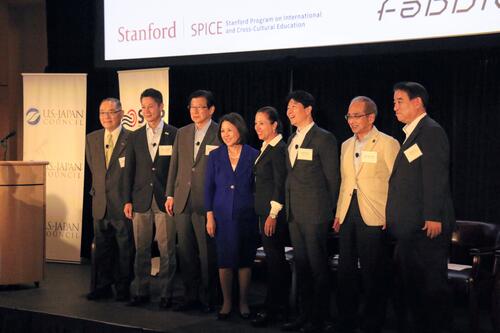
On August 26, 2019, SPICE/FSI served as the Stanford University host of the California-Japan Governors’ Symposium, which was co-hosted by the U.S.-Japan Council (USJC) and the Silicon Valley Japan Platform (SVJP). Four governors and one vice governor from Japan were in attendance along with dignitaries from California.


Dignitaries from Japan
Mr. Katsusada Hirose, Oita Prefecture Governor
Mr. Ryuta Ibaragi, Okayama Prefecture Governor
Dr. Heita Kawakatsu, Shizuoka Prefecture Governor
Mr. Yutaka Ota, Nagano Prefecture Vice Governor
Mr. Hidehiko Yuzaki, Hiroshima Prefecture Governor

Dignitaries from California
Ms. Eleni Kounalakis, California State Lieutenant Governor
Mr. John Roos, former U.S. Ambassador to Japan
Mr. Tomochika Uyama, Consul General of Japan in San Francisco


The goal of the Symposium was to create an opportunity for leaders from Silicon Valley and Japan to come together, reinforce relationships, consider new ways of thinking, initiate dialogue, and catalyze outcomes that benefit both the United States and Japan. USJC President Irene Hirano, California State Lieutenant Governor Kounalakis, and Ambassador Roos set the context for the Symposium by highlighting the interdependence of Japan and California broadly—and Silicon Valley specifically—historically, economically, and socially.

The Symposium featured one panel and two sessions. First, Stanford Emeritus Professor, Shorenstein Asia-Pacific Research Center Co-Founder, and Co-Chair of the SVJP Executive Committee Dr. Daniel Okimoto moderated a panel that featured the governors and the vice governor sharing some of the challenges and opportunities in their prefectures with a special focus on their prefectures’ relationship with Silicon Valley and institutions of higher learning like Stanford. Second, SPICE Director Dr. Gary Mukai moderated an education-focused session that explored issues at the intersection of education and global citizenship. SKY LABO Co-Founder Dr. Rie Kijima and SKY LABO Co-Founder and SPICE Instructor Dr. Mariko Yoshihara Yang spoke about their work in fostering the next generation of innovative human resources in STEAM (Science, Technology, Engineering, Arts, and Mathematics) education with special attention to girls’ and women’s education. They were followed by Governors Hirose, Ibaragi, and Yuzaki, who shared education-related priorities and concerns in their prefectures, e.g., declining school enrollment especially in rural areas, low numbers of Japanese students choosing to study abroad, and empowering Japanese students with global points of view. Third, Dr. Devang Thakor moderated a healthcare-focused session. Stanford Associate Professor Phillip Yang, a cardiologist, and Dr. Caleb Bell, G4S Capital and Ikigai Accelerator, shared comments on the application of AI and machine learning to medical diagnosis and treatment. Also in the session, Governor Kawakatsu and Vice Governor Ota shared reflections on health-related topics such as aging societies, the rising cost of healthcare, and prevention and wellness.

In his closing comments, Okimoto noted that he hopes to convene another symposium with the governors from Japan in three to five years. The goal of the symposium would be to share and discuss the progress that has been made since last month’s gathering.

Over the next three to five years, SPICE plans to do its part—in at least five areas—in terms of building upon the discussion from the education-focused session. First, later this month, Mukai will be offering the first class of Stanford e-Oita, an online class on U.S. society and culture that SPICE will offer to high school students in Oita this fall. Second, Rylan Sekiguchi, Instructor of Stanford e-Hiroshima, will begin instruction from this fall of an online class on U.S. society and culture that SPICE will offer to high school students in Hiroshima. Third, Yang will be visiting Hiroshima in November to meet Governor Yuzaki as well as to offer the final class of the Stanford-Hiroshima Collaboration Program, which will be offered to MBA students at the Prefectural University of Hiroshima and other universities also from this fall. Fourth, SPICE will continue to assist Okayama Prefecture and Shizuoka Prefecture on their educational efforts in areas like sister city school programs and engaging their students in Stanford e-Japan, a national online class that SPICE offers to high school students throughout Japan. Stanford e-Japan is taught by Waka Takahashi Brown and Meiko Kotani. Fifth, SVJP Executive Director Kenta Takamori and Mukai recently shared reflections on the Symposium and their work with the prefectures on NBC Bay Area. They hope to continue to inform the broader Silicon Valley community of the outcomes of the Symposium.


Five Japanese governors and California lieutenant governor Kounalakis convene at Stanford University for the California-Japan Governors’ Symposium.
Professor Okimoto, Governor Yuzaki, Governor Kawakatsu, Ms. Hirano, Lieutenant Governor Kounalakis, Governor Ibaragi, Governor Hirose, Vice Governor Ota


To stay informed of SPICE-related news, join our email list and follow SPICE on Facebook or Twitter.


Related articles:


Hero Image
Education session at the California-Japan Governors’ Symposium
Education session with Dr. Mariko Yoshihara Yang, Dr. Rie Kijima, Governor Ibaragi, Governor Hirose, Governor Yuzaki
Rylan Sekiguchi
All News button
1
Subtitle

On August 26, 2019, SPICE/FSI served as the Stanford University host of the California-Japan Governors’ Symposium, which was co-hosted by the U.S.-Japan Council (USJC) and the Silicon Valley Japan Platform (SVJP).

Date Label
Display Hero Image Wide (1320px)
No
Authors
Gary Mukai
News Type
News
Date
Paragraphs

On August 9, 2019, six students from SPICE’s Stanford e-Japan online course and three students from the Reischauer Scholars Program (RSP) were recognized during the 13th annual Japan Day at Stanford University. The nine honorees had the chance to share presentations of their research papers with an audience that included Consul General Tomohiko Uyama (Consulate General of Japan in San Francisco), Ambassador Michael Armacost (former U.S. ambassador to Japan), SPICE supporter Amanda Minami Chao, and Stanford Professor and SPICE advisor Indra Levy.

The program began with opening remarks by Consul General Uyama and his words resonated in me as I grappled with the fact that the celebratory Japan Day was being held on a solemn occasion, the 74th anniversary of the atomic bombing of Nagasaki. Consul General Uyama stated:

The Japan–U.S. alliance is the cornerstone of security, stability, and prosperity in the Asia-Pacific region. As we look at the global challenges we face today, I believe that we must strive to ensure that our special relationship remains strong and vital. One way to accomplish this is by preparing the best and brightest of our young people with the kind of learning opportunities that will deepen mutual understanding. The RSP and the Stanford e-Japan are admirably working toward this goal by providing the knowledge and expertise our young people will need as future leaders in Japan–U.S. relations.

After hearing Consul General Uyama’s comments, I came to the realization that honoring young future leaders from both countries on the 74th anniversary can symbolize the ray of hope for global peace that I feel with programs like the RSP and Stanford e-Japan. The presentations that the nine students made confirmed this feeling. Though the topics of their presentations were varied—ranging from historical topics like post-World War II art in Japan to contemporary social issues in Japan—a common thread among all was the significance of the U.S.–Japan relationship to the security of the world. Their presentations were followed by the awarding of plaques and lunch. During the program and a tour of campus, one could witness the budding relationships between the Japanese and American students.

SPICE students and instructors at Stanford Japan Day SPICE student honorees and instructors at Stanford Japan Day 2019
Stanford e-Japan is an online course, which focuses on U.S. society and culture and U.S.–Japan relations, that SPICE has offered to high school students in Japan for five years. The current supporter of the course is Mr. Tadashi Yanai, President of the Yanai Tadashi Foundation, Tokyo. “Carving a brighter future” is at the core of the Foundation’s mission and I hope that all RSP and Stanford e-Japan alumni keep this mission close to their hearts. One of the key programs of the Foundation is the Yanai Tadashi Scholarship Program, which awards scholarships to Japanese students who enroll at select universities in the United States. Several Stanford e-Japan alumni and Stanford students are recipients of the Scholarship.

The 2018 spring and fall Stanford e-Japan course instructors were Elin Matsumae and Waka Takahashi Brown, respectively. Key themes like interdependence, multiple perspectives, and diversity were emphasized in their online courses. Naoya Chonan, Waseda University Senior High School, Tokyo, reflected, “The Stanford e-Japan program was different from any classes at my school in terms of diversity. It prepared an opportunity to compare diverse ideas from all over Japan and the U.S. Collaborative coursework with excellent students taught me the importance of realizing and embracing differences of viewpoints and opinions among people.”

This comment resonated in Brown who noted that the annual Japan Day celebration is so rewarding not only for the students, but also for the instructors. “The students always amaze me with their extraordinary scholarship and poise during their presentations. Perhaps what is most gratifying, however, is the campus tour that we end our day with in which the students are relaxed and happy. It’s during this time they talk with each other about their dreams and future plans. I have no doubt these are the future leaders of the next generation.”

The RSP is an online course that SPICE has offered to high school students in the United States for 16 years. The course introduces Japanese society and culture and U.S.–Japan relations and has enrolled students from most states. Since the inception of Stanford e-Japan, RSP Instructor Naomi Funahashi and Brown have facilitated joint online classes with RSP and Stanford e-Japan students. Funahashi reflected, “It is so rewarding to see the RSP and e-Japan honorees be recognized for their tremendous efforts in their respective courses. Japan Day is a unique opportunity to bring these remarkable students physically together, and it really gives them a chance to learn from one another and deepen the meaningful ways in which these courses connect young leaders across the U.S. and Japan.”

Japan Day was clearly meaningful to the students as well. Sandi Khine, Arcadia High School, Arcadia, California, commented in a follow-up note to Funahashi, “Thank you so much! I’m still kind of in shock that today happened, it feels like such a dream! I had so much fun today meeting Jaimie and Mei and all the other Stanford e-Japan students. I’ll definitely look back on this with lots of love.”

Lantern with the word “heiwa” (peace) in Nagasaki, 74th anniversary of the atomic bombing Lantern with the word “heiwa” (peace) in Nagasaki, 74th anniversary of the atomic bombing

Following the Japan Day ceremony, I read about the 74th anniversary ceremonial events that took place in Nagasaki. One of the traditional ceremonial events on the anniversaries of the atomic bombings of Hiroshima and Nagasaki has been the lighting of lanterns. While watching the American and Japanese students receive plaques from their instructors, one could definitely see a glow in each one of them and also in their instructors. I felt a surge of pride in the students, of course, but also in their teachers—Funahashi, Brown, and Matsumae—for empowering their students with such incredible learning experiences and recognition that most certainly brightened their students’ futures.

(Image at right: Lantern with the word “heiwa” (peace) in Nagasaki, 74th anniversary of the atomic bombing; photo credit: Jiji Press.)


Stanford e-Japan and the Reischauer Scholars Program are two of several online courses for high school students offered by SPICE, Stanford University, including the Sejong Scholars Program (on Korea), the China Scholars Program, and Stanford e-China.

To stay informed of SPICE-related news, join our email list and follow SPICE on Facebook or Twitter.


Related articles:

Hero Image
High school student honorees with Japanese Consul General at Stanford Japan Day
Consul General Tomohiko Uyama (front row, third from left) with Japan Day honorees and their teachers
Rylan Sekiguchi
All News button
1
Subscribe to North America