Stanford e-Japan is an online course that teaches Japanese high school students about U.S. society and culture and U.S.–Japan relations. The course introduces students to both U.S. and Japanese perspectives on many historical and contemporary issues. It is offered biannually by the Stanford Program on International and Cross-Cultural Education (SPICE). Stanford e-Japan is currently supported by the Yanai Tadashi Foundation. The Fall 2019 cohort was the ninth group of students to complete Stanford e-Japan.
In Summer 2020, three of the top students of the Fall 2019 Stanford e-Japan distance-learning course will be honored at an event at Stanford University. The three Stanford e-Japan Day honorees—Ayano Hirose (Okayama Sozan High School), Chisaki Sano (Gunma Kokusai Academy), and Natsumi Shindo (Keio Girls Senior High School)—will be recognized by Stanford e-Japan Instructor Meiko Kotani for their coursework and exceptional research essays that focused respectively on “Three Basic Ways to Promote Cross-Cultural Understanding in Japanese Education,” “U.S.–Japan Relations: Economic Interdependence Seen in 7-Eleven Operations,” and “The U.S.–Japan Security Alliance: Its Preservation and the Responsibilities of Both Countries.”
Yuta Myojo (Rikkyo Ikebukuro High School) received an Honorable Mention for his coursework and research paper on “How Could Japanese Society Achieve Increased Biculturalism: From the Aspects of Education Reform and Self-Awareness.”
In the Fall 2019 session of Stanford e-Japan, students from the following schools successfully completed the course: Aiko Gakuen (Ehime), Gunma Kokusai Academy (Gunma), Hiroshima High School (Hiroshima), Hiroshima Prefectural Hiroshima Junior/Senior High School (Hiroshima), Hitachi First Senior High School (Ibaraki), Ichikawa Junior and Senior High School (Chiba), Keio Girls Senior High School (Tokyo), Keio Senior High School (Kanagawa), Mita International High School (Tokyo), Nishiyamato Gakuen High School (Nara), Okayama Prefecture Asahi Senior High School (Okayama), Okayama Sozan High School (Okayama), Rikkyo Ikebukuro High School (Tokyo), Ritsumeikan Uji High School (Kyoto), Sendai Shirayuri Gakuen (Miyagi), Senior High School at Otsuka, University of Tsukuba (Tokyo), Senior High School at Kyoto University (Kyoto), Shibuya Kyouiku Gakuen Shibuya Senior High School (Tokyo), Shibuya Makuhari Senior High School (Chiba), Shirayuri Gakuen Senior High School (Tokyo), Takada High School (Mie), Takatsuki Senior High School (Osaka), Tokyo City University Senior High School (Tokyo), Waseda University Senior High School (Tokyo), Yokohama Science Frontier High School (Kanagawa), and Zushi Kaisei High School (Kanagawa).
For more information about the Stanford e-Japan Program, please visit stanfordejapan.org.
Following the 1989 Loma Prieta earthquake, I recall being astounded that the iconic arches and pillars of Stanford University—though damaged—didn’t collapse or fall during the powerful earthquake. Wooden supports were inserted below the arches and remained for years while retrofitting took place. Since then, the arches and pillars have symbolized for me the stability and the security of the foundation of Stanford University. During yet another unstable time in 2020, this symbolism has once again taken on critical significance here and abroad.
In 1989, the World Wide Web was yet to be born, so obviously SPICE did not offer online classes to students in the United States, let alone to students abroad. SPICE’s first online course, the Reischauer Scholars Program, was launched in 2004. RSP Instructor Naomi Funahashi introduces topics related to Japan and U.S.–Japan relations to high school students in the United States. In 2015, SPICE launched Stanford e-Japan, an online course on U.S. society and culture and U.S.–Japan relations that Waka Takahashi Brown and Meiko Kotani offer to high school students in Japan. Since then, several other regional classes have been launched, including Stanford e-Kawasaki in 2019.
[[{"fid":"240970","view_mode":"crop_870xauto","fields":{"format":"crop_870xauto","field_file_image_description[und][0][value]":"Kawasaki City logo","field_file_image_alt_text[und][0][value]":"Kawasaki City logo","field_file_image_title_text[und][0][value]":"Kawasaki City logo","field_credit[und][0][value]":"","field_caption[und][0][value]":"Kawasaki City logo","thumbnails":"crop_870xauto"},"link_text":null,"type":"media","field_deltas":{"2":{"format":"crop_870xauto","field_file_image_description[und][0][value]":"Kawasaki City logo","field_file_image_alt_text[und][0][value]":"Kawasaki City logo","field_file_image_title_text[und][0][value]":"Kawasaki City logo","field_credit[und][0][value]":"","field_caption[und][0][value]":"Kawasaki City logo","thumbnails":"crop_870xauto"}},"attributes":{"alt":"Kawasaki City logo","title":"Kawasaki City logo","style":"float: right; margin: 5px; height: 150px; width: 256px;","class":"media-element file-crop-870xauto","data-delta":"2"}}]]
Stanford e-Kawasaki is an online course for high school students in Kawasaki City that is jointly offered by Kawasaki City and SPICE. Stanford e-Kawasaki Instructor Maiko Tamagawa Bacha provides students with an introduction to diversity and entrepreneurship in the United States and equips students with substantive knowledge about U.S. culture and society that may have a significant impact on their future choice of study and career.
The inaugural Stanford e-Kawasaki course began in October 2019 and culminated this month with presentations of final research projects by students from Tachibana High School and Kawasaki High School, the two participating schools in the inaugural course. Leading scholars from Stanford University and Silicon Valley entrepreneurs—including Dr. Stephen Murphy-Shigematsu from Stanford and Silicon Valley entrepreneurs Sukemasa Kabayama, CEO and Co-Founder of Uplift, and Rika Nakazawa, VP Strategy and Business Development at Atheer—led online class discussions and not only encouraged students to critically think about diversity and entrepreneurship in the United States but also in Japan. These discussions helped students to conceptualize topics for their final research projects.
The research projects were varied and included a comparative analysis of college admissions in the United States and Japan, an examination of psychological issues affecting youth in the United States and Japan, and a discussion about whether a Silicon Valley-type ecosystem can be created in Japan. The students’ presentations were not only content rich and creative but also effectively engaged the audience, which included Vice Principal Akihiro Igarashi of Tachibana High School, Miyuki Kitamura of Kawasaki City, SPICE Instructors Carey Moncaster, Rylan Sekiguchi, and Kasumi Yamashita, Bacha, teachers from both high schools, and me. Bacha reflected, “Though my students were not able to make their presentations physically in front of audiences [as originally planned] due to the current COVID-19 pandemic, I was grateful to have had the chance to virtually observe all of the presentations from Colorado along with my colleagues in California, Hawai‘i, and Washington. I was especially impressed with my students’ demonstrated growth in their English-speaking abilities and confidence. Especially gratifying was to witness students asking each other questions.”
Vice Principal Igarashi noted, “I am deeply grateful for the opportunity given to the Tachibana High School students to join online class discussions led by leading scholars in the United States… As I watched them passionately delivering their final research presentations that they worked hard on, I could tell that they gained unique experiences which they cannot experience in regular school classes. By comparing Japan and the United States in their research projects, I am sure that they discovered new things about their own country, Japan… I believe from the bottom of my heart that the online classes and assignments given by this course will empower the youth of the future.”
While listening to the presentations, I was struck by how well the students engaged the audience. In my final comments, I commended their use of several effective presentation techniques, such as the following.
Emphasis on interdisciplinarity in their research
Incorporation of multiple perspectives
Voice projection
Use of images, including photos, drawings, statistics, and graphs
Signposting
Embedding questions for the audience in the presentation, e.g., Can we create a Silicon Valley in Japan?
Providing historical context
Definition of complex terms
In addition, for the first time since SPICE launched online courses, I felt a deep sense of satisfaction from knowing that we could bring some stability and security to the lives of students who could no longer physically go to school. The students gushed with enthusiasm despite their nervousness.
Mizuho Toyama, a Teacher of the English Department at Kawasaki High School noted, “We were so excited about our students’ online presentations this morning. What they did was tremendous and the experience they went through—I am sure—has become their priceless treasure… They learned not only English as a foreign language but also, more importantly, stepping out of their ‘comfort zone’ to seek advanced levels of learning. Raising cultural awareness with peers and also sharing thoughts without racial biases is an excellent source of learning. I am thankful for this program for encouraging students to be more openminded.”
Erica Oh, an American Assistant Language Teacher of English at Kawasaki High School, also commented on Bacha’s course. “Again, thank you and your staff, especially Maiko Tamagawa Bacha, for the awesome opportunity you have given our students to learn more and think outside their cultural box. It was an absolute delight for me to be able to witness their growth. I hope Stanford and Kawasaki stay in partnership and that this program continues.” For one of the online classrooms that focused on diversity, Bacha invited former Japan Exchange and Teaching (JET) Program Assistant Language Teachers—John Branderhorst, Jeffrey Fleischman, Ryan Moore, and Cerell Rivera—to share their perspectives. “Bringing Americans and Japanese together—albeit virtually—at a time like this is invaluable,” commented Bacha.
Students who successfully completed the course will earn a Certificate of Completion from SPICE/Stanford University on March 26, 2020 during a virtual closing ceremony. Mayor Norihiko Fukuda will make opening comments. In addition to SPICE staff, others who will be in attendance are Hisashi Katsurayama from the Kawasaki Board of Education and Katsuyoshi Abe, Yoshitaka Tsuchihama, and Miyuki Kitamura of Kawasaki City, all of whom have been unwavering in their support of Stanford e-Kawasaki.
When SPICE launched its online courses, I never imagined that the SPICE instructors would be reaching many students whose school lives were disrupted by a pandemic. I feel indebted to FSI Director Dr. Michael McFaul and FSI Deputy Director Dr. Kathryn Stoner for their support during this unstable time and enabling SPICE to help add some stability and security to students’ lives.
With the start of baseball season, a fun fact to note is that on April 16, 1905, the Tokyo-based Waseda University baseball team played the Stanford baseball team in California. Stanford beat Waseda 9-1. This game may have been the first formal event between Stanford and Waseda. Since then, Waseda and Stanford have engaged in numerous academic and research collaborations, student exchanges, and sporting events, and each has enrolled the other’s alumni in graduate and professional programs.
Nearly 115 years later, on March 3, 2020, SPICE offered a one-day seminar for Waseda students, all of whom are aspiring teachers. The visit to Stanford was initiated by Professor Hiroyuki Tanaka of Waseda University’s Graduate School of Teacher Education. The seminar underscored the importance of Waseda Vision 150, Waseda’s strategic plan that includes the goal of cultivating future leaders with global perspectives.
I began the seminar with a lecture on curriculum that introduced diversity in the United States and encouraged the future teachers to think about addressing the needs of an increasingly diverse student population in Japanese classrooms. The afternoon featured a panel of educators from SPICE that included Jonas Edman, Meiko Kotani, and Dr. Mariko Yoshihara Yang who spoke about teacher professional development, student-centered learning in Stanford e-Japan, and girls’ empowerment and SKY Labo, respectively; and a lecture on STEAM education by Yang that underscored the significance of the arts and its intersection with the STEM fields.
The seminar was highlighted by two student-led presentations. The first focused on Japanese school lunches by Graduate School of Teacher Education students Akihiro Baba, Yurina Kano, Hideki Nakamura, and Karen Tashiro, who aspire to be Japanese language, music, mathematics, and elementary school teachers, respectively. Their presentation stimulated a broader discussion of comparisons between Japanese and U.S. elementary schools as well as U.S. efforts—through the Licensed Agencies for Relief in Asia—that provided large amounts of food and clothing to Japan from 1946 to 1952. The second featured Waseda student Kuma Shibata, who spoke about bukatsudo (extracurricular school clubs), a feature of Japanese secondary education. Shibata, who aspires to become a physical education teacher, described the advantages and challenges of bukatsudo that included advantages such as the physical benefits of sports clubs and challenges such as the sometimes-extensive time commitments on the part of not only students but also teacher supervisors. Following the presentation by Shibata, who studies the sociology of sport, U.S. and Japanese perspectives on his academic area of interest were shared by the audience and Shibata.
SPICE staff with Waseda University students and Professor Hiroyuki Tanaka (top right); photo courtesy Gary Mukai
Since the 2012 establishment of the San Francisco Office of Waseda USA, an initiative to promote the interests of Waseda University abroad, SPICE has had the pleasure of meeting and working with many scholars affiliated with Waseda. In addition to having had the experience of working with students of Tanaka for many years, SPICE has also had the pleasure of consulting and/or working with the following scholars at Waseda: Dr. Yoichi Aizawa, Professor Tetsuo Harada, Mr. Satoshi Hattori, MBA, Professor Kanetaka Maki, Professor Takao Mimura, Professor Atsuko Shimbo, and Professor Aya Yoshida. I have had the chance to consult with many of them about Stanford e-Japan, which Kotani described during the panel discussion. Since 2015, SPICE has offered Stanford e-Japan, an intensive online course taught in English that introduces Japanese high school students to U.S. society and culture and U.S.–Japan relations. Waseda alumnus Tadashi Yanai is the current supporter—through the Yanai Tadashi Foundation—of Stanford e-Japan. Admission to its fall and spring courses is very competitive with students from throughout Japan vying for only up to 30 slots per course.
Several high school students from Waseda’s fuzoku (affiliated high schools)—Waseda Jitsugyo High School, Waseda University Honjo High School, and Waseda University Senior High School—have been accepted into Stanford e-Japan. On August 6, 2020, SPICE will honor three of the top students of both the Spring 2019 and Fall 2019 Stanford e-Japan courses at a Japan Day event at Stanford University. One of the honorees will be Kota Watanabe (Waseda University Senior High School, Tokyo), who will be recognized for his coursework and exceptional research essay “A More Sufficient Language Learning Environment for Foreign Students in Japan: A Comparison with the American ESL Education System.” During the 2017 and 2018 Japan Day events, Waseda University Senior High School students Reon Hiruma and Naoya Chonan, respectively, were recognized for their coursework and exceptional research essays.
SPICE is proud to continue Stanford’s 115-year history of collaboration with Waseda University by helping to cultivate future teachers with global perspectives. To mark the quasquicentennial anniversary of the 1905 baseball game, I hope that Waseda will play Stanford again in 2030, and that students like Baba, Chonan, Hiruma, Kano, Nakamura, Shibata, Tashiro, and Watanabe will be in the audience cheering for Waseda, of course, but feeling at least some nostalgia for their experiences with Stanford.
Waseda University Baseball Team at Stanford University, 1905; courtesy of Waseda University.
All News button
1
Subtitle
With the start of baseball season, a fun fact to note is that on April 16, 1905, the Tokyo-based Waseda University baseball team played the Stanford baseball team in California.
A primary goal of SPICE is to support educators who wish to infuse their teaching with global perspectives. One of the most important ways in which we strive to do this is through our collaboration with Stanford Global Studies (SGS) on the U.S. Department of Education’s Title VI-funded Education Partnership for Internationalizing Curriculum, also known as EPIC. EPIC is coordinated by Denise Geraci, SGS’s Outreach and Academic Coordinator.
Each year, EPIC accepts up to ten community college instructors to participate in a one-year fellowship program aimed at internationalizing the community college curriculum. The program commences with a three-day institute at Stanford University that includes lectures, workshops, presentations, and meetings with faculty and staff from multiple disciplines and organizations at Stanford. Following the institute, the fellows return to their home institutions to work on their EPIC projects alongside their regular teaching duties. Over the following months, the Stanford-based EPIC staff meets regularly with the fellows online to discuss their projects, offer feedback, and facilitate collaboration. At year’s end, the fellowship program culminates in an all-day symposium for community college instructors during which the fellows present their work to their colleagues and peers.
Working with community college instructors is one of the most rewarding aspects of my job. As a former public high school teacher, I am familiar with the challenges and rewards of teaching students of diverse socio-economic and ethnic backgrounds, which often typifies the community college classroom. Add to that a significant proportion of international students—many of whom are learning English for the first time—and you start to get a sense of the true diversity of student experiences, needs, and goals that community college instructors have to take into account in their teaching.
Over the years of working with EPIC fellows, I consistently find myself in awe of their pedagogical expertise and dedication to their students, and this year is no different. For the 2019–2020 EPIC fellowship program, I have had the pleasure of working with the following five exceptional community college instructors and their unique EPIC projects: Lauren Arenson, Professor of Anthropology and Humanities, Pasadena City College, and her project on environmental justice and social equity from a global perspective; Dana Grisby, Professor of African American Studies, Laney College, and her project on internationalizing her African American Studies course with diaspora dialogues; Humberto Merino-Hernandez, Adjunct Economics Instructor, Cerritos College, and his project on global financial crises; Soraya Renteria, Art History Instructor, Las Positas College, and her project on creating a global introduction to Art History; and Citali Sosa-Riddell, History Instructor, Pierce College, and her project on connecting American myths with global myths.
The 2020 EPIC Symposium will take place on May 16th at Stanford University. The symposium is an opportunity for community college faculty and administrators from across California to discuss strategies for preparing students for a globalized world. In addition to the EPIC fellows’ presentations of their projects, there will also be presentations from Stanford faculty and roundtable discussions for participants. If you are a community college instructor interested in internationalizing the curriculum, I hope to see you there.
The Stanford University Scholars Program for Japanese High School Students or “Stanford e-Japan” is an online course sponsored by the Yanai Tadashi Foundation and the Stanford Program on International and Cross-Cultural Education (SPICE), Stanford University. This online course teaches Japanese high school students about U.S. society and underscores the importance of U.S.–Japan relations. Through Stanford e-Japan, ambassadors, top scholars, and experts throughout the United States provide web-based lectures and engage Japanese high school students in live discussion sessions called “virtual classes.” Stanford e-Japan is now in its 6th year and 10th session overall.
On January 24, 2020, 29 high school students across Japan were notified of their acceptance to the Spring 2020 Stanford e-Japan Program. The 10th session of the online course kicks off today and runs until June 30, and will include students representing the following prefectures: Chiba, Fukuoka, Fukushima, Hiroshima, Hyogo, Ibaraki, Kanagawa, Okayama, Osaka, Saitama, Shizuoka, Tokyo, and Yamagata. In addition to a diverse geographical representation within Japan, the students themselves bring a diverse set of experiences to the program, many having lived overseas in places such as Myanmar, Thailand, Mexico, and the United States.
The selected Stanford e-Japan high school students will listen to lectures by renowned experts in the field including Professor Emeritus Peter Duus, Professor Kathryn Gin Lum, and Dr. Kenji Kushida (all at Stanford University) on topics such as, “The Atomic Bombings of Japan,” “The Attack on Pearl Harbor,” “Religion in the U.S.,” and “Silicon Valley and Entrepreneurship.” Live virtual classes include guest speakers such as Ms. Suzanne Basalla (Toyota Research Institute), Ms. Maiko Cagno (U.S. Consulate, Fukuoka), and Dr. Makiko Oku (Co-Founder, KiKO Japan).
Many Stanford e-Japan students in the current cohort (as well as past ones) have mentioned their desire to study in the United States. The Stanford e-Japan Program equips many students with the motivation and confidence to do so, in addition to many of the skills they will need to study at U.S. universities and colleges. In addition to weekly lectures, assignments, discussion board posts, and virtual classes, the program participants will complete a final research paper on a topic concerning U.S. society or the U.S.–Japan relationship.
“I’ve encouraged my students to seriously consider undergraduate studies in the United States and to look into opportunities like the Yanai Tadashi Foundation Scholarships,” commented Stanford e-Japan Instructor Waka Brown. “Many e-Japan alumni have gone on to study in the United States, either for their entire college experience or for shorter overseas study opportunities. A couple of them received full scholarships, thanks to The Yanai Tadashi Foundation.”
In 2019, SPICE established two new online courses for students in Hiroshima—one for MBA students and one for high school students. These courses have a special significance to me because my ancestral home is Hiroshima. My paternal grandfather left Hiroshima for Hawaii to work as a sugar cane field laborer in 1903. After three years, he departed for California. My paternal grandmother departed Hiroshima in 1909 to join him as a “picture bride.” My maternal grandfather left Hiroshima for California to work as a strawberry field laborer in 1919, and my maternal grandmother, who was born in Hawaii and raised in Hiroshima, joined him also as a picture bride in 1931.
One of the biggest regrets in my life is that I never had the chance to meet my maternal grandfather, who returned to Japan from California in 1954 just before I was born. I wish that I could tell him that SPICE’s two new online courses for students in his birthplace were established 100 years after his arrival in California in 1919 and that this article was posted on SPICE’s website 78 years after President Franklin D. Roosevelt’s signing of Executive Order 9066 on February 19, 1942. This order led to my family’s internment—including my grandparents and parents—during World War II.
The two online courses are called the Stanford-Hiroshima Collaborative Program on Entrepreneurship (SHCPE), an online course for MBA students that was conceptualized in consultation with the Hiroshima Business and Management School at the Prefectural University of Hiroshima (PUH), and Stanford e-Japan, an online course for high school students.
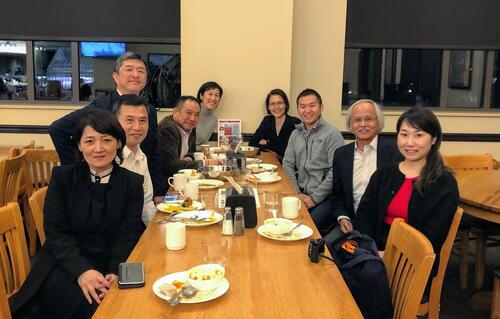
SHCPE gathering at Arrillaga Family Dining Commons, February 13, 2020
SHCPE Instructor Dr. Mariko Yoshihara Yang recently shared her reflections on the inaugural course that was offered in fall 2019. On February 13, 2020, Yang welcomed PUH faculty and staff members Professor Katsue Edo, Professor Yasuo Tsuchimoto, Professor Narumi Yoshikawa, and Kazue Hiura to Stanford to debrief the 2019 course and to prepare for the 2020 course. Joining the meeting were three guest speakers for SHCPE. The guest speakers were Tasha Yorozu, a legal counsel who has worked extensively with Japanese companies in Silicon Valley; Seiji Miyasaka, an active venture capitalist on both sides of Pacific; and Tatsuki Tomita, who has established multiple startups. During the meeting, I had the chance to share the Japanese passports of my paternal grandfather and grandmother, who were born in 1882 and 1892, respectively. I have shared the passports with many Japanese visitors as a way to note their contributions—through agriculture—to early U.S.–Japan relations.
As I listened to the discussion, I came to realize the significance of the word, “Collaborative,” in the title of Yang’s course. Course feedback from the MBA students who were enrolled in SHCPE was also carefully considered as modifications for the 2020 course were mapped out. Preliminary plans were also made for a visitation to Stanford by SHCPE students following the 2020 course.
In addition to SHCPE, SPICE offers an online course for high school students in Hiroshima that is called Stanford e-Hiroshima. Stanford e-Hiroshima Instructor Rylan Sekiguchi is working with students who attend the following high schools in Hiroshima Prefecture.
Miyoshi High School
Sera High School
Kuremitsuta High School
Yasufuruichi High School
Onomichi Kita High School
Onomichi Higashi High School
Hiro High School
Hiroshima High School
Hiroshima Kokutaiji High School
Hiroshima University High School
Fukuyama Junior and Senior High School
Hatsukaichi High School
Gion Kita High School
Fukuyama Seishikan High School
Saijyou Agricultural High School
I had the pleasure of sharing the stories of early Japanese immigration to the United States—including those of my grandparents—during a Stanford e-Hiroshima online class. Sekiguchi’s students were not only attentive but also asked excellent questions. They are currently in the midst of preparing and delivering their final presentations for Stanford e-Hiroshima. At the end of the course, the top two highest performing students will be invited to Stanford for a ceremony on August 17, 2020, just a few days after the 75th anniversary of the dropping of the atomic bomb on Hiroshima, August 6, 1945. I believe that my grandparents would be pleased to hear about educational efforts—such as Stanford e-Japan and SHCPE—that promote a better understanding between Americans and Japanese so that the current friendship will remain forever.
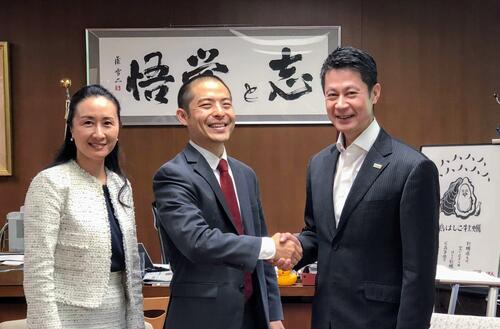
From left to right: Superintendent Rie Hirakawa, Stanford e-Hiroshima Instructor Rylan Sekiguchi, and Governor Hidehiko Yuzaki
I would like to express my appreciation to Hiroshima Governor Hidehiko Yuzaki (Stanford MBA, 1995). Without his vision, SHCPE and Stanford e-Japan would not have been realized. I am grateful to those from Hiroshima—Edo, Tsuchimoto, Yoshikawa, and Hiura—and those based in the United States—Yorozu, Miyasaka, and Tomita—for having taken the time in their busy schedules to meet with Yang on February 13, 2020. In addition, I would like to express my appreciation to Superintendent Rie Hirakawa of the Hiroshima Prefectural Board of Education and Teacher Consultants, Rika Ryuoh and Nobuo Kawahara, who have been unwavering of their support of Sekiguchi and Stanford e-Hiroshima. Last but not least, I am thankful to Sekiguchi and Yang for their course leadership and for allowing me the chance to keep my grandparents’ legacies alive through their courses.
Last fall, SPICE provided me an opportunity to design and organize its first post-collegiate online course. The Stanford-Hiroshima Collaborative Program on Entrepreneurship (SHCPE’s Japanese-friendly pronunciation, “shu-ppe”) was conducted in collaboration with the Hiroshima Business and Management School (HBMS) at the Prefectural University of Hiroshima (PUH). HBMS offers the only Master of Business Administration (MBA) program in Japan’s western region of Chugoku and Shikoku. Interacting with amazing individuals on both sides of the Pacific, this unique experience brought me priceless moments.
Innovation in Itself
SHCPE, a course to help nurture entrepreneurial thinking, was an innovation in itself. The program was born out of Governor Hidehiko Yuzaki’s vision to design and implement a social challenge to help accelerate Hiroshima’s regional growth. Harnessing the resources of Stanford and Silicon Valley, the new online class was launched to empower the students and to revitalize the business sector in Hiroshima. SPICE created the curricular content and HBMS provided the learning environment designed to maximize the academic experience for the students. As the course’s curriculum designer, I leveraged the expertise of my fellow SPICE online instructors and applied design thinking, a method developed by Stanford faculty, practiced widely in Silicon Valley, and popularized globally to understand the end-user, challenge our assumptions, and reconstruct alternative perspectives to generate innovative ideas.
Bridging Silicon Valley and Hiroshima
SHCPE’s 18 MBA students in Hiroshima met every Saturday morning for three hours from September 28 to November 16, 2019 to connect online with Japanese entrepreneurs, professionals, and scholars in Silicon Valley. The first virtual class focused on discussing the mindset expected for the course as well as the conceptual framework. In the following six weeks, we welcomed guest speakers who shared their diverse experiences. What were their prior experiences, expertise, and insights? What resources did they have to achieve their goals? What were the major promoters and impediments to their journeys? Through active exploration of these questions, the students were exposed to real-life case studies to analyze Silicon Valley’s ecosystem and think critically about entrepreneurial competence and qualification. The course was conducted entirely in Japanese.
The guest speakers engaged and energized the HBMS students. Akira Onozato spoke about the evolution of Silicon Valley over the past three decades. His diverse experiences as a serial entrepreneur painted a rich picture of the San Francisco Bay Area’s growth cycle. Akira’s story provided a great segue to Rika Nakazawa’s lecture on the mindset and culture surrounding startups. Rika highlighted grit, tolerance of failure, and branding as important assets of successful entrepreneurs. Dr. Fumiaki Ikeno spoke on the landscape and trends in the medical device industry. He pointed to Japan’s declining productivity and economic competitiveness and discussed the persistent fear of failure as a major impediment to promoting entrepreneurship. As an active venture capitalist on both sides of Pacific, Seiji Miyasaka explained the funding schemes and financial cycles surrounding the investment climate of startups. Using case studies, he highlighted the role of investors who act as coaches to aspiring entrepreneurs. Tatsuki Tomita’s definition of a startup was shaped by his own experiences of starting multiple companies. His discussion of the pivot pyramid provided a visual guideline for how startups can experiment with ideas and find their product-market fit. Tasha Yorozu shared her expertise as a legal counsel, walking through the steps of starting a business in Silicon Valley. Along with Jumpei Ishii, a visiting legal counsel from Japan, Tasha further discussed their observations of successful startup practices and common pitfalls. The diversity of SHCPE guests represented the vibrant Silicon Valley community.
Active Learning and Knowledge Construction
While these professionals provided informative accounts of their expertise, SHCPE’s ultimate goal was to help each HBMS student to develop a mindset of an active learner. The MBA students were constantly challenged to think critically about the weekly theme, and work in pairs or teams to discuss assigned topics. The experience offered a dynamic and interactive learning environment for the Japanese students in their 30s, 40s, and 50s who had been accustomed to traditional lecture-style formats. SHCPE’s curriculum based on design thinking adopted an inquiry-based learning pedagogy, which engaged every student through weekly assignments and in-class discussions. During the first class, the students were informed that SHCPE would not teach them entrepreneurship. Instead, this course would provide them with the opportunity to reconstruct their knowledge of entrepreneurship and innovation based on what they observe, hear, and feel during the class. In addition, the students were required to provide feedback after each class, which was utilized to redesign the lesson plans for the following week.
This active and experiential mindset was envisioned by Dr. Gary Mukai, Director of SPICE and a renowned Japan–U.S. educator. “At SPICE, we provide students an opportunity to own their learning experience. Education is about empowering the students,” Dr. Mukai asserts. This tradition comes from the American philosopher and education reformist John Dewey, who said, “I believe finally, that education must be conceived as a continuing reconstruction of experience; that the process and the goal of education are one and the same thing.” SHCPE’s inaugural curriculum aimed to implement this philosophy through direct, real-life interaction with founders and movers in Silicon Valley, and through the iterative process to deconstruct and reconstruct their knowledge on entrepreneurship.
Innovation Through Education
What SHCPE aimed to achieve was innovation through education. The weekly three-hour online class was roughly divided into three parts: guest lecture, class discussion, and interview. Prior to the interview session, a pre-assigned team of three students met with me in a separate online room and brainstormed their interview questions. For the majority of the students, it was their very first time to formally interview a person, and the experience brought a novel learning opportunity to think critically about entrepreneurial competence. Many commented on the challenge and the excitement of getting to know strangers by engaging them in a thoughtful conversation. The weekly interview highlighted the philosophy, aspiration, and raw sentiments of the guest speakers, evoking passion, energy, and empathy among the students.
SHCPE 2019 team with Ken-ichi Nakamura, President of the Prefectural University of Hiroshima
Through observations and discussions, the SHCPE participants built their own knowledge and understanding of what constitutes entrepreneurship. To conclude the eight-week course, I had the chance to visit Hiroshima to offer the last SHCPE class in person, and to observe first-hand their reaction to the curriculum design. Meeting the students as well as the HBMS faculty and staff who supported SHCPE, was an incredibly rewarding experience. My class focused on education and empowerment. The students discussed in teams how they might develop a curriculum to promote entrepreneurship in Hiroshima. Much to everyone’s delight, one of the students expressed his hope to apply what he learned in this course and serve as an angel investor to support local startups. The class culminated with a closing ceremony during which each student was presented an official Certificate of Completion. My trip to Hiroshima also provided a valuable opportunity to visit Governor Yuzaki as well as PUH President Ken-ichi Nakamura, who emphasized the importance of adding a real-life, global perspective to the HBMS curriculum. Programs such as SCHPE were made possible through these leaders’ foresight and support.
SHCPE strived to adopt the pedagogy of active learning and the toolsets of design thinking to implement Governor Yuzaki’s vision of “learning innovation.” The course appears to have succeeded in helping to realize his vision as one student reflected upon his experience:
This class does not intend to offer answers [to the question what entrepreneurship is]. Instead, it urges the students to constantly think on their own and engage themselves in learning. This is very different from the Japanese traditional pedagogy, which relies on rote memorization and mechanical process of practice problems. This class highlighted the fundamental difference in the philosophy of how we look at education, and I enjoyed this eye-opening experience.
SHCPE ’19 concluded with much enthusiasm. SPICE looks forward to continuing its partnership with HBMS to build upon the invaluable lessons learned from the inaugural program. With Stanford e-Hiroshima, an online course for high school students managed and taught by my colleague Rylan Sekiguchi, SPICE will continue its efforts to empower the people in Hiroshima.
Acknowledgement
I am greatly indebted to Dr. Gary Mukai for providing me this invaluable opportunity. Special thanks go to Carey Moncaster, Dr. HyoJung Jang, Jonas Edman, Meiko Kotani, Naomi Funahashi, Rylan Sekiguchi, Sabrina Ishimaru, Dr. Tanya Lee, and Waka Takahashi Brown for their valuable comments on the preliminary curriculum. I thank all of my colleagues at SPICE for their support and encouragement throughout the process.
My special gratitude goes to Akira Onozato, Dr. Fumiaki Ikeno, Jumpei Ishii, Rika Nakazawa, Seiji Miyasaka, Tatsuki Tomita, and Tasha Yorozu who took the time out of their busy Friday evening to participate in the virtual classroom. Their contagious enthusiasm energized the students.
Last but not least, I would like to express my deep appreciation to my collaborators at HBMS. I thank Professor Katsue Edo for his hard work and commitment to implement the program, Professor Yasuo Tsuchimoto for his technical expertise and dedication to administer the distance-learning, Professor Narumi Yoshikawa for supporting in-class discussions, and Kazue Hiura, Yoshihiko Oishi, and Kenji Okano for their capable assistance and thoughtful arrangements. Last but not least, my heartfelt congratulation goes to the 18 MBA students who successfully completed SHCPE ’19. The inaugural class will always have a special place in my heart.
[[{"fid":"240970","view_mode":"crop_870xauto","fields":{"format":"crop_870xauto","field_file_image_description[und][0][value]":"Kawasaki City logo","field_file_image_alt_text[und][0][value]":"Kawasaki City logo","field_file_image_title_text[und][0][value]":"Kawasaki City logo","field_credit[und][0][value]":"","field_caption[und][0][value]":"Kawasaki City logo","thumbnails":"crop_870xauto"},"link_text":null,"type":"media","field_deltas":{"1":{"format":"crop_870xauto","field_file_image_description[und][0][value]":"Kawasaki City logo","field_file_image_alt_text[und][0][value]":"Kawasaki City logo","field_file_image_title_text[und][0][value]":"Kawasaki City logo","field_credit[und][0][value]":"","field_caption[und][0][value]":"Kawasaki City logo","thumbnails":"crop_870xauto"}},"attributes":{"alt":"Kawasaki City logo","title":"Kawasaki City logo","style":"float: right; margin: 3px 5px; height: 118px; width: 200px;","class":"media-element file-crop-870xauto","data-delta":"1"}}]]
When I first visited Kawasaki City, I was immediately struck by the multicolored character for 川or “kawa” (river) in the Chinese characters for川崎 (Kawasaki) that appears on signs, buildings, posters, and even storm drain covers. I learned from Kawasaki Mayor Norihiko Fukuda that the multicolored 川 symbolizes the importance that Kawasaki City places upon diversity.
Kawasaki City is a large industrial city in the greater Tokyo area with a population of approximately 1.5 million, making it Japan’s sixth most populous city after Tokyo. It is one of Japan’s most ethnically diverse cities. Many Japanese multinational companies are based in Kawasaki. In 2014, the U.S. multinational company Johnson & Johnson opened the Tokyo Science Center in Kawasaki.
With the vision of Mayor Fukuda and support from Kawasaki City, SPICE has launched Stanford e-Kawasaki, an online course that is offered to high school students in Kawasaki. Stanford e-Kawasaki’s main course topics are diversity and entrepreneurship. Stanford e-Kawasaki Instructor Maiko Tamagawa Bacha recently noted, “The Kawasaki students have shown strong interest in these timely and relevant topics and are always actively engaged in discussions. One of the great things about Stanford e-Kawasaki is that it provides a place where students feel free and encouraged to express themselves. It also provides an important opportunity for students to reflect on their own society by learning about the United States. I look forward to our continued learning together for the rest of the course.” The course began in fall 2019 and a closing ceremony will be held in March 2020.
Maiko Tamagawa Bacha
Bacha is a graduate of the University of Tokyo and the Middlebury Institute of International Studies at Monterey. Prior to joining SPICE, she worked for the Ministry of Foreign Affairs of Japan for 14 years. In her most recent role as Advisor for Educational Affairs at the Consulate General of Japan in San Francisco, she had the opportunity to work closely with SPICE to support the Reischauer Scholars Program and Stanford e-Japan.
Like Bacha, Mayor Fukuda has also done formal studies in the United States. As a graduate of Furman University in South Carolina, Mayor Fukuda experienced life in the United States firsthand. Mayor Fukuda reflected, “I am grateful to SPICE at Stanford University… for starting this program for high school students in Kawasaki City. I am encouraged to learn that the students are actively learning and engaged in discussions on topics related to diversity and entrepreneurship. I strongly hope that they will grow to be men and women of high caliber, who are keen to experience their lives with broad perspectives.” With the presence of many multinational corporations in Kawasaki, Mayor Fukuda witnesses the interdependence of Japan and the world every day and fully appreciates the significance of topics like diversity and entrepreneurship to the U.S.–Japan relationship.
The SPICE staff would like to express its appreciation also to Hisashi Katsurayama from the Kawasaki Board of Education and Yoshitaka Tsuchihama and Miyuki Kitamura of Kawasaki City and for their unwavering support of Stanford e-Kawasaki.
On a recent Friday afternoon at Stanford, the weather reminded me of some crisp yet clear winter days in Japan. The sun brightly lit the Falcon Lounge on the 5th floor of Encina Hall as six alumni from the 2014 to 2018 Reischauer Scholars Program (RSP) and Sejong Korean Scholars Program (SKSP) cohorts gathered to celebrate the new year. This annual shinnenkai (literally, “new year gathering,” in Japanese) luncheon offers alumni of SPICE’s pre-collegiate online courses to meet or reconnect over lively conversation and delicious food. For the SPICE instructors, the shinnenkai is often the first time to meet alumni in person.
The RSP is an online course on Japan and U.S.–Japan relations that is offered to U.S. high school students each spring, and will welcome its seventeenth cohort in a few weeks. The SKSP is preparing for its eighth cohort, and offers an intensive online study of Korea and U.S.–Korea relations to U.S. high school students. SPICE also offers a third online course to U.S. high school students on China and U.S.–China relations, the China Scholars Program. The CSP is preparing for its sixth cohort.
One of the attendees, James Noh (RSP ‘16, Stanford University ‘22), reflected on his RSP experience following the shinnenkai: “My RSP experience not only nurtured my interest in East Asia, but also made me realize that I wanted to incorporate my interest in East Asia into both my academic and professional careers. Looking back, I think participating in RSP played an important role in influencing my decision to take a gap year to study Mandarin in China after high school and major in international relations with a focus on East Asia.” During the shinnenkai, it was interesting to hear other alumni share thoughts on how their experiences in the RSP and SKSP helped to prepare them for and also shape their college life. Comments ranged from “informing choices” like class or major selection to “honing skills” like writing research papers.
Through the many years in which SPICE has engaged U.S. high school students in these intensive online courses, we have been fortunate to work with many exceptional students such as James. As the instructor of the RSP, I especially treasure the face-to-face opportunities to meet with alumni of these courses. These opportunities are rare treats given that our courses take place entirely online. The annual shinnenkai is truly a highlight of my year.
Stanford e-Japan is an online course that teaches Japanese high school students about U.S. society and culture and U.S.–Japan relations. The course introduces students to both U.S. and Japanese perspectives on many historical and contemporary issues. It is offered biannually by the Stanford Program on International and Cross-Cultural Education (SPICE). Stanford e-Japan is currently supported by the Yanai Tadashi Foundation. The Spring 2019 cohort was the eighth group of students to complete Stanford e-Japan.
In Summer 2020, three of the top students of the Spring 2019 Stanford e-Japan online course will be honored at an event at Stanford University. The three Stanford e-Japan Day honorees—Rinko Kawamoto (UWC ISAK Japan, Nagano), Renee Ohnuki (Senior High School at Sakado, University of Tsukuba, Saitama), and Kota Watanabe (Waseda University Senior High School, Tokyo)—will be recognized for their coursework and exceptional research essays that focused respectively on “Hollywood and U.S. Society: A Study Through the Ages,” “U.S.–Japan Drone Technology Collaboration and Its Application to Photocatalytic Technology to Resolve Air and Water Pollution,” and “A More Sufficient Language Learning Environment for Foreign Students in Japan: A Comparison with the American ESL Education System.”
Isshin Yunoki (Kaisei Academy, Tokyo) received an Honorable Mention for his research paper on “The Characteristics and Social Influence of Traditional Music in Japan and America.”
In the Spring 2019 session of Stanford e-Japan, students from the following schools successfully completed the course: Canadian Academy (Hyogo); Clark Memorial International High School (Osaka); Fudooka High School (Saitama); Hiroo Gakuen High School (Tokyo); Hiroshima Jogakuin Senior High School (Hiroshima); Hiroshima University High School (Hiroshima); Hokkaido Sapporo Minami High School (Hokkaido); Ichikawa Gakuen Senior High School (Chiba); Inagakuen Comprehensive High School (Saitama); Kaisei Academy (Tokyo); Kaishi Kokusai High School (Niigata); Kaiyo Academy (Aichi); Katayama Gakuen Senior High School (Toyama); Katoh Gakuen Gyoshu Senior High School (Shizuoka); Keio Shonan Fujisawa High School (Kanagawa); Komaba Toho Senior High School (Tokyo); Kwansei Gakuin Senior High School (Hyogo); Kyuyou High School (Okinawa); Senior High School at Otsuka, University of Tsukuba (Tokyo); Senior High School at Sakado, University of Tsukuba (Saitama); Shiba Junior and Senior High School (Tokyo); Tokyo Metropolitan Mita High School (Tokyo); Tokyo Minamitama Secondary Education School (Tokyo); UWC ISAK Japan (Nagano); and Waseda University High School (Tokyo).
For more information about the Stanford e-Japan Program, please visit stanfordejapan.org.



 SHCPE 2019 team with Ken-ichi Nakamura, President of the Prefectural University of Hiroshima

 Maiko Tamagawa Bacha


