0
jenny_lee.jpeg MA

Seo Jin (Jenny) Lee is the instructor of Stanford e-Saidai, an online course for Saitama University at the Stanford Program on International and Cross-Cultural Education (SPICE).

Prior to joining SPICE, she worked for Rakuten Group, Inc. in Japan as a digital marketing specialist where she managed marketing materials on social media channels and search engines. She also has experience in managing sports events and projects with international teams.

Jenny received a BA in East Asian Studies from the University of Tokyo, and an MA in East Asian Studies with a focus on Japan from Stanford University. She was born in South Korea and has lived in Japan, the United States, and China. She is a passionate advocate for diversity and committed to empowering students through inclusive education and mentorship. 

Instructor, Stanford e-Saidai
Date Label
0
sukemasa_kabayama.png

Sukemasa Kabayama is the instructor for the Stanford-Hiroshima Collaborative Program on Entrepreneurship (SHCPE), a course offered by the Prefectural University of Hiroshima and the Stanford Program on International and Cross-Cultural Education (SPICE).

Masa is passionate about scaling emerging technologies that deliver exceptional user experiences while creating a positive societal impact. He is currently the Co-founder and CEO of Uplift Labs, an AI-powered technology startup that provides accurate 3D motion capture and movement analysis to optimize performance and health utilized by professional sports teams and leagues, NCAA college programs, sports academies, and healthcare providers.

Masa has held leadership roles at some of the world’s leading global companies, driving innovation and market growth. As President of Tesla Motors Japan, he led the launch and expansion of the Model S. Prior to Tesla, he served as Director of Education at Apple Japan, spearheading the introduction of the iPad in the education sector. Before then, Masa spent seven years as Country Manager for LEGO Education Japan, leading the expansion of LEGO’s robotics platform in schools and universities and launching LEGO Schools to foster creativity and problem-solving skills.

Masa earned a BA in Design of the Environment (Architecture) from the University of Pennsylvania. He was born in Tokyo, Japan, and grew up in Canada, Japan, and the United States. Given his multicultural upbringing and as a member of the International House of Japan and other organizations, Masa is deeply committed to fostering strong U.S.–Japan relationships, especially supporting the next generation of cross-border talent to expand their potential, embrace an entrepreneurial mindset, and develop resilience.
 

Instructor, Stanford-Hiroshima Collaborative Program on Entrepreneurship
Date Label
Authors
News Type
News
Date
Paragraphs

Applications are now open for Stanford e-Entrepreneurship Japan (SeEJ), an online course conducted in English to foster Japanese students’ creative thinking and innovative problem-solving skills to address social issues. SeEJ is offered twice a year in the fall and spring through a collaboration between SPICE and the non-profit organization e-Entrepreneurship in Japan. It is open to Japanese-speaking students, in or from Japan, in their first and second years of high school. The fall 2025 course will be taught by Irene Bryant and will run from late October 2025 through February 2026.

The application form is now live at https://forms.gle/52f9U8okGxchtxE8A. The deadline to apply is September 5, 2025 at 23:59 Japan Time.

This program made innovative thinking and design thinking my norm.
Shinnosuke Nakagawa, fall 2024 participant

Stanford e-Entrepreneurship Japan offers students an opportunity to engage with scholars and entrepreneurs from Stanford University and beyond through live virtual classes, which are held twice a month on Sundays. The course will culminate in an individual research paper and final group projects. Students who successfully complete the course will receive a Certificate of Completion from SPICE and NPO e-Entrepreneurship.

Past students have credited SeEJ with not only expanding their knowledge about entrepreneurship, but also shifting their attitudes and mindset in how to look at problems. “What I really loved about this program is that it required constant innovative thinking, relatively free presentation topics, and more independent action,” reflects Shinnosuke Nakagawa, who completed the fall 2024 course. “This program made innovative thinking and design thinking my norm. I think this program helped me to develop thinking habits that will be very useful in the future.”

Fellow alum Shia Han agrees. “Stanford e-Entrepreneurship Japan gave me insight on topics I would otherwise never be able to learn about. From the mechanisms on how to think entrepreneurially to how various companies strive for social change, I gained valuable information on how I can work towards solving issues in the world. Hearing about how the guest lecturers and my peers in this program were actively taking action towards topics they were interested in motivated me to not be held back because of my age or abilities but to work towards contributing to causes I was passionate about.”

For more information about Stanford e-Entrepreneurship Japan, visit the program webpage. Interested high school students should apply online by September 5, 2025.

Stanford e-Entrepreneurship Japan is one of several online courses offered by SPICE.

To stay updated on SPICE news, join our email list or follow us on Facebook, Instagram, and X.

Read More

a person standing in the snow
Blogs

Solving Tough Problems with Teen Ideas

Millie Gan, a current student of Stanford e-Entrepreneurship Japan, launches Teenage Business Contest Japan (TBCJ), a new social entrepreneurship platform for teens.
Solving Tough Problems with Teen Ideas
Group of high school students sitting at tables
Blogs

Empathy and Growth: Reflections on Stanford e-Entrepreneurship Japan

Course instructor Irene Bryant reflects on four years of empowering Japan's changemakers and social entrepreneurs of tomorrow.
Empathy and Growth: Reflections on Stanford e-Entrepreneurship Japan
Headshot of a high school girl
Blogs

Stanford e-Entrepreneurship Japan: Fueling Positive Change Through Empowerment, Purpose, and Connection

High school student Aylie Guyodo Oyama reflects on her transformative educational experience in Stanford e-Entrepreneurship Japan, and on connecting entrepreneurship with her passion for helping others.
Stanford e-Entrepreneurship Japan: Fueling Positive Change Through Empowerment, Purpose, and Connection
Hero Image
the arches of the main quad at Stanford University
The arches of the Main Quad | Photo Credit: Andrew Broadhead
All News button
1
Subtitle

Applications are now being accepted for the fall 2025 session. Interested high school students in Japan should apply by September 5, 2025.

Date Label
Authors
Rylan Sekiguchi
News Type
News
Date
Paragraphs

SPICE continues to broaden its impact across Japan, recently launching the new Stanford e-Yamaguchi program. This addition joins the growing network of SPICE’s regional high school programs in Japan, which already includes Stanford e-Hiroshima, Stanford e-Kagoshima City, Stanford e-Kawasaki, Stanford e-Kobe, Stanford e-Oita, Stanford e-Tottori, Stanford e-Wakayama, and Stanford e-Fukuoka*.

These online courses are the result of partnerships between SPICE and local governments and schools in Japan. Designed to challenge students to think critically, the programs focus on global issues related to U.S. society, culture, and U.S.–Japan relations.

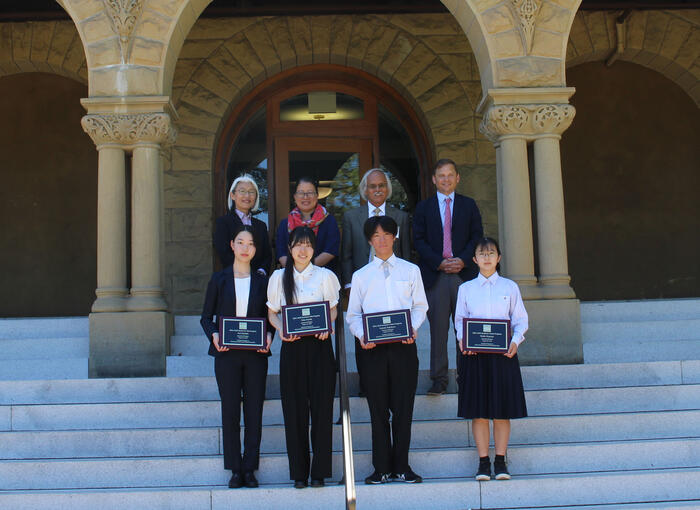
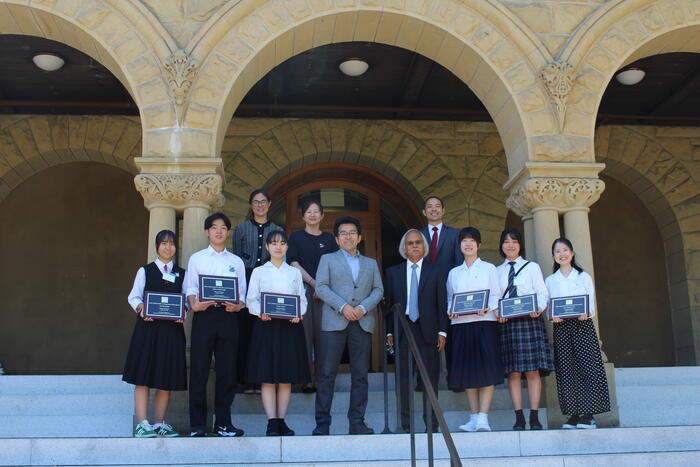
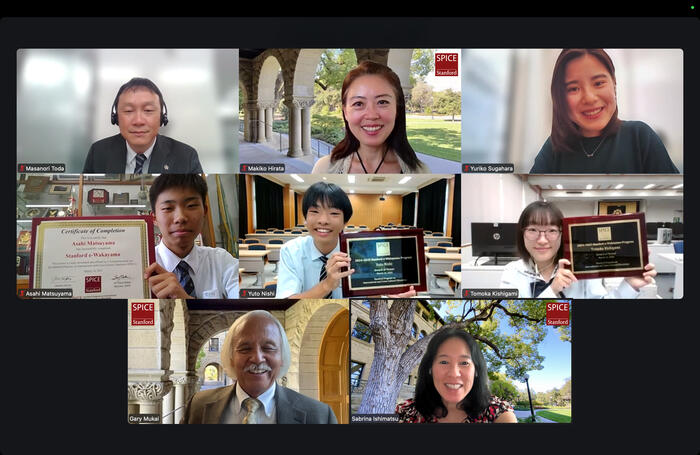
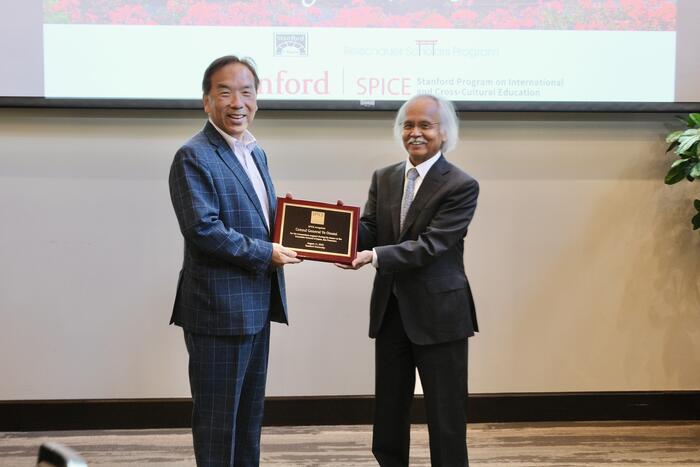
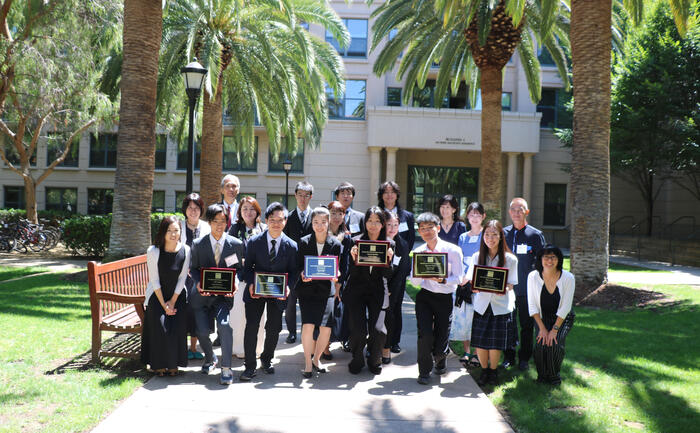
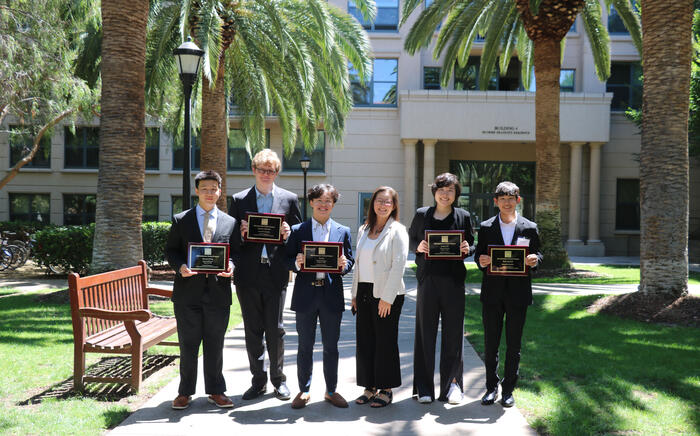
With the conclusion of the 2024–2025 academic year, each program has selected two standout students for their overall performance, including exceptional final research projects. These 16 honorees will present their work during several recognition ceremonies to be held at Stanford University in August 2025. Distinguished guests will include members of the Stanford community, the Consulate General of Japan in San Francisco, and representatives from the Japanese community in the Bay Area.

The SPICE staff extends its warmest congratulations to the following student honorees for their remarkable academic performance.

Stanford e-Hiroshima (Instructor Rylan Sekiguchi)

Student Honoree: Haruka Morisako
School: Kamo High School

Student Honoree: Yura Sakamoto
School: Kure Mitsuta High School

Stanford e-Kagoshima City (Instructor Amy Cheng)

Student Honoree: Aoi Machida
School: Kagoshima Gyokuryu High School

Student Honoree: Yujiro Matsunaga
School: Kagoshima Gyokuryu High School

Stanford e-Kawasaki (Instructor Maiko Tamagawa Bacha)

Student Honoree: Yuka Nagasawa
School: Kawasaki High School

Student Honoree: Reimi Ito
School: Tachibana High School

Stanford e-Kobe (Instructor Alison Harsch)

Student Honoree: Karen Ito 
School: Kobe Municipal Fukiai High School

Student Honoree: Shoko Urakami
School: Kobe University Secondary School

Stanford e-Oita (Instructor Kasumi Yamashita)

Student Honoree: Yuri Kishida
School: Ajimu High School

Student Honoree: Yoka Okuda
School: Usa High School

Stanford e-Tottori (Instructor Jonas Edman)

Student Honoree: Maiko Koyama
School: Tottori Nishi High School

Student Honoree: Nobuki Tokukura
School: Seishokaichi High School

Stanford e-Wakayama (Instructor Makiko Hirata)

Student Honoree: Yuto Nishi
School: Kushimoto Koza High School

Student Honoree: Tomoka Kishigami
School: Kaichi High School

Stanford e-Yamaguchi (Instructor Mia Kimura)

Student Honoree: Asako Kaya
School: Iwakuni High School

Student Honoree: Miku Kuramura
School: Shimonoseki Nishi High School

SPICE applauds the curiosity, academic excellence, and global mindset of these students and looks forward to celebrating their achievements next month.

* Stanford e-Fukuoka ends later this summer so its honorees will be announced at a later date.

SPICE also offers online courses to U.S. high school students on Japan (Reischauer Scholars Program), China (China Scholars Program), and Korea (Sejong Korea Scholars Program), and online courses to Chinese high school students on the United States (Stanford e-China) and to Japanese high school students on the United States and U.S.–Japan relations (Stanford e-Japan) and on entrepreneurship (Stanford e-Entrepreneurship Japan).

To stay informed of news about Stanford e-Japan and SPICE’s other programs, join our email list and follow us on FacebookX, and Instagram.

Read More

screenshot of two speakers
Blogs

Top Students in SPICE’s 2023–2024 Regional Programs in Japan Are Recognized

Congratulations to the 2023–2024 student honorees from Fukuoka, Hiroshima, Kagoshima, Kawasaki, Kobe, Oita, Tottori, and Wakayama.
Top Students in SPICE’s 2023–2024 Regional Programs in Japan Are Recognized
2023–24 Stanford e-Kagoshima City students with Mayor Shimozuru (seated in center with green tie) and instructor Amy Cheng (far right on screen)
Blogs

Closing Thoughts on Stanford e-Kagoshima City

Making connections between program achievements and students’ personal aspirations
Closing Thoughts on Stanford e-Kagoshima City
Stanford e-Hiroshima Class of 2023–24
Blogs

Class Photo

Instructor Mia Kimura reflects on students of this year’s Stanford e-Hiroshima course.
Class Photo
Hero Image
aerial view of university campus with a tower in the middle
Aerial view of Stanford campus | Photo Credit: Andrew Broadhead
All News button
1
Subtitle

Congratulations to the 16 student honorees from Hiroshima Prefecture, Kagoshima City, Kawasaki City, Kobe City, Oita Prefecture, Tottori Prefecture, Wakayama Prefecture, and Yamaguchi Prefecture.

Date Label
Authors
News Type
Blogs
Date
Paragraphs

The following is a guest article written by Akiko Mizuno, who traveled to the San Francisco Bay Area with other graduate students from the University of Tokyo—under the leadership of Professor Hideto Fukudome—in January 2025. SPICE/Stanford collaborates closely with the Graduate School of Education at the University of Tokyo and met with the students during their visit to the Bay Area.     

As a student at the University of Tokyo’s Graduate School of Education, I had an opportunity to travel to Stanford University to participate in a SPICE-supported intensive seminar at the end of January this year. What I learned during the week-long program far exceeded my expectations. I would like to share some of the highlights of my experience during my stay at Stanford University, but first I would very much like to express my appreciation to Dr. Hideto Fukudome of the University of Tokyo who led our group, and to Dr. Gary Mukai, Director of SPICE, who guided us throughout the special lecture series. My heartfelt thanks also go to all the lecturers who gave us such a heartwarming welcome and truly inspiring and eye-opening lectures.

There were many great things that impressed me through my participation in the SPICE-supported intensive seminar. One of the experiences that gave me a lasting impression was a morning walk through San Jose Japantown guided by Dr. Mukai. As we walked, he told us about his childhood growing up as a sansei (third-generation Japanese American) in the 1960s. As I kept listening to his stories, I was able to imagine the hardships he and his family must have gone through even though he told his stories without drama or hyperbole.

Image
granite monument


At one street corner in Japantown, there was a long, horizontal granite monument. There, I saw big romaji characters carved in capital letters that read “GAMAN. KODOMO NO TAME NI,” which means, “Endure. For the sake of our children.” It suddenly dawned on me that years upon years of struggles that issei (first-generation Japanese immigrants) and nisei (second-generation Japanese Americans) endured so that their children could have a brighter future were expressed in just those 19 letters etched on the stone bench. To this day, I can still vividly recall those letters because they are now etched on my heart.

Another experience that left me with a strong impression was a lecture on design thinking by SPICE educational researcher Dr. Mariko Yang-Yoshihara. Before we left Japan, she had given us an assignment to watch a video about Dr. Ge Wang, professor in the Center for Computer Research in Music and Acoustics (CCRMA) at Stanford University, and write about our reactions. The video included Dr. Wang’s talk and a demonstration of how he produces novel musical sounds using a computer and a bow-shaped metal. At first, they were so unfamiliar to me that I felt somewhat uncomfortable. “Is this considered music?,” was my initial reaction. However, when he played Bach on the Ocarina iPhone app he had invented, I could even say that it was soothing. Towards the end of the video, Dr. Wang also introduced us to a piece of music performed by the Stanford Laptop Orchestra, which he had founded. As I listened to their unconventional orchestra sound, I became even more relaxed and fascinated by the beautiful harmony they produced. I then realized that the whole point of this assignment was to gain a perspective on how we should not be close-minded and embrace new experiences. In her research, Dr. Yang-Yoshihara has introduced a trilogical mindset—think out of the box, give it a try, and fail forward—highlighting these as common attitudes shared by individuals thriving in STEAM fields (Science, Technology, Engineering, the Arts, and Mathematics) across diverse sectors today. By being introduced to Dr. Ge Wang’s endeavor and experiencing my own shift in how I appreciate music, I now see myself beginning to “think out of the box” and finding new experiences more enjoyable.

Dr. Mukai, a noted educator and compassionate person, was the very personification of his parents’ profound love and perseverance, and I learned from Dr. Yang-Yoshihara the importance of having an open mind to be innovative. Having had these valuable lessons, how could I stay the same as before? I am truly thankful that I can still grow even though I am no longer in my youth.

In March 2025, both Dr. Mukai and Dr. Yang-Yoshihara came to Japan and took some time to visit us at the University of Tokyo’s Graduate School of Education. It was a big bonus for me to be able to see them again. I know I am fortunate to have had this extra opportunity to further exchange ideas and learn from them. I am looking forward to implementing the lessons learned through SPICE in my daily life. It was indeed a wonderful way to start a New Year.

To stay informed of SPICE news, join our email list and follow us on Facebook,  X, and Instagram.  

Read More

group photo of students and professors in a conference room
Blogs

Reflections on Dr. Mariko Yang-Yoshihara’s Lecture on STEAM Education

Ryoya Shinozaki, a doctoral researcher at the University of Tokyo’s Graduate School of Education, reflects on his experience in the SPICE-linked intensive seminar in the San Francisco Bay Area.
Reflections on Dr. Mariko Yang-Yoshihara’s Lecture on STEAM Education
Hideto Fukudome in front of the avenue of ginkgo trees, University of Tokyo
Blogs

Reflections on Education and Diversity

Collaboration between the Graduate School of Education, the University of Tokyo and SPICE/Stanford offers opportunities to discuss education and diversity.
Reflections on Education and Diversity
people gathered in a restaurant, holding red paper bags
Blogs

Experiencing Global Education Firsthand: The Profound Value of In-Person Education Reassessed in an Era of Digitalization

Makoto Nagasawa, a doctoral researcher at the University of Tokyo’s Graduate School of Education, reflects on his experience in the SPICE-linked intensive seminar in the San Francisco Bay Area, led by Professor Hideto Fukudome.
Experiencing Global Education Firsthand: The Profound Value of In-Person Education Reassessed in an Era of Digitalization
Hero Image
person standing at the Angel Island
Akiko Mizuno on Angel Island | Photo courtesy Akiko Mizuno
All News button
1
Subtitle

Akiko Mizuno, a graduate student at the University of Tokyo’s Graduate School of Education, reflects on her experience in the SPICE-supported intensive seminar in the San Francisco Bay Area.

Date Label
Authors
News Type
Blogs
Date
Paragraphs

The following reflection is a guest post written by Millie Gan, a student in the Spring 2025 Stanford e-Entrepreneurship Japan Program. Millie recently launched Teenage Business Contest Japan, a platform for encouraging social entrepreneurship among teens.

I believe that ideas from young people can help solve some of the world’s toughest problems; the voices of students are more essential than ever.

My name is Millie Gan, and I am a high school senior in San Diego and a participant in the Stanford e-Entrepreneurship Japan (SeEJ) program. I am a British national, born and raised in Tokyo. I’m bilingual in English and Japanese, and studying Spanish. My mother is a third-generation Korean-Japanese, and my father is originally from Hong Kong. Though I have no ethnic roots in Japan, living there allowed me to appreciate and respect its people, traditions, and local diversity. 

When I moved to the U.S. three years ago, I was surprised by the number of questions asked by peers and teachers about Japan’s rural challenges, such as its aging population, shrinking towns, and what people were doing to help. I realized how giving younger people a voice can raise awareness of these urgent issues. That is why I created Teenage Business Contest Japan (TBCJ), a national contest that invites high school students across Japan to identify issues in rural areas and propose business solutions, all in English. The top 10 finalists will pitch their ideas live to judges from large corporations and academia. I had the drive to make TBCJ work, but SeEJ helped me execute that drive into action, giving me the mindset and community to take the project further than I could have alone.

Image
flyer


SeEJ gave me a deeper understanding of what it means to lead with purpose and empathy. For example, Dr. Rie Kijima’s session on design thinking taught me how to think from the perspective of those directly impacted. Dr. Damon Horowitz’s lessons on ethical entrepreneurship helped me reflect on why I started this journey. Ms. Megan Carroll’s insights into the nonprofit sector inspired me to treat TBCJ as a mission-driven platform, not just a contest. In one of our first VC sessions, I was partnered with another student for an exercise on creative problem-solving. My partner chose Japan’s aging society and spoke passionately about the need to amplify student voices. At that moment, I remember thinking, “That is exactly what TBCJ is about.” That moment reminded me that while our concerns are local, our hopes are widely shared.

These lessons transformed how I approached leadership as I began to see every obstacle as a lesson. As I worked to grow TBCJ, I started to think more like an entrepreneur: solving problems while learning from them, adjusting my strategies, and staying true to my original mission.

One of the first things I had to figure out was securing sponsorship. I reached out to dozens of companies focused on education and regional revitalization. After many emails and meetings, I was fortunate to secure seven sponsors and raise over ¥3 million. This funding allowed us to provide prizes for the contest and recognize the efforts of students working to help the community.

Reaching students was another major challenge. Japan has nearly 4,800 high schools, but only 150 have strong English or international programs. I directly contacted the 100 schools that had available email addresses. At first, there was silence, and I remember refreshing my inbox, getting more and more frustrated each day, hoping for a reply. But slowly, after a few weeks, a few schools and their students began responding and signing up. That small breakthrough reminded me how wide the access gap truly is. Only around 17% of Japanese citizens hold a valid passport, compared to around 50% in the U.S., which shows how few Japanese students get global exposure. It made me even more determined to connect local youth with global perspectives and to use English as a bridge to opportunity.

The most difficult challenge was gaining official recognition. I applied to multiple Japanese Government offices for endorsement, but most declined due to government policies and TBCJ’s short history. Thankfully, the Cabinet Office met with me and offered support through their regional revitalization team. Soon after, the University of Tokyo’s Innovation Platform Co., Ltd. (IPC) offered its endorsement and created a new “UTokyo IPC Special Innovation Prize” for the contest.

Through this experience, and with the support of SeEJ, I have learned that we don’t have to wait to make a difference. Entrepreneurship isn’t necessarily about launching companies, but about identifying problems and solving them with purpose. I hope to continue expanding TBC Japan and encouraging more students to take initiative, because I truly believe that ideas from young people are what can solve these challenges. It’s our future, and it is up to us to protect and improve it.

If you’re passionate about solving real-world problems, I highly recommend the Stanford e-Entrepreneurship Japan Program.

Sign up now to participate in TBCJ.

Stanford e-Entrepreneurship Japan will start accepting applications for fall 2025 in August.

Stanford e-Entrepreneurship Japan is one of several online courses offered by SPICE.

To stay updated on SPICE news, join our email list and follow us on FacebookX, and Instagram.

Read More

Group of high school students sitting at tables
Blogs

Empathy and Growth: Reflections on Stanford e-Entrepreneurship Japan

Course instructor Irene Bryant reflects on four years of empowering Japan's changemakers and social entrepreneurs of tomorrow.
Empathy and Growth: Reflections on Stanford e-Entrepreneurship Japan
Headshot of a high school girl
Blogs

Stanford e-Entrepreneurship Japan: Fueling Positive Change Through Empowerment, Purpose, and Connection

High school student Aylie Guyodo Oyama reflects on her transformative educational experience in Stanford e-Entrepreneurship Japan, and on connecting entrepreneurship with her passion for helping others.
Stanford e-Entrepreneurship Japan: Fueling Positive Change Through Empowerment, Purpose, and Connection
Stanford e-Entrepreneurship Japan student Naho Abe in Mexico City
Blogs

Stanford e-Entrepreneurship Japan: Fostering Innovative Ways to Address Social Issues

The following reflection is a guest post written by Naho Abe, an alumna of Stanford e-Entrepreneurship Japan.
Stanford e-Entrepreneurship Japan: Fostering Innovative Ways to Address Social Issues
Hero Image
a person standing in the snow
All News button
1
Subtitle

Millie Gan, a current student of Stanford e-Entrepreneurship Japan, launches Teenage Business Contest Japan (TBCJ), a new social entrepreneurship platform for teens.

Date Label
Authors
News Type
News
Date
Paragraphs

Applications are now open for the Fall 2025 session of the Stanford University Scholars Program for Japanese High School Students (also known as “Stanford e-Japan”). The course will run from the end of September 2025 through March 2026, with an application deadline of August 17, 2025.

Stanford e-Japan
Fall 2025 session (September 2025 to March 2026)
Application period: July 1 to August 17, 2025

All applications must be submitted at https://spicestanford.smapply.io/prog/stanford_e-japan/ via the SurveyMonkey Apply platform. Applicants and recommenders will need to create a SurveyMonkey Apply account to proceed. Students who are interested in applying to the online course are encouraged to begin their applications early.

Accepted applicants will engage in an intensive study of U.S. society and culture and U.S.–Japan relations. Government officials, leading scholars, and experts from Stanford University and across the United States provide web-based lectures and engage students in live discussion sessions.

Stanford e-Japan is offered by the Stanford Program on International and Cross-Cultural Education (SPICE), Stanford University. Stanford e-Japan is generously supported by the Yanai Tadashi Foundation, Tokyo, Japan.

For more information about Stanford e-Japan, please visit stanfordejapan.org.


Stanford e-Japan is one of several online courses for high school students offered by SPICE, including the Reischauer Scholars Program, the China Scholars Program, the Sejong Korea Scholars ProgramStanford e-ChinaStanford e-Entrepreneurship Japan, as well as numerous local student programs in Japan.

To stay informed of news about Stanford e-Japan and SPICE’s other student programsjoin our email list or follow us on FacebookInstagram, and X.

Read More

people sitting around a table
Blogs

The Yanai Tadashi Foundation and SPICE/Stanford University

Four Stanford freshmen Yanai Scholars reflect on their experiences.
The Yanai Tadashi Foundation and SPICE/Stanford University
cherry blossoms blooming in Japan
News

Announcing the Spring and Fall 2024 Stanford e-Japan Award Recipients

Congratulations to the students who have been named our top honorees and honorable mention recipients for 2024.
Announcing the Spring and Fall 2024 Stanford e-Japan Award Recipients
Students holding plaques standing on staircase on Stanford campus.
Blogs

Highest Performing Students of Stanford e-Japan and the Reischauer Scholars Program Are Recognized at Stanford University

The Honorable Yo Osumi, Consul General of Japan in San Francisco, makes opening comments.
Highest Performing Students of Stanford e-Japan and the Reischauer Scholars Program Are Recognized at Stanford University
Hero Image
stanford campus scenery
Main Quad | Photo Credit: Andrew Broadhead
All News button
1
Subtitle

Interested students must apply by August 17, 2025.

Date Label
Authors
News Type
Blogs
Date
Paragraphs

The following is a guest article written by Akari Kikuchi, an undergraduate student studying at the School of Social Sciences at Waseda University in Japan. Akari enrolled in the 2025 SPICE/Stanford–Waseda Intensive Course: Exploring Peace in East Asia and Beyond Through the Lenses of Cultural Understanding, Education, and International Relations, which was organized by SPICE and Waseda’s Faculty of Social Sciences and taught by Meiko Kotani. The course brought together students from the Graduate School of Social Sciences, the School of Social Sciences, the Graduate School of Asia-Pacific Studies, the School of International Liberal Studies, and the School of Political Science and Economics. With participants from Japan and international students representing 10 different countries, the course created a truly dynamic and diverse learning environment.

Looking back on our five-day program, I feel a deep sense of gratitude—for the opportunity to take part in the program, and for the people I met along the way. I’m proud to have shared this experience with such thoughtful, motivated students and teachers.

Although the program took place during our spring break, the energy and engagement from the students involved were truly inspiring. I was impressed by their insightful questions and responses.

Our group presentation—which took place on the final day of the course, after a week full of thought-provoking lectures and discussions—was especially memorable for me. It reminded me how exciting it can be to overcome differences in language and perspective. My part of the presentation focused on how media shapes public perceptions—and sometimes even hostilities—toward other nations. That topic reflected something I found really interesting from one of the lectures earlier in the week: how essential media literacy is when it comes to understanding the world around us. We looked at how the same event can be framed differently depending on the source, and how these narratives create public emotions and opinions.

What I found most important—what I’d like to emphasize—is that this program didn’t just talk about “peace” as an abstract goal. Instead, it helped me understand how peace has been threatened. Through this practical approach, we could explore the often-elusive concept of “peace” in a real-world context.

The world today feels overwhelmingly unstable. The more you think about peace, the more cruelty you see around you. It can feel disheartening, but I found a sense of renewed hope through this project. We discussed weighty, complex issues with people from different countries and cultures. Although that seemed challenging to me at first, in the end I realized that it was based in the simple experience of learning to respect the person in front of me. I think the memory of discussing peace with people from diverse backgrounds during this project will serve as “a guide” toward peace.

The fear of opening up or facing language barriers might hold people back, but I believe the program is worth trying, and I hope many more people will take this great opportunity in the future!

To stay informed of SPICE news, join our email list and follow us on FacebookX, and Instagram.

Read More

a person standing in front of pink flowers
Blogs

Reimagining Peace, One Perspective at a Time

Joan Benedict, an undergraduate student at Waseda University, reflects on her experience participating in the SPICE/Stanford–Waseda intensive course.
Reimagining Peace, One Perspective at a Time
a person standing at a crossing
Blogs

From Presence to Dialogue: A Personal Reflection on Peace, Learning, and Difference

Graduate student Wenxin Fu reflects on the impact of the SPICE/Stanford–Waseda intensive course on her academic and personal growth.
From Presence to Dialogue: A Personal Reflection on Peace, Learning, and Difference
a student standing in front of a tower on university campus
Blogs

Pros, Impressions, and Takeaways from the SPICE/Stanford–Waseda Intensive Course on Peacebuilding in East Asia

Lindsay Baltzell, an undergraduate student at Waseda University, reflects on her experience participating in the SPICE/Stanford–Waseda intensive course.
Pros, Impressions, and Takeaways from the SPICE/Stanford–Waseda Intensive Course on Peacebuilding in East Asia
Hero Image
a person at a university campus
Akari Kikuchi at the Waseda University campus | Photo Credit: Akari Kikuchi
All News button
1
Subtitle

Undergraduate student Akari Kikuchi from the School of Social Sciences reflects on her experience participating in the SPICE/Stanford–Waseda intensive course.

Date Label
Authors
Sabrina Ishimatsu
News Type
Blogs
Date
Paragraphs

The SPICE/Stanford e-Course on Global Health is a distance-learning course sponsored by Takatsuki Senior High School and the Stanford Program on International and Cross-Cultural Education (SPICE) at Stanford University. Students are encouraged to think critically about global health through a variety of lenses and contexts. Course instructor Sabrina Ishimatsu recently wrote these reflections about the program’s 10th anniversary.

For the last ten years, it has been my privilege to work with Principal Tsuyoshi Kudo, the staff, and the students of Takatsuki Senior High School. Without the vision and leadership of Principal Kudo, this course would not be what it is today.

Many years ago, as a young college graduate, I worked as an English teacher in Japan through the Japan Exchange and Teaching (JET) Program. It was one of the seminal experiences of my life. Being immersed in a new country and culture opened my mind to new ideas and possibilities I had not before considered.

All these years later, working with the Takatsuki Senior High School students has been very natsukashii (fondly nostalgic). Seeing them in their classroom and wearing their school uniforms feels so familiar and brings back great memories of my time in Japan. However, what makes this course so personally fulfilling is reconnecting to such curious and hopeful young minds. Their earnest enthusiasm and optimism imbue me with a similar youthful spirit. 

Image
student receiving a certificate in front of the classroom in front of a screen


As a middle-aged adult, it is easy to forget that the most urgent questions young people ask themselves are ones of self-identity. “Who am I? What do I stand for? Where will my future take me?” While this course doesn’t claim to answer these questions, I hope it will open students’ minds to new possibilities. Week after week, we learn from acclaimed global health professionals—including many from Stanford’s School of Medicine—who work in the real world. I recall one guest lecturer, an emergency room doctor who established the first comprehensive emergency response system in India and then created a similar system in Nepal where none had previously existed. There was also the doctor who trained community members in rural Guatemala to make house calls and monitor malnutrition in babies, drastically reducing the area’s child mortality rate. These brilliant and resourceful people, rather than focusing on material wealth, have dedicated their lives to help vulnerable people around the world. Their stories light the path for how a health professional can be a noble global citizen and change the world for the better. What a powerful example for the students of Takatsuki Senior High School who have not only gained knowledge from these experts but have also had their eyes opened to the many possibilities for them to be change-making global citizens.

There is a 16-hour time difference between Japan and California, so I usually begin teaching each class at 9:00pm on a Friday, and it ends late into the night. When a class is particularly inspiring, I find myself buzzing with excitement and I can’t go to sleep. I have to find my husband or one of my 16-year-old twin daughters to tell them all about it. When they look at me, their expression suggests, “Why are you so hyper right now?” My response usually starts, “You won’t believe the amazing person I met tonight…” and “I can’t believe the insightful questions my students asked in their second language!”

The SPICE/Stanford e-Course on Global Health is one of SPICE’s local student programs in Japan

To stay informed of SPICE news, join our email list and follow us on FacebookX, and Instagram.

Read More

Sabrina Ishimatsu and Tsuyoshi Kudo in the Quad, Stanford University
News

Global health for global classrooms

Since 2015, SPICE has offered the “SPICE/Stanford e-Course on Global Health” to students of Takatsuki Jr. and Sr. High School, one of the few schools in Japan with both designations.
Global health for global classrooms
sabrina
News

Global health for Takatsuki senior high school

Thirty sophomores and juniors in Osaka, Japan, recently completed the inaugural Stanford e-Course on Global Health for Takatsuki Senior High School.
Global health for Takatsuki senior high school
memorial church sabrina
Blogs

Reaching Students at Takatsuki Jr. and Sr. High School, Osaka, Japan

SPICE is currently offering the ninth year of the SPICE/Stanford e-Course on Global Health.
Reaching Students at Takatsuki Jr. and Sr. High School, Osaka, Japan
Hero Image
students in uniform standing with certificates in front of a screen
Students pose with Principal Kudo after receiving their certificates following their successful completion of the SPICE/Stanford e-Course on Global Health | Photo Credit: Ai Maeda
All News button
1
Subtitle

Reflections on my work with Principal Tsuyoshi Kudo and the students of Takatsuki Senior High School.

Date Label
Subscribe to Japan