snow_covered_mountain_during_sunrise.jpg
-
Ongoing application period which include fellowship date (new value)
1

The application period for the summer 2026 session will open March 1, 2026.

Summer course dates: June 6 to October 3, 2026

Follow SPICE on Facebook, X, and Instagram and join our email list to receive announcements for the next application period.


Stanford e-Entrepreneurship U.S. is an online program for 20 exceptional high school sophomores, juniors, and seniors across the United States. Offered by the Stanford Program on International and Cross-Cultural Education (SPICE), and taught by Makiko Hirata, it is designed to empower students by learning to harness their creativity in crafting original solutions to pressing global and local challenges.

Grounded in human-centered active learning, the program prepares students to be self-aware and agile problem identifiers who are poised to contribute thoughtfully and innovatively to the world around them. Through a design-inspired, goal-driven framework, students begin by clarifying their personal motivations—what drives them, how they wish to grow, and through what strategies—encouraging each learner to take ownership of their journey. 

In our live “virtual classes,” participants will engage in discussions and activities with scholars and experts from Stanford University, Silicon Valley and beyond. In between the virtual classes, students will engage with each other on discussion boards, prompted by open-ended questions, group projects, research, and assignments. 

Students who successfully complete the course will earn Stanford Continuing Studies credit and a Certificate of Completion from SPICE.  

Stanford e-Entrepreneurship U.S. is made possible with generous support from anonymous donors.


Eligibility: 

  • High school sophomores, juniors, or seniors enrolled in the United States. Applications from “gap year” students will also be considered.
  • Availability to attend all virtual classes on specified Saturday evenings from 5 to 7 p.m. Pacific Time
  • Ability to devote approximately 4 hours per week for class preparation, assignments, and group work
  • Access to a computer with camera, microphone, and reliable high-speed internet (Classes will take place over Zoom.)
  • Students from all walks of life are encouraged to apply. The program values the unique perspectives students bring from their personal experiences and backgrounds—together reflecting the rich fabric of the United States. 


If you have any questions, please contact the course instructor, Dr. Makiko Hirata, at mhirata@stanford.edu


view-of-the-golden-gate-bridge-above-the-clouds-san-francisco-california-usa-18353702.jpg
-
1

The application period for the spring 2026 course is closed. 
The application period for the spring 2027 course will open in September 2026.

Follow SPICE on Facebook, X, and Instagram and join our email list to receive announcements for the next application period.


U.S.–China Co-Lab on Climate Solutions

Collaboration between the United States and China is more urgent than ever, especially on climate issues. Last year was the hottest year on record, but together we can reverse this trend.

SPICE’s new transnational, online high school program is for students from the U.S. and China. We are seeking 15–18 students from each country, intellectually curious 10th through 12th graders with a sincere desire to connect across cultures and learn how to tackle the climate crisis.

As the world’s two superpowers, biggest economies, and largest sources of greenhouse gas emissions, the United States and China must collaborate on climate solutions to ensure global sustainability. U.S.–China relations are complicated, spanning cultural differences, geographical distance, technological firewalls, and political tensions. We need committed and well-informed young people ready to take on this challenge.

The U.S.–China Co-Lab on Climate Solutions is a spring-term course, an active lab for collaborative practice engaging both Chinese and American students in one class as co-learners.


In this program, students will: 

  • study and experience the principles and best practices of cross-cultural collaboration;  
  • explore existing models for U.S.–China collaboration specifically;
  • learn the fundamentals of the climate change issues facing our planet;
  • assess local, bilateral, and global climate action so far;
  • actively imagine their own place in the future of U.S.–China relations; and
  • gain cooperative experience and skills on climate to apply toward future studies and professions.


The program will feature guest speakers from the Stanford University faculty and other world-class institutions, sharing their expertise on collaborative models and strategies; environmental impacts; clean energy and energy markets; climate justice; and other topics.

Coursework will be highly interactive and discussion-oriented, with an emphasis on small-group assignments, culminating in a collaborative project that could be implemented in the students’ own communities. The program will be conducted online, using Zoom video conferencing and the Canvas course platform. Real-time meetings will be held on Friday evenings (U.S.) / Saturday mornings (China).

This is a joint program of SPICE’s Stanford e-China (for students in China) and China Scholars Program (for U.S. students) and is co-taught by SPICE instructors Carey Moncaster and Tanya Lee. We hope to foster an active network of U.S.–China Co-Lab alumni. 

Admission is competitive. Application requirements include a personal essay, transcript, and letter of recommendation. 


Eligibility:

  • Must be a high school student in the U.S. or China, grades 10 through 12. Applications from “gap year” students will also be considered.
  • Must be able to read, write, and discuss complex ideas in English. (Chinese language ability is not required, but could be helpful.)
  • Students should expect to devote 3–5 hours per week on average.
  • Students from diverse backgrounds are encouraged to apply.
  • Admission will be competitive, and a high level of academic achievement is expected.
  • Limited financial assistance will be available for those with demonstrated need. 


If you have any questions, 


windmills_and_solar_panels.jpg
-
Ongoing application period which include fellowship date (new value)
1

The application for the spring 2026 course is now open. Applicants will be notified of their status by April 1, 2026.

Apply online at https://forms.gle/FQDX6NNqj28KKAE37.

Final deadline to apply: March 1, 2026 (Japan Time)

Spring course dates: April 12 to August 23, 2026 (Japan Time)


Follow SPICE on Facebook, X, and Instagram and join our email list to receive announcements for the next application period.


First offered in Spring 2020, Stanford e-Entrepreneurship Japan is an online course that engages about 20 students in and from Japan with top scholars and entrepreneurs from Stanford University, Silicon Valley, Japan, and beyond and involves students in live discussion sessions or “virtual classes.” It is conducted in English and offered twice annually in the fall and spring by SPICE and the non-profit organization e-Entrepreneurship in Japan. The instructors are Irene Bryant (fall) and Natalie Montecino (spring). 

The goal of the course is to foster creative thinking and problem-solving skills in students with a focus on innovation to address social issues. Students will explore the design thinking process and topics including, but not limited to, health, education and technology, and the environment. The course will culminate in a final individual research paper and a final group project, which will be presented at the last virtual class of the course. 

Students who successfully complete the course will receive a Certificate of Completion from SPICE, Stanford University, and NPO e-Entrepreneurship. Top students in the fall and spring courses will be invited to present their final research papers.

The fall course is generously supported by Noriko & Norman Chen and Andrew & Mako Ogawa. The spring course is generously supported by Tomonori & Sakiko Tani.


Course components encourage active participation and development of student interests:

  • 6 to 8 live “virtual classes” (VCs) offered twice a month online on Sunday mornings (Japan Time)
  • Reading and video assignments of varying length and difficulty
  • Required participation in virtual discussion boards with peers
  • Small-group presentations given during VCs
  • Active engagement with students and guest speakers in VCs
  • Research in an area of interest aligned with course goals (with instructor guidance)
  • Support from the instructor throughout the course


Open to high school students in and from Japan, admission to this program is competitive.


Requirements include:

  • Enrollment in first or second year (or equivalent) of high school with interest in social entrepreneurship
  • Ability to read, write, and discuss complex ideas in English
  • Availability to attend all virtual classes on Sunday mornings (2 to 2.5 hours) and closing ceremony
  • Ability to allot 3–5 hours per week for class preparation, individual assignments, and group work
  • Access to personal computer, camera, microphone, and reliable, high-speed Internet 


If you have a question that isn't answered on the Frequently Asked Questions page, please contact Irene Bryant (fall course) at irene3@stanford.edu or Natalie Montecino (spring course) at nmonteci@stanford.edu.


pexels-markus-spiske-2990610 (reduced).jpg
-
1

The application period for the fall 2025 course has closed.
The next application period will be announced in late spring 2026.

Follow SPICE on WeChat (QR code below), FacebookX, or Instagram and join our email list to receive announcements for the next application period.


Climate Tech Innovation and U.S.–China Collaboration

Offered every fall, Stanford University is offering a distance-learning opportunity to exceptional high school students and year 1–2 university students from China. Born out of Stanford e-China’s original program, Technologies Changing the World, this interactive, virtual course will focus more specifically on climate tech innovation, as well as collaborative strategies at the global, bilateral, and community levels in pursuit of climate solutions. Students will also be introduced to design thinking and apply the human-centered framework to a climate-related challenge for their final project. In real-time seminars with leading Stanford University scholars and Silicon Valley entrepreneurs, students will participate in a rigorous learning experience as they explore exciting areas for academic study and future professional opportunities. In this English-language course, students will engage in live and online discussions.

Students who successfully complete the course will receive a Certificate of Completion from SPICE, Stanford University.


Students will also gain practical, academic skills:

  • Pre-recorded, university-level lectures by leading scholars from Stanford University offer practice listening to a variety of lecturing styles
  • Real-time discussions led by guest lecturers familiarize students with the dynamics of classroom participation in schools such as Stanford University
  • Short writing assignments improve critical thinking skills
  • The final project requires students to investigate a challenge related to course themes, develop a compelling presentation, and practice oral English skills


Course components emphasize active participation and development of student interests:

  • 10 “virtual classes” online in real time on Saturday mornings Beijing time
  • Weekly reading assignments of varying length and difficulty
  • Required participation in virtual discussion boards with classmates
  • Short writing assignments reflecting on readings and lectures
  • Research in an area of interest related to course themes (with instructor guidance)
  • Direction, facilitation, and support from the instructor throughout the course


Admission to this program is competitive; up to 30 exceptional students will be accepted. Requirements include:

  • Enrollment in grades 10, 11, or 12 in a high school in China with exceptional academic experience, or in year 1 or 2 in a university in China
  • Ability to read, write, and discuss complex ideas in English
  • A complete application including a written personal statement, transcript, and availability for a virtual interview
  • Availability for all or most of the virtual classes on Saturday mornings
  • Ability to allot 3–4 hours per week for class preparation and assignments, on student’s own schedule
  • Use of a personal computer, camera, microphone, and reliable access to a broadband Internet connection
 

QR code for Stanford e-China on WeChat


For more information, please see the Frequently Asked Questions, contact Carey Moncaster (Stanford e-China Instructor) via email at cmoncaster@stanford.edu, or contact Liyi Ye (Stanford e-China Advisor in China) via WeChat at hiStanford.


pexels-andrea-piacquadio-3758105 (reduced).jpg
-
1

The application period for the spring 2026 course has closed.
The application period for the fall 2026 course will open in March 2026.

Follow SPICE on WeChat (QR code below), FacebookX, or Instagram and join our email list to receive announcements for the next application period.


Design Thinking into Action: Teen Well-Being (Adolescent Psychological and Physical Health)

Offered every spring and fall, Stanford University is offering a distance-learning opportunity to exceptional high school students and year 1–2 university students from China. This interactive, virtual course of Stanford e-China will introduce students to design thinking––a creative framework and mindset for human-centered innovation. In real-time seminars with leading Stanford University scholars and Silicon Valley entrepreneurs, students will participate in a rigorous learning experience as they apply basic aspects of the design thinking process to challenges in adolescent mental and physical health. In this English-language course, students will explore the concepts of empathy, ideation, prototyping, and iteration as they brainstorm innovative solutions to problems impacting the lives of youth. They will also delve into the concept of purpose learning. Through discussions, assignments, and a mini-design challenge, students will nurture an entrepreneurial mindset that they can apply to their academic and professional aspirations.

Students who successfully complete the course will receive a Certificate of Completion from SPICE, Stanford University.


Students will also gain practical, academic skills:

  • Pre-recorded, university-level lectures by leading scholars from Stanford University offer practice listening to a variety of lecturing styles
  • Real-time discussions led by guest lecturers familiarize students with the dynamics of classroom participation in schools such as Stanford University
  • Short writing assignments improve critical thinking skills
  • The final project requires students to investigate a challenge related to course themes, develop a compelling presentation, and practice oral English skills


Course components emphasize active participation and development of student interests:

  • 10 “virtual classes” online in real time on Saturday mornings Beijing time
  • Weekly reading assignments of varying length and difficulty
  • Required participation in virtual discussion boards with classmates
  • Short writing assignments reflecting on readings and lectures
  • Research in an area of interest related to course themes (with instructor guidance)
  • Direction, facilitation, and support from the instructor throughout the course


Admission to this program is competitive; up to 30 exceptional students will be accepted. Requirements include:

  • Enrollment in grades 10, 11, or 12 in a high school in China with exceptional academic experience, or in year 1 or 2 in a university in China
  • Ability to read, write, and discuss complex ideas in English
  • A complete application including a written personal statement, transcript, and availability for a virtual interview
  • Availability for all or most of the virtual classes on Saturday mornings
  • Ability to allot 3–4 hours per week for class preparation and assignments, on student’s own schedule
  • Use of a personal computer, camera, microphone, and reliable access to a broadband Internet connection


QR code for Stanford e-China on WeChat


For more information, please see the Frequently Asked Questions, contact Carey Moncaster (Stanford e-China Instructor) via email at cmoncaster@stanford.edu, or contact Liyi Ye (Stanford e-China Advisor in China) via WeChat at hiStanford.


pexels-pixabay-270288 (reduced).jpg
1

The Wit and Pep Initiative (WAPI) encourages young students worldwide to express themselves effectively through public speaking and writing, focusing on global challenges and opportunities that demand international collaboration and cross-cultural understanding. Organized and managed by Spes Global, an innovative education company founded by Stanford alumni passionate about learning, education, and technology, WAPI emphasizes the importance of cross-cultural dialogue in a connected world. A select group of outstanding WAPI participants will be recognized by Stanford e-China.

Participants are invited to explore and discuss topics within one of the following themes:

  • Technology and Innovation
  • Environmental Sustainability
  • Health and Well-being
  • Education and Learning
  • Business and Economics
  • Culture and the Arts

For more information and to register for WAPI, please submit the interest form.


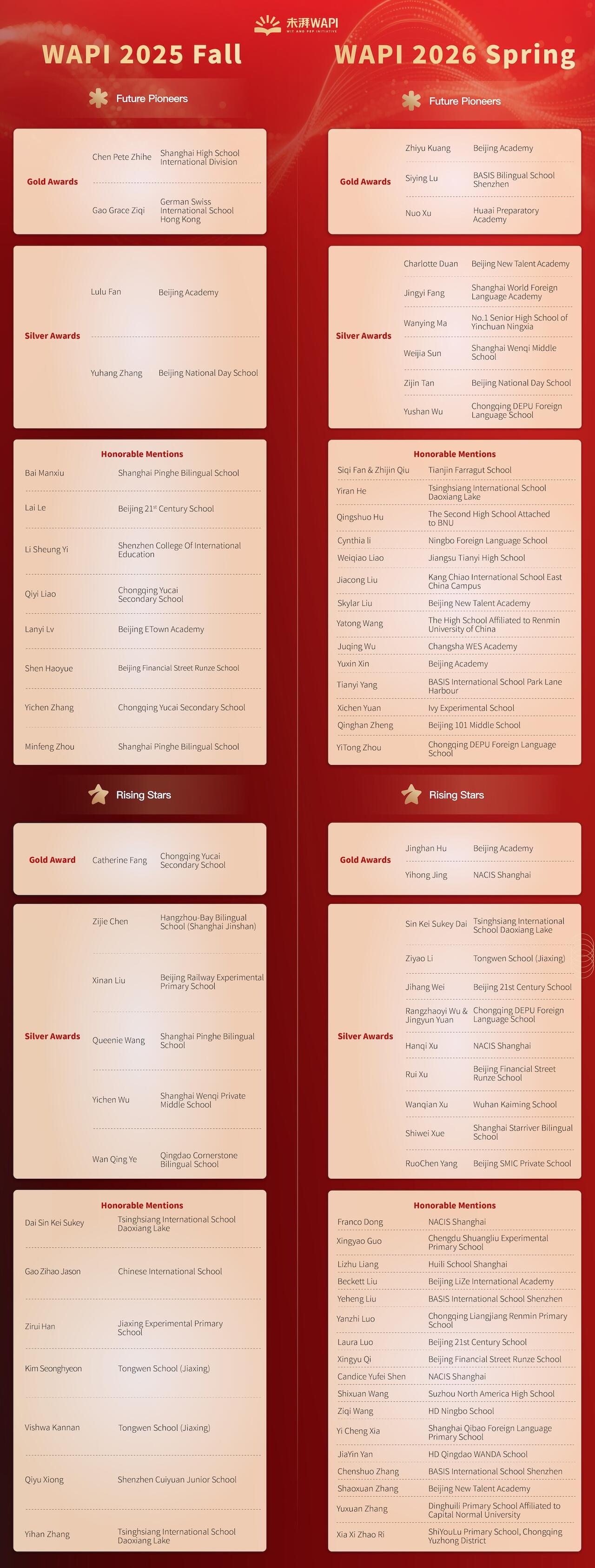
We are thrilled to share the results of the 2024 Fall and 2025 Spring Wit and Pep Initiative! Congratulations to the following students!

list of students recognized in the 2024 Fall and 2025 Spring Wit and Pep Initiative


Stay Connected

QR code for SPICE's WeChat account, stanfordspice

WeChat Public Account

stanfordspice


cherry_blossoms_at_stanford.jpeg
-
Ongoing application period which include fellowship date (new value)
1

The application period for the spring 2026 session has closed.
The application period for the fall 2026 session will open July 1, 2026.

To stay informed of news about Stanford e-Japan and SPICE’s other programs, join our email list and follow SPICE on FacebookX, and Instagram.


The Stanford University Scholars Program for Japanese High School Students or “Stanford e-Japan” is a distance-learning course sponsored by the Stanford Program on International and Cross-Cultural Education (SPICE) with generous support from the Yanai Tadashi Foundation. First offered in Spring 2015, Stanford e-Japan enrolls exceptional high school students from Japan to engage in an intensive study of U.S. society and culture. The course underscores the importance of U.S.–Japan relations. Ambassadors, top scholars, and experts throughout the United States provide web-based lectures and engage students in live discussion sessions or “virtual classes.” The course is offered in English.

The web-based lectures include historical topics such as the importance of the U.S.–Japan relationship, contemporary topics such as Silicon Valley and entrepreneurship, high schools in the United States, and other topics of interest to Japanese students.

Accepted students will participate in approximately 10–12 “virtual classes” via the Internet. The “virtual classes” will be offered 3–4 times per month on Saturday afternoons (1 PM Japan time). Students should expect to allot 3–4 hours per week to complete the lectures, discussions, readings, and assignments. Since this is a distance-learning course, however, students will be able to structure most of the work around their individual schedules.

The course will culminate in an independent research project. Final research projects will be printed in journal format, and students will also be required to lead one presentation on U.S. society at their schools or in their local communities.

Students who successfully complete the course will receive a Certificate of Completion from SPICE, Stanford University. Although intensive, Stanford e-Japan will equip Japanese students with a rare degree of expertise about U.S. society and culture and U.S.–Japan relations that may have a significant impact on their choices of study and future careers. 


SPICE would like to acknowledge the following individuals (listed alphabetically) for their unwavering support of Stanford e-Japan from its conceptualization to its realization.

  • Dr. Caroline Fern Benton, Vice President and Executive Director for Global Affairs, University of Tsukuba
  • Mr. Satoshi Hattori, Executive Director, San Francisco Office, Waseda University
  • Dr. Toshinori Ishikuma, Professor Emeritus, Former Vice President and Executive Superintendent for Education Bureau of the Laboratory Schools, University of Tsukuba
  • Mr. David P. Janes, Chair, Board of Trustees, EngageAsia; former Director of Foundation Grants and Assistant to the President at the United States-Japan Foundation
  • Dr. Ryoichi Kuboi, former Executive Director, Osaka University San Francisco Center for Education and Research; Professor Emeritus, Osaka University
  • Mr. Tsuyoshi Kudo, Vice Principal, Takatsuki Jr. & Sr. High School
  • Mr. Tomio Yamamoto, Teacher, Keio Hiyoshi Senior High School


If you have a question that isn't answered on the Frequently Asked Questions page, please send questions to Stanford e-Japan Manager and Instructor Waka Takahashi Brown at waka@stanford.edu or Fall session instructor Meiko Kotani at meiko@stanford.edu.


Stanford e-Japan in the News

RSPheadliner.jpg
RSPheadliner.jpg
-
1

The application period for the spring 2026 course is closed.

Follow SPICE on FacebookX, and Instagram and join our email list to receive announcements for the next application period.


The Reischauer Scholars Program (RSP) is an online course for high school students sponsored by the Stanford Program on International and Cross-Cultural Education and the Freeman Spogli Institute for International Studies (FSI). Named in honor of former Ambassador to Japan Edwin O. Reischauer, the RSP annually selects 25–30 exceptional high school sophomores, juniors, and seniors from throughout the United States to engage in an intensive study of Japan. Selected students participate in the online course on Japan from February to June of each year.

Established in 2003, the RSP provides students with a broad overview of Japanese history, literature, religion, art, politics, economics, and contemporary society, with a special focus on the U.S.–Japan relationship. Ambassadors, top scholars, and experts throughout the United States and Japan provide online lectures and engage students in live discussion sessions. RSP students will interact with the Japanese high school students of the Stanford e-Japan Program, deepening their mutual cross-cultural understanding and broadening their global perspectives. Students also complete readings and weekly assignments, with the coursework culminating in an independent research project. Final research projects are printed in journal format, and students are also required to lead two presentations on Japan at their schools or in their local communities. Students who successfully complete the course will earn Stanford Continuing Studies Program (CSP) credit and a Certificate of Completion from SPICE, Stanford University.


Selected students will participate in 10 "virtual classes" via the Internet between February and June. Students should expect to allot 5–7 hours per week to complete the lectures, discussions, readings, and assignments. Since this is a distance-learning course, however, students can structure most of the work around their individual schedules. Although intensive, the RSP will equip participants with a rare degree of expertise about Japan that may have a significant impact on their choice of study and future career. Students do not need to know the Japanese language to participate in this course.

For more information, please see the Frequently Asked Questions or e-mail Naomi Funahashi, Reischauer Scholars Program Manager and Instructor, at nfunahashi@stanford.edu.

FREQUENTLY ASKED QUESTIONS

RSP Facebook page


Student testimonials:

"RSP was the catalyst to my interest in Japan and Japanese culture. I really enjoyed discussing the content with my peers—they are amazing and talented individuals who offered so many new perspectives that helped me dive into the course material. RSP was a truly fulfilling course and I recommend it to anyone who wishes to broaden their outlook on the world."

– Ankita Devasia, Nashua, NH


"The Reischauer Scholars Program offers insight into Japanese history and culture in a way that no other high school class can do. The quality of resources and lectures provided by the RSP are outstanding and have inspired me to pursue a career in U.S.–Japan relations."

– Evan Wright, Greenwood, IN


"What surprised me most about the Reischauer Scholars Program was the impressive diversity of backgrounds from which my peers came. I found that my understanding of Japan's nuances was greatly enhanced by the discussions I had with fellow students, who were equally passionate and incredibly brilliant, often addressing points that I wouldn't have otherwise considered."

– Nina Yamada, Elk Grove, CA


RSP in the News

GettyImages-552569475 (reduced).jpg
-
1

The application period for the fall 2025 course has closed.

Follow SPICE on FacebookX, and Instagram and join our email list to receive announcements for the next application period.


Introduction to Contemporary China

This is a synchronous, online course for high school students in the United States, offered through the China Scholars Program and sponsored by the Stanford Program on International and Cross-Cultural Education and the Freeman Spogli Institute for International Studies (FSI)

Offered every fall, “Introduction to Contemporary China” explores key issues in contemporary China, spanning politics, economics, social issues, culture, and the arts, emphasizing its relationship with the United States. This one-semester, college-level course offers students a rare opportunity to develop expertise on a rising world power of critical importance to 21st-century global dynamics.

Real-time, “virtual classrooms” with leading scholars, experts, and former government officials from Stanford University and other institutions, provide a rigorous learning experience. The program also includes an opportunity to meet with high school students in China participating in SPICE’s Stanford e-China Program.

The CSP selects 20 to 25 exceptional high school sophomores, juniors, and seniors from throughout the United States to engage in the course. Those accepted must be available to participate from late August through December, including attendance at 12 or 13 real-time “virtual classrooms” on Thursday evenings, 6pm Pacific Time (specific dates TBA). 

Coursework includes weekly reading and writing assignments, as well as an independent research project, culminating in a formal, academic paper. Final research projects will be shared with peers, and students are also asked to share with their home schools or local communities.  

Students should expect to devote approximately 6 hours per week to complete the lectures, discussions, readings, assignments, and independent research. Since this is a distance-learning course, however, students can structure most of the work around their individual schedules.

Students who successfully complete the course will earn Stanford Continuing Studies Program credit.

See CSP Frequently Asked Questions for more information. 

Contact Dr. Tanya Lee (tanyalee@stanford.edu), China Scholars Program Instructor, with further questions.


FREQUENTLY ASKED QUESTIONS


The China Scholars Program offers two courses: 

  • In the fall, the research-intensive “Introduction to Contemporary China” is offered to U.S. high school students.
  • In the spring, CSP partners with Stanford e-China for “U.S.–China Co-Lab on Climate Solutions,” a collaborative experience bringing high school students from the U.S. and China together in one course. 


CSP in the News


681-small_sksp_logo_blackbar.jpg
sksp_headliner_2022_2.jpeg
-
1

The application period for the spring 2026 course is closed.
The application period for the spring 2027 course will open in September 2026.


Follow SPICE on FacebookX, and Instagram and join our email list to receive announcements for the next application period.


The Sejong Korea Scholars Program (SKSP) is a college-level online course on modern Korean history and society, with an emphasis on U.S.–Korea relations, sponsored by the Stanford Program on International and Cross-Cultural Education. The SKSP selects 20–25 exceptional high school students (grades 10–12) from throughout the United States to participate each spring from February through early June. 

The program provides a broad, multi-disciplinary overview of Korean history and U.S.–Korea relations. Top scholars and experts from Stanford University and beyond provide online lectures and engage students in live discussion sessions.  

Students attend about 12 real-time, “virtual classrooms,” most held on Wednesday evenings. Coursework includes weekly reading and writing assignments, as well as an independent research project, culminating in a formal, academic paper. Final research projects will be shared with peers, and students are also asked to share with their local schools or communities.  

Students should expect to devote approximately 4 to 6 hours per week to complete the lectures, discussions, readings, assignments, and independent research. Since this is a distance-learning course, however, students can structure most of the work around their individual schedules. The SKSP is not a language course and is taught completely in English.

Students who successfully complete the course earn Stanford Continuing Studies Program credit.

In this rigorous program, students can develop expertise on Korea and U.S.–Korea relations that may have a significant impact on their choices of study and future careers. 

For more information, please see the Frequently Asked Questions or e-mail the instructor, Dr. Tanya Lee (tanyalee@stanford.edu).


FREQUENTLY ASKED QUESTIONS
 

SKSP in the News


Stanford Sejong Korea Scholars Program logo


Subscribe to Pre-collegiates