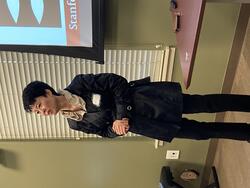
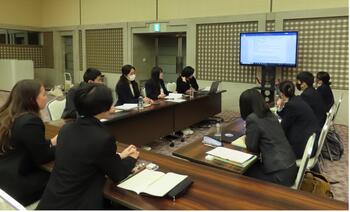
Applications opened today for Stanford e-Entrepreneurship Japan (SeEJ), an online course conducted in English to foster Japanese students’ creative thinking and innovative problem-solving skills to address social issues. SeEJ is offered twice annually in the fall and spring by the Stanford Program on International and Cross-Cultural Education (SPICE) at Stanford University and the non-profit organization e-Entrepreneurship in Japan. It is open to Japanese students in their first and second years of high school. The fall 2023 course will be taught by Irene Bryant and will run from late October 2023 through February 2024.
Three stimulating months later, I now have a clear vision of what entrepreneurship is, a goal that I desire to achieve, and a countless amount of information about our world’s issues.
Juria Kawabe, summer 2022 participant
SeEJ offers students an opportunity to engage with various scholars and entrepreneurs from Stanford University and beyond through its virtual classes, which are held twice a month on Sundays. The course will culminate in an individual research paper and final group projects. Students who successfully complete the course will receive a Certificate of Completion from SPICE and NPO e-Entrepreneurship.
“When I came across this program, I had to look up what the word ‘entrepreneurship’ meant,” said Juria Kawabe, a student in the summer 2022 session of SeEJ. “Three stimulating months later, I now have a clear vision of what entrepreneurship is, a goal that I desire to achieve, and a countless amount of information about our world’s issues.”
For more information about Stanford e-Entrepreneurship Japan, visit the program webpage. Interested high school students should apply online by September 8, 2023.
Webinar Description: The Stanford Program on International and Cross-Cultural Education (SPICE) and Stanford Global Studies (SGS) are excited to offer a professional development workshop for community college instructors who wish to internationalize their curriculum. The workshop will feature a talk by Stanford historian Dr. Bertrand Patenaude on the major famines of modern history, the controversies surrounding them, and the reasons that famine persists in our increasingly globalized world. Workshop participants will receive a copy of Dr. Patenaude’s book Bread + Medicine: American Famine Relief in Soviet Russia, 1921–1923 (Hoover Institution Press, 2023). Published in June, the book recounts how medical intervention, including a large-scale vaccination drive, by the American Relief Administration saved millions of lives in Soviet Russia during the famine of 1921–23.
Dr. Bertrand M. Patenaude teaches history, international relations, and human rights at Stanford, where he is a Lecturer for the International Relations Program, a Research Fellow at the Hoover Institution, and a Faculty Fellow at the Center for Innovation in Global Health (CIGH). Patenaude teaches courses at the Stanford School of Medicine as a Lecturer at the Center for Biomedical Ethics (SCBE). His seminars range across topics such as United Nations peacekeeping, genocide, famine in the modern world, humanitarian aid, and global health.
Dr. Bertrand Patenaude
Lecturer for the International Relations Program, a Research Fellow at the Hoover Institution, and a Faculty Fellow at the Center for Innovation in Global Health (CIGH)
616 Jane Stanford Way Encina Hall, E005 Stanford, CA 94305-6060
0
amycheng@stanford.edu
amy_cheng.jpg
MA
Amy Cheng is the instructor of Stanford e-Eiri Girls High School and Stanford e-Kagoshima City for the Stanford Program on International and Cross-Cultural Education (SPICE). As of 2023 she has returned to SPICE on a part-time basis while she continues to work at Sony Interactive Entertainment as senior manager of a 12-member content creation team in the United States and the United Kingdom. Prior to Sony, she was a technical/education writer at Pearson Education as well as a curriculum writer for SPICE. In the earlier years with SPICE, she helped develop curricular units on Hiroshima, China in the 21st century, and U.S.–Mexico relations.
In the mid-1990s, Amy was a graduate student at Stanford University, completing coursework toward an M.A. in East Asian Studies and an M.A. in International Comparative Education at the Graduate School of Education. She received her degree from the Center for East Asian Studies in 1998. As an undergraduate, Amy studied English at the University of California at Berkeley.
Amy was born in Yokohama, Japan, and immigrated to the Bay Area in the late ’70s with her family. Besides Japan, she has lived in China and South Korea.
The Stanford/SPICE East Asia Seminars for Teachers in Hawaiʻi (“Stanford SEAS Hawaiʻi”) is a professional development program for teachers in Hawaiʻi. It was launched in 2020–21 and the third year ended this month. Stanford SEAS Hawaiʻi is generously supported by the Freeman Foundation.
The third year of Stanford SEAS Hawaiʻi included four virtual seminars that featured Stanford-affiliated scholars who lectured on topics related to Japan (Professor Ethan Segal), China (Professor Andrew Walder), Korea (PhD candidate Zoë Gioja), and Southeast Asia (Ambassador Scot Marciel). The virtual seminars took place during the 2022–23 academic year. The third year culminated in a three-day institute that was held at the East-West Center, Honolulu on July 11, 12, and 13, 2023.
The SPICE staff was pleased to work with the Stanford/Freeman SEAS Hawaiʻi Teacher Fellows below.
Amy Boehning, Mililani High School Carl Wright, Kapolei High School Chayanee Brooks, Ka‘u High and Pahala Elementary School David Brooks, Ka‘u High and Pahala Elementary School Grace Nguyen, Konawaena High School Gregory Gushiken, Punahou School Hannah Lim, ‘Iolani School John Ates, Le Jardin Academy Jonathan Chang, Apex for Youth Jonathon Medeiros, Kauaʻi High School Laura Viana, Mid-Pacific Institute Mariko Shiraishi, Hawaii Baptist Academy Michael Hamilton, Leilehua High School Molly M. Satta-Ellis, Konawaena High School Niti D. Villinger, Hawai‘i Pacific University Patricia Tupinio, Leilehua High School Ria Lulla, Kawananakoa Middle School Sarah Fujioka, Waipahu High School William Milks, ‘Iolani School
The institute featured welcoming comments by East-West Center President Suzanne Vares-Lum (photo above), who touched upon two of the key themes of the institute: the importance of recognizing diverse perspectives and the interconnectedness of the world. Her comment that “Hawaiʻi can have an impact on the world” especially resonated among the Stanford/Freeman SEAS Hawaiʻi Teacher Fellows and the SPICE staff.
President Vares-Lum’s welcoming comments set the context for presentations by University of Hawaiʻi-affiliated scholars and community leaders, and curricular presentations by SPICE staff. The first day’s topics were “Immigration and Migration,” “Japan and World War II,” and “Contemporary U.S.–China Relations”; the second day’s topics were “Immigration, Migration, and the Korean Diaspora,” “Colonial and Post-Colonial Korea,” “The Korean War,” and “International Textbook Comparisons”; and the third day’s topic was “Asian Immigration and Diasporas in the United States.” These topics were taken from the Hawaiʻi Core Standards for Social Studies. The presenters were:
Day One Ken K. Ito, Professor Emeritus of Japanese Literature, UH Mānoa Carole Hayashino, President Emerita, Japanese Cultural Center of Hawai‘i Jane Kurahara, Volunteer, JCCH Betsy Young, Volunteer, JCCH Shana Brown, Associate Professor and Department Chair of History, UH Mānoa
Day Two Merle Grybowski, Director of Teacher Training, Pacific and Asian Affairs Council Edward J. Shultz, Professor Emeritus of History, UH Mānoa Duk Hee Lee Murabayashi, Director, Korean Immigration Research Institute in Hawaiʻi Naomi Funahashi, Manager of Teacher Professional Development, SPICE
Day Three Gary Mukai, Director, SPICE John Rosa, Associate Professor of History, UH Mānoa HyoJung Jang, Instructor of the Sejong Korea Scholars Program and Curriculum Specialist, SPICE
The institute also included a reception. Special guests included Graeme Freeman (photo above), President of the Freeman Foundation, which generously supports Stanford SEAS Hawaiʻi. Graeme spoke about the Freeman Foundation’s mission of helping to enhance the teaching of East Asia through programs such as the National Consortium for Teaching about Asia and Stanford SEAS Hawaiʻi and expressed his gratitude to the Teacher Fellows for the ripple effect their learning has on their students. Graeme was joined by Director of Operations and Programs Shereen Goto and Office Manager Robin Sato, both of the Freeman Foundation.
Over the next month, each Teacher Fellow will submit a lesson plan to SPICE that incorporates content that was introduced during Stanford SEAS Hawaiʻi. The SPICE staff awaits in anticipation of seeing how content from the seminar will reach hundreds of secondary school students throughout the Hawaiian Islands.
Rylan Sekiguchi, Manager of Stanford SEAS Hawaiʻi, and Sabrina Ishimatsu, SPICE Event Coordinator, organized the institute, which was facilitated by SPICE Manager of Teacher Professional Development Naomi Funahashi.
Mia Kimura is a Curriculum Consultant at the Stanford Program on International and Cross-Cultural Education (SPICE).
Prior to joining SPICE, Mia worked in marketing communications, supporting foreign firms in the Japanese market, and Japanese organizations in the United States. She has also served as Principal at Poppins Active Learning School, an international program for early childhood education in Tokyo. She holds a Bachelor of Arts in Cognitive Science from Brown University, and a Master of Business Administration from The Graduate School of International Corporate Strategy at Hitotsubashi University in Tokyo. She was born in San Francisco and lived in Tokyo for 25 years before returning to the Bay Area.
Mia’s role at SPICE represents the culmination of decades of experience bridging Japanese and American business and social cultures. She also draws from background as an executive coach, defining her role of instructor as an enabler of students’ own curiosity and abilities to question, reflect, and learn.
Applications opened recently for the Fall 2023 session of the Stanford University Scholars Program for Japanese High School Students (also known as “Stanford e-Japan”), which will run from the end of September 2023 through the end of February 2024. The deadline to apply is August 12, 2023.
Stanford e-Japan Fall 2023 session (September 2023 to February 2024) Application period: June 30 to August 12, 2023
All applications must be submitted at https://spicestanford.smapply.io/prog/stanford_e-japan/ via the SurveyMonkey Apply platform. Applicants and recommenders will need to create a SurveyMonkey Apply account to proceed. Students who are interested in applying to the online course are encouraged to begin their applications early.
Accepted applicants will engage in an intensive study of U.S. society and culture and U.S.–Japan relations. Government officials, top scholars, and experts from Stanford University and throughout the United States provide web-based lectures and engage students in live discussion sessions.
Stanford e-Japan is offered by the Stanford Program on International and Cross-Cultural Education (SPICE), Stanford University. Stanford e-Japan is generously supported by the Yanai Tadashi Foundation, Tokyo, Japan.
For more information about Stanford e-Japan, please visit stanfordejapan.org.
Sponsored by Stanford Global Studies (SGS), the Education Partnership for Internationalizing Curriculum (EPIC) Community College Faculty Fellowship program brings together a cohort of community college faculty and academic staff from various disciplines to work collaboratively with Stanford staff for one academic year (August–May). Each EPIC fellow designs a project that aims to internationalize curricula and develop global competencies among community college students. Jonas Edman and I met monthly with six of the 11 2022–23 EPIC fellows throughout the academic year. For me, some of the more meaningful discussions revolved around topics related to culturally relevant pedagogy; non-Western perspectives on topics like psychology, global citizenship, and finance; community college demographics; and the fellows’ communication with Stanford faculty and/or the incorporation of Stanford scholarship in the fellows’ projects. The fellowship culminated with the EPIC Symposium, “Integrating Global Topics into Community College Curricula,” which was held on May 20, 2023 and featured panels of current EPIC faculty and leadership fellows. The six EPIC fellows with whom Edman worked are listed below and their projects all focused on curriculum, which is a key component of SPICE’s mission to help make Stanford scholarship on global issues accessible to K–12 and community college educators and students. Each fellow gave an overview of their project to an audience of Stanford faculty and staff, EPIC alumni, and other community college faculty and staff.
Amy Coren, Professor of Psychology, Pasadena City College
Project: Beyond WEIRD: Reconceptualizing the Introduction to Psychology Course
Fran Farazdaghi, Associate Professor of Global and Peace Studies, Golden West College
Project: An Expanded Boundary of Care: Global Citizenship in the Modern World
Michelle Macfarlane, Agriculture Faculty and Distance Learning Coordinator, Sierra College
Project: Decolonizing the United States Food System
Yuliana Mendez, Associate Professor of Business, Yuba Community College
Project: Expanding the Borders of Personal Finance Curriculum Through Global Perspectives
Elisa Queenan, Professor of Business and Economics, Porterville College
Project: International Virtual Collaboration: Where the Only Thing More Unpredictable Than Your Wi-Fi Is the Conversation
Mark Rauzon, Professor and Chair of Geography Department, Laney College
Project: Breaking Up in the Bering Sea: Russia/U.S./Climate Change Chaos and the Effect on Native Communities and Bering Sea Ecology
Summaries of all of the 11 2022–23 EPIC fellows’ projects can be found here.
After an engaging question-and-answer session, Edman made closing comments and mentioned how much he had learned from the EPIC fellows not only in terms of subject matter content but also pedagogical content knowledge, especially at the community college level.
At the end of the symposium, the EPIC fellows received certificates from SGS Executive Director Kate Kuhns and Academic and Outreach Manager Kristyn Hara for their successful completion of the fellowship. During the symposium, they were invited to join the Global Educators Network (GEN), which in partnership with SGS seeks to inform, inspire, engage, and empower community college educators—and their students—to more deeply engage with global themes and learning resources, as well as international dialogue, research, and pedagogical strategies.
Following the symposium, I reflected on each of the presentations. I was, of course, already familiar with the content of their projects prior to the symposium. However, something unexpected from each presentation really stood out. Coren and Mendez described how their collaboration with other EPIC fellows in the group really enhanced their work with their students and commented on how their EPIC projects became a bridge between the cohort of EPIC fellows and their students. Farazdaghi spoke about how EPIC enabled her to empower her students to drive and shape her new curriculum on global citizenship. Macfarlane shared insights on the challenges of integrating her new course in departments like ethnic studies. Queenan spoke about how she adapted the five-step Design Thinking framework into her course. And through a video interview of a Siberian Yupik, Rauzon integrated an Indigenous perspective in his talk. These comments will help to further refine how Edman and I approach working with the 2023–24 EPIC fellows.
Importantly, Edman and I are most grateful to Kristyn Hara for expertly facilitating the EPIC program over the past year and for planning and implementing this year’s EPIC symposium.
The EPIC Community College Faculty Fellowship program is made possible through the support of U.S. Department of Education Title VI funding.
On August 13 and 14, 2020, Stanford Global Studies welcomed 12 new Education Partnership for Internationalizing Curriculum (EPIC) Fellowship Program community college instructors as members of its 2020–21 cohort.
(top row, left to right) Gary Mukai, Elisa Queenan, Amy Coren, Yuliana Mendez, Michelle Macfarlane, Fran Farazdaghi; (bottom row, left to right) Jonas Edman, Mark Rauzon.
All News button
1
Subtitle
Stanford Global Studies hosts 2023 Education Partnership for Internationalizing Curriculum (EPIC) Symposium: Integrating Global Topics into Community College Curricula.
Applications opened this week for Stanford e-Entrepreneurship Japan (SeEJ), an all-English online course to foster Japanese students’ creative thinking and innovative problem-solving skills to address social issues. SeEJ is offered twice annually in the fall and spring by SPICE and the non-profit organization e-Entrepreneurship in Japan. The instructors are Irene Bryant (fall) and Makiko Hirata (spring). It is open to Japanese students in their first and second years of high school. The spring 2023 course will run from early July through September.
Participating in the program has broadened my world enormously.
Yura Mizutani, fall 2022 participant
SeEJ offers students an opportunity to engage with impactful entrepreneurs from California and beyond through its virtual classes offered twice a month on Sundays. The course will culminate in an individual research paper and final group research projects, the latter of which will be presented at the last virtual class of the course in September. Students who successfully complete the course will receive a Certificate of Completion from SPICE, Stanford University, and NPO e-Entrepreneurship.
Testimonials from recent alumni attest to the transformative experience that the course has offered students since its inaugural year in 2020. Yura Mizutani (fall 2022 SeEJ) wrote about how the course introduced her to more complex, layered, and multidisciplinary approaches to addressing social issues. “Before joining Stanford e-Entrepreneurship, I was passionate about solving social problems from a public policy perspective. Participating in the program has broadened my world enormously, as I have learned that there are many ways to solve social problems from an entrepreneurial perspective as well.”
For more information about Stanford e-Entrepreneurship Japan, visit the program webpage. To apply, submit the online application by June 19.
Stanford e-Entrepreneurship Japan is one of several online courses offered by SPICE.
On May 5, 2023, the Spring 2023 TEACH Conference attracted people from across Stanford University for professional development, networking, and socializing around undergraduate and graduate teaching and learning. The conference engaged participants in the following key topics:
Engagement: How can we captivate students and motivate them to apply what they are learning effectively to their projects, assignments, research, and so on?
Well-being: How can we support thriving among learners and teachers?
Belonging: How can we invite learners and teachers to bring their whole selves to class?
Makiko Hirata touched upon each of the three key topics through her perspective and experiences as a concert pianist, educator, and researcher. Hirata opened her session on “Sound Communication” with a performance of Chopin’s “Etude Op. 25-1 in A-flat Major” a.k.a. “Aeolian Harp” and immediately drew in the audience.
Hirata demonstrated how music can encourage people to be more empathetic and imaginative through a series of short vocalization and listening exercises. Between different exercises, she interspersed research on the synching or coupling of brainwaves between listeners in effective communication. She structured her talk around four components of music—silence, rhythm, melody, and harmony—and she offered insightful remarks on how understanding such components can make people better educators who can also help to facilitate the well-being and belonging of their learners.
Her interactive session included asking the participants to sit in silence. “If you only have two minutes to relax,” Hirata told the participants, “studies show that sitting in silence is more effective than listening to so-called ‘relaxing music.’ We only have so much cognitive capacity, and the brain needs silence in between inputs to process the information it receives.” Another exercise focused on rhythm as she engaged the audience in a clapping exercise. It was a lesson on non-verbal leadership, including the importance of using breath, body language, and eye contact as cues.
Hirata also made references to neuroscience, which has documented the effects of music. A summary of this is captured in the March 31, 2023 edition of the Los Angeles Times: “When we listen to music together, our heartbeats actually start to align and we start breathing together to the lyrics. Even our brain waves start to synchronize, according to Makiko Hirata, an international concert pianist who works with neuroscientists to quantify the benefits of music on our well-being.”
After participating in her workshop, I was eager to apply these musical concepts to my teaching for more enhanced sense of belonging and engagement among my students. In addition to the four components of music, I will also keep the following four questions—outlined by Hirata—in mind as I plan my future lessons.
How much attention do you pay to your tone of voice in the classroom?
What is the range of your vocal inflections during your presentations?
What is the tempo of your bullet points and rhythms in your choice of words?
Do you know the power that sonification can give to a set of data?
Hollie Fortcamp, one of the organizers of the TEACH Conference, noted, “It was a joy to attend ‘Sound Communication’ by Dr. Makiko Hirata, SPICE, at the TEACH Conference. We are so blessed to have her expertise and delight! She captivated the room. She gave us all much to ponder about how the various aspects of musicality influence communication, especially the communication of teaching and learning. We are still talking about it.” In addition, three of the participants’ written comments noted “Makiko’s lovely piano playing and moments of silence in a great workshop”; “the measurable value of silence in information processing”; and “music/sound and more importantly, silence in teaching is important.” Fortcamp continued, “Makiko was an ideal presenter as she highlighted all three topics of the TEACH Conference—that is, engagement, well-being, and belonging.”
The following is a guest post written by Sarah Sumire Nomoto, who participated in the G7 Hiroshima Junior Conference in Hiroshima Prefecture. Sarah was a participant of the fall 2022 Stanford e-Japan course, which was taught by Meiko Kotani.
I am Sarah Sumire Nomoto. I am 17 years old, and I was born and raised in Hiroshima. My father is American, and my mother is Japanese. In this post, I would like to share thoughts on my experiences at the G7 Hiroshima Junior Conference, which was held from March 27th to 30th, 2023, and was organized by the Citizens Council for the Hiroshima Summit.
In advance of the G7 Summit in Hiroshima, this conference had the aim to have young people from the G7 countries come together to consider, discuss, and deepen understanding about international issues and initiatives and forge a resolution from the perspective of youth. There were 24 high school students participating, including 12 Japanese students from Hiroshima Prefecture and 12 students from the remaining G7 countries: France, the U.S., the U.K., Germany, Italy, and Canada. We were divided into three groups: (1) Peace; (2) Sustainability; (3) Diversity and Inclusion. Because of my background as a Japanese American living in Japan and my mother’s involvement in LGBTQ+ issues in Japan, I have been interested in the topic of diversity from an early age, which led me to join the diversity group.
On the first day, we went to the Hiroshima Peace Memorial Park and Museum and listened to a story from a hibakusha (atomic bomb survivor)—something I have experienced many times as a student in Hiroshima. I knew from the Stanford e-Japan program that American students are usually taught the reasons of the bombings, but little of the impact. Then, I saw a lot of G7 country participants getting shocked by the hibakusha’s story and the museum exhibits. After this experience, we talked together about finding the difference between “knowing” and “realizing.” This was exactly the point I had tried to make in my Stanford e-Japan research paper which was coming true in front of me at the G7 Hiroshima Junior Conference.
Image
The second day marked the start of our group’s focus on the theme of diversity. We went on a study tour which was meant to broaden our cultural horizons. However, we learned and realized that Japanese societal views are often limited to cultural and ethnic diversity, and other critical issues such as gender equality, LGBTQ+ rights, disabilities, and generational differences are less discussed. We felt that the perspectives of how our society sees diversity and inclusion must be expanded.
On the third day, as youth representatives of the G7 countries, we presented our final outcome to Hiroshima Prefecture Governor Hidehiko Yuzaki. We recommended and demanded that youth play key roles in the discussions surrounding diversity and inclusion, as there are many crucial issues that must be addressed now. When we talked about and created our document, I realized how valuable the Stanford e-Japan program had been in preparing me to be involved in discussions like this.
I am currently doing the International Baccalaureate program in high school, and my dream is to raise people’s awareness of global issues through film production. I would like to continue my efforts based on what I have learned at this conference and through Stanford e-Japan.
Stanford e-Japan
The Stanford University Scholars Program for Japanese High School Students or “Stanford e-Japan” is a distance-learning course sponsored by the Stanford Program on International and Cross-Cultural Education (SPICE) with generous support from the Yanai Tadashi Foundation.
Stanford e-Hiroshima, SPICE’s Newest Online Course for High School Students: Sharing Cranes Across the Pacific
Stanford e-Hiroshima seeks to underscore the importance of helping high school students understand the interdependence between Japan and the United States.
G7 Junior Conference youth representatives with Governor Hidehiko Yuzaki, Hiroshima Prefecture; photo courtesy Citizens Council for the Hiroshima Summit. Sarah is in fourth row, second from the left.
All News button
1
Subtitle
Stanford e-Japan alumna Sarah Sumire Nomoto shares her experience as a youth representative at the G7 Hiroshima Junior Conference.