Authors
News Type
Blogs
Date
Paragraphs

The following reflection is a guest post written by Stanford e-Hiroshima alum Rio Sasaki, who served as one of three high school peace messengers from Hiroshima Prefecture in 2021–22.


Hello. I am Rio Sasaki, a 19-year-old woman living in Hiroshima, Japan. Today, I want to share about my experience as a Hiroshima Nagasaki Peace Messenger.

Do you know the Hiroshima Nagasaki Peace Messengers program? It was started in 1998, and since then, Peace Messengers have visited the United Nations every year to appeal for the abolition of nuclear weapons and the realization of a peaceful world. Hiroshima Nagasaki Peace Messengers collect signatures against war and do peace-promoting operations. We have submitted more than two million signatures so far. We visited the UN Headquarters in New York City, the United States, until 1999, and since 2000 we have been visiting the UN Office at Geneva, Switzerland, where the Conference on Disarmament will be held.

Last year, in my third year of high school, I was chosen as a Hiroshima Nagasaki Peace Messenger. The reason why I wanted to be a Hiroshima Nagasaki Peace Messenger was because my grandparents are hibakusha (atomic bomb survivors) and I wanted to tell the truth of their story to posterity as the last generation that can hear the voice of hibakusha. Moreover, I was inspired by the story of a young woman who fought to protect democracy in Hong Kong. Then I thought to myself, “I want to make a difference in the world, too.”

I did not think an ordinary high school student like me would have a chance to talk to the prime minister of a country. I was very nervous, but it became a memorable day for me.

Rio Sasaki speaking as a peace messenger Rio Sasaki speaking as a peace messenger
The most shocking event in my year as a Peace Messenger was the world suddenly being in a situation in which nuclear weapons may be used in war. We—the Hiroshima Nagasaki Peace Messengers—held urgent fundraising activities for Ukraine and collected signatures against the war. After that, we went to the Ministry of Foreign Affairs in Tokyo with the signatures we collected and handed them to State Minister for Foreign Affairs Odawara. Then, I conversed with Prime Minister Kishida at the Hiroshima Peace Memorial Museum as a Youth Communicator for a World without Nuclear Weapons. I did not think an ordinary high school student like me would have a chance to talk to the prime minister of a country. I was very nervous, but it became a memorable day for me. In this way, my experience as a Hiroshima Nagasaki Peace Messenger had a huge effect on my life. Photo to the right: Rio Sasaki in Nagasaki speaking as a peace messenger.

I participated in the Stanford e-Hiroshima program when I was in the first year of high school and learned about the United States and the world. Being able to finish this curriculum lent me great confidence. In particular, my life changed by meeting my Stanford e-Hiroshima instructor, Mr. Rylan Sekiguchi. I challenged myself to become a Hiroshima Nagasaki Peace Messenger when I was a second-year high school student, but I was not chosen and felt very discouraged. However, Mr. Rylan encouraged me to keep my chin up. The next year, I applied a second time, and I was chosen. If it had not been for Mr. Rylan’s support, I wouldn’t be who I am. Participating in Stanford e-Hiroshima and meeting Mr. Rylan Sekiguchi were extremely important events in my life.

I am now a first-year student at Hiroshima City University majoring in International Studies. Moving forward, I hope to continue advocating for peace in my community and around the world. From now on, I plan to polish my English skills to continue promoting peace activities to the world.

Read More

Rylan Sekiguchi at Hiroshima University High School with Kenzi Watanabe, Principal, and Akiyoshi Kai, Head of R&D Department and member of the Mathematics Department
Blogs

Stanford e-Hiroshima: Empowering Youth in Hiroshima

Ryuji and Nanako Yamada share reflections on their lives in Hiroshima and their American mentors.
Stanford e-Hiroshima: Empowering Youth in Hiroshima
California-Japan Governors’ Symposium education panel, Stanford University
News

Stanford Alumni Weekend (October 24–27, 2019) Feature: Hiroshima Governor Hidehiko Yuzaki & SPICE’s Dr. Mariko Yoshihara Yang and a New Online Course for MBA Students in Japan

Stanford Alumni Weekend (October 24–27, 2019) Feature: Hiroshima Governor Hidehiko Yuzaki & SPICE’s Dr. Mariko Yoshihara Yang and a New Online Course for MBA Students in Japan
Stanford e-Hiroshima is an online course for high school students created by SPICE and Hiroshima Prefecture
News

Stanford e-Hiroshima, SPICE’s Newest Online Course for High School Students: Sharing Cranes Across the Pacific

Stanford e-Hiroshima seeks to underscore the importance of helping high school students understand the interdependence between Japan and the United States.
Stanford e-Hiroshima, SPICE’s Newest Online Course for High School Students: Sharing Cranes Across the Pacific
Hero Image
Stanford e-Hiroshima alumna Rio Sasaki
Stanford e-Hiroshima alumna Rio Sasaki; photo courtesy Rio Sasaki
All News button
1
Subtitle

Stanford e-Hiroshima alumna Rio Sasaki shares her thoughts on being part of the last generation to hear the voices of atomic bomb survivors.

0
makiko_hirata_square.jpg DMA

Dr. Makiko Hirata is the instructor of Stanford e-Entrepreneurship U.S. 

An international pianist with ten released albums, Dr. Hirata is also known as “Dr. Pianist.” With a Doctor of Musical Arts degree from Rice University, she is on a mission to promote the power of music to heal and unite us. She collaborates with neuroscientists to quantify the benefit of music and promote the power of music as an overlooked social resource to enhance our individual and social well-being. She is a US-Japan Leadership Program Fellow, a founding member of TEMPO: Music for Climate Action, and a recipient of the Coeuraj 2022 Global Courage Fellowship, which honors industry leaders around the world whose work focuses on building trust in an era of polarization.

Japanese-born Dr. Hirata has lived in the United States since she was accepted to the Juilliard School Pre-College Division at the age of 13. She has given recitals, lectures, concerto performances, and outreach concerts in the Americas and Eurasia with ensembles and artists, such as the River Oaks Chamber Orchestra, the Pecs Hungarian Symphony Orchestra, conductor Leon Fleisher, and clarinetist David Krakauer. She has taught at New York University, Colburn Conservatory of Music, Rice University, and Lone Star College, and given master classes and lectures internationally. 

Instructor, Stanford e-Entrepreneurship U.S.
Date Label
Authors
News Type
News
Date
Paragraphs

Applications opened recently for the Fall 2022 session of the Stanford University Scholars Program for Japanese High School Students (also known as “Stanford e-Japan”), which will run from the end of September 2022 through the end of February 2023. The deadline to apply is August 12, 2022.

Stanford e-Japan
Fall 2022 session (September 2022 to February 2023)
Application period: July 1 to August 12, 2022

All applications must be submitted at https://spicestanford.smapply.io/prog/stanford_e-japan/ via the SurveyMonkey Apply platform. Applicants and recommenders will need to create a SurveyMonkey Apply account to proceed. Students who are interested in applying to the online course are encouraged to begin their applications early.

Accepted applicants will engage in an intensive study of U.S. society and culture and U.S.–Japan relations. Government officials, top scholars, and experts from Stanford University and throughout the United States provide web-based lectures and engage students in live discussion sessions.

Through the course, I learned that people-to-people connections are important in international relations. I am forever grateful to the people I met in this program—like-minded friends who supported me through the course!
Mio Kobayashi
Fall 2021 Stanford e-Japan Honoree

Stanford e-Japan is offered by the Stanford Program on International and Cross-Cultural Education (SPICE), Stanford University. Stanford e-Japan is generously supported by the Yanai Tadashi Foundation, Tokyo, Japan.

For more information about Stanford e-Japan, please visit stanfordejapan.org.

To stay informed of news about Stanford e-Japan and SPICE’s other student programsjoin our email list or follow us on FacebookInstagram, and Twitter.


SPICE offers separate courses for U.S. high school students. For more information, please visit the Reischauer Scholars Program (online course about Japan), the Sejong Korea Scholars Program (online course about Korea), and the China Scholars Program (online course about China).

Read More

collage of Japanese students
News

Empowering the Next Generation of Japanese Leaders

Yanai Scholars, Stanford e-Japan alumni, and EducationUSA representatives highlight a special session for the Spring 2022 Stanford e-Japan students.
Empowering the Next Generation of Japanese Leaders
headshots of three students from Japan
News

Winners Announced for the Fall 2021 Stanford e-Japan Award

Congratulations to our newest student honorees.
Winners Announced for the Fall 2021 Stanford e-Japan Award
Professor Yujin Yaguchi in front of the main library at University of Tokyo
Blogs

Professor Yujin Yaguchi, University of Tokyo, Offers Lecture on Pearl Harbor for Stanford e-Japan

Professor Yujin Yaguchi introduced diverse perspectives on Pearl Harbor to 27 high school students in Stanford e-Japan.
Professor Yujin Yaguchi, University of Tokyo, Offers Lecture on Pearl Harbor for Stanford e-Japan
Hero Image
Stanford e-Japan alumna Mio Kobayashi, who will be studying at Minerva University as a Yanai Tadashi Foundation Scholar.
Stanford e-Japan alumna Mio Kobayashi, who will be studying at Minerva University as a Yanai Tadashi Foundation Scholar; photo courtesy Mio Kobayashi
All News button
1
Subtitle

Interested students must apply by August 12, 2022.

Authors
News Type
Blogs
Date
Paragraphs

“Be careful with the scissors,” my grandma would remind me once more. The blistering heat of the Tokyo summer radiated through the living room mercilessly, temporarily distracting me from my task at hand. My eight-year-old hands, glistening with sweat, carefully cut through an empty plastic bottle. I would neatly cut through the grooves of the water bottle, making sure not to leave any sharp ridges, per my grandma’s instructions. After some additional modifications of my own, the mini-trash can was complete. This would be used in various places in my grandparents’ house from the bathroom to the kitchen sink, providing the plastic bottle with years of repurposed life. When I ask my grandma why she won’t simply buy a new plastic container for the same purpose, she would predictably respond: “Mottainai kara” (translation: Because that would be mottainai).

This word, mottainai, which most closely translates to “wasteful,” is a staple of Japanese culture. It is commonly used to express one’s sentiment of wastefulness. It can be used in various contexts from feeling wasteful about food being thrown away to the feeling of regret after wasting time. Awareness of mottainai has been a constant throughout my entire life. I recall my favorite childhood bedtime story being Mottainai Baasan—the story of a baasan, or grandma, who found creative ways to reduce and repurpose waste. Her simple yet riveting creativity ingrained into me an instinct of reducing waste from a young age. I would stuff old shirts into my pillow case to adjust my pillow height; tape pencils sharpened down to less than an inch to the back of a pen to be able to use them to the very end; water down almost empty tomato sauce cans and shake it with the lid closed to be able to use every last bit of the sauce—all were ideas inspired by Mottainai Baasan.

While I had always taken mottainai for granted, I never questioned why Japan as a society practices mottainai so diligently. Through Stanford’s Reischauer Scholars Program (RSP), I was able to explore this familiar concept of mottainai through an academic and historical lens, recontextualizing a mindset I grew up with into what I now realize is a combination of Shinto principles and the result of Japan’s efforts to reconstruct the country following their loss in World War II.

RSP allowed me to retroactively come to appreciate the sentiment behind mottainai.

This collective awareness of and desire for self-betterment and respect for one another casted mottainai in a brand-new light. Such realizations allow me to appreciate my family’s culture in a way that ties into grounded historical events.

In particular, books such as Edwin O. Reischauer and the American Discovery of Japan by George Packard explained questions I had long wondered about, specifically regarding key differences in Japanese and Korean culture. As it turns out, America learned from certain setbacks they faced when Westernizing Japan and reshaped its approach in Korea, resulting in many of the differences between Japanese and Korean culture we observe today.

Furthermore, having participated in public Japanese education for over a decade, the opportunity to study Japan under an American lens was incredibly insightful. Whether it be biases I began to realize between Japanese and American teachings or the different approaches to introducing topics involving both countries, connecting different perspectives began to feel like a four-dimensional puzzle spanning time and cultures. The opportunity to immediately discuss my thoughts with other students in RSP culminated into multiple “aha!” moments that have stuck with me since. These thoughtful discussions with my peers stood out as a central part of my experience in the program. For additional context, my experience with RSP coincided with the early stages of the COVID-19 pandemic. Despite such distractions, RSP allowed me to learn in an engaging and captivating manner. Since the program was originally designed to be in an online setting long before COVID, a strong sense of community was already baked into the experience, and I was able to learn directly from my classmates around the world in an efficient and organized manner.

The opportunity to learn the context and history behind various aspects of Japanese culture that I grew up with and previously took for granted was a priceless experience. Being able to understand why certain cultural quirks exist as well as how they came to be and in what ways they impact modern Japanese society renewed my outlook while deepening my appreciation for Japan.

Read More

high school girl standing amidst park greenery
Blogs

Finding My Place in the RSP & the U.S.–Japan Relationship

The following reflection is a guest post written by Kristine Pashin, an alumna of the Reischauer Scholars Program, which will begin accepting student applications on September 6, 2021.
Finding My Place in the RSP & the U.S.–Japan Relationship
Evan Wright (front row, third from the right), Adriana Reinecke, RSP 2009 (first row, third from the left), and Monica, RSP 2013 (second row, third from the right) with the Reischauer Center staff in Mt. Vernon
Blogs

The Reischauer Legacy: How the RSP Inspired Me to Dedicate My Life to U.S.–Japan Relations

The following reflection is a guest post written by Evan Wright, an alumnus of the Reischauer Scholars Program.
The Reischauer Legacy: How the RSP Inspired Me to Dedicate My Life to U.S.–Japan Relations
students gathered for a luncheon
Blogs

Reconnecting Under the Trees: An RSP Alumni Lunch Gathering at Stanford

Alumni of the Reischauer Scholars Program recently met at Stanford University over Japanese bentos and sushi.
Reconnecting Under the Trees: An RSP Alumni Lunch Gathering at Stanford
Hero Image
Seiji Yang at Microsoft corporate headquarters, Redmond, Washington
Seiji Yang at Microsoft corporate headquarters, Redmond, Washington; photo courtesy Seiji Yang
All News button
1
Subtitle

The following reflection is a guest post written by Seiji Yang, a 2020 alumnus of the Reischauer Scholars Program, which will begin accepting student applications on September 5, 2022.

Authors
News Type
Blogs
Date
Paragraphs

In March 2022, SPICE released Introduction to Issues in International Security, an online lecture series that was developed in consultation with the Center for International Security and Cooperation (CISAC). Four CISAC scholars are featured in accessible video lectures that aim to introduce high school students to various global security issues.

Dr. Ignacio Ornelas Rodriguez, high school educator, historian, and researcher, was an advisor to the first cohort of high school students to engage with the lectures. Ornelas guided students from San Jose and Salinas through the video lectures and accompanying curriculum. Students took the initiative to complete the series and assignments on top of their regular schoolwork.

Ornelas’s efforts culminated in the inaugural International Security Symposium that was held on May 26, 2022. The four CISAC scholars gathered online with the first cohort of students. The objectives of the symposium were to offer students a chance to interact with leading scholars in the field of international security and to learn from the scholars about careers in the field.

The scholars, who are featured in the lecture series and who were present during the symposium, are:

Dr. Martha Crenshaw, Senior Fellow, Freeman Spogli Institute for International Studies (Terrorism and Counterterrorism)

The Honorable Rose Gottemoeller, former Deputy Secretary General of NATO and Frank E. and Arthur W. Payne Distinguished Lecturer at Freeman Spogli Institute for International Studies (International Security and North Korea’s Nuclear Program)

Dr. Norman Naimark, Professor of History and Senior Fellow, Hoover Institution and the Freeman Spogli Institute for International Studies (Ethnic Cleansing and Genocide)

Dr. Megan J. Palmer, Executive Director of Bio Policy and Leadership Initiatives at Stanford University, Adjunct Professor in the department of Bioengineering, and Affiliate of the Center for International Security and Cooperation (Biosecurity)

During the symposium, the scholars shared key turning points in their careers and how they came to be in their fields of expertise. This was followed by student presentations in breakout sessions, where the students were given the opportunity to present on one of the four topics covered in Introduction to Issues in International Security.

In the breakout session on ethnic cleansing and genocide, Professor Naimark was impressed by how the students had absorbed the most important lessons of the material on mass atrocities: 1) that ethnic cleansing and genocide are an important part of human history, and 2) that these are phenomena that need to be studied and understood in order to prevent them from repeating in the future.

The student participants from Salinas were recently featured in an article in The Salinas Californian. Alisal High School student Ashley Corral commented that the series “brought awareness to COVID, mass atrocities and weapons,” and “it was really helpful that students from Salinas Valley could have that opportunity.” Another student, Bilha Piceno said, “It lets me see if this is something that I’m interested in."

The lecture series encourages students to think about international security not only on a broader level, but also how they can contribute to the safety of the world as global citizens starting with their own communities. Given the success of the first symposium, CISAC and SPICE hope to expand on the lecture series, which is part of their DEI-focused efforts, and reach more underrepresented minority students.

Read More

CISAC Scholars Martha Crenshaw, Rose Gottemoeller, Norman Naimark, Megan Palmer; photos courtesy CISAC
News

Introduction to Issues in International Security

A new video curriculum series is released.
Introduction to Issues in International Security
Dr. Hebert Lin
News

Virtual Workshop for Community College Instructors Will Explore Cyber Threat Across the U.S. Nuclear Enterprise

SPICE and Stanford Global Studies will offer a free virtual workshop with Dr. Herbert Lin on January 25th, 4:00pm–6:00pm.
Virtual Workshop for Community College Instructors Will Explore Cyber Threat Across the U.S. Nuclear Enterprise
an image of five men at the beach and an image of a man standing
Blogs

Teaching Diverse Perspectives on the Vietnam War

On Veterans Day 2021, SPICE Director Gary Mukai reflects on some lesser-known stories of Vietnam War veterans.
Teaching Diverse Perspectives on the Vietnam War
Hero Image
Dr. Ignacio Ornelas Rodriguez speaks with Salinas students
Dr. Ignacio Ornelas Rodriguez speaks with Salinas students; photo courtesy Jocelyn Ortega/The Salinas Californian
All News button
1
Subtitle

High school students from San Jose and Salinas Valley met online with scholars from Stanford's Center for International Security and Cooperation for the inaugural International Security Symposium.

Authors
Jonas Edman
News Type
News
Date
Paragraphs

SPICE continues to expand its regional programs for high school students in Japan. This year marked the launch of the Stanford e-Kobe program, which joins the previously established programs, Stanford e-Hiroshima, Stanford e-Kawasaki, Stanford e-Oita, and Stanford e-Tottori.

These online courses are a collaboration between SPICE and local government and school officials in Japan and challenge students to think critically about global themes related to U.S. society and culture and U.S.–Japan relations.

All five courses have now finished their 2021–2022 term. This summer, two top students from each program will present their final research projects and be honored at a virtual event hosted by SPICE, Stanford University. Congratulations to the ten honorees below on their excellent academic achievement!

Stanford e-Hiroshima (Instructor Rylan Sekiguchi)

Student Honoree: Minori Imai
School: Hiroshima Prefectural Kuremitsuta High School
Project Title: All Lives Are Important

Student Honoree: Yui Miyake
School: Hiroshima Prefectural Hiroshima High School
Project Title: U.S. Prison System: How the Country’s History of Racial Inequality Drives the High Rate of Incarceration in America

Stanford e-Kawasaki (Instructor Maiko Tamagawa Bacha)

Student Honoree: Sayaka Kiyotomo
School: Kawasaki High School
Project Title: How Can We Improve Junior and Senior High School English Education in Japan?

Student Honoree: Anne Fukushima
School: Tachibana High School
Project Title: How Are Invisible Disorders Accepted in the United States and Japan?

Stanford e-Kobe (Instructor Alison Harsch)

Student Honoree: Nonoha Toji
School: Kobe University Secondary School
Project Title: How to Foster Entrepreneurship in School Days: Between U.S. and Japan

Student Honoree: Cullen Hiroki Morita
School: Kobe Municipal Fukiai High School
Project Title: The Different Work-Life Balance in Japan and America

Stanford e-Oita (Instructor Kasumi Yamashita)

Student Honoree: Rina Imai
School: Usa High School
Project Title: Learn About War and Peace Through the Naval Air Base Bunkers in Oita

Student Honoree: Yuki Nojiri
School: Hofu High School
Project Title: I Want to Live in the Second House of the Three Little Pigs

Stanford e-Tottori (Instructor Jonas Edman)

Student Honoree: Sakurako Kano
School: Tottori Keiai High School
Project Title: Being Proactive

Student Honoree: Yuki Yamane
School: Tottori Nishi High School
Project Title: The Effect of Collectivism and Individualism on Education

The SPICE staff is looking forward to honoring these ten students in a virtual ceremony on August 9, 2022 (August 10 in Japan). Each student will be given the opportunity to make a formal presentation to members of the Stanford community, the Consulate General of Japan in San Francisco, and the Japanese community in the San Francisco Bay Area.


SPICE also offers online courses to U.S. high school students on Japan (Reischauer Scholars Program), China (China Scholars Program), and Korea (Sejong Korea Scholars Program), and online courses to Chinese high school students on the United States (Stanford e-China) and to Japanese high school students on the United States and U.S.–Japan relations (Stanford e-Japan).

To stay informed of SPICE news, join our email list and follow us on FacebookTwitter, and Instagram.

Read More

Principal Officer John C. Taylor and Governor Seitaro Hattori with students
Blogs

Opening Ceremony for Stanford e-Fukuoka

Governor Seitaro Hattori, Ambassador Rahm Emanuel, and Principal Officer John C. Taylor congratulate students in inaugural class.
Opening Ceremony for Stanford e-Fukuoka
Photo of student honorees holding plaques
News

SPICE Honors Top Students from 2020–2021 Regional Programs in Japan

Congratulations to the eight student honorees from Hiroshima Prefecture, Kawasaki City, Oita Prefecture, and Tottori Prefecture.
SPICE Honors Top Students from 2020–2021 Regional Programs in Japan
Honorees of SPICE’s regional programs in Japan
News

Ceremony Honors Top Students from SPICE’s Regional Programs in Japan

Congratulations to the eight honorees of SPICE’s 2019–2020 regional programs in Japan.
Ceremony Honors Top Students from SPICE’s Regional Programs in Japan
Hero Image
Encina Hall
Encina Hall, Stanford University, home of SPICE; photo courtesy Irene Bryant
All News button
1
Subtitle

Congratulations to the ten student honorees from Hiroshima Prefecture, Kawasaki City, Kobe City, Oita Prefecture, and Tottori Prefecture.

Authors
Gary Mukai
News Type
Blogs
Date
Paragraphs

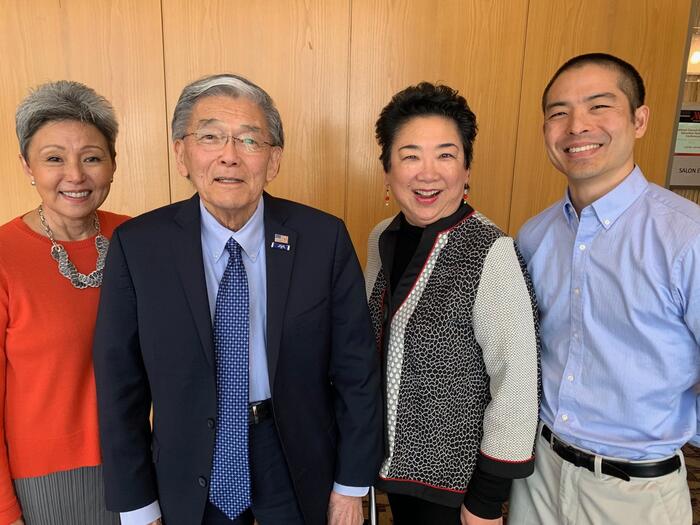
As a young student in San Jose in the 1960s and early 1970s, I used to see Norman Mineta on occasion in San Jose’s Japantown. Once at Jackson Barber Shop in Japantown, Norm was on the barber chair. After he left, barbers Takeo and Atsuo Fukuda asked me if I knew who he was. I didn’t, and Takeo told me that he was Norman Mineta, vice mayor of San Jose. That was the first time that I sat next to him, and the last time (photo above) was on September 20, 2019, just a few months prior to the pandemic.

Since that day at Jackson Barber Shop, I recognized Norm whenever I saw him in Japantown, in the San Jose Mercury News, and in the national news. Whenever I met with him as mayor, congressman, or secretary, I was struck by how he remembered members of my family in San Jose. His capacity for empathy is something that I have admired since my youth and aspire to in my adulthood. Norm’s passing on May 3, 2022 prompted me to recall our work together on several education-focused projects that were deeply personal to him and to me.

Norm’s life story—including his family’s incarceration in Heart Mountain Relocation Center by the U.S. government during World War II—is eloquently captured in the remembrance, “Remembering Mineta as unselfish American,” which was written by Daniel Okimoto, Professor Emeritus, Stanford University. Norm’s life is also brilliantly captured in the film, Norman Mineta and His Legacy: An American Story, by Dianne Fukami and Debra Nakatomi, Mineta Legacy Project. According to Fukami and Nakatomi, the film is about injustice and redemption, and Norm’s burning desire for all people to be treated equally. That desire was influenced greatly by his childhood incarceration experience. I often heard Norm talk about the anguish and heartbreak he felt as a 10-year-old when his family was taken from their San Jose home in 1942 and he was forced to leave behind his dog, Skippy.

In the early 2000s, I consulted with him about SPICE’s curricular work on a comprehensive curriculum unit that focused on the incarceration of Japanese Americans during World War II and a teacher’s guide for the film, Uncommon Courage: Patriotism and Civil Liberties, directed by gayle yamada. The curriculum helps to raise public awareness concerning the history and the lessons of civil rights violations or civil liberties injustices experienced by certain communities—something that Norm experienced first-hand as a child. The teacher’s guide helps teachers to set the context for and to debrief the viewing of the film that tells the story of the Military Intelligence Service (MIS) during World War II and the Allied Occupation of Japan. Approximately 6,000 MIS soldiers, primarily Japanese American, fought for the United States in the Pacific, interrogating Japanese prisoners, translating documents, intercepting communications, and infiltrating enemy lines. Many of the soldiers volunteered from the incarceration camps. While developing the guide, I spoke to Norm about many of the MIS soldiers whom he knew and also about his experiences as an intelligence officer in Japan and Korea in the 1950s.

When I was a board member of the National Japanese American Memorial Foundation, Norm (as one of the founding members of the Memorial) supported the development of educational resources on the Memorial in Washington, DC, which I developed back in the early 2000s with Kerry Yo Nakagawa, Director, Nisei Baseball Research Project. Norm’s quote is inscribed on one of the walls of the Memorial. It reads,

May this memorial be a tribute to the indomitable spirit of a citizenry in World War II who remained steadfast in their faith in our democratic system.

Image
National Council of History Education conference, Washington, DC; Secretary Norman Mineta with Nakatomi (left) and Fukami (right) and Sekiguchi.


In addition, my colleague, Rylan Sekiguchi, and I had the honor of working in collaboration with the Mineta Legacy Project—specifically with Norm, Dianne Fukami, Debra Nakatomi, and Amy Watanabe—on the development of a comprehensive web-based curriculum called “What Does It Mean to Be an American?” Inspired by the life and career of Norm, the six themed lessons are: Immigration, Civil Liberties & Equity, Civic Engagement, Justice & Reconciliation, Leadership, and U.S.–Japan Relations. Norm also joined Sekiguchi and members of the Mineta Legacy Project in introducing the curriculum at several venues, including the U.S.-Japan Council annual conference in Tokyo (November 2018); National Council of History Education conference in Washington, DC (March 2019); Ronald Reagan Presidential Library in Simi Valley, California (April 2019); and the National Council for the Social Studies annual conference in Austin, Texas (November 2019). Note: The photo above was taken at the National Council of History Education conference, Washington, DC; Secretary Norman Mineta with Nakatomi (left) and Fukami (right) and Sekiguchi.

Lastly, in spring of 2021, I was asked by Stanford’s Center for East Asian Studies for recommendations for a keynote speaker for the CEAS commencement. The first person who came to mind was Norm, and he accepted CEAS’s invitation. I will always remember his important words—that there are two things to always cherish and to hold dear to your heart no matter what the situation. These are your name and integrity.

Image
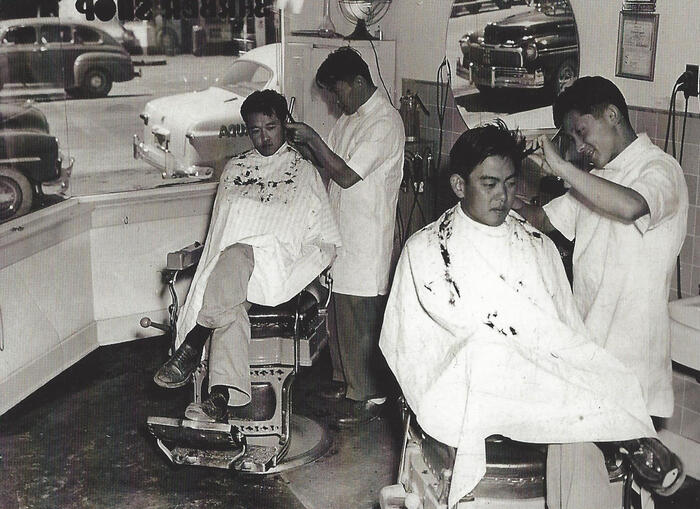
Jackson Barber Shop


During the keynote address, my mind periodically drifted back to my first encounter with Norm at Jackson Barber Shop. Today, May 30, 2022, Memorial Day, I walked past the location of where Jackson Barber Shop once stood. I recalled the first time that I saw Norm and remembered Atsuo and Takeo, who are shown in the photo (1950s) above where Takeo (near the window) is cutting my father’s hair and Atsuo is cutting the hair of one of my father’s best friends. Takeo and Atsuo’s family was in the same block as my father and his family in Poston War Relocation Center in Arizona. Takeo used to cut my hair, and I remember talking with him about one of my relatives, Hachiro Mukai, who was drafted into the U.S. Army from Poston and was killed in action in France. Norm wanted Hachiro’s story (and others like it) to be transmitted to future generations. I will always remember that and his support of SPICE’s educational efforts over the years. Note: Photo of Jackson Barber Shop, courtesy Chiyo Fukuda.

At the COPANI XX conference in San Francisco, I shared the photo of Jackson Barber Shop with Norm and we shared not only some sadness about the bygone years of many Japantown businesses but also some laughter too, as he said that I still needed a haircut.

Read More

headshots of eight high school students for WDIMTBA 8
Blogs

What Does It Mean to Be an American?: Reflections from Students (Part 8)

Reflections of eight students on the website “What Does It Mean to Be an American?”
What Does It Mean to Be an American?: Reflections from Students (Part 8)
Secretary Norman Mineta and Rylan Sekiguch
News

What Does It Mean to Be an American?: A Webinar for Educators, February 20, 2021, 10am PST

The Mineta Legacy Project and SPICE are providing an educational opportunity for people across the country to learn about the Japanese American experience during World War II by presenting a webinar on Saturday, February 20, at 10am PST.
What Does It Mean to Be an American?: A Webinar for Educators, February 20, 2021, 10am PST
mlp team with bush manual rotate 360
News

Presidents Bill Clinton and George W. Bush interviewed for the Mineta Legacy Project

Presidents Bill Clinton and George W. Bush interviewed for the Mineta Legacy Project
Hero Image
Gary Mukai and Norman Mineta at Convención Panamericana Nikkei (COPANI) XX, San Francisco, September 20, 2019
Gary Mukai and Norman Mineta at Convención Panamericana Nikkei (COPANI) XX, San Francisco, September 20, 2019; photo courtesy Mark Shigenaga
All News button
1
Subtitle

The late Secretary Mineta was unwavering in his commitment to SPICE’s efforts to educate students about civil liberties and equality.

Authors
Gary Mukai
News Type
News
Date
Paragraphs

In 2015, SPICE launched Stanford e-Japan, an online course for high school students in Japan that is generously supported by the Yanai Tadashi Foundation, Tokyo, Japan. The two key objectives of Stanford e-Japan are to introduce the students to U.S.–Japan relations and to also encourage the students to consider studying in the United States. Since then, many Stanford e-Japan alumni have spent time or are spending time studying at U.S. colleges as exchange students and as four-year undergraduates. The two Stanford e-Japan instructors are Waka Brown (spring course) and Meiko Kotani (fall course). On May 13, 2022, Brown organized and facilitated a session that introduced her students to opportunities to study abroad.

The session began with comments by Chizuru Sasada, Senior EducationUSA Advisor of Fulbright Japan; Vincent Flores, EducationUSA Regional Educational Advising Coordinator for Northeast Asia and the Pacific; and Kaede Ishidate, an intern at EducationUSA and student at Harvard University. EducationUSA is a U.S. Department of State network of international student advising centers in many countries and territories that provides free advice and comprehensive information to prospective students wishing to study at U.S. colleges and universities. Sasada and Flores offered advice on studying abroad and noted, “There’s nothing like ‘being there!’” and fielded questions from the Stanford e-Japan students on topics such as college application essays, balancing extracurricular activities, and letters of recommendation.

After the comments by Sasada, Flores, and Ishidate, the Stanford e-Japan students were offered the opportunity to meet with Japanese students who are currently studying at colleges abroad in breakout groups. The breakout groups were led by the following college students:

  • Ryusei Best Hayashi (University of California, Berkeley) is majoring in Business Administration and Political Science and was a participant in the Stanford e-Japan Spring 2020 course. He is half-Mexican and half-Japanese, and was born in Mexico. He studied at Aoba-Japan International School, Tokyo.
  • Anna Matsumoto (Stanford University) is studying Mechanical Engineering. She is a Yanai Tadashi Scholar and is from Tokushima, Japan. She attended Tokushima Bunri High School, Tokushima. The New York Times featured her in an article in 2021.
  • Ayano Shirakawa (University of British Columbia, Canada) participated in the Stanford e-Japan Spring 2019 course and is studying at UBC Sauder School of Business majoring in Commerce and minoring in Law & Society. She was born and raised in Kobe, Japan, and attended the Canadian Academy.
  • Keilyn Tai (Brigham Young University) grew up in Hong Kong before moving to Japan to attend high school at Shibuya Makuhari Senior High School, Chiba, Japan. She participated in the Stanford e-Japan Fall 2020 course. She is considering Computer Science as a major.
  • Hannah Tauchi (University of California, San Diego) is majoring in Bioengineering with a focus on biotechnology. She participated in the Stanford e-Japan Spring 2017 course and was a student at Futaba High School, Tokyo. She is a Yanai Tadashi Scholar.
     

Reflecting on the breakout sessions, the Stanford e-Japan students shared takeaways from their discussions about the college admission process. These included:

In closing, Brown underscored the importance of the takeaways, encouraged her students to explore new opportunities, and also reassured them that it is okay if they as high school students do not yet know what they want to do in their lives. She also noted the importance of a good “college fit.” Reflecting upon the session, she noted, “I am so grateful to Sasada-san, Vincent, Kaede, the Yanai Scholars, and Stanford e-Japan alumni for the insight that they provided my students. I wish that I had such invaluable advice when I was a high school student.”

Image
kaede ishidate
Reflecting on the session, Ishidate noted, “I was very impressed by the students from the Stanford e-Japan program who were all highly motivated and eager to ask questions about study abroad opportunities in the U.S. It was encouraging to see that they have access to the right resources and even more, that they have the mindset to expand their horizons and pursue their goals. While I was only able to speak with them for a short amount of time, I myself felt inspired by the students to continue my own academic journey!”

Read More

Japanese scholar and Ambassador Armacost chatting in a conference room
News

Four Stanford e-Japan Alumni Awarded Yanai Tadashi Foundation Scholarships

In 2015, SPICE launched the inaugural online course, Stanford e-Japan, for high school students in Japan.
Four Stanford e-Japan Alumni Awarded Yanai Tadashi Foundation Scholarships
Yanai Tadashi Foundation President Tadashi Yanai with SPICE Director Gary Mukai and Stanford e-Japan instructor Waka Brown
News

Yanai Tadashi Foundation and SPICE/Stanford University

The Yanai Tadashi Foundation is the current supporter of Stanford e-Japan, an online course about U.S. society and culture and U.S.–Japan relations.
Yanai Tadashi Foundation and SPICE/Stanford University
Stanford e-Japan alumni Jun Yamasaki and Hanako “Hannah” Tauchi
News

The Yanai Tadashi Foundation and Stanford e-Japan: Cultivating Future Leaders in Japan

The Yanai Tadashi Foundation and Stanford e-Japan: Cultivating Future Leaders in Japan
Hero Image
collage of Japanese students
Participating students (clockwise from top left): Ryusei Best Hayashi, Anna Matsumoto, Ayano Shirakawa, Keilyn Tai, Hannah Tauchi
All News button
1
Subtitle

Yanai Scholars, Stanford e-Japan alumni, and EducationUSA representatives highlight a special session for the Spring 2022 Stanford e-Japan students.

Authors
Gary Mukai
News Type
Blogs
Date
Paragraphs

Mayor Norihiko Fukuda of Kawasaki City—the sixth most populous city in Japan—spoke during the closing ceremony of Stanford e-Kawasaki on March 29, 2022. The ceremony marked the end of the third-year offering of Stanford e-Kawasaki, which is taught by Instructor Maiko Tamagawa Bacha. Nineteen students representing Kawasaki High School and Tachibana High School successfully completed the course and each received a certificate from Mayor Fukuda as Bacha announced each student’s name.

Stanford e-Kawasaki focuses on two themes, entrepreneurship and diversity. In Mayor Fukuda’s comments to students, he noted that with people coming from across and outside of Japan to Kawasaki, the city has developed to become a city of 1.54 million people and one of the most diverse cities in Japan. Given this, Fukuda underscored the importance of having students value diversity, and stated, “I want young people in Kawasaki to appreciate this core value.” He continued,

I also want students to foster entrepreneurial mindsets as they pursue their future careers… With the English and critical-thinking skills that they have gained in this program, they have taken off from a starting line to make their way into the world.

This year’s course featured a diverse group of speakers, including a panel of Japan Exchange and Teaching (JET) Program alumni who spoke about diversity in the United States. The panelists included Jeffrey Fleischman, Cerell Rivera, and Kai Wiesner-Hanks, who spoke on topics such as ethnic diversity, gender equality and identity, religious diversity, and cultural diversity. Bacha is a former Advisor for Educational Affairs at the Consulate General of Japan in San Francisco and one of her major responsibilities was overseeing the JET Program. She commented, “It was particularly gratifying for me to provide a platform for JET alumni to continue to offer their support to students in Japan.” Other sessions were led by Dr. Stephen Murphy-Shigematsu who addressed the central question, “What is diversity?,” and also discussed diversity issues in Japan, and Stanford graduate student Alinea Tucker, who spoke on “Black Lives Matter.”

In the area of entrepreneurship, Miwa Seki, General Partner, M Power Partners, provided perspectives as an investor, and Sukemasa Kabayama, Founder and CEO of Uplift Labs, shared his journey as an entrepreneur in Japan and in the United States.

A highlight of the closing ceremony was the announcement of the two honorees of Stanford e-Kawasaki. They are Sayaka Kiyotomo from Kawasaki High School and Anne Fukushima from Tachibana High School.

Reflecting on the three years of teaching the course, Bacha noted, “Since the inception of Stanford e-Kawasaki, Mayor Fukuda’s unwavering commitment has without a doubt contributed greatly to the success of the course. The students and I have always felt his support.” After the ceremony, Mayor Fukuda brought the students to one of his meeting rooms and engaged them in informal discussions. His formal and informal comments were very inspirational to the students.

I am most grateful to Mayor Norihiko Fukuda for his vision and for making this course possible. I would also like to express my appreciation to Mr. Nihei and Mr. Katsurayama from the Kawasaki Board of Education; and Mr. Abe, Mr. Tanaka, Mr. Kawato, and especially Mr. Inoue from Kawasaki City for their unwavering support. Importantly, I would like to express my appreciation to Principal Iwaki and his staff of Kawasaki High School and Principal Takai and his staff from Tachibana High School for their engagement with Stanford e-Kawasaki. An article in Japanese about the closing ceremony that was published by Kawasaki City can be found here.

headshot

Maiko Tamagawa Bacha

Instructor, Stanford e-Kawasaki
Full Bio

Read More

SPICE Director Dr. Gary Mukai with Mayor Norihiko Fukuda
Blogs

Stanford e-Kawasaki: The Vision of Mayor Norihiko Fukuda

Stanford e-Kawasaki: The Vision of Mayor Norihiko Fukuda
Stanford e-Kawasaki students and instructors
Blogs

Opening Ceremony Held for Stanford e-Kawasaki

Kawasaki Mayor Norihiko Fukuda makes welcoming comments.
Opening Ceremony Held for Stanford e-Kawasaki
Photo of student honorees holding plaques
News

SPICE Honors Top Students from 2020–2021 Regional Programs in Japan

Congratulations to the eight student honorees from Hiroshima Prefecture, Kawasaki City, Oita Prefecture, and Tottori Prefecture.
SPICE Honors Top Students from 2020–2021 Regional Programs in Japan
Hero Image
Students with Mayor Fukuda; photo courtesy Kawasaki City
All News button
1
Subtitle

Stanford e-Kawasaki closing ceremony held.

Subscribe to Japan